




Software engineer hiring did not wait for ChatGPT to turn down. In the US, the Indeed Hiring Lab index for software development job postings peaked on February 28, 2022, according to a new data essay by Ricardo Pallás, published at Good Night, and Good Luck: AI, fear and what the job data says. That peak sits nine months before ChatGPT's November 30, 2022 launch. By the day OpenAI shipped the chat model, software postings on Indeed had already fallen about 39% from the peak, and Pallás calculates that 53% of the total decline from peak to the post-ChatGPT low happened before ChatGPT existed.
The essay climbed Hacker News on November 8, 2026, with readers praising the trend work. It does not say AI has zero labor impact. It argues the timing of the software posting crash fits 2022 monetary tightening and the post-pandemic hiring correction better than it fits a single model release, while a separate junior hiring gap still lines up with generative AI exposure research. This post walks through what the primary series say, where AI still matters, and how that compares to explainx.ai's earlier Did AI actually take these jobs? audit.
TL;DR: what the charts claim
| Question | What Pallás and primary data suggest |
|---|---|
| Did ChatGPT start the software posting crash? | Mostly no on timing. Peak was Feb 2022; Fed began hiking in March 2022. |
| Did AI do nothing to software work? | Not that either. Junior cohorts lag; senior and AI-titled postings drive the 2025–26 rebound. |
| Are postings the same as jobs? | No. BLS employment fell ~5% from a 2023 peak while postings fell much more from 2022. |
| Is hiring booming again? | Recovery, not boom. Indeed still puts software postings ~27.5% under prepandemic index levels. |
| Should you trust viral job-loss posts? | Verify. Pallás ties fear loops to engagement payouts and frontier-model marketing incentives. |
The Indeed index and the 2022 peak
Indeed Hiring Lab publishes daily job posting indices by country and sector. The index is anchored at 100 on February 1, 2020, just before the pandemic shock. Pallás plots US software development postings against all occupations and overlays major AI product dates.
The US software line tops out on February 28, 2022. ChatGPT arrives November 30, 2022. Pallás's core arithmetic: more than half the drawdown from the software peak to the ChatGPT-era trough completed before the model shipped. He points to the Federal Reserve's first rate hike on March 16, 2022, two weeks after the posting peak, with the effective federal funds rate moving from near zero toward 5.33% over the next year and a half, per Federal Reserve policy materials.
That story matches how CFOs behave. Software investment pays off years later. When capital costs jump, teams freeze headcount growth even if shipped products still need maintenance. Pallás also notes the 2021 over-hiring bubble: software postings briefly reached 2.3× the prepandemic index, then mean-reverted.
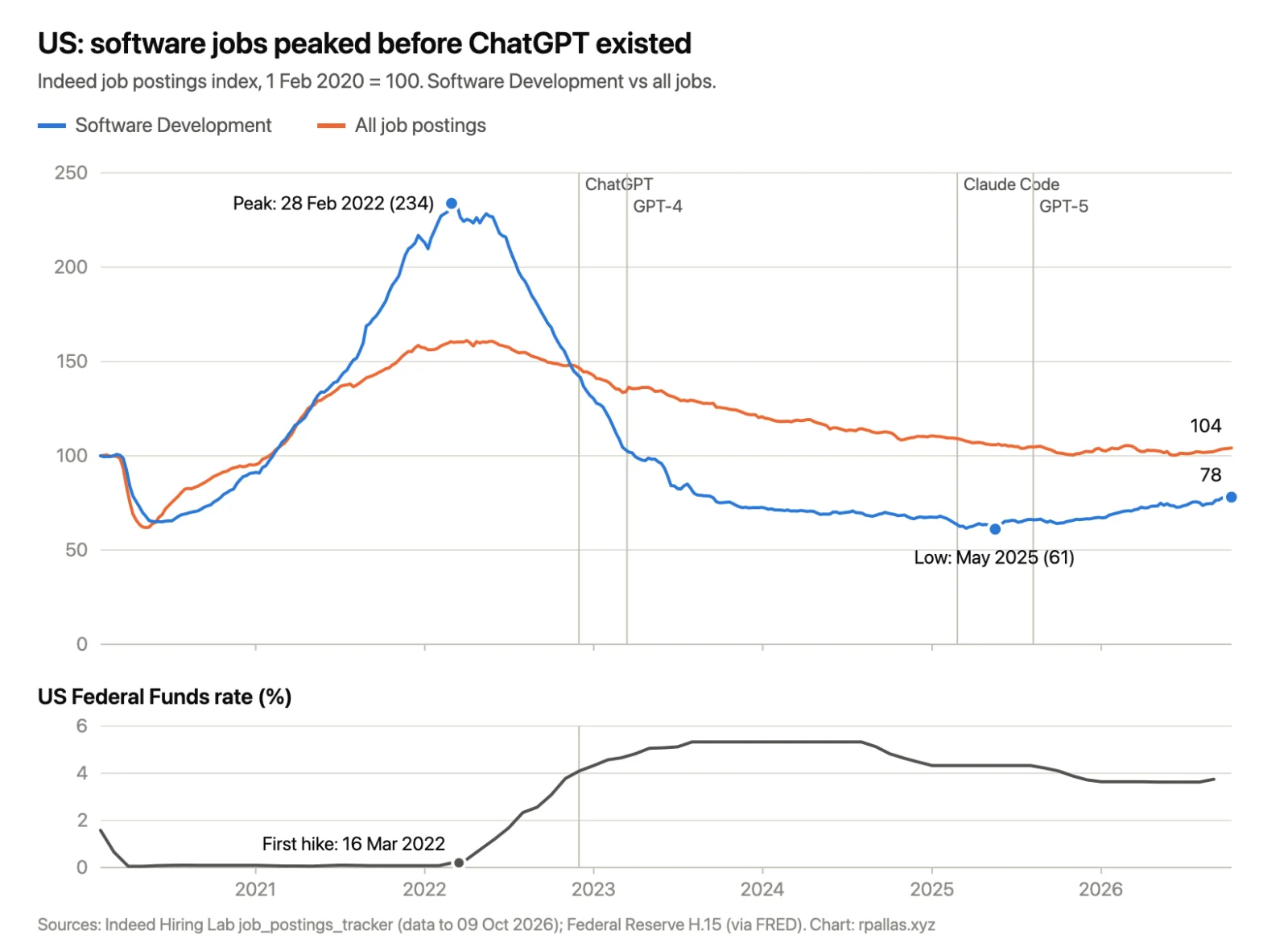 US software job postings versus all jobs on Indeed index before ChatGPT release
Image: Ricardo Pallás
The Indeed Hiring Lab's July 8, 2026 analysis adds a second layer. Economist Guillermo Gallacher writes that between 2022 and 2026, occupations with more AI exposure generally saw larger posting declines. But in the most recent year, that pattern flipped: highly exposed occupations, including software development, posted some of the largest rebounds.
Indeed is explicit that correlation is not causation around Claude Code, which launched in late February 2025. Still, Gallacher calls the timing "a coincidence that cannot be ignored." US software development postings on Indeed rose almost 15% from that launch window through the analysis date while overall postings fell 7%. Even after that rise, software postings remained about 27.5% below the prepandemic index level, while the all-jobs index sat near its February 2020 baseline.
Pallás highlights a sharper US move: software postings up about 28% since May 2025 while all postings were flat, citing Indeed's public charts through October 9, 2026. That is a recovery from a deep hole, not a return to the 2022 peak.
Postings versus employed people
A common viral mistake treats job postings as employment. They measure different things.
Pallás cites US Bureau of Labor Statistics data for computer systems design and related services. Employment peaked around March 2023 at roughly 2.48 million workers, then fell about 5% to 2.36 million by September 2026. That decline is real, but it is far smaller than the posting index crash from 2022, when companies mostly stopped adding engineers rather than conducting mass layoffs of everyone already on payroll.
Postings also inflate demand. One "Senior Backend Engineer" ad can fill many seats over time, or fill none. Pallás cites Greenhouse data reported in press coverage that 18–22% of listings on its platform may be ghost jobs posted for branding rather than immediate hires. That is why labor economists use both postings and payroll employment when testing AI displacement claims, as we summarized in our July data check.
International pattern: peak before ChatGPT
Pallás extends the Indeed charts to six countries. In each, the software posting peak lands before ChatGPT:
| Country | Software peak (approx.) | Drop to ChatGPT launch | Share of fall before ChatGPT |
|---|---|---|---|
| US | Feb 2022 | −39% | 53% |
| Canada | May 2022 | −37% | 52% |
| UK | Apr 2022 | −27% | 38% |
| Australia | Apr 2022 | −24% | 38% |
| Germany | May 2022 | −11% | 16% |
| France | Jul 2022 | −6% | 9% |
Germany and France look different after ChatGPT: Pallás notes software postings there still weak while all postings are soft too, suggesting macro weakness more than a US-style AI narrative. Indeed's July post also observes software's share of total postings rising in many large economies, with English-speaking markets showing more consistent positive trends, matching our enterprise AI adoption surveys showing uneven global deployment speeds.
Juniors versus seniors: where AI shows up
Pallás does not claim AI has no effect. He separates macro timing from cohort shape.
Stanford Digital Economy Lab researchers Erik Brynjolfsson, Bharat Chandar, and Ruyu Chen document in Canaries in the Coal Mine? (August 2026 revision, per Pallás's citations) that workers aged 22–25 in highly AI-exposed occupations sit about 19% below where employment would be if it had kept pace with similarly aged workers in less-exposed jobs, using ADP payroll microdata—the gap was 15% at the July 2025 vintage. Experienced workers do not show the same gap. The mechanism is less hiring of young workers, not a spike in firings across all ages.
That aligns with Indeed's decomposition for May 2025 through May 2026: 71% of the net increase in US software development postings came from senior roles, and 37% from titles that mention AI (categories overlap). Gallacher's chart title in the official post calls the rebound concentrated in senior and AI roles.
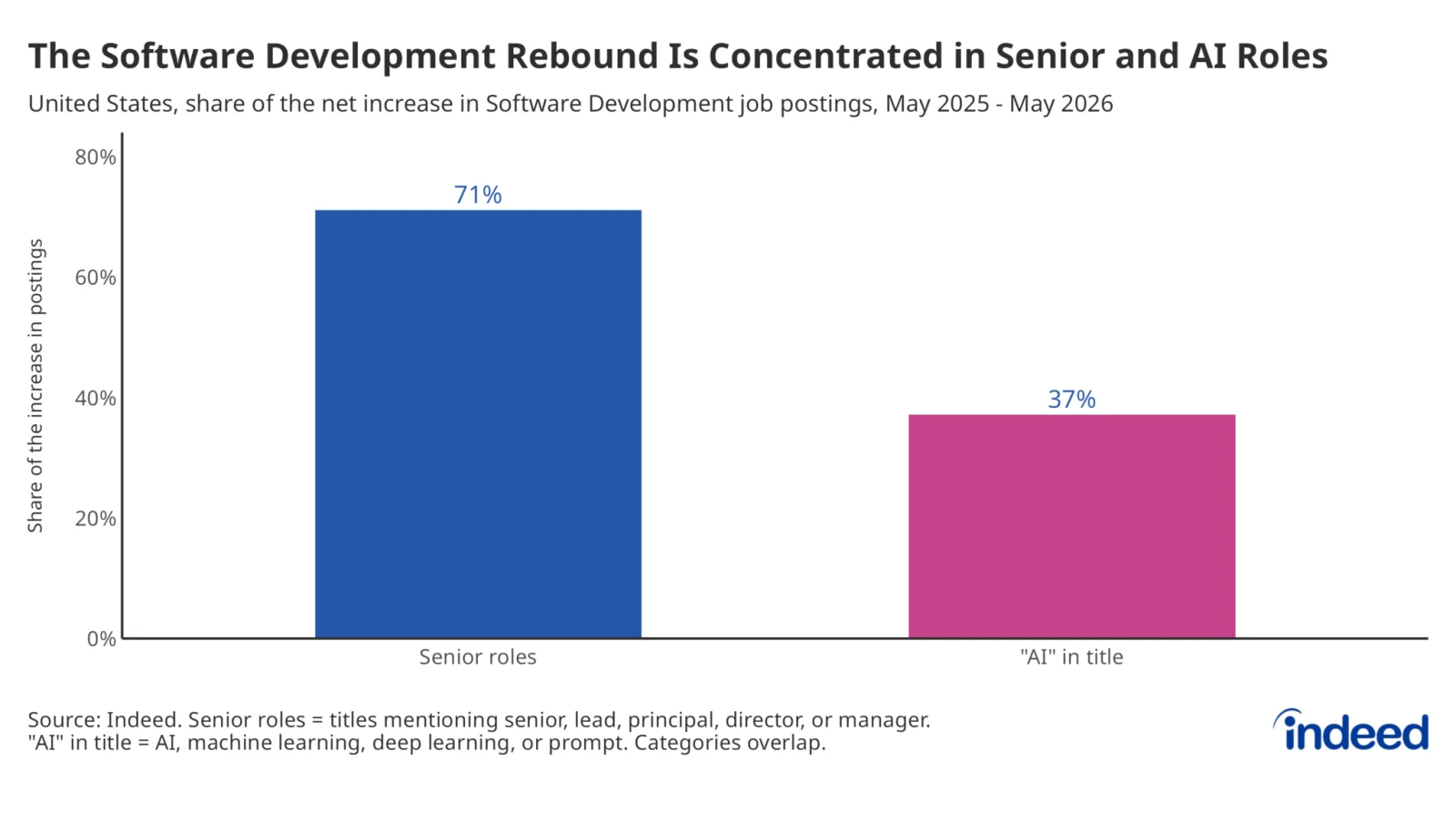 Senior and AI-titled roles accounted for most of the US software posting rebound from May 2025 to May 2026
Image: Indeed Hiring Lab
Pallás's summary line: economics explains the crash; AI helps explain the shape of the recovery—fewer juniors, more seniors who can supervise models. We traced the same junior squeeze in Bill Gates's August essay on AI and education and in US computer science enrollment declines. Pallás adds Clearinghouse-style context: undergraduate enrollment in computer and information science at four-year US colleges fell 8.1% in fall 2025 while total enrollment grew, per National Student Clearinghouse figures he links.
If you are hiring or job hunting, the actionable read is not "ignore AI." It is do not confuse a 2022 macro freeze with proof that today's models already eliminated the profession, while still preparing for entry-level compression and rising demand for engineers who can ship with agents under audit, a theme we covered under the AI verification tax.
Fear, incentives, and what labs say versus do
Pallás's McCarthy-era film metaphor is not decorative. He argues fear is a product in both media and AI markets.
On social platforms, payout rules now weight engagement from paying subscribers. Posts that trigger arguments earn more than nuanced charts. On the corporate side, he quotes public warnings—including Anthropic CEO Dario Amodei's January 2026 Davos remarks that models could handle most software-engineering work within months, as Fortune's Davos recap summarizes from Pallás's citations—and juxtaposes them with Anthropic's own hiring. Pallás scraped Internet Archive snapshots of Anthropic's careers site and counts software engineer-titled openings rising from 17 in May 2024 to 97 on October 21, 2026, with total open roles near 674. Open requisitions are not hires, and hypergrowth labs always post aggressively, but the gap between "engineers only edit model output" rhetoric and more SWE reqs than ever is the point.
He also ties fear to moat economics. If open weights on a gaming GPU match last year's closed frontier for many tasks, subscription labs must convince buyers they still need datacenter-scale models. That incentive does not make safety warnings false, but it means labor predictions from sellers deserve the same charts Pallás builds from Indeed and BLS.
Stock narratives follow the same pattern. Pallás mentions the February 2026 SaaSpocalypse drawdown after agent plugins, then partial rebounds, which we discussed alongside AI-cited layoff totals. Markets reacted to distribution risk long before payrolls showed mass unemployment.
What developers are saying on Hacker News
The November 8 thread drew limited comment volume but praise for the empirical approach. User shoaibjamil called it the "Best analysis on trends" in comment 50410197. No hands-on counter-benchmarks appeared in the top-level replies we reviewed; the discussion treated the essay as a synthesis piece rather than a peer-reviewed paper.
Treat HN reactions as sentiment, not verification. The verification work is checking Pallás's Excel-linked Indeed exports and the Stanford/Indeed primary posts yourself.
How this updates explainx.ai's labor coverage
Our July 2026 data check already graded viral claims: no mass unemployment in aggregates, real pressure on young developers, layoff announcements overstated as one-for-one replacement counts. Pallás does not overturn that scorecard. He sharpens the timeline for software postings, showing the biggest step-down predates ChatGPT, and he documents the 2025–26 senior-skewed rebound Indeed published officially.
If you manage a team, use three monitors:
- Your sector's Indeed index, not global doom posts.
- Cohort hiring for interns and new grads, where ADP-based research still finds gaps.
- Output per engineer with agents, because posting growth for AI-literate seniors suggests employers want orchestration skill, not fewer humans.
What to watch next
Pallás plans to re-check Anthropic headcount quotes after January 2027. Indeed will update whether the posting rebound broadens beyond senior titles. Stanford may refresh Canaries with 2026 payroll quarters. We will append updates here when those releases add new numbers, not when another outlet rewrites the same Indeed chart.
For career planning, pair this labor read with practical skill posts: what employers list in AI job ads, how Menlo Ventures sees enterprise API spend shifting, and Sam Altman's walked-back labor apocalypse framing when executives disagree with their own earlier quotes.
Related reading
- Did AI actually take these jobs? A 2026 data check
- Bill Gates on AI, jobs, and education in a turbulent era
- US computer science enrollment and the AI narrative
- The AI verification tax at work
- AI skills employers actually want in 2026
- 97,000 AI-cited job cuts and what they prove
Labor market indices, Anthropic careers counts, and enrollment figures reflect sources accessed November 8, 2026, and will change as new Indeed and BLS releases ship.