



On August 26, 2026, Bill Gates published a roughly 6,000-word essay titled "The turbulent AI era is here. The choices we make now are critical." It reached Hacker News at 151 points and 135 comments. Most of the news coverage led with the robot tax, because a billionaire proposing to tax robots is a headline.
That is the least interesting part of the essay.
The load-bearing part is a two-sentence claim about young workers, backed by a real Stanford paper, and one paragraph about how an AI tutor should behave. Those two passages describe the world explainx.ai teaches into every week. This post checks every study Gates cites, engages the strongest objections from the thread, and then answers the question the essay never gets to: what a person who is learning or teaching AI right now should actually do differently on Monday.
TL;DR
| Question | Direct answer |
|---|---|
| What is the essay? | ~6,000 words on gatesnotes.com, August 26, 2026 — three named risks, three proposals, one disclosed conflict of interest |
| Is the entry-level jobs study real? | Yes — Brynjolfsson, Chandar, and Chen, Stanford Digital Economy Lab, November 13, 2025, ADP payroll data, 16% relative employment decline for ages 22-25 in AI-exposed occupations |
| What is "Human Reserved"? | Gates's coinage for jobs deliberately set aside for people, analogized to nature reserves. He admits he has no answer for who decides or how it is enforced |
| Does the token tax survive contact? | Weakly. The best objection is that it accelerates local and open-weight inference, which produces untaxed tokens |
| What did HN actually argue about? | Whether "new space" for jobs gets created at all — that is the real crux, and it is unresolved |
| The most actionable line in the essay | Preserve "productive struggle": an AI tutor should explain up front, then withhold the answer at the comprehension check |
| What changes for learners? | Demonstrated capability replaces credential-plus-time as the entry ticket, because the junior rung is thinning |
The disclosure comes first, because it should
Gates puts his conflict of interest in the essay itself rather than a footnote:
I want to acknowledge a potential bias. I have benefited enormously from the technology industry. Although I have diversified my portfolio quite a bit, I still have financial ties to it. I am working with Microsoft and other AI companies in my role as chairman of the Gates Foundation to try and ensure AI is deployed in ways that will truly benefit people around the world.
And then, unusually: "Of course, readers will have to decide for themselves whether this clouds my view."
That is the right way to write it. It also does not settle anything. The Gates Foundation has, by his own accounting, "19 years left of the 20 years in which it will spend its remaining $200 billion" — an organization with that much deployment ahead of it has a structural interest in AI being both dangerous enough to need governing and useful enough to spend on. Hold both.
Risk one: jobs, and why he thinks this transition is different
The historical-analogy rebuttal is the part of the essay doing the most work. Gates takes the standard optimist case — agriculture to office work, everyone was fine — and names the specific reason he thinks it does not transfer:
However, that proceeded over several generations and created new jobs where human cognition was required. In this case, the technology can substitute for human cognition.
Two claims are packed in there. Speed: he says AI "will hit these industries rapidly, over the course of a decade rather than a few generations." Substitution target: past automation displaced muscle and routine, and the escape hatch was cognition. If the thing being automated is cognition, the escape hatch is the thing that closed.
He names the first wave — sales, customer support, software engineering, paralegal work — then a second: "assessing loan applications, doing data analysis, and even triaging patients." And he is specific about who absorbs it: "The jobs at most risk are entry- and mid-level, and the new jobs being created will mostly require skills that take many years to learn."
That is a squeeze from both ends. The rung you used to step onto is being removed, and the rung above it now requires a climb you can no longer perform in stages.
The study behind the claim — verified
Gates writes that after generative AI adoption, employment "fell significantly among young workers in jobs that are especially vulnerable to replacement, but not among their older colleagues," and links to a PDF. That PDF is real, and it is stronger than his summary suggests.
It is "Canaries in the Coal Mine? Six Facts about the Recent Employment Effects of Artificial Intelligence" by Erik Brynjolfsson, Bharat Chandar, and Ruyu Chen, dated November 13, 2025, from the Stanford Digital Economy Lab. From the abstract:
Using high-frequency administrative data from ADP, we document six facts characterizing labor market shifts following the widespread adoption of generative AI. Early-career workers (ages 22-25) in AI-exposed occupations experienced 16% relative employment declines, controlling for firm-level shocks, while employment for experienced workers remained stable.
Three details matter more than the headline number:
- It is payroll data, not a survey. Monthly individual-level records from ADP through September 2025, across millions of workers. That puts it in a different evidence class from the UK Work Foundation survey where 36% of employers reported cutting entry-level roles — surveys capture what employers say, payroll captures what they did.
- Automation and augmentation split cleanly. The paper's third fact is that entry-level employment declined in occupations where AI automates work and grew where it augments — they distinguish the two using how observed Claude queries substitute for or complement occupational tasks. That is the single most useful finding for anyone choosing what to learn, and Gates does not mention it.
- It survives the obvious confounder. Controlling for firm-time effects — absorbing interest-rate and industry shocks that hit everyone at a firm — leaves a 15 log-point relative decline for 22-to-25-year-olds intact.
This is the sturdiest empirical leg the essay stands on, and it is worth separating from the forecasts stacked on top of it. It is a well-identified finding about 2022-2025, not a proof of what 2030 looks like.
Risk two: harm, from criminals to the models themselves
Gates's cyber paragraph is the one security people will quote:
The smartest cybersecurity experts I know are scared about the next few years, because the attackers are getting powerful new capabilities faster than the defenders can fix all the weaknesses.
The mechanism he names is the one that makes this hard to regulate: "the same AI model that can find a flaw in software so a company can fix it can also help a criminal exploit it." Dual use is not a policy failure here, it is the shape of the capability. The same paragraph structure repeats for bioterrorism — "the positive capabilities are hard to separate from the dangerous ones."
He then escalates past human misuse to autonomous weapons and, finally, to loss of control:
as the models become more powerful, they could begin to act against our interests and we could lose control.
He flags that he will write more about this later, which is a way of saying he has not made the argument. Taken as written it is a statement of concern, not a case. Readers who want the framework this sits inside can start with what AI ethics actually covers.
Risk three: kids, companions, and critical thinking
This is where the essay is most careful with evidence, and where secondary coverage has been least careful. Gates writes that "the body of evidence on this subject is still small and a bit mixed." Keep that clause attached to everything that follows.
The companion study is real. It is "The Rise of AI Companions: Interaction with AI Companions and Psychological Well-being" (arXiv 2506.12605) by Yutong Zhang, Dora Zhao, Jeffrey T. Hancock, Robert Kraut, and Diyi Yang — Stanford and Carnegie Mellon, 1,131 U.S. adults who use Character.AI, plus chat session data. The finding: smaller social networks were associated with using a chatbot primarily for companionship, which in turn was associated with lower well-being, and the effect was stronger for intensive, emotionally disclosive use.
That is an association among people who already use companion apps. It is not evidence that companions cause isolation.
Gates then borrows a line from Jonathan Haidt's The Anxious Generation about children raised "in a protected greenhouse," and lands his own image: "An AI companion designed to never upset you is a big, protected greenhouse." As metaphors go it is good. As evidence it is a metaphor.
The critical-thinking paper is where precision matters most. Gates writes: "One preliminary survey suggested that heavier AI use was associated with less critical thinking. The effect was stronger for younger people." The link goes to Michael Gerlich's "AI Tools in Society: Impacts on Cognitive Offloading and the Future of Critical Thinking," published in Societies on January 3, 2025, with 666 survey participants plus interviews.
Every qualifier there is load-bearing. Preliminary. Survey. Associated with. The paper's own mechanism is cognitive offloading — delegating cognitive tasks to an external aid and disengaging from the reflective work. That is a claim about a mode of use, not about exposure to a tool.
This distinction is the whole ballgame for anyone learning, and we have written about the same effect from the coding side: the cognitive debt you take on when you accept LLM code without retyping or reasoning through it is the identical mechanism wearing an IDE. The problem is not that the answer came from a model. It is that nothing in your head changed on the way past.
The three proposals
| Proposal | What Gates actually says | Where it gets weak |
|---|---|---|
| New governance framework | Domestic bodies that set priorities across agencies, plus an international organization combining elements of "an inspections regime for nuclear weapons, regulations for international aviation, and agreements that protect the ozone layer" | Requires "some cooperation between the U.S. and China." He notes the post-9/11 US reorganization was the biggest since WWII and served one function; AI touches employment, education, taxation, energy, elections, public health, and more |
| Human Reserved | Jobs deliberately set aside for people, analogized to nature reserves — "places where we could put buildings and roads, but we choose not to because the loss would be too great" | He says so himself: "The idea of Human Reserved raises a host of questions I don't have answers to. Who gets to decide what we reserve for humans? What criteria should we use? How do you keep companies from cheating and using robots anyway?" |
| Tax AI tokens and robots | "if you're an employer and you hire someone, you pay payroll taxes on their earnings. But if you buy a robot, you can usually write it off right away as a business expense. The tax system nudges you toward replacing people with machines." | Concedes the inefficiency and argues it is worth paying. Does not address local inference at all |
The Human Reserved section is grounded in the most personal passage in the essay. Gates's father died of Alzheimer's in 2020, cared for by paid caregivers who "understood him even when he struggled to express himself. He couldn't always tell them when he was hungry, but they always knew."
Something in the care they gave my dad was irreplaceably human. No robot could or should have done it.
He also cites Pope Leo XIV's encyclical "On Safeguarding the Human Person in the Time of Artificial Intelligence" — Magnifica Humanitas, dated May 15, 2026 — as laying "a strong foundation for the work that needs to be done." That document exists on vatican.va and is what he says it is.
The token tax has a hole in it
The sharpest technical objection in the thread came from commenter deadbabe, in one sentence:
Taxing AI tokens will only lead to the acceleration of local LLMs, to produce tax-free tokens.
This is correct and it is not a small problem. A per-token levy is enforceable at a metering boundary — an API bills you, so a government can tax the bill. Tokens generated by an open-weight model on hardware you own cross no such boundary. There is no invoice, no counterparty, and no meter.
So the tax does not weigh evenly on "AI." It weighs on the hosted-API path and leaves the local path untouched, which means its first-order effect is to subsidize exactly the migration that is already happening for cost and privacy reasons. We have tracked that migration all year: desktop tooling that trains and runs models locally, large mixture-of-experts models that fit on a single GPU, and the strategic argument over open weights versus closed models. A token tax lands in the middle of that and pushes.
A robot tax has the opposite property — robots are physical, customs-visible, depreciable capital, and genuinely taxable. Gates bundles them into one proposal. They are not one proposal.
What Hacker News actually argued about
A substantial share of the thread rejected the messenger rather than the argument, revisiting Gates's personal history and Microsoft's 1990s conduct instead of engaging with any claim in the essay. That is worth noting once and then leaving; explainx.ai is not going to relay unverified personal allegations about a living person. The substantive disagreements are more interesting anyway.
The actual crux: is new space created?
Commenter mcnichol made the standard optimist case — switchboard operators, horses to cars, "Jobs transition, new space is created, people are caught in the crossfire of supply and demand curves."
numeri isolated the load-bearing word in one reply:
> new space is created
That seems to be the crux here. You think it will be, I (and a lot of other people) aren't sure it will. If new space for jobs are created, I am certain we'll be fine long term.
And azan_ stated the mechanism plainly:
If AI would become better at cognitive work than humans, I don't really see what new jobs would be created.
This is the whole disagreement, compressed. Every prior technology transition created new work because it automated a capability and left the general-purpose faculty — human judgment, human cognition — as the residual that new jobs were built out of. If cognition itself is the thing being automated, the residual is not obviously non-empty.
Nobody in the thread resolved it, and neither will this post, because it is an empirical question about a future that has not happened. What we can say is that we watched the identical argument run three weeks ago on the other side of the table, when Mark Zuckerberg predicted an abundance of jobs — world builders, personal biologists, one-person studios. Checking that claim against labor data, we found it defensible on the endpoint and silent on the transition. Gates is the mirror image: he takes no position on the endpoint and says the transition is the emergency.
Both can be right. "Fine in twenty years" and "catastrophic in five" are not contradictory statements, and treating them as if they were is why this debate keeps going in circles.
Why not just end poverty directly?
lukeschlather pushed the strongest version of the abundance objection:
If AI is really that powerful, shouldn't someone like Gates be able to end hunger and homelessness with a one-time capital expenditure? Somehow "give people jobs" is the primary problem he wants to solve, not ending poverty.
He sharpened it further downthread: "Ending poverty is a purely mechanical problem, with very straightforward solutions if you have robots that can do any mechanical task. You don't need to give anyone a job, you just need to give them food and shelter."
The strongest reply came from reasonableklout, and it does not dodge:
His point is that people get a ton of meaning out of their work in our current capitalist system, and regardless of whether or not we change our system in the long term, if we don't do something about jobs in the short term, there will be a civil crisis.
That reply is grounded in the essay's own text — Gates writes that employment is "a key source of dignity and social connection," not merely income, and points at research linking factory closures to opioid deaths. The disagreement is not about whether post-scarcity is desirable. It is about whether you can get there without the intervening decade breaking something. We took the underlying question apart separately in can AI end poverty.
The model-collapse sub-thread, which is a genuinely open question
mcnichol also argued that AI trained on AI output produces "wobble... which results inevitably into delirium." sltkr countered with AlphaGo Zero: trained purely through self-play with no human games in the loop, it beat the human-data-trained version 100-0 after three days, which he read as proof that AI can transcend human data entirely.
Two rebuttals landed. LogicalRisk: "Absent the extremely specific 'rules of this game' set by a human none of the programs work." mcmcmc: "Go is a simple game with a clear win condition... You have no evidence that self improvement can work at generalized tasks. The world is much bigger than a Go board." Both are right that self-play in a closed system with a scalar reward is not evidence about open-ended domains.
Then the thread got specific about papers, and this part is worth getting exactly right because it is a live research dispute, not a settled one:
- mrtesthah cited the model-collapse paper — Shumailov, Shumaylov, Zhao, Papernot, Anderson, and Gal, "AI models collapse when trained on recursively generated data," published in Nature on July 24, 2024. Its claim: "Indiscriminate use of model-generated content in training causes irreversible defects in the resulting models, in which tails of the original content distribution disappear."
- dwohnitmok replied that the paper's framing has been contested, citing arXiv 2404.01413, which finds that "accumulating the successive generations of synthetic data alongside the original real data avoids model collapse," whereas "replacing the original real data by each generation's synthetic data does indeed tend towards model collapse." Real pipelines accumulate. He also pointed at Microsoft's Phi-4 as an empirical case where a majority-synthetic training mix outperformed predecessors.
- sltkr landed on the word that reconciles them: indiscriminate. The Nature result holds when generated content is fed back without curation. It says much less about curated synthetic pipelines.
The honest summary: model collapse is a real phenomenon under a specific and increasingly unrealistic assumption — that synthetic data replaces real data rather than accumulating alongside it. Anyone citing it as proof that AI progress hits a data wall is overclaiming. Anyone waving it away entirely is also overclaiming.
The energy objection
tintor aimed at Gates's clean-energy optimism directly:
AI data centers are driving electricity consumption in 100s of GW, and most of that energy is not clean renewable nor nuclear.
Gates does gesture at this — "Local communities are already raising concerns about the energy and water needed for data centers" — but he raises it as a source of public backlash to be managed, not as a cost to be subtracted from the climate benefit he claims elsewhere. The gap is real, and it is the same gap we mapped in the data center backlash: the compute that funds the climate modeling is being built on the grid we already have.
What this means if you are learning or teaching AI right now
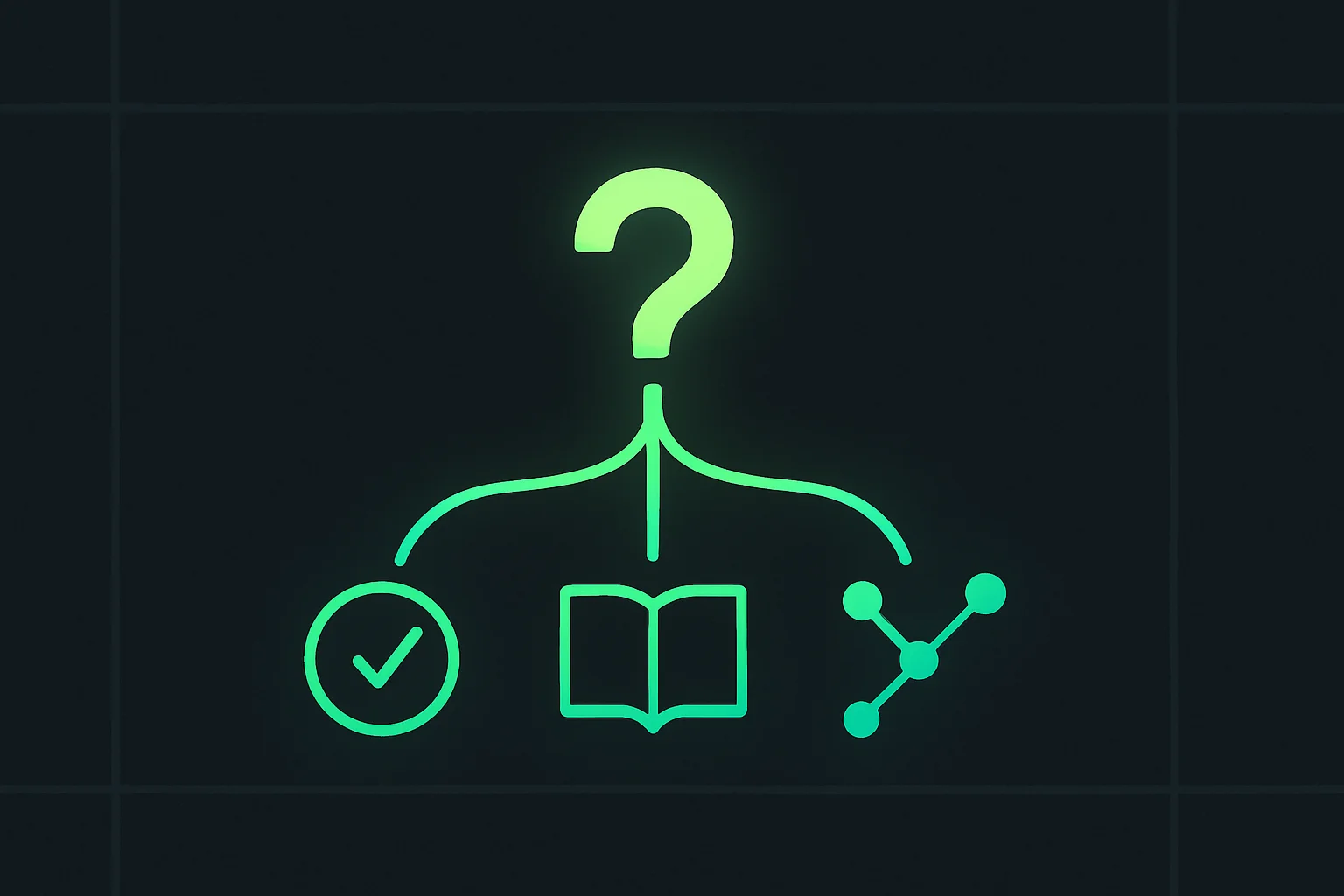 Question mark branching into three paths — a verification checkmark, an open book, and a network graph — illustrating how AI-era learning splits into checking, studying, and transferring knowledge
Gates wrote this essay for governments. Everything in it is addressed to someone with a budget and a legislature. That leaves the reader who is actually affected — a student, a career switcher, a person teaching a room of them — with a well-sourced description of their problem and no instructions.
Here is the translation. Three things in the essay change what you should do; the rest does not.
1. The entry-level squeeze changes what the entry ticket is
If the Stanford finding holds — 16% relative decline for 22-to-25-year-olds in AI-exposed occupations, on payroll data, with older workers stable — then the mechanism that has moved people into knowledge work for forty years is degrading. That mechanism was: get hired junior, be economically unproductive for eighteen months, learn on the company's time, become senior.
That path assumed the junior rung existed and that someone would pay for you to stand on it. When a model does the tasks the rung was made of, the employer's rational move is to stop funding the apprenticeship and hire only people who already cleared it. This is what the UK employer survey and the layoff anxiety showing up in Indian tech are both describing from different angles.
The practical consequence is narrow and specific: demonstrated capability replaces credential-plus-time as the entry ticket. Not because portfolios are inherently better than degrees, but because the interval in which an employer used to accept "credential plus time will make this person useful" is exactly the interval being removed. A thing you built, that runs, that you can explain the failure modes of, is the only artifact that survives a hiring freeze — and it is what a hiring manager reaches for when there is no junior budget to gamble with. Our read on which AI skills employers actually ask for has said the same thing all year; Gates's essay is the macro evidence underneath it.
The Stanford paper's automate-versus-augment split is the other half of this, and it is more useful than anything in Gates's essay: employment fell where AI substituted for the tasks and grew where it complemented them. Pick work where you are the one steering the model, not work the model performs end to end.
2. "Productive struggle" is the most actionable sentence Gates wrote
Buried in the optimistic section, this is the single most useful paragraph in 6,000 words:
For students, an AI tool that preserves what researchers call "productive struggle"—the cognitive work that builds understanding—can strengthen learning. When a student first encounters a new idea, the AI gives substantive explanations and offers both questions and answers. Later, when it's checking their comprehension, it holds the answer back and helps them arrive at it on their own.
Read that as a spec, because it is one. The same model, the same student, the same topic — and whether learning happens turns entirely on when the answer is released. Explanation-first at introduction. Answer-withheld at the check. A tutor that opens with the solution at every stage is not a worse tutor, it is a different tool doing a different job: it is answering, not teaching.
This is not new pedagogy dressed up in AI. It is the finding behind every AI tutor effect-size study worth reading, and it is why we argue schools should teach verification and question formulation rather than racing the model at retrieval.
It is also, concretely, why explainx.ai runs live workshops instead of shipping recorded courses. In a live session you build a thing that does not work yet, in front of someone, and the struggle is not optional — you cannot skip to the answer because the answer does not exist until you produce it. That is the format doing the pedagogical work, not the instructor being charismatic. A recording cannot withhold an answer from you; you can always scrub forward.
The same spec applies when you are alone with a model. Attempt first, then ask. Ask it to critique your attempt before it offers its own. When it hands you code, retype it or reason through it rather than pasting. None of this is about using AI less. It is about which of the two available modes you are in.
3. The critical-thinking finding indicts passive use, not AI use
Gerlich's paper measures cognitive offloading — delegating the thinking, not using the tool. That distinction is not a nitpick, it is the entire actionable content of the finding. "Heavier AI use correlates with lower critical thinking" is a headline. "Delegating the reasoning step correlates with lower critical thinking" is an instruction.
Two people can burn identical token counts and land in opposite places. One asks for a plan, executes it, and ships. The other asks for a plan, argues with it, finds the assumption that does not hold in their case, and ships something different. The second person's critical thinking is being exercised by the tool. The first person's is being performed by it.
The practical test is embarrassingly simple: after a session with a model, can you explain why the approach works and what would break it? If yes, you were augmenting. If no, you were offloading — and the tokens you spent bought output, not capability. This is the same line we drew in when answers get cheap, trust becomes the job: generation got cheap, and judging the generation did not.
That skill also happens to be the one Gates's own labor analysis says is safest — the Stanford paper found growth in augmentative occupations. The pedagogy and the job market are pointing at the same behavior, which is rare enough to be worth acting on.
What we think
The essay is better-sourced than its critics allow and less complete than its proposals imply. Every study Gates cites is real and he characterizes each one with appropriate hedging — "preliminary survey," "small and a bit mixed," "associated with." Secondary coverage stripped those qualifiers within hours. He did not.
The governance proposal is the one he ranks highest and the one with the least mechanism behind it. Human Reserved is a genuinely interesting frame with, by his own admission, no answers to who decides, what criteria apply, or how it survives international trade. The token tax has a hole a commenter found in one sentence.
But the diagnosis holds where it matters. The entry-level finding is payroll data, not vibes. The productive-struggle paragraph is a correct and testable claim about how to use these tools to learn. And the crux the thread found — whether new space gets created when cognition itself is the automated input — is the right question, still open, and not answerable by analogy to switchboard operators.
If you take one thing from 6,000 words: the transition is the emergency, not the endpoint. That is true whether or not the endpoint is good. Plan for the decade, not the destination — and in that decade, the thing that separates people is whether they used these tools to become more capable or merely more productive. Those are not the same outcome, and only one of them survives the squeeze.
Update — September 28, 2026: Gates pressed the governance half of this essay on NBC's Meet the Press — federal AI legislation required, Hugging Face cited as self-regulation failure — Meet the Press coverage.
Related reading on explainx.ai
- Zuckerberg's "abundance of jobs" claim, checked against the data — the direct counterpoint on the jobs question
- UK employers cut entry-level jobs: 36% reduced hiring as AI rises — survey evidence next to the Stanford payroll evidence
- If AI can answer every question, what should schools actually teach? — the curriculum side of the productive-struggle argument
- Cognitive debt: why you should retype LLM code — the offloading mechanism from the coding side
- When answers get cheap, trust becomes the job — what remains scarce once generation is not
- Can AI end poverty? — the question lukeschlather raised, taken seriously
- The AI data center backlash map — the energy cost Gates raises but does not subtract
- American closed AI vs China open weights — why a token tax cannot reach local inference
- What is AI ethics? A complete guide — the framework his harm section sits inside
- Bryan Johnson says the singularity will feel like a 5-MeO-DMT trip — the same anxiety, argued toward acceptance rather than action
Primary sources: Gates's essay is on gatesnotes.com at /a-turbulent-ai-era-and-critical-choices-to-make. The employment paper is Brynjolfsson, Chandar, and Chen, "Canaries in the Coal Mine?", Stanford Digital Economy Lab, November 13, 2025. The companion study is arXiv 2506.12605. The critical-thinking paper is Gerlich, Societies 15(1):6, January 3, 2025. The model-collapse dispute is Shumailov et al., Nature, July 24, 2024, versus arXiv 2404.01413.
Accurate as of August 27, 2026. Study findings, employment figures, and the Hacker News discussion reflect the state of the record on that date; the Stanford employment data runs through September 2025 and the policy proposals discussed here are proposals, not enacted law.