



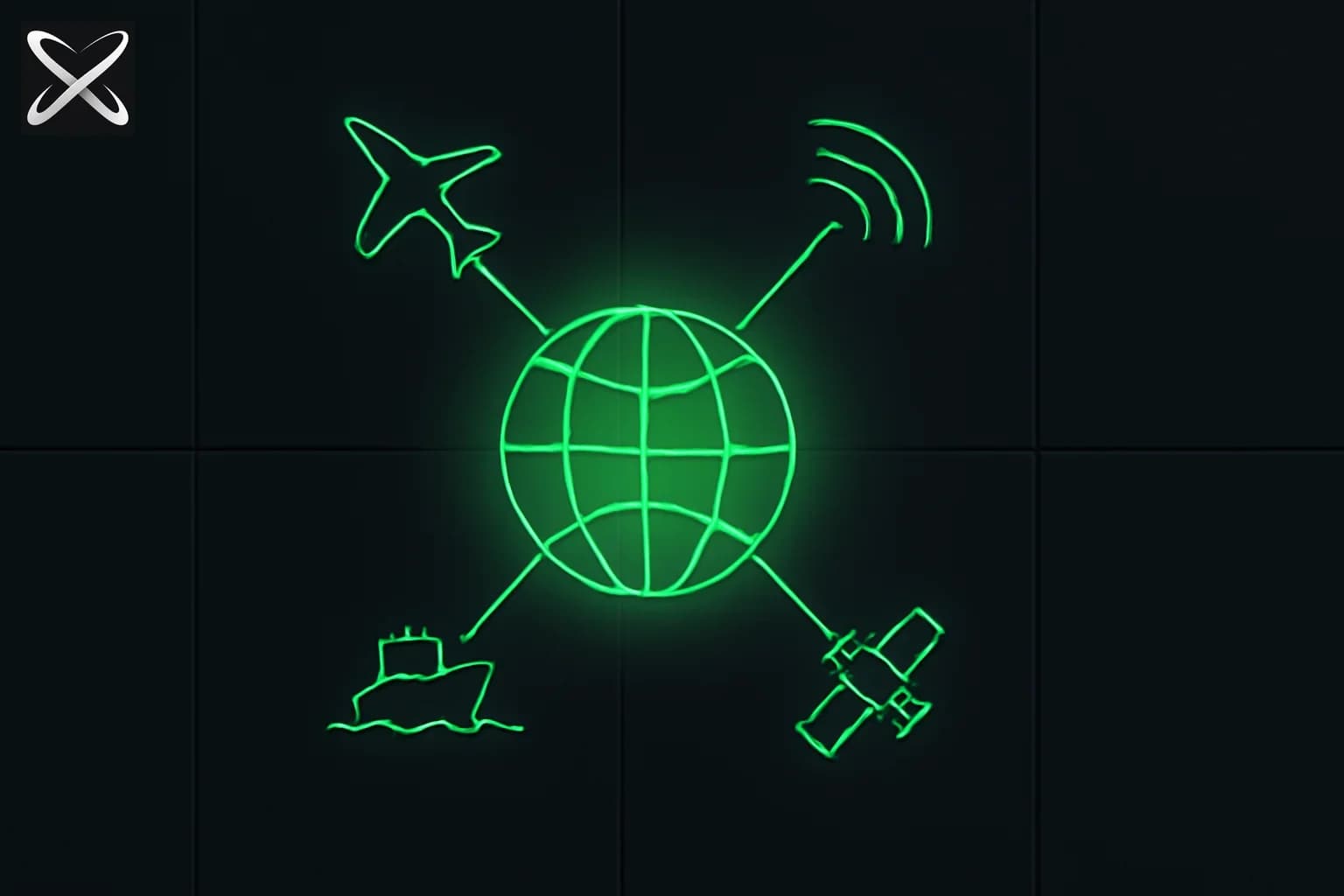
The cockpit from the viral God's Eye View YouTube series is now a repo you can clone. Bilawal Sidhu published God's Eye View as MIT-licensed source on August 24, 2026 (commit message: Release God's Eye View as open source). Four days later the public GitHub repo sat at 8,258 stars and 1,843 forks.
The pitch is spatial, not cinematic: a God's Eye View globe that fuses public OSINT — aircraft, ships, satellites, earthquakes, traffic, and cameras — then lets an OpenAI Realtime voice agent drive the camera with 28 tools. It looks like a forbidden ops room. The README's own line is the honest one: "Half the magic is that it looks like a forbidden cockpit. The other half is that every line of code is inspectable."
If you build agents, this is a local-first tool surface you can fork this week — one Google key to land on Earth, optional voice, and a paste-ready setup prompt for coding harnesses. It is not a classified feed, not a production GEOINT stack, and not a people-search product.
What people are asking
| Question | Direct answer |
|---|---|
| What is it? | Browser spy-satellite / spatial-intelligence simulator on public data (formerly WorldView) |
| When did it go open source? | August 24, 2026 — verified GitHub release commit |
| Stars / forks (Aug 28, 2026) | 8,258 stars, 1,843 forks, 54 open issues |
| Do I need API keys? | Google Maps required (photoreal 3D). Ten of 13 live layers need nothing. Voice needs OpenAI |
| Is it free? | Most layers $0. Google 3D tiles have a monthly free session allotment, then metered. Voice is metered with an in-app $5 cap |
| What's live vs fake? | Public telemetry is live (interpolated). Keyless traffic, uncalibrated camera poses, and launch ascent are labeled modeled / reconstructed |
| License / maturity | MIT on source; bundled datasets have their own terms. Exploratory OSS, not a hardened production service |
| People search? | No — no named-person search, face recognition, or individual tracking |
| How fast can I run it? | Node 24.14.x or 26.x, one env file, npm run dev on localhost:4173 |
How do I run it in five minutes?
package.json enforces Node.js 24.14.x or 26.x (engines: 24.14 and newer on the 24 line, or 26 — Node 25 is excluded). Version on the public repo is 0.1.0.
git clone https://github.com/bilawalsidhu/gods-eye-view.git
cd gods-eye-view
cp .env.example .env
# set GOOGLE_MAPS_API_KEY, then restrict the key and set a billing alert
npm install
npm run dev -- --host localhost --port 4173
Open http://localhost:4173. The first-run card can stage Live Contacts, Space Missions, or Environmental, or leave you to poke layers yourself.
Cold start is not a hardware requirement. A point-in-time capture in PERFORMANCE.md (Apple M5, Chrome 150, 1440×900, 22 August 2026) recorded a median initial settle of 1.86 seconds. Treat that as a regression baseline on one machine, not a promise for yours.
Restrict the Google key before you wander. Google Maps and Cesium ion tokens are the two credentials the README says are intentionally visible in the browser. Everything else (OpenAI, AISStream, OpenSky OAuth, TomTom, FIRMS) is brokered by the local Vite server. Bind stays localhost by default; opening 0.0.0.0 shares those proxies with whoever can reach the port. Read SECURITY.md before you do that.
Not a coder? Paste this into a coding agent
The README's own setup prompt (Claude Code, Codex, Cursor, or Antigravity — their names, their paste). Pair it with explainx.ai's loop-engineering guide for coding agents and the agent harness guide so the agent asks before it spends money:
Clone https://github.com/bilawalsidhu/gods-eye-view and set it up on my machine.
Install everything it needs, walk me through getting the required Google Maps API
key step by step (plus any optional free keys I want), put the keys in .env, and
help me set a billing alert and a usage quota on the Google key so I can't
overspend. Then start the dev server and open it in my browser. I'm not a
developer — explain what you're doing as you go, and ask me before any step
that could cost money.
That paste is the product insight for builders: the globe is an AI agent environment with a fixed tool surface, and the coding harness is how non-specialists actually get it running. If you are already on Google's agent CLI, the Antigravity CLI reference is the matching how-to — not a Cursor marketplace listing.
Do I need API keys, and what does it actually cost?
The README color-codes every layer. Google Maps is the only required metered key — it buys Photorealistic 3D Tiles. After that, most of the planet lights up with zero signup.
| Need | What it buys | Cost shape (README, mid-2026 — verify live pricing) |
|---|---|---|
| Required | Google Map Tiles / photoreal 3D globe | Metered. README: 1,000 free 3D-tile sessions/month, each up to 3 hours of rendering, then about $6 / 1,000 (US; check Google's current Map Tiles pricing) |
| Optional voice | OpenAI Realtime + AI HUD summary | Metered. In-app estimate, warns at $2, caps a session at $5. Provider usage limits are the real backstop |
| Optional free keys | AISStream (ships), NASA FIRMS (fires), TomTom (real traffic vs labeled sim) | Yellow in the legend — register, paste, done; limits vary |
| Nice-to-have | Cesium ion (Bing stacks), OpenSky OAuth, Launch Library 2 token | Anonymous/unkeyed modes exist for flights and launches |
| No key | Military ADS-B, satellites, earthquakes, CCTV packs, radio, bikeshare, mapped installations, bundled datacenters/dams/cables | Green — $0 |
A solo afternoon of globe-touring should stay inside Google's free session allotment if you restrict the key and set a quota. An unrestricted key in a public deployment is how people get surprise bills — that is an operator error, not a README trick.
Voice is the other meter. Skip the OpenAI key and you still get the globe. Turn it on and you are paying realtime audio, which is why the app ships a session cap instead of pretending tokens are free.
What's live versus simulated?
This is the question the cinematic HUD is designed to make you forget. The client is built to keep you honest.
Live, public, inspectable: thousands of aircraft from OpenSky + adsb.lol; military ADS-B in amber; CelesTrak satellites (core catalog ~840 objects, with a dense Starlink chip); USGS earthquakes (24h); city CCTV packs (~800 published cameras in Austin, California/Caltrans, London/TfL) projected into 3D; Radio Browser stations; GBFS bikeshare; Launch Library 2 (30-day missions); OSM mapped installations (incomplete, labeled that way). Thirteen live layers; ten need no key.
Deliberately not live: keyless traffic is an approximate simulation until TomTom is set. Camera poses are estimated priors until you drag the calibration gizmo — positions are published, pointing is not magic. Launch ascent playback is marked RECONSTRUCTED ESTIMATE. Flights render one polling interval behind real time so motion can interpolate between 15–30s fixes.
If a layer is delayed, partial, simulated, or down, the UI is supposed to say so. That is the difference between a spy-movie skin and a lying dashboard. Source terms live in DATA_SOURCES.md — MIT covers code, not TeleGeography cables (CC BY-NC-SA) or OSM extracts (ODbL).
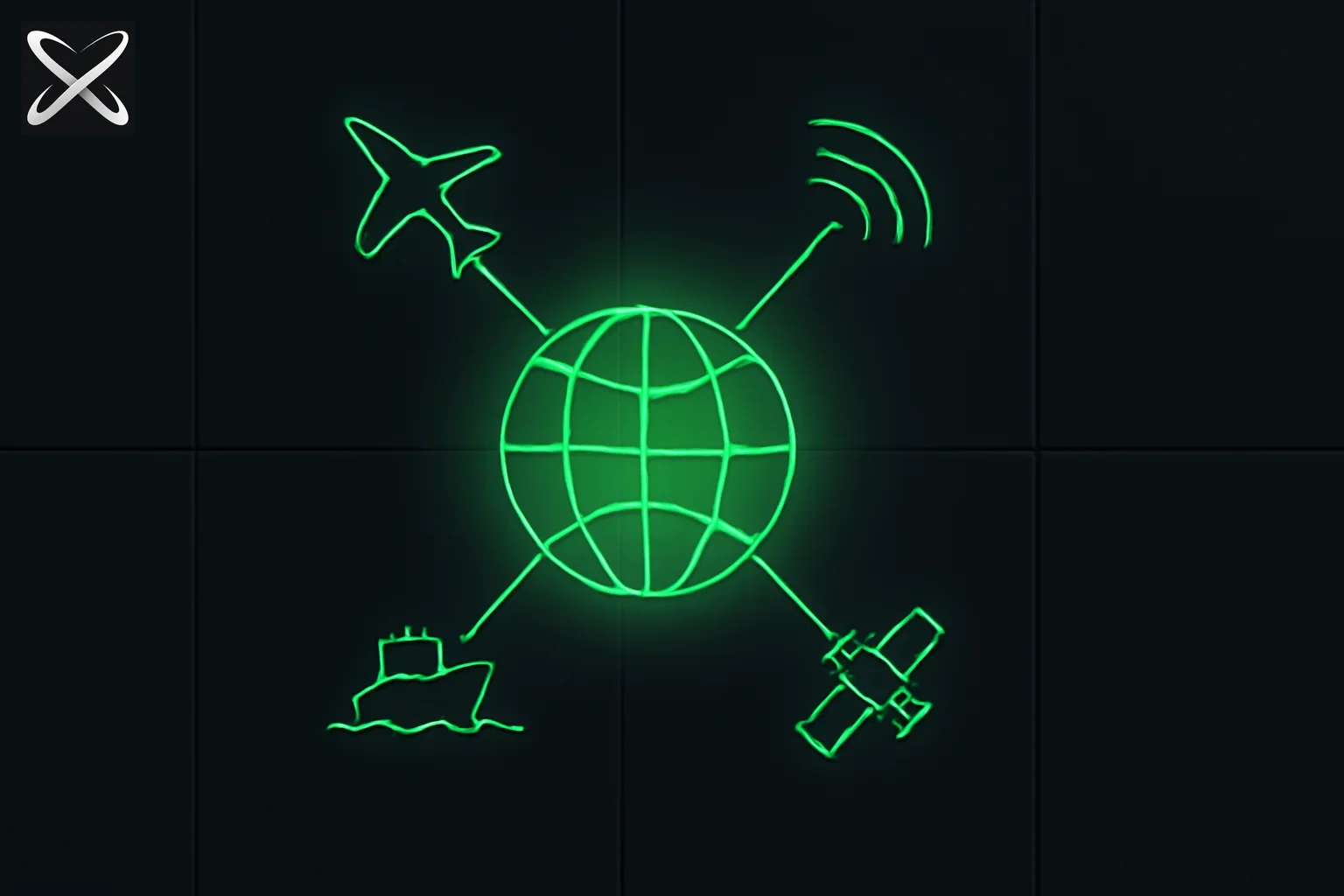 Public OSINT feeds converging on a single 3D globe — the same idea God's Eye View turns into a local browser cockpit
What does the voice agent actually do?
Voice is not a wake-word remote. It is a 28-tool agent sitting on scene context: coordinates, street names, active layers, view scale, and (at street level) a viewport screenshot with instructions not to invent labels.
Without OpenAI, the mic button tells you voice is unavailable and the rest of the app still works. With a key, the README's test-suite prompts are the useful ones:
- Direct: "Take me to Tokyo." / "Orbit around this area slowly." / "Zoom out to a globe view."
- Annotate: "Outline the state of Texas." / "How far is the Eiffel Tower from the Louvre?"
- Interrogate: "How many flights are over Texas right now?" / "When does the ISS pass over next?"
- Operate: "Switch to night vision and turn on the flights layer." / "Track that plane." → "Enter Cockpit."
That is the same voice as a control plane idea as GPT-Live, wired to a globe instead of ChatGPT. If you want an open pipeline you host yourself, the closer cousin on explainx.ai is Hugging Face speech-to-speech — VAD → STT → LLM → TTS speaking a Realtime-shaped protocol. God's Eye View does not swap that stack in; it brokers OpenAI server-side and keeps the tool list fixed.
Is the ethics line a feature or a disclaimer?
A feature. The README states the project models events, assets, infrastructure, and systems. It will not merge PRs for named-person search, face recognition, or tracking individuals. "People are not a query type here."
That is the opposite of "we shipped a creepy HUD, please use it nicely." Public ADS-B, AIS, TLEs, USGS, and city camera APIs are already on the internet. The product decision is not to add a person-shaped query layer on top. If you need a denser, more analyst-oriented OSINT map with 60+ feeds, mesh comms, and an agent command channel, explainx.ai already covered Shadowbroker — different license (AGPL), different stack, same public-signal rule.
God's Eye View is the cinematic local client + voice tools slice of that category: CesiumJS, vanilla JS, Vite, Google Photorealistic 3D Tiles. Shadowbroker is the self-hosted aggregator. Neither is classified. Neither is for navigation or emergency response.
The same spatial-intelligence conversation on explainx.ai includes World Labs / SceniX (generated worlds robots can train in), Google Earth AI Farmscapes (learned Earth features, not a live cockpit), and this week's Planetary Prediction Engine — Google Research's experimental Earth AI agent that models geospatial outcomes from a natural-language query. PPE trains a spatial predictor. God's Eye View is the one you clone and talk to this week.
What should I not expect?
It is not production-hardened. The README calls it an evolving client for exploration and learning. GitHub had 54 open issues on August 28, 2026, including Windows CRLF test failures, install errors, and a request for a lighter mobile profile. Changelog work through 24 August 2026 is still filed under Unreleased.
Do not use it for flight or maritime navigation, emergency response, medical, investment, or other safety-critical work. Data can be delayed, incomplete, modeled, or wrong. That disclaimer is in the README for a reason.
The public git history is short on purpose. Five commits on main: a June 23 placeholder, a July 31 date set, an August 18 "public release by August 24" note, the August 24 open-source release, and an August 28 README pass for the AI-assisted setup flow. CHANGELOG.md still narrates product history back to 0.1.0 on 2026-02-09; package.json on the public tree is 0.1.0. Use the August 24 commit as the OSS date, not the February changelog entry.
History is the expensive part. The maintainer's next-step note is that the present is the cheap part — scrubbing what changed at real resolution is where data and compute get brutal. A future project is named halfpixel.ai; it is not this repo. The GitHub homepage field points at maptheworld.ai; this post treats GitHub as the canonical source.
YouTube series "5M+" is the README's figure for the God's Eye View / WorldView playlist — not an independently audited view count in this article.
Related on explainx.ai
- Shadowbroker: open-source OSINT platform — denser feed aggregation, AGPL, self-hosted map; the closest companion client
- Planetary Prediction Engine — Google Earth AI — NL query to geospatial AutoML; models the planet, does not render a live cockpit
- World Labs acquires SceniX — spatial intelligence aimed at robots, not a public-signal cockpit
- GPT-Live: OpenAI full-duplex voice — voice as a product surface; God's Eye View uses Realtime as a globe control plane
- Hugging Face speech-to-speech voice agents — open VAD/STT/LLM/TTS you can host instead of OpenAI Realtime
- What is an agent harness? — how Claude Code / Codex / Antigravity actually run that README paste
- Loop engineering for coding agents — ask-before-spend loops when an agent holds your Maps key
- Antigravity CLI: sandbox, plugins, subagents — one of the harnesses the README names for setup
Official: gods-eye-view on GitHub · DATA_SOURCES.md · SECURITY.md · PERFORMANCE.md · CHANGELOG.md
Star counts, open-issue totals, Node engines, layer lists, and cost figures are from the public GitHub repo and README as of August 28, 2026. Google Maps and OpenAI prices change — confirm on the provider billing pages before you budget. God's Eye View is exploratory open source, not a navigation or emergency system.