




Black Forest Labs has released FLUX 3 Image Klein, a 5.6B-parameter open-weights model for text-to-image generation, image editing and multi-reference generation. In its announcement, the lab says Klein ranks first in internal evaluations of text-to-image, multi-reference generation and editing, ahead of larger open models, and that an INT8 build runs on RTX GPUs with as little as 8GB of VRAM. It is the second open release from the FLUX 3 family, after FLUX 3 Action.
If you read our earlier piece on FLUX 3 unifying video, audio and robot action, this is the first model from that family that an ordinary image workflow can use today. The weights are on Hugging Face, the reference code is on GitHub, and day-one support covers ComfyUI and Diffusers.
TL;DR: FLUX 3 Image Klein at a glance
| Question | Answer (source: Black Forest Labs) |
|---|---|
| Size | 5.6B parameters (generator only, text encoder not counted) |
| What it does | Text-to-image, editing, multi-reference generation with up to 10 images |
| Native resolution | Up to 4K |
| Extras | Bounding boxes to place elements or confine edits |
| Checkpoints | Base (for fine-tuning) and step-distilled (low latency); FP8, INT8 and NVFP4 builds |
| Minimum VRAM | 8GB with the INT8 build on GeForce RTX |
| Weights size | 11.2 GB in BF16, 5.6 GB in FP8 |
| License | FLUX Kommunity License: free commercial use under 5M dollars annual revenue |
| API | flux-3-image-klein, from 0.009 dollars per 1K image |
| Speed claim | About 4 seconds per 1MP image on an RTX 5090, under 9 seconds on an RTX 4070 (ComfyUI, distilled, INT8) |
What is actually new in Klein?
Klein is the small, fast tier of the family. Its predecessor, FLUX.2 klein 9B, was already popular for local use. Black Forest Labs says the new model gains 91 Elo in text-to-image and 70 Elo in editing over FLUX.2 klein 9B while using 38 percent fewer parameters.
The lab ties that jump to how FLUX 3 is trained. In its words, images contribute spatial detail, video adds motion and physical dynamics, and audio adds information about events and interactions, so the model produces images that feel grounded in the real world. That is a claim about training data, not something you can check from the weights. What you can check is output quality on your own prompts.
Three capabilities matter for practical work:
- Multi-reference generation. You can feed up to 10 reference images, for example a product shot, a style sample and a character sheet, and ask for a new scene that keeps them consistent.
- Pixel-perfect editing. The API path includes pixel restoration, which preserves unedited regions of an image exactly rather than re-rendering the whole frame.
- Bounding boxes. You can mark where an element should appear, or confine an edit to a region. The reference repo includes a Gradio demo for this.
How good is it? The benchmark claim, with caveats
Here is the lab's own chart of rating against generator size.
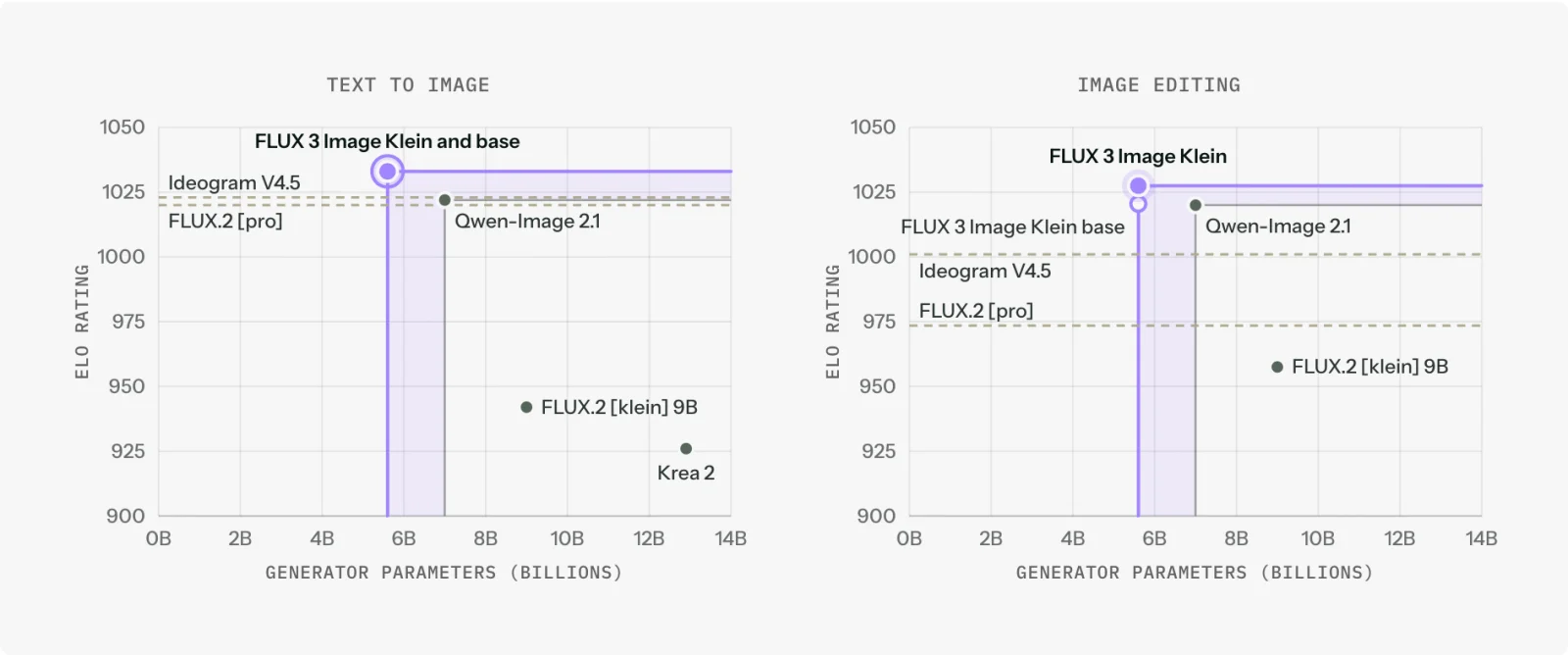 FLUX 3 Image Klein Elo rating versus generator parameter count for text-to-image and editing
Image: Black Forest Labs
FLUX 3 Image Klein Elo rating versus generator parameter count for text-to-image and editing
Image: Black Forest Labs
Black Forest Labs compares Klein with Qwen-Image 2.1 (7B) and Krea 2 (12.9B) among open models, and with the closed Ideogram V4.5 and FLUX.2 pro. It says Klein rates above all of them in text-to-image, and that Krea 2 is excluded from the editing comparison because it does not support editing.
Treat the ranking carefully. These are internal evaluations run by the model's maker, parameter counts are "as each publisher reports them," and text encoders are excluded, so a model with a heavy text encoder looks smaller than it is in practice. Latency numbers also mix methods: Klein was timed on the lab's servers, while other models were timed from the client, which includes polling and network time. None of this makes the numbers wrong, but it is why an independent leaderboard run would be worth waiting for.
For context on the rivals, see our coverage of Krea 2's technical report, Qwen-Image 2.1 and the Ideogram 4 open model.
Can you run it on your own GPU?
This is the part most readers care about. The lab says the generator weights need 11.2 GB in BF16 and 5.6 GB in FP8, and that the INT8 build works on GeForce RTX cards with as little as 8GB of VRAM through ComfyUI or Diffusers.
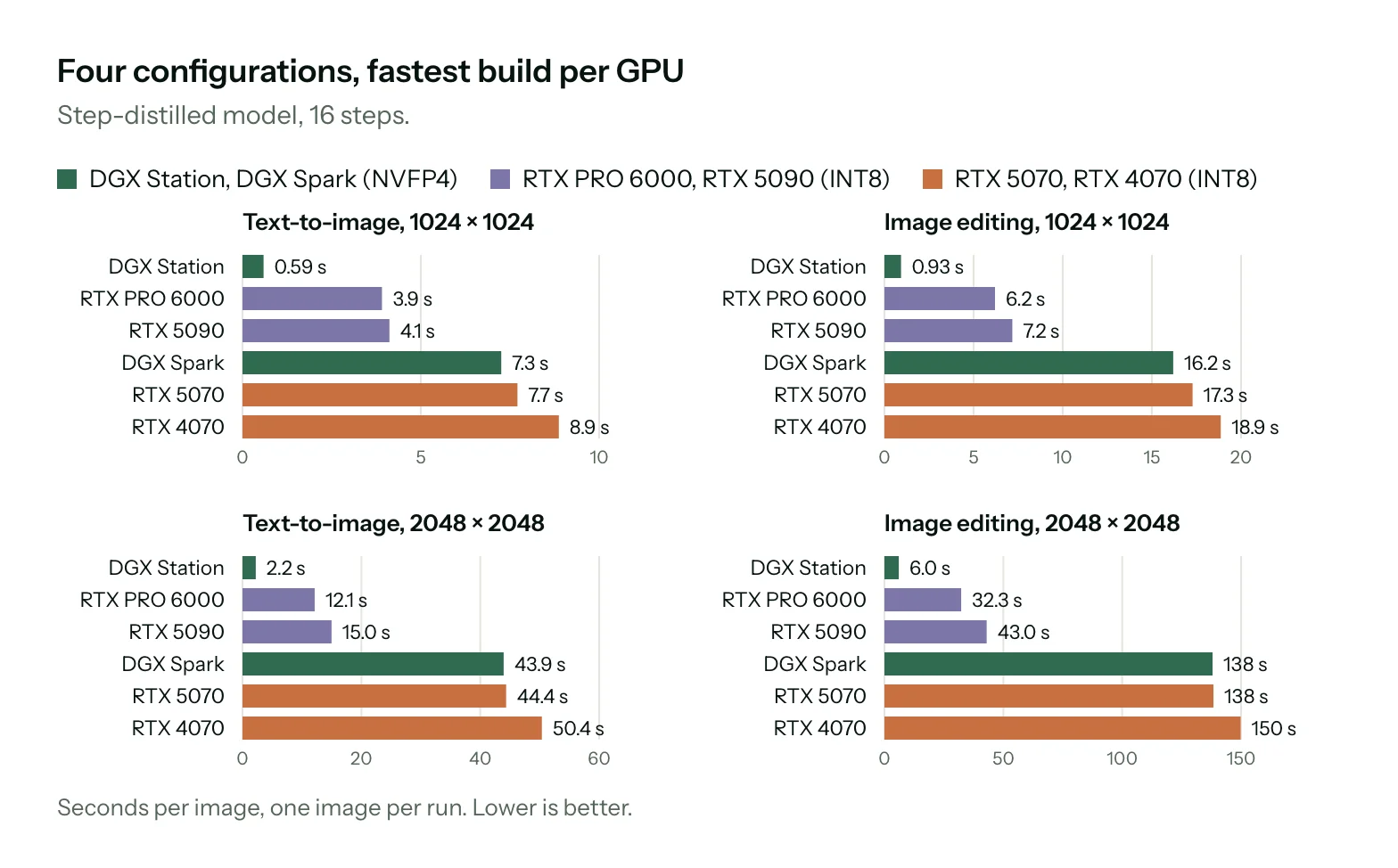 Generation time per image by GPU for the step-distilled FLUX 3 Image Klein model
Image: Black Forest Labs
Generation time per image by GPU for the step-distilled FLUX 3 Image Klein model
Image: Black Forest Labs
The chart, measured by NVIDIA, shows the distilled model at 16 steps. The lab's stated headline numbers are about 4 seconds for a 1MP image on an RTX 5090 and under 9 seconds on an RTX 4070 in ComfyUI. On datacenter hardware, an NVIDIA GB300 produces a 1MP image in under 0.6 seconds in NVFP4, and serving a LoRA adds about 5 percent to generation time.
A practical reading: the distilled checkpoint is for interactive use, the base checkpoint (50 steps) is for fine-tuning and for quality-first batch runs, and the FP8 or NVFP4 builds are for people with newer NVIDIA hardware. If you have a 6GB or smaller card, nothing in the announcement promises it will work.
Quick start
- Download the distilled or base weights from the Hugging Face collection.
- In ComfyUI, update to the latest release and load the Klein workflow, or use Diffusers with the INT8 build on an 8GB card.
- Start with the distilled model at 16 steps, 1MP, and only move to the base model when you need to fine-tune.
- For editing, pass your reference images and describe what changes and what stays the same.
The companion model: a prompt upsampler
Alongside the image model, Black Forest Labs published a 9B vision-language model that rewrites a short request into a detailed prompt tuned for Klein. Its model card describes a full fine-tune of Qwen3.5-9B under Apache 2.0, with four modes (text-to-image, image-to-image, and both with bounding boxes) and support for up to 10 reference images. It writes English prompts even for requests in other languages.
Two cautions from the card: the upsampler does not refuse requests, with safety checks left as optional in the inference code, and reference images are resized, so fine details may be described incorrectly. The hosted API runs prompt upsampling by default, which is one reason API results and local results can differ if you skip the upsampler locally.
What the license actually allows
The weights ship under the FLUX Kommunity License. According to the announcement, it allows free commercial use for individuals and companies with annual revenue under 5 million dollars, plus research and non-commercial use. Larger organizations can deploy commercially through self-hosted licensing or the API.
That makes Klein "open weights" rather than open source in the OSI sense. For a startup or hobbyist it is effectively permissive. For an enterprise it is a licensing conversation, so read the full text before building a product on it. It is a different position from Apache-licensed models such as the prompt upsampler.
Fine-tuning and ecosystem support
The base checkpoint is built for customization. Black Forest Labs says Diffusers and Ostris's AI Toolkit support LoRA training from day one, and NVIDIA's NeMo AutoModel ships training recipes that start from the released checkpoints. For serving, the model is supported in TensorRT-LLM, SGLang Diffusion and vLLM-Omni, and the model was trained on NVIDIA GB200 NVL72 systems.
If you want a tool to try local training, our guide to Unsloth Desktop covers a local train-and-run workflow, and Hugging Face's ML Intern experiment shows what custom model training costs in practice.
Safety and misuse
The lab says it used dataset filters during pre-training and targeted post-training to suppress harmful behavior, and that checkpoints were red teamed internally and evaluated by an external partner, Cinder, which it says found substantially fewer vulnerabilities than other popular open models. That is the lab's statement; the report details are on its safety page. As with any open-weights image model, local users can remove safeguards, so the responsibility for deepfake and likeness misuse shifts to whoever runs it.
FLUX 3 Image Klein vs the alternatives
| Model | Parameters (generator) | Editing | Weights | Source of ranking |
|---|---|---|---|---|
| FLUX 3 Image Klein | 5.6B | Yes, up to 10 references | Open (Kommunity License) | Black Forest Labs internal evals |
| Qwen-Image 2.1 | 7B | Yes | Open | Compared in BFL's chart |
| Krea 2 | 12.9B | No | Open | Compared in BFL's chart |
| FLUX.2 klein 9B | 9B | Yes | Open | BFL: Klein gains 91 Elo T2I, 70 Elo editing |
| Ideogram V4.5 | Not stated | Not stated | Closed | Compared in BFL's chart |
Every score in that comparison originates from the maker of the winning model. Until Artificial Analysis or a community arena publishes its own Elo, the safest conclusion is "very competitive for its size, and unusually easy to run locally."
What this means for what you build or pay
- Local workflows: an 8GB INT8 build puts a current-generation editing model within reach of mid-range gaming laptops and desktops.
- API costs: from 0.009 dollars per image, a 10,000-image batch would cost about 90 dollars at the starting price. Check the live pricing page, since the starting rate may not apply to every resolution or feature.
- Product risk: the revenue cap in the license matters if you plan to resell generation as a service at scale.
- Fine-tuning: a 5.6B base with LoRA support is cheaper to adapt than 12B-plus models, which is the real draw for brand-style and character-consistency work.
What to watch next
Black Forest Labs says more FLUX 3 models will follow. Watch for an independent leaderboard result, community LoRAs, ComfyUI workflow templates for multi-reference editing, and whether the full FLUX 3 Image model gets open weights. We will add an update here if third-party tests contradict or confirm the lab's numbers.
Related reading
- FLUX 3: Black Forest Labs unifies video, audio and robot action
- Krea 2 technical report: open-weights image model
- Qwen-Image 2.1 and transparent image generation
- Ideogram 4: how to run the open image model
- Unsloth Desktop: train and run models locally
- Hugging Face ML Intern: six custom models for 103 dollars
Specs, prices and license terms are as stated by Black Forest Labs on October 15, 2026 and may change.