




Cloudflare released open-weight Clairic and Clairic-flash on November 18, 2026, hosted on Workers AI and published on Hugging Face, with the Workers AI Superintelligence team branding the launch. The update graduates Clairic from preview, adds a 9B flash tier, and re-architects extraction for PDFs, images, tables, and dates.
If you already use System One models to shrink chat bills, this is the extraction-specific release that pairs with Clef for routing and decisions.
What did Cloudflare announce?
The November 18 blog post names two deliverables:
| Model | Role | Workers AI ID |
|---|---|---|
| Clairic (27B) | Flagship typed extraction | @cf/cloudflare/clairic |
| Clairic-flash (9B) | Faster, cheaper extraction | @cf/cloudflare/clairic-flash |
Both ship as open weights and managed endpoints. Cloudflare says the mission is purpose-built small models that augment expensive LLM usage rather than replace frontier chat models entirely.
What is System One extraction?
System One is Cloudflare's label for narrow models that return typed values — numbers, dates, enums, spans — instead of free-form text. Our earlier claimed-vs-verified Clairic preview piece walked the preview API.
The November 18 release keeps the schema-first contract:
- Confidence scores and character spans per field
- Structured fields you define in the request
- No separate output-token meter; Cloudflare charges input tokens only
That pricing shape matters when you extract hundreds of fields from invoices, leases, or support tickets.
Architecture changes since preview
Cloudflare says preview feedback pushed a full redesign:
- Parallel slot autoregressive generation for ordinary text and number fields, so each field stops at its own end marker while the batch advances together
- Special heads for estimates, forecasts, durations, calculated dates, and arithmetic
- PDF and image ingestion beyond the receipt photo demo from preview
On internal tracked assertions, Cloudflare reports 1,263/1,263 correct fields for both new models versus 1,033/1,263 for preview. On synthetic receipt fields, it reports 576/576 for Clairic and Clairic-flash versus 369/576 for preview.
Treat those tables as vendor evals, not independent benchmarks.
 Cloudflare Clairic internal eval scores for text image PDF and receipt extraction
Image: Cloudflare
Receipt and image extraction example
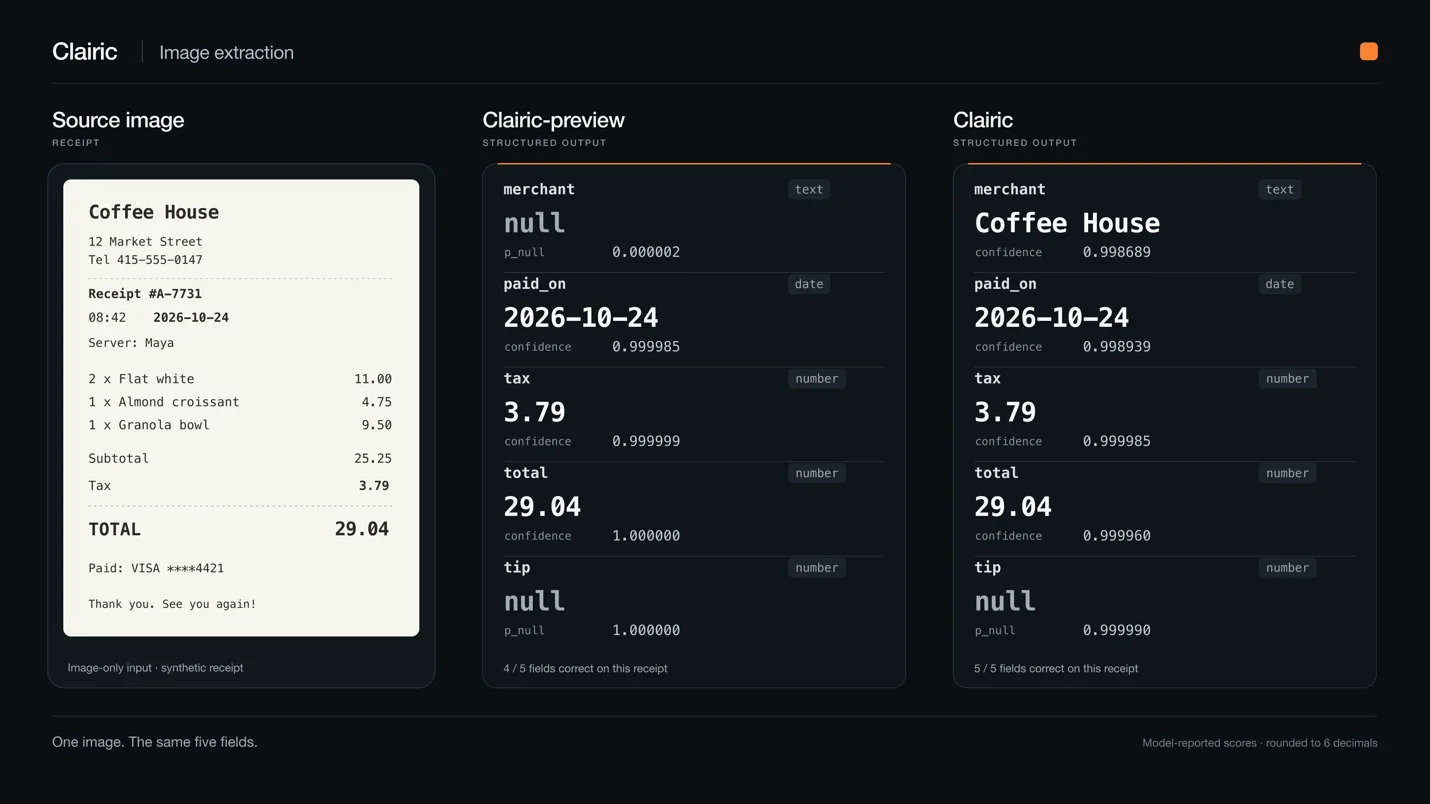 Cloudflare Clairic open-weight model receipt extraction comparison versus preview
Image: Cloudflare
Cloudflare's side-by-side coffee shop receipt shows preview returning null for the merchant name while Clairic returns Coffee House with all five fields filled. Image extraction error counts moved from 207 errors to zero on an internal mixed-input set, per the blog.
For operators, the lesson is validate on your document distribution. Receipt OCR is not the same as scanned contracts or noisy mobile photos.
Latency: is Clairic fast enough for online flows?
Cloudflare measured full HTTP response time on a self-hosted server and published p50 / p95 in milliseconds:
| Eval set | Clairic p50 / p95 | Clairic-flash p50 / p95 |
|---|---|---|
| Fresh text fields | 358 / 736 ms | 155 / 328 ms |
| Fresh image fields | 453 / 976 ms | 305 / 605 ms |
| Commercial leases | 691 / 803 ms | 379 / 519 ms |
| Loan pricing | 395 / 407 ms | 188 / 192 ms |
Clairic-flash targets sub-second responses on several sets below 400 ms p50. Full Clairic still lands under one second on many rows, which Cloudflare contrasts with typical chat completions on similar workloads.
Pricing and the December 1 promo
Cloudflare moved the 9B preview endpoint to Clairic-flash and placed the 27B model on the main Clairic ID.
| Model | List input price after promo | Promo through Dec 1, 2026 |
|---|---|---|
| Clairic 27B | $0.24 per million input tokens | $0.10 |
| Clairic-flash 9B | $0.10 per million input tokens | $0.10 |
If you pinned preview Clairic at $0.10, Cloudflare says the endpoint upgrades in place to better extraction without a schema migration. Cost-sensitive jobs should test Clairic-flash before December 1, when 27B returns to $0.24.
Compare this shape to OpenAI Decisions API and Microsoft Decision-1.1 when you route versus extract.
Open weights on Hugging Face
Cloudflare follows Clef's open-weight playbook: publish weights for research and fine-tuning, keep managed inference on Workers AI.
Reasons builders download weights:
- Air-gapped document pipelines
- Fine-tunes on industry-specific forms
- Latency experiments on your own GPUs
Reasons to stay on Workers AI:
- No kernel tuning
- Billing integration with Workers and R2
- Automatic model router updates
Check license files on Hugging Face before redistributing derivatives.
Competitive context: extraction is crowded
Cloudflare compares against Liquid AI D1.2 with Apple Vision OCR and Scaledown Extract in its tables. It admits no public extraction leaderboard exists yet.
That honesty matters. Extraction is becoming a commodity layer as agents ingest email, PDFs, and tickets. Jev and Microsoft's Decision models sit adjacent but optimize decisions, not field filling.
If you run agents on Cloudflare, validate every extracted field before it triggers a tool call when untrusted documents enter the loop.
How to try Clairic this week
- Open Workers AI docs for
@cf/cloudflare/clairicand@cf/cloudflare/clairic-flash. - Port one production form with five to ten fields and compare preview-era accuracy.
- Load-test Clairic-flash if p95 under 400 ms is a hard SLA.
- Download Hugging Face weights only if self-host TCO beats $0.10/M promo math on your volume.
Workers AI Superintelligence team
Cloudflare reframes its frontier research group as the Workers AI Superintelligence team, responsible for Clef, Clairic, and unannounced models.
For edge developers, the takeaway is Cloudflare building models, not only hosting others' checkpoints. That affects router defaults and which open weights get first-class Workers integrations.
PDFs, leases, and multi-page line items
Cloudflare's PDF support is the largest user-visible upgrade since preview. You can request supplier, line items, and totals when fields span pages. The cap is four images or PDF pages per request, which pushes designers toward chunking very large packets.
For commercial leases, Cloudflare's latency table shows 691 ms p50 on full Clairic and 379 ms on flash. Loan pricing rows are tighter — 395 ms versus 188 ms — suggesting numeric tables compress well in the 9B model.
If you migrate from general chat extraction, benchmark three document types you actually ship: invoices, contracts, and support exports. Cloudflare's tracked customer assertions row is the closest proxy to messy production.
Self-hosted vs Workers AI: a cost sketch
Open weights enable private cloud deployment, but total cost is GPU hours + engineer time, not only $/M tokens.
A rough decision tree:
- Under a few million fields per month — stay on Workers AI during the $0.10 promo, especially if you already pay for Workers and R2.
- Strict data residency — download Hugging Face weights and run on your VPC, accepting higher p95 until you tune kernels.
- Burst-heavy batch — compare Clairic-flash throughput against batching on your own vLLM cluster.
Cloudflare's input-only pricing simplifies math: you do not multiply by output tokens when schemas return large JSON.
Pairing Clairic with agents and routers
Most production stacks should not send every user message to Clairic. Typical layering:
- Clef or Decision model — classify intent and pick tools
- Clairic — fill typed slots from attachments
- Frontier chat model — synthesize narrative answers only when needed
That pattern mirrors Microsoft IQ plugins and OpenAI Decisions API stories from the same month.
Eval tables: how to read Cloudflare's numbers
Cloudflare publishes fresh text, mixed-input, customer assertions, and synthetic receipt rows. Clairic and Clairic-flash tie on several perfect scores, while preview lags.
When vendors compare against Liquid D1.2 + OCR and Scaledown Extract, note different OCR pipelines. Apple Vision on D1.2 is not identical to Clairic's native image heads.
Until a neutral leaderboard exists, treat comparisons as directional and run your own 200-field golden set.
Security and untrusted documents
Extraction models read attacker-controlled PDFs. That is indirect injection surface when an agent auto-invokes Clairic on email attachments.
Combine schema validation with agent guardrails when untrusted files enter the loop. Typed JSON does not stop malicious field content from flowing downstream.
What developers are saying
The Hacker News thread was quiet at launch, with few hands-on reports yet. When builders post latency numbers from real PDFs, treat them as complements to Cloudflare's self-hosted measurements.
Related reading
- Clairic vs Clef vs Decisions comparison
- Clairic preview claimed vs verified
- Microsoft Decision-1.1 at Ignite
- OpenAI fair use and extraction workloads
- Edge inference with ONNX WebGPU
- Workers AI and agent security patterns
Migration checklist from Clairic preview
If you integrated @cf/cloudflare/clairic during preview, Cloudflare says weights and schemas roll forward without renaming your Workers binding. Still run this checklist before December 1:
- Re-benchmark ten production documents; preview null fields may disappear.
- Switch latency-sensitive routes to Clairic-flash and compare p95 against your SLA.
- Pin Hugging Face revisions if you self-host, because open-weight tags can move independently of Workers AI defaults.
- Update cost dashboards when 27B returns to $0.24 per million input tokens.
Document schema versions in your repo so finance can reconcile November promo spend against December list prices.
Pricing and model IDs reflect Cloudflare's November 18, 2026 announcement. Promo pricing ends December 1, 2026 unless Cloudflare extends it.