



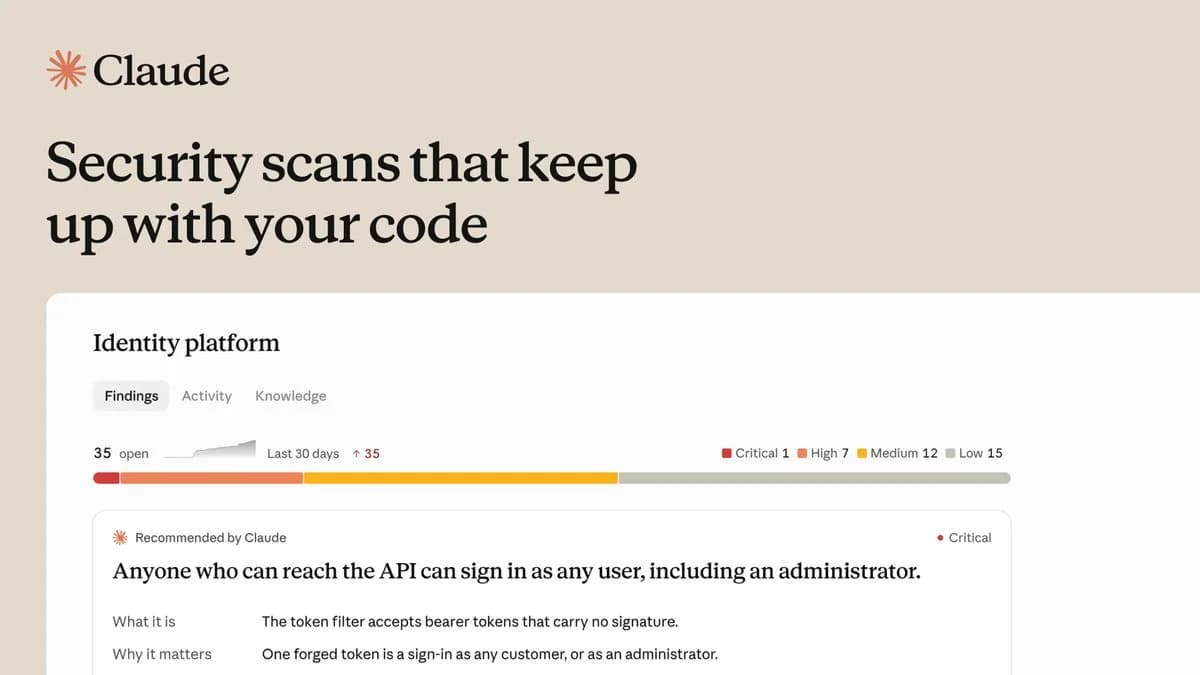
Claude Security just changed from a scan you run to a scanner that keeps watching. On October 21, 2026, Anthropic announced that Claude Security, its AI code security product, "now keeps up with your repositories as your code changes." Connect your repos once, and Claude runs a deep baseline scan, then re-scans changes as they land. When a fix ships, it marks the finding fixed, even if your team fixed it outside Claude Security; if the issue comes back, the finding reopens. Each project gets a threat model written by Claude from your code, which your team can edit.
Anthropic also says thousands of organizations have used Claude Security to find "over a million vulnerabilities" since the public beta began, and that it now runs on Anthropic's full model family "including Claude Mythos, with no Cyber Verification Program access required." It is in public beta for Claude Enterprise, with $25,000 a month in free credits for two months. This post explains what changed, how it works, who can use it and what to watch. For the earlier version, see our Claude Security public beta guide.
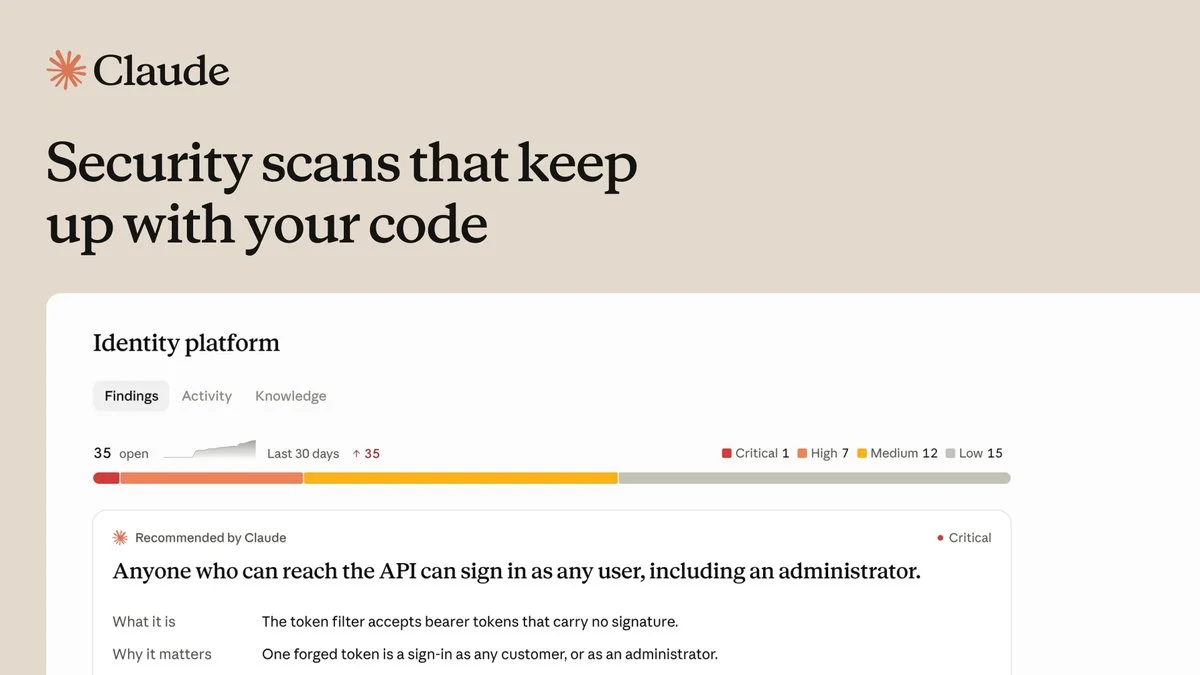 Claude Security continuous scanning dashboard with findings by severity and an example critical finding
Image: Anthropic. The example finding reads: "Anyone who can reach the API can sign in as any user, including an administrator."
The short version
| Question | Answer |
|---|---|
| What changed? | Continuous scanning instead of on-demand scans |
| Fix tracking | Findings close automatically when fixes land anywhere; reopen if the issue returns |
| Threat model | Claude writes one per project from your code; your team can edit it |
| Knowledge base | Tell Claude how code is deployed and which controls exist |
| Integrations | New API, webhooks, MCP connector in Claude.ai and Claude Code |
| Git providers | GitHub (incl. Enterprise Server), GitLab and others via access token |
| Access control | New role-based access: who can view, triage and create projects |
| Models | Full Claude family incl. Mythos; no Cyber Verification Program needed |
| Who | Claude Enterprise, public beta |
| Price | $25K/month free credits for two months, through Dec 31, 2026 |
| Track record | 1M+ vulnerabilities found since April (company figure) |
What continuous scanning means in practice
A traditional security scan is a snapshot. Code changes every day, so a report from last month is already stale. Anthropic's answer has four parts:
- Baseline, then deltas. You create a project, connect repositories, and pick a branch and scope. Claude runs a deep baseline scan, then "scans changes regularly based upon their risk and complexity." A one-line copy change will not get the same attention as a new authentication path.
- Multi-repo projects. A project can hold several repositories, so Claude can catch issues "that live between services, like a backend that trusts input a client was supposed to validate." That is a class of bug single-repo scanners miss.
- Fix tracking. "Most fixes happen outside the tool that found the issue." Claude Security checks open findings against changed code and closes them when the fix lands, whether it came from Claude Code or anywhere else. Regressions reopen automatically.
- Severity with an exploit path. Each finding gets a severity judged against your project's threat model, an explanation of how an attacker could reach the code, and sometimes an attack-path diagram, so teams fix what is reachable first.
The threat model and knowledge base
 A threat model shapes which Claude Security findings matter for each project
Generic scanners flood teams with findings that do not apply to their environment. Claude Security's fix is context:
- Knowledge base: each project has one where you describe how code is deployed, which security policies apply, and "anything a new security engineer on your team would need to know." That helps Claude skip risks your environment already handles, such as a WAF or a network control.
- Threat model: Claude writes one from your code. Your team reviews and edits it, and later scans use it to decide what is worth flagging. Claude's help docs note that because the model is written from code alone it can miss deployment context, which is why it is editable.
Vanta's director of security, Nathan Hunstad, described the effect: once his team wrote their own risk policy into the threat model, "the findings matched how we prioritize instead of only a severity score."
Getting findings into your tools
| Integration | What it does |
|---|---|
| API | List and read projects and findings, resolve or reopen findings, create and manage projects and repositories |
| Personal access tokens | Created in Claude Security settings; can only see and change what the user can |
| Webhooks | Notify systems such as Slack or Jira when a new finding lands |
| MCP connector | In Claude.ai and Claude Code: pull up a finding, ask about it, start the fix and mark it resolved in one session |
| Role-based access | Admins choose who can view projects, triage findings and create projects |
The MCP connector is the piece builders will feel most. A developer working in Claude Code can open a security finding, have Claude explain it, write the fix and close the finding without switching tools. If you are new to MCP, start with what MCP is.
Mythos without the verification queue
The quiet headline is the model line: Claude Security "is powered by our full family of models, including Claude Mythos, with no Cyber Verification Program access required." Anthropic's most capable cyber model has been gated behind verification for offensive security work, and Anthropic's own Public Benefit Report admits that verification "can take days or weeks." Running it inside a defensive product scoped to your own repositories lets Enterprise teams use that capability on their code without that wait. For background on Mythos, see Claude Mythos and Project Glasswing.
What customers say
Anthropic quoted early users:
- IonQ: "Claude Security found many material issues that a traditional pen test conducted at the same time missed, several of which would have had significant impact if exploited in the wild." (Jon Donovan, Software Engineer)
- Gusto: "Claude Security scanned our code once to set a baseline. Now it keeps up as our code changes, and our team fixes issues right in Claude instead of switching to another tool." (Jake Meredith, Product Security)
- Vanta: "Claude Security found a number of logic flaws that none of our other tools had caught." (Nathan Hunstad, Director of Security)
These are vendor-selected testimonials, so treat them as examples rather than benchmarks.
Who can use it, and the catch
Claude Security is in public beta for Claude Enterprise only. Admins enable it in the admin console. Organizations get $25,000 in free usage credits per month for two months, for usage through December 31, 2026, with terms in the Help Center.
That Enterprise limit was the top reaction on X. One reply asked: "How is this helpful if it's not available to general public?" For individual developers and small teams, the closest options today are the Claude Code security review features, Anthropic's free scanner program for open-source maintainers, and open-source tools like Cloudflare's security audit skill.
Why this matters right now
The timing is pointed. The same week brought PHP2Shell, found by researchers using AI, a GitLab CVSS 10 flaw and a run of supply chain breaches. AI is finding bugs faster on both sides, and a quarterly scan cannot keep up. Continuous, context-aware scanning is the defender's version of that speed.
Two limits to keep in mind:
- It scans your code, not your dependencies' release pipelines. Several October attacks shipped malware through trusted packages and official binaries, which a code scanner of your repos will not catch. AgentBeam's October incident tracker covers those.
- "Over a million vulnerabilities" counts findings, not fixes. The new fix tracking should make that number more meaningful over time.
Common questions
Does continuous scanning burn through usage quickly?
Anthropic says changes are scanned "based upon their risk and complexity," so not every commit gets a deep look. During the beta, the $25,000 monthly credits for two months are meant to cover that usage. After December 31, check the Help Center terms before rolling it out to every repository.
Will it change my code on its own?
No. Claude Security finds and tracks issues; fixes happen in your normal workflow, including Claude Code. It closes a finding only after it sees the fix in changed code, and reopens it if the problem comes back.
Is my code used to train models?
The announcement does not change Anthropic's Enterprise data terms. Claude Enterprise customers should confirm data handling in their agreement and the Claude Security Help Center before connecting sensitive repositories.
How is this different from GitHub's built-in code scanning?
Rule-based scanners match known patterns. Claude Security reasons about how code behaves, uses a threat model of your system, and looks across multiple repositories at once, which is why customers report logic flaws other tools missed. Most teams will run both.
Related reading on explainx.ai
- Claude Security public beta: scan, validate, patch
- Anthropic's free AI vulnerability scans for OSS maintainers
- Claude Mythos and Project Glasswing
- VulnCheck: AI-found bugs and exploit rates
- Anthropic's 2026 Public Benefit Report
- AgentBeam: how continuous AI scanning fits a security program
Sources: Anthropic: Claude Security now scans continuously and tracks fixes · Claude on X · Unite.AI · TestingCatalog
Accurate as of October 22, 2026. Claude Security is a public beta; features and pricing may change.