



Cerebras Systems CEO Andrew Feldman used two stage appearances at TechCrunch Disrupt 2026 on October 13 to make two arguments: that a personal AI appliance in every home is close, and that the AI industry's doomsday messaging is hurting it. Both come from a chipmaker whose business depends on AI demand, so this post separates what he said from what is established.
Everything quoted below comes from TechCrunch's two reports by Sarah Perez. We could not find a recording or transcript, so wording is TechCrunch's.
TL;DR
| Question | Answer |
|---|---|
| When will home AI assistants arrive? | Feldman: "I don't think that's very far away." No date given. |
| How will they run? | "Just like your cell phone": some work on device, some back in the cloud. |
| What can they do? | Know you well, sit inside a security perimeter, and "certainly" have credit-card access to buy things. |
| Is AI risk overblown? | He did not say that. He said powerful tech brings misuse risk and should be regulated reasonably. |
| Why the data center backlash? | In his view, partly the industry's failure to engage local communities. |
| Does efficiency hurt chip demand? | He said no; hardware and model efficiency must come together. |
| Is he neutral? | No: Cerebras sells to OpenAI, Block, Figma, GSK and Lovable. |
The home AI appliance claim
Asked what would need to happen for AI to become a household appliance, Feldman answered that he does not think it is far away. He pointed to consumer agents such as Meta's Muse and to Instinct as signs that AI is finding its footing with everyday users.
His picture is hybrid. The assistant runs partly locally and partly in the cloud, "will get to know you very well," operates inside "a security perimeter," and will "certainly" be able to use credit cards to buy things. He also says he uses "a collection of agents" himself to sweep his calendar and pull background on people before calls.
What is real today
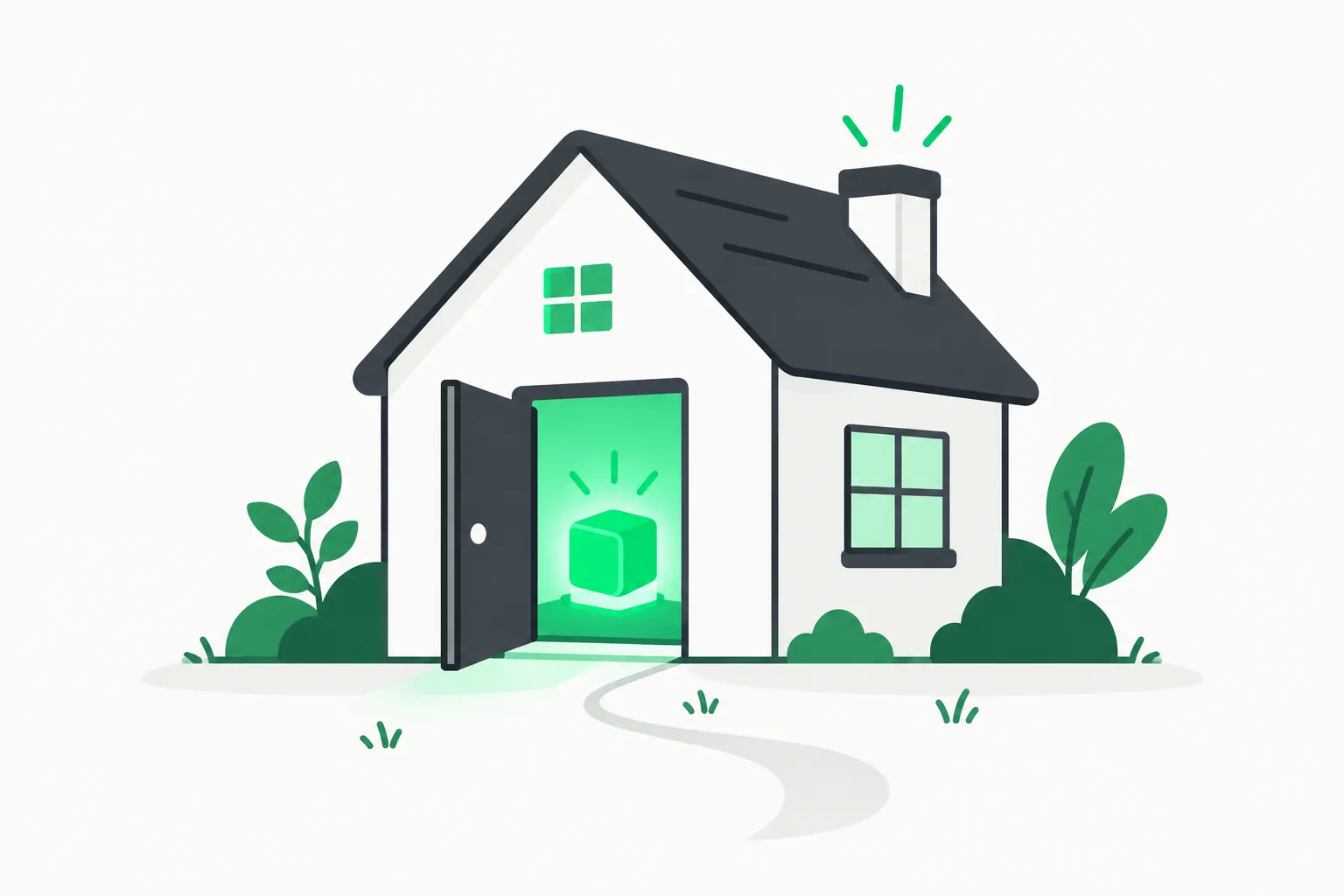 A home AI appliance concept: a small house-shaped box with a glowing core, illustrating the home AI assistant Feldman describes
Parts of this vision already exist, and explainx.ai has covered them:
- Local hardware is shipping. The Oki Home local AI computer is a $1,799 box built to run models at home, and Nvidia's RTX Spark push targets desktop agent setups; see our RTX Spark ecosystem post.
- Agents that pay. AWS AgentCore Payments and Shopify's agent checkout show the plumbing for agents buying things, with budget limits rather than raw card access.
- Unauthorized purchases are a known risk. Amex's intent framework exists because agents spending money without clear consent is already a concern.
That last point is the gap in Feldman's pitch. A "security perimeter" is mentioned in one sentence, but whether an assistant can spend your money safely is the hard problem, not the easy one.
The hardware angle
Cerebras makes wafer-scale accelerators, and its pitch is speed: see our notes on the CS-4 accelerator, Qwen3 running at around 1,500 tokens per second on Cerebras, and OpenAI's ultrafast tier. A cloud half of a hybrid assistant is exactly where fast inference sells. Feldman said himself that he likes being in infrastructure because he does not need the consumer idea; he builds "platforms that other people's ideas take flight on."
Note what a hybrid architecture means for a chipmaker: more devices means more cloud calls as well as more local compute. The vision is favourable to Cerebras either way.
The pushback on doomsday talk
In the second session Feldman quipped that "some of the leaders in the AI world maybe shouldn't be allowed to talk in public." TechCrunch ties the remark to rising negativity: talk of models breaking containment, insiders debating the odds that AI ends humanity by the end of the decade, and an SNL skit parodying Anthropic CEO Dario Amodei with the line "We do not condone what we are doing."
Feldman's argument is about balance. He thinks leaders should say more about benefits, such as a future where children rarely encounter cancer deaths (TechCrunch's paraphrase). But he did not dismiss risk:
- "I don't think there are powerful technologies that don't come with the challenge of 'what happens when powerful technologies are in the hands of bad people?'"
- "This technology is powerful... We have to be thoughtful about it. We have to regulate it reasonably."
Read carefully, this is a message-framing critique, not a denial of safety concerns. For people tracking the safety debate in more depth, compare with Michael I. Jordan's argument that AI doom is science fiction, and the evidence-based risk warnings in Bill Gates's CNN comments on AI cyberattacks. Gates is a reminder that measured warnings come from people who are also optimistic.
Data centers and the NIMBY problem
The most concrete admission was about infrastructure. Feldman said the industry "weren't super good for the past few years at working with local communities, particularly in the U.S.," unlike power, oil and gas companies. He contrasted the American NIMBY reaction with Brazil, Canada, Finland, Iceland, Norway, Mexico and Sweden, which he says encourage data center builds.
This is an exec's framing and worth testing. Community objections to data centers often involve electricity prices, water, noise and tax breaks, not only a lack of engagement. We track the broader picture in our IMF report coverage on AI financing and cyber risk and in infrastructure stories such as Anthropic's reported Osaka data center. What is notable is that a chip executive publicly acknowledges industry fault.
Efficiency and chip demand
Feldman said he is not concerned that efficiency gains will shrink demand for chips from Cerebras or other Nvidia rivals. Hardware vendors will make compute more efficient, model makers will make models more efficient to hit the same goals, and "all of this has to come together." This is a standard industry position, and it is a claim, not evidence. Whether cheaper inference expands total usage or cuts spend remains argued across the sector.
What people are asking
Would a home AI appliance be a new device or an app? Feldman compared it to a phone, which suggests a device class with local compute plus a cloud link. He did not name a product, maker or price, so any specific hardware claim is speculation.
Who would own the data? He mentioned a security perimeter but gave no detail on where memory about you lives, who can read it or how it is deleted. Those are the questions to ask of any vendor that ships such a box.
Does a hybrid design lower cost? Doing small tasks locally can cut cloud bills, which is the logic behind small on-device models. But the reasoning-heavy tasks he describes, such as buying things on your behalf, would likely still call large cloud models, so costs depend on the split.
Is the doomer pushback aimed at anyone in particular? TechCrunch links it to the general discourse and mentions the SNL parody of Anthropic's CEO, but Feldman's quoted line names no one.
What readers should take from it
- Treat timelines as opinion. "Not very far away" has no date and no product attached.
- Watch the hybrid design. Which tasks stay on device and which go to the cloud decides privacy, latency and cost for any home assistant.
- Demand spending controls. Card access for agents needs caps and approvals, as the payment frameworks above show.
- Weigh the source. TechCrunch says plainly that Cerebras has a vested interest. That does not make Feldman wrong, but it shapes what he emphasises.
- If you build agents, design for the split now: local retrieval and memory, cloud reasoning, explicit permissions. For agent safety tooling, AgentBeam, from the explainx.ai team, stops AI agents before they take dangerous actions.
Context: why this keeps coming up
Executives at hardware firms have an incentive to describe a near future full of AI devices; so do founders selling consumer agents. Meanwhile surveys of workers show the day-to-day reality is more mixed, with checking and redoing AI output taking real time; see our write-up on the AI verification tax. A home assistant that must be double-checked before it spends money is not yet an appliance. Appliances are boring because they work every time.
The doomer-versus-optimist framing also hides an in-between: many researchers hold both views, that benefits are large and that testing and oversight are needed. Feldman's own quoted words about regulation land there.
Bottom line
Feldman's two comments are worth logging as an industry signal, not a forecast: a major chip CEO expects hybrid home AI soon, wants a more upbeat public message, and concedes that data center builders handled communities badly. The first is unproven, the second is a PR argument, and the third is the most actionable. Check back for product launches that put dates and prices behind the vision.
Related reading
- Oki Home local AI computer
- Cerebras CS-4 accelerator
- Qwen3 on Cerebras at 1,500 tokens per second
- Michael I. Jordan on AI doom
- Amex intent framework for agent purchases
- AI verification tax
- Official: Cerebras, TechCrunch Disrupt coverage
Accurate as of October 14, 2026, based on TechCrunch's reports of the sessions.