




Headlines calling Blackstone’s inaugural BXDC purchase “50% cheaper than building” do not match what Blackstone published on November 16, 2026 or what its SEC 8-K discloses. The verified core is a ~$5 billion transaction for 75.1% of joint ventures holding 13 powered shells leased back to Amazon Web Services at a stated 7.0% initial cap rate.
explainx.ai tracks this because AI demand is reshaping who owns the concrete under cloud GPUs.
See Ohio voter fights over AWS campuses, hyperscaler nuclear deals, and PJM fast energization rules.
What is confirmed in primary filings
| Fact | Document |
|---|---|
| $5.0B gross value, 7.0% initial cap rate | Blackstone press release, Nov 16, 2026 |
| 75.1% BXDC interest, AWS 24.9% retained | 8-K contribution agreement description |
| 647 MW IT power, 13 buildings, Indiana + Mississippi | 8-K property summary |
| Triple-net lease, 12-year initial term, 32-year extended term, 2.75% annual rent escalator | 8-K lease terms |
| ~$1.9B IPO cash into JVs, ~$2.5B non-recourse mortgage debt contemplated | 8-K funding table |
AWS infrastructure VP Prasad Kalyanaraman supplied a community-impact quote in Blackstone’s release; that is CSR framing, not financial engineering detail.
What the “50% cheaper” claim lacks
Aggregator posts tied the deal to half-off construction economics. Neither Blackstone nor AWS used that phrase in the press release or 8-K. American Buildout’s recap instead emphasizes ~$385 million per building and ~$7.7 million per MW implied by the $5B / 647 MW math—useful for REIT investors, not proof of a 50% capex discount.
Cap rate describes income yield on stabilized assets, not replacement cost savings. Powered shells are pre-leased to a hyperscaler tenant; BXDC is buying cash-flowing infrastructure, similar in spirit to sale-leaseback finance seen across data-center REIT narratives, but with AWS co-equity.
Why AWS sold majority stakes
Sale-leasebacks let AWS recycle capital into new regions while Blackstone scales a listed vehicle targeting stabilized, investment-grade tenants. The 12-year / 32-year lease ladder mirrors how Amazon’s $17B Ohio buildout debates who pays for grid upgrades—here, rent escalators shift some inflation risk to BXDC shareholders.
Indiana “20% cheaper power” slides appear in investor decks cited by trade press; treat them as marketing comparisons, not audited bills.
Implications for AI builders
This deal does not:
- Change EC2 instance prices on announcement day.
- Open new regions by itself—the shells are already constructed.
- Prove aggregate AI capex is falling.
It does show financialization of AI real estate: public markets can fund hyperscaler footprints without every dollar sitting on Amazon’s balance sheet. If you forecast GPU supply, watch BXDC’s closing conditions and mortgage terms in Q4 2026—delays hit capacity timelines indirectly, not model releases.
Powered shells versus turnkey halls
AWS contributed newly constructed powered shells—buildings with power and cooling ready for tenant fit-out—not necessarily fully populated GPU halls. The 647 MW figure is IT power capacity across 13 buildings on two campuses:
- Northern Indiana (greater Chicago market): nine buildings.
- Mississippi: four buildings.
American Buildout notes investor decks comparing Indiana power costs to Illinois, marketing ~20% cheaper power without publishing audited tariffs in the press release.
Powered-shell JVs let AWS keep operational control via leaseback while Blackstone sells yield to public shareholders. That is distinct from Blackstone private funds buying operating racks narratives traders discussed in November.
Cap rate math for non-REIT readers
A 7.0% initial capitalization rate on $5B gross value implies ~$350M of annualized NOI at closing economics, before Blackstone’s fees and debt service on the ~$2.5B mortgage contemplated in the 8-K.
Cap rates move with interest rates and tenant credit. Amazon parent guarantees on the triple-net lease support investment-grade profiling, but 2.75% rent escalators may lag GPU inflation in some investor models.
If you are a builder, not a REIT holder, the useful output is timeline: Q4 2026 close means shell capacity may lease faster than Ohio voter-blocked greenfield paths.
Why “50% cheaper than building” spread without filings
Social headlines implied BXDC bought half-price buildings versus ground-up construction. Official sources instead disclose:
- Transaction value ($5B).
- Cap rate (7%).
- JV equity split (75.1% / 24.9%).
- Lease term (12 initial, 32 extended).
None state replacement cost savings. A sale-leaseback can look cheap to equity investors because risk shifts to tenant credit and rent escalators, not because concrete poured for 50% less.
When explainx.ai runs claimed-vs-verified on infra, we treat percent-off construction memes like vLLM Rubin throughput rumors: interesting, unverified until filings repeat them.
BXDC’s first deal as a template
CEO Nick Pell called the transaction a “match for IPO proceeds” in Blackstone’s release. BXDC listed recently as a pure-play stabilized data-center REIT targeting hyperscaler triple-net leases. If the Q4 2026 close completes, other cloud vendors may copy the JV + leaseback pattern to monetize powered shells without selling operating clusters.
Mortgage debt (~$2.5B contemplated) means rate shocks flow to shareholders, not AWS rent—watch Fed financial stability reporting on REIT leverage in our November Fed AI exposure note.
Environmental angles remain local: Indiana and Mississippi sites still face grid interconnection politics similar to PJM fast-track debates. This deal does not resolve community bans; it financializes already-built shells.
Verification checklist for readers
- Read Blackstone’s press release for cap rate and JV splits.
- Read the 8-K for MW count, lease terms, and debt.
- Ignore percent-cheaper memes unless repeated in those documents.
- Pair with SK Hynix memory supply reporting for the full stack story.
Closing conditions investors watch
The 8-K lists minimum cash distribution thresholds to AWS at closing, debt commitment letters, and Q4 2026 timing. Slippage into 2027 would not pause existing regions, but it could delay shell absorption that traders price into Amazon capex efficiency narratives.
Watch BXDC shareholder letters and Morgan Stanley / CBRE advisor disclosures for cap rate moves if rates shift before close.
AWS renter economics after the JV
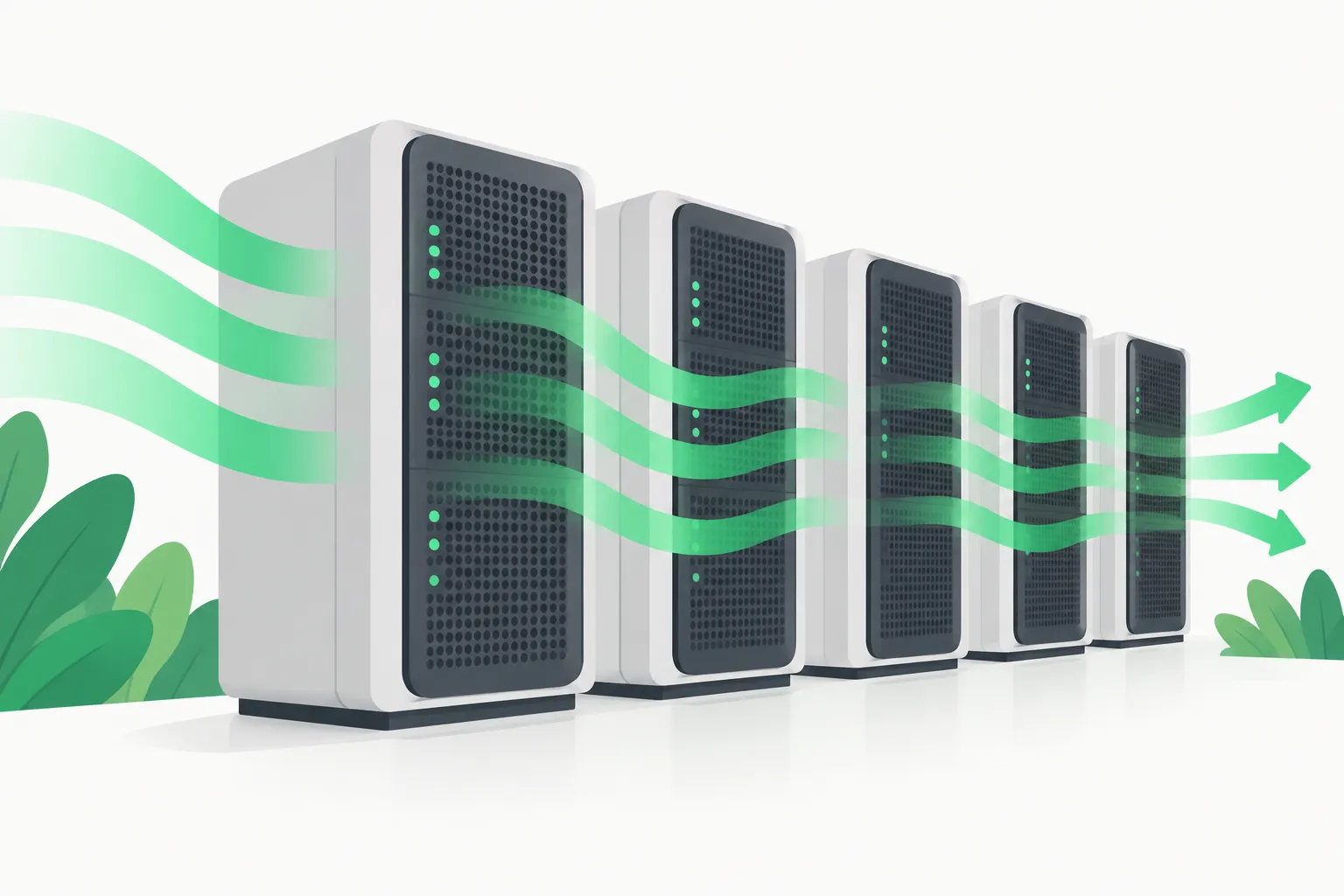 Cooling loops beside a server hall, illustrating triple-net costs behind AWS powered shells
Triple-net leases push property tax, insurance, and maintenance to the tenant—here, AWS. Rent escalators at 2.75% lag some power tariff spikes unless contracts include true-ups we cannot see in the public 8-K.
Hyperscalers accept that trade when balance-sheet capacity for $5B shells competes with custom silicon and Trainium builds. Builders still pay per-instance; this is landlord chess, not EC2 discounts.
Midwest vs Deep South siting logic
 Power lines feeding a regional grid, illustrating Indiana and Mississippi shell siting and tariff spreads
Chicago-market Indiana sites chase fiber backhaul, cooling climate, and power spreads versus Illinois tariffs in investor slides. Mississippi campuses diversify weather and interconnect paths, similar to how Google Quaise geothermal Oregon bets mix geographies.
Community groups in both states still file permit objections; a REIT close does not guarantee fleet energization on Day 1 if grid upgrades slip—see PJM interconnection reporting.
What AWS customers should ask account teams
- Does this JV change us-east-1/us-east-2 capacity reservations?
- Are new shells earmarked for Trainium or GPU fit-out?
- How do lease escalators flow into long-term EC2 pricing? (Expect no direct answer until close.)
- Will water disclosures differ by campus versus Apple and Google compact templates?
Document answers in your DR runbooks; financial engineering still affects your latency when AZ expansion stalls.
Retail REIT holder lens
If you hold BXDC for yield, read FFO guidance after close, not Hugging Face leaderboards. 7% cap can compress if Amazon credit spreads widen or data-center backlash raises insurance.
Traders already connected Ohio bans to scarcity rents in Amazon Ohio reporting—this deal offsets some greenfield risk by recycling shells.
Glossary for finance readers new to AI infra
Powered shell: building with power and cooling delivered; tenant installs IT gear.
Triple-net lease: tenant pays taxes, insurance, maintenance.
Cap rate: NOI / property value; higher cap often means higher perceived risk or lower growth.
JV equity: here 75.1% BXDC / 24.9% AWS—not the same as operating control of GPUs.
Historical parallel: sale-leasebacks in cloud booms
Sale-leasebacks surge whenever hyperscalers want cash for silicon while REITs hunt yield in a rate-sensitive market. The pattern is older than ChatGPT: carriers did it for cell towers; oil majors for pipelines. AI just swaps crude for tokens.
The difference for developers is subtle but real: landlord stability can accelerate shell delivery even when GPU allocations remain rationed. Watch availability zone announcements—not Blackstone earnings calls—for latency changes.
Status: based on Blackstone’s November 16, 2026 press release and the November 11, 2026 SEC 8-K; closing remains subject to stated conditions and financing.