



NVIDIA Rubin HPC is a new Vera Rubin GPU for scientific simulation and analytics, not a rename of the 28,672-CUDA-core Rubin part already shipping toward AI factories. At SC26 on November 16, 2026, NVIDIA said Rubin HPC will carry more than 50,000 CUDA cores on a single GPU, sparse data acceleration for scattered-memory workloads, and seventh-generation NVLink, with availability expected in 2028. For builders, the headline is a second Rubin branch aimed at agent-invoked simulations—climate models, engineering meshes, genomics, and risk grids—while the inference Rubin line chases token throughput we track in vLLM's Vera Rubin benchmarks.
TL;DR: what NVIDIA confirmed vs what is still missing
| Topic | Confirmed at SC26 | Not published yet |
|---|---|---|
| Product name | Rubin HPC on Vera Rubin platform | Rack SKU names beyond press imagery |
| CUDA cores | More than 50,000 per GPU (NVIDIA blog) | Exact count, SM layout, die count |
| Today's Rubin GPU (comparison) | 28,672 cores per Tom's Hardware | Whether Rubin HPC uses Rubin Ultra-style multi-die packages |
| Interconnect | NVLink 7 generation named | New bandwidth or lane specs at announcement |
| Ship window | Expected 2028 | Pricing, OEM systems, power envelopes |
| Memory | Not stated for Rubin HPC | Do not copy 288 GB HBM4 / 22 TB/s from inference Rubin unless NVIDIA confirms |
What NVIDIA announced at SC26
The official blog post frames Rubin HPC around agents that propose candidates—materials, molecules, designs—then call GPU simulations to filter what is worth building in a lab. Ian Buck, vice president of hyperscale and HPC at NVIDIA, is quoted saying that for those agents, "faster simulation means faster discovery."
NVIDIA lists three hardware themes:
- Record CUDA core count — more than 50,000 on one GPU.
- Sparse data acceleration — keeping those cores busy when apps gather scattered values from huge datasets.
- NVLink 7 — faster GPU-to-GPU links inside scale-up domains.
The post emphasizes balanced scaling: data movement grows with compute instead of adding cores alone. That language targets stencil computations, sparse linear algebra, sorting, and reductions—the inner loops of CFD, climate, genomics, and Monte Carlo risk engines.
Rubin HPC vs the Rubin GPU you already hear about in AI news
If you only follow LLM inference, Vera Rubin means NVL72 racks, SemiAnalysis AgentX curves, and posts like our vLLM Rubin throughput breakdown. That story is about tokens per second per user on agentic coding traces.
Rubin HPC is a different product intent. Tom's Hardware's Jeffrey Kampman notes the current Rubin GPU ships 224 SMs and 28,672 CUDA cores—less than three-fifths of the 50,000+ figure NVIDIA quotes for Rubin HPC. Kampman writes that reaching 50,000+ cores likely requires more dies on the package, similar to a four-die Rubin Ultra style layout linked with NVLink-C2C, though NVIDIA did not confirm die geometry at launch.
That distinction matters for procurement committees already signing Vera Rubin AI factory contracts. You may end up with:
- Inference Rubin blocks for training and serving frontier models.
- Rubin HPC blocks for simulation-heavy agent tools that call CUDA-X math libraries between LLM reasoning steps.
The same week NVIDIA also pushed Nemotron for Science—open weights, LitmusBench chemistry data, and recipes for scientific agents. Rubin HPC is the hardware bet underneath those agent loops when simulations dominate wall-clock time.
NVLink 7, sparse data, and why agents care
Scientific workloads rarely look like dense matrix multiplies on every clock. NVIDIA's post describes a repeating pattern: reach into a huge dataset, pull a few values, compute, repeat billions of times. When memory access is irregular, raw FLOPS marketing understates the problem—cores stall waiting for data.
Sparse data acceleration is NVIDIA's label for hardware that shortens that stall time. The company did not publish microarchitecture slides in the blog post, so treat the feature as a directional promise until whitepapers ship.
NVLink 7 is named for multi-GPU jobs that still partition meshes or genomes across sockets. Tom's Hardware reports NVIDIA did not announce new bandwidth numbers at SC26, but prior public comments suggested NVLink 7 might keep roughly 3.6 TB/s per GPU while expanding how many GPUs can share a scale-up domain compared with NVLink 6 on today's Rubin systems.
For agent swarms, faster all-to-all on simulation ranks shrinks the hypothesis → simulate → refine loop Buck described. That is the same product logic as DGX Spark's desk-scale HPC kit: let researchers debug multi-node MPI before they queue on a national supercomputer.
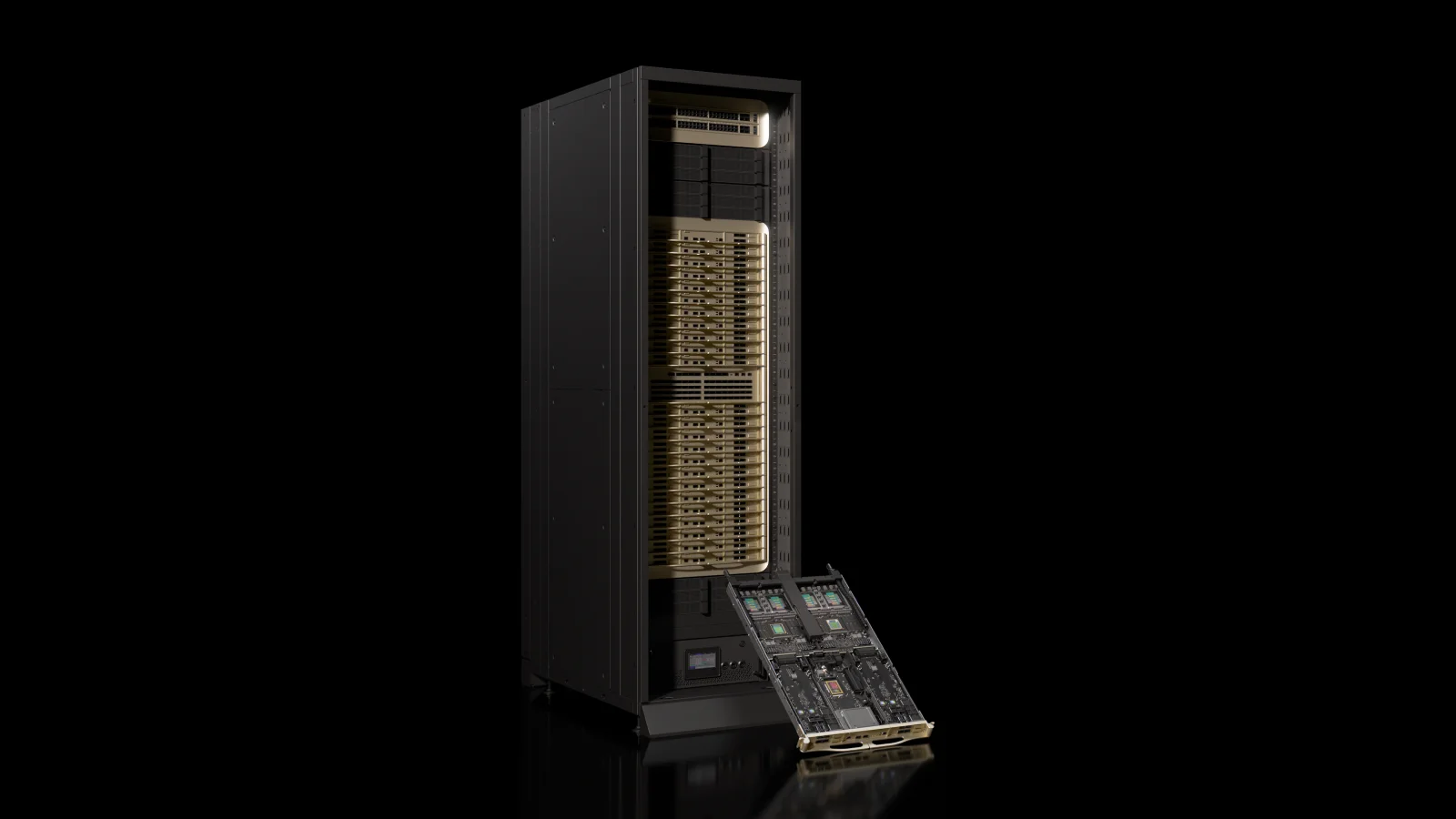 Rubin HPC NVL rack tray showing Vera Rubin platform hardware at SC26
Image: NVIDIA
FP64, competition at SC26, and the 2028 timeline
NVIDIA's launch copy stresses precision breadth in prose—simulation from FP64 through FP4—but the SC26 blog does not list official FP64 teraflops for Rubin HPC. Trade coverage at the show noted AMD and Intel pitching FP64-capable GPUs the same week, reviving a debate about whether recent NVIDIA data-center parts de-emphasized native double precision relative to Hopper H100 generations.
Until NVIDIA publishes a spec sheet, do not plan a CFD migration from H100 or H200 clusters based on core count alone. Core count and memory bandwidth are coupled problems; Kampman explicitly warns that HBM capacity and bandwidth were not disclosed for Rubin HPC.
Availability: expected 2028. That is a planning horizon, not an order window. Teams renting CoreWeave's first Vera Rubin clusters today are buying inference-era silicon, not Rubin HPC. Budget for Rubin HPC as a follow-on tranche after standard Rubin rolls through cloud catalogs.
 Stacked GPU memory illustration beside Rubin HPC sparse simulation workloads
How to prepare before 2028
You cannot buy Rubin HPC yet. You can rehearse the software stack NVIDIA is selling alongside it:
- Profile your simulation kernels for sparse memory access and MPI communication, not just peak FLOPS. If your code is already network-bound, NVLink 7 domain size will matter more than core count.
- Prototype agent loops that call CUDA-X libraries between LLM steps, using the same patterns as Nemotron for Science and IBM–Fermilab quantum CUDA-Q jobs announced at SC26.
- Separate inference and simulation capacity in architecture docs. Mixing token-serving SLOs with batch simulation queues on one fleet is how labs lose both latency and science throughput.
- Track NVIDIA's SC26 hub for follow-on posts on CUDA-X libraries for agents—the company published multiple same-day pieces that flesh out the software side Rubin HPC depends on.
Search questions this announcement raises
What is NVIDIA Vera Rubin HPC test hardware? Search snippets sometimes conflate supermicro Vera Rubin HPC bring-up boards with this Rubin HPC GPU name. At announcement time, NVIDIA only described a GPU product, not a specific Supermicro SKU. Watch OEM pages and NVIDIA Marketplace after 2027 for validated systems.
Is Rubin HPC the same chip as Rubin Ultra? NVIDIA did not equate the names at SC26. Press analysis speculates about multi-die packaging because of the core-count jump from 28,672 to 50,000+. Wait for packaging disclosures before drawing die-level conclusions.
Who should care about Rubin HPC today? Research groups that already run agent loops on simulation back ends should care most. NVIDIA's launch post names science, engineering, and finance as target domains. If your agents spend more wall-clock time waiting on a mesh solver or a risk grid than on LLM tokens, the sparse data acceleration claim speaks to your bottleneck. If your workload is chat inference, the inference Rubin line remains the relevant track, and nothing in the SC26 announcement changes that.
What should a team ask NVIDIA or an OEM? Ask for the exact CUDA core count, HBM capacity, memory bandwidth, FP64 throughput, power envelope, and NVLink 7 domain size. Those are the items the launch material left open, so they decide whether a given simulation code benefits.
What this means for AI builders
Rubin HPC does not change what you ship this quarter. It does clarify NVIDIA's bet that scientific agents will spend as much GPU time in simulation kernels as in LLM forward passes. If your product roadmap includes materials discovery, biotech design loops, or engineering copilots that call FEM solvers, start measuring simulation latency now—that is the metric Rubin HPC targets.
For token economics, stay on the inference Rubin track documented in co-design and NVFP4 posts. Rubin HPC is complementary silicon, not a drop-in replacement for serving ChatGPT-class models.
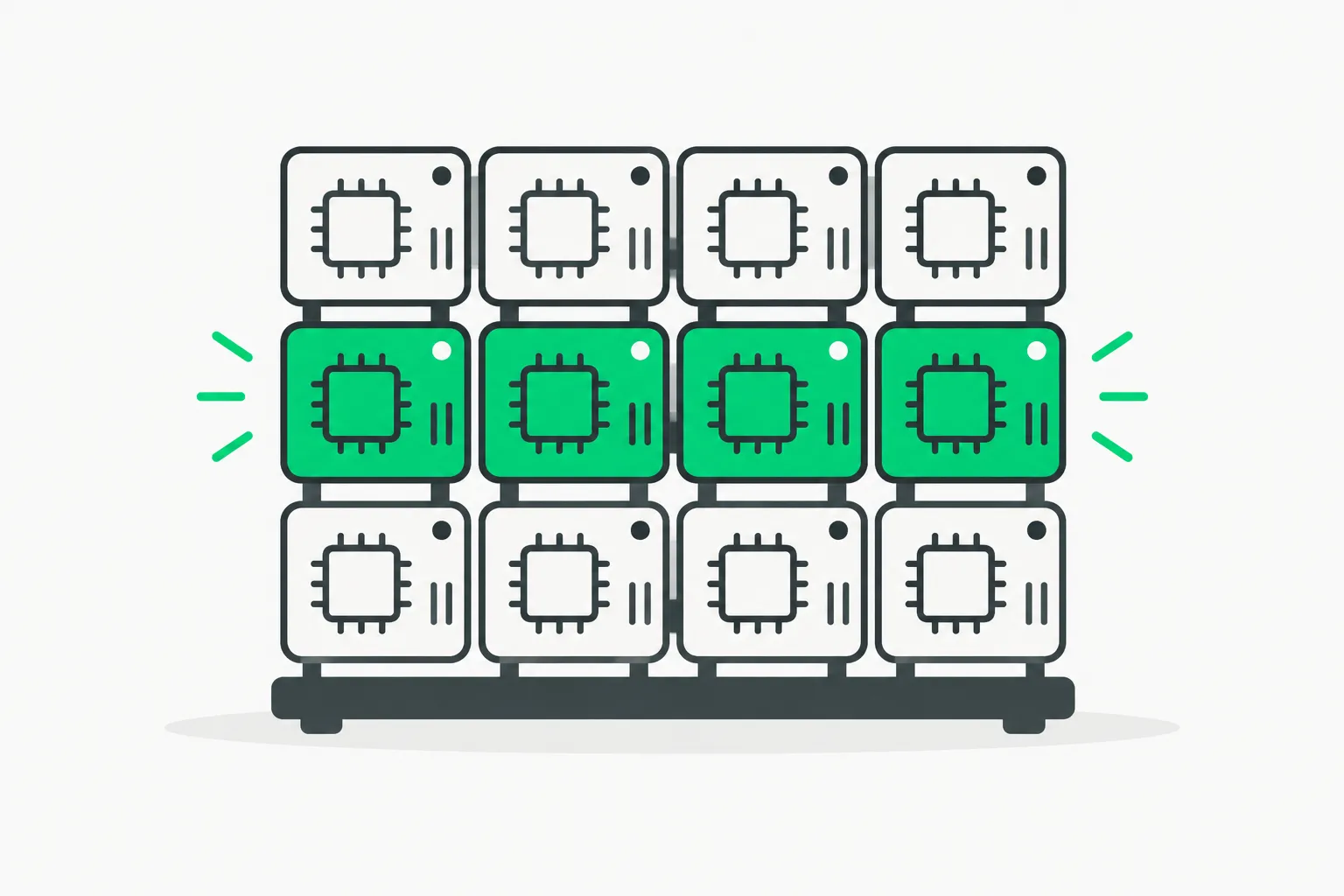 GPU cluster grid illustrating Rubin HPC multi-GPU scale-up domains
If you are comparing clouds, pair this hardware story with Baseten's frontier inference guide: science agents may need two purchase orders—one for models, one for simulation back ends.
Classroom analogy: inference Rubin vs Rubin HPC
Think of Vera Rubin inference racks as the express checkout lane at a grocery store optimized for identical basket sizes—millions of short LLM requests with similar shapes. Rubin HPC is the industrial kitchen behind the store: fewer customers, heavier jobs, irregular recipes, and long waits if a single ingredient is missing from the pantry.
That analogy breaks if you force one lane to do both jobs. Clouds that collapse token serving and overnight CFD into undifferentiated "GPU hours" will see neither workload hit SLO. NVIDIA's explicit Rubin HPC SKU is an admission that scientific memory patterns need silicon marketing distinct from tensor-core AI training.
National labs already mirror the split: Nemotron for Science partners quote simulation-heavy drug and materials pipelines, while vLLM's Rubin charts track agentic coding throughput. Rubin HPC is the hardware name tag for the first bucket. Watch NVIDIA's SC26 roundup for whitepapers that connect CUDA-X library versions to Rubin HPC system configs as OEMs publish validated stacks.