



Related guides: Touch ID and security, blur faces and backgrounds, remove photo backgrounds, AI use cases.
On September 9, 2026, Apple held its "Surprise and Shine" keynote at the Steve Jobs Theater — the first major product launch under John Ternus, who became CEO on September 1 after Tim Cook stepped down. Ternus posted a keynote recap video on X that crossed 6.7 million views within days, framing the event as continuity plus one big bet: iPhone Duo, Apple''s first foldable, alongside iPhone 18 Pro and Pro Max, new Apple Watches, and AirPods 5.
explainx.ai previewed this lineup from leaks and supply-chain reporting on September 3. The September 9 keynote largely confirmed the shape of that preview — with official names, prices, and dates from Apple Newsroom and iPhone 18 Pro coverage. What changed is the foldable''s final branding: iPhone Duo, not the "Fold" or "Ultra" names leaks floated.
For AI builders, the through-line is unchanged from WWDC 2026: iOS 27, Siri AI, and Apple Intelligence finally ship on silicon tuned for on-device inference — but Ternus, a hardware engineer by career, led with chips, displays, and wearables rather than a second AI keynote.
TL;DR — every product at a glance
| Product | Starting price | Key spec | Pre-order | On sale / ships |
|---|---|---|---|---|
| iPhone Duo | $1,999 | 7.6" inner / 5.4" outer, A20 Pro | Oct 16, 2026 | Oct 23, 2026 |
| iPhone 18 Pro | $1,199 | A20 Pro, new burgundy color | Sep 12, 2026 | Sep 18, 2026 |
| iPhone 18 Pro Max | $1,299 | Largest Pro battery + display tier | Sep 12, 2026 | Sep 18, 2026 |
| Apple Watch Series 12 | TBD tiered | Health + fitness stack refresh | Sep 12, 2026 | Sep 18, 2026 |
| Apple Watch Ultra 4 | Premium tier | Live Rewind (15 sec recap, double-press Crown) | Sep 12, 2026 | Sep 18, 2026 |
| AirPods 5 | TBD | Next-gen buds in fall cycle | Sep 12, 2026 | Sep 18, 2026 |
| Base iPhone 18 | — | Not announced | Spring 2027 (expected) | Spring 2027 (expected) |
Cross-cutting hardware story: Apple claimed 50% battery charge in 15 minutes on supported wireless charging for the new iPhone lineup — a spec aimed at reducing range anxiety on Pro Max and Duo daily use, not just wired MagSafe peaks.
John Ternus''s first keynote — leadership context
Tim Cook''s transition was fast: executive chairman role, farewell post August 31, Ternus CEO September 1, keynote September 9. That is eight days between title change and standing on stage alone.
Ternus joined Apple in 2001, moved through Product Design into Hardware Engineering, and became SVP of Hardware Engineering in January 2021. He is credited internally with iPad, Mac, and iPhone mechanical design leadership — the person who ships hinges, thermals, and antenna windows, not keynote slides about foundation models.
What that means for explainx.ai readers who track AI strategy:
| Cook era emphasis (2011–2026) | Ternus era signal (Sep 2026+) |
|---|---|
| Services growth, wearables scale | Silicon + form-factor bets (fold, Ultra watch) |
| Apple Intelligence announced at WWDC | Same AI roadmap, hardware-led delivery |
| Privacy marketing as differentiator | On-device Neural Engine as proof point |
| Gemini-backed Siri (partnership inherited) | No new model vendor announced at Sept 9 |
Ternus did not rewrite Apple Intelligence in one keynote. He validated the container: A20 Pro for phone inference, watch silicon for Live Rewind, AirPods for ambient audio AI — the same "AI runs on devices we sell" thesis OpenAI publicly disputed in the August trade-secrets fight, but that Apple keeps betting on in product.
Watch Ternus''s post-keynote video on X for tone: less "one more thing" mysticism, more engineering walk-through of Duo hinge tolerance and Pro camera stack — consistent with a CEO who ran the team that had to manufacture what WWDC promised in June.
iPhone Duo — Apple''s $1,999 foldable
Apple''s foldable is officially iPhone Duo, starting at $1,999. It is a book-style fold — inner tablet panel, outer phone cover — not a Galaxy Flip-style clamshell. Apple''s own marketing calls it "the largest iPhone display ever, in a thin, foldable design," and ships it in two finishes: Night Sky and Star White.
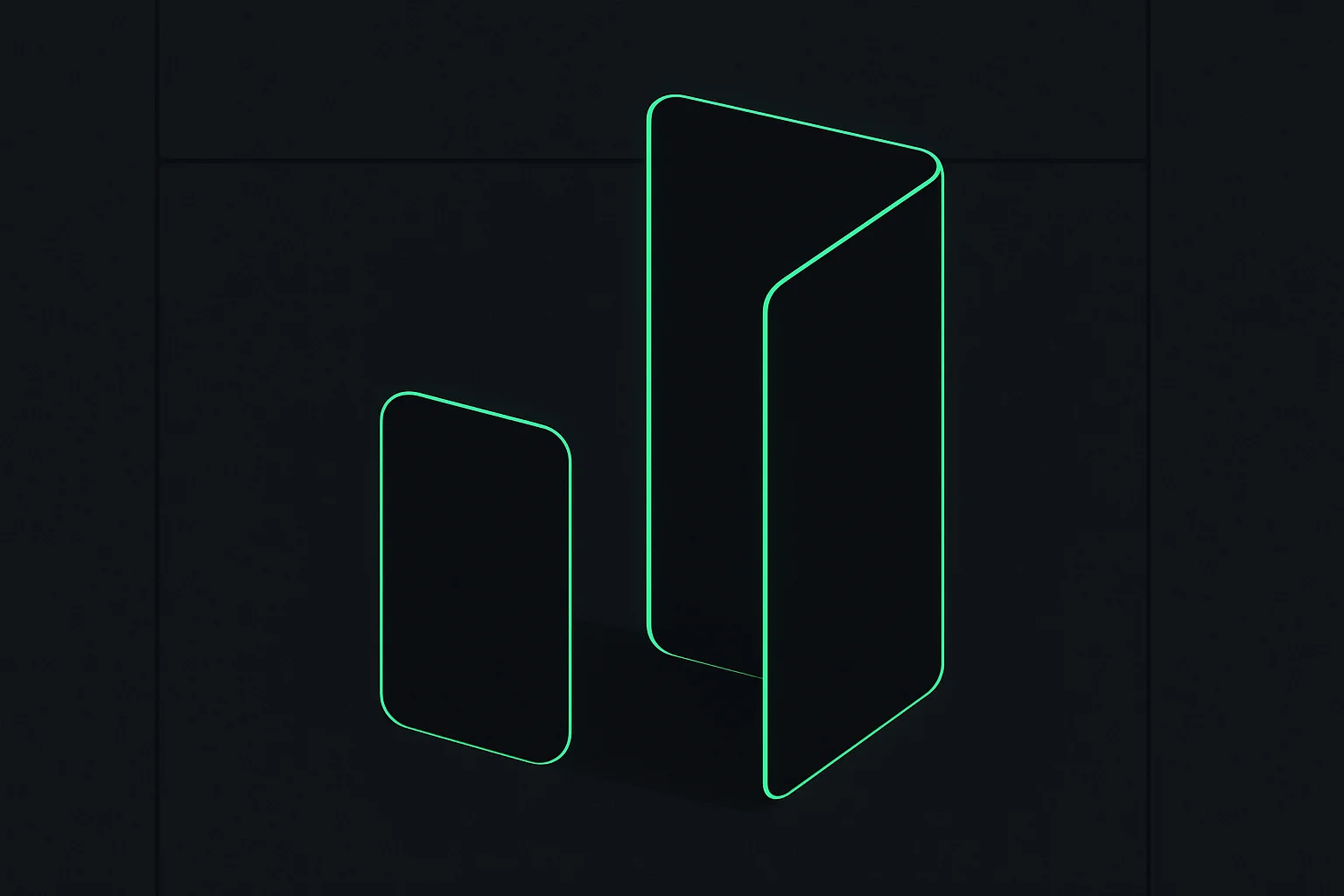 iPhone Duo shown closed and open, illustrating the book-style fold with a compact outer display and a larger inner tablet-style display
Display and form factor
| Spec | iPhone Duo |
|---|---|
| Inner display | 7.6 inches — Super Retina XDR, primary canvas for multitasking, video, and iPad-class layouts |
| Outer display | 5.4 inches — more than 90% of the screen area of iPhone 18 Pro; full phone usability when closed |
| Nano-texture | 10 ultrathin layers with a custom nano-texture finish on the inner display to reduce glare; peak brightness of 3,000 nits |
| Front camera | Under-display FaceTime camera — hidden inside the inner panel so there''s no notch or hole-punch cutout |
| Aspect ratio | Fixed at 1:1.4 (≈1:√2) on both displays, matching ISO 216 paper proportions (A4/A5) — closing or opening the phone keeps the same ratio, which is why side-by-side apps or a full-screen app scale cleanly between the two panels |
| Form factor | Book fold; Apple emphasized crease management and hinge durability in keynote demos |
| Chip | A20 Pro — shared branding with iPhone 18 Pro tier, tuned for dual-display power budgets |
| Weight / thickness | 254 g (8.96 oz), roughly on par with iPhone 18 Pro Max; folded body is noticeably wider (about 3.31") than a standard iPhone despite the shorter outer screen |
The Duo sits $800 above iPhone 18 Pro Max ($1,299 → $1,999). Apple is not trying to make foldables volume phones in year one; it is buying category creation and ASP lift while skipping the base iPhone 18 to avoid channel confusion.
Camera system — two lenses, not three
Unlike the Pro tier''s triple-camera stack, Duo ships with a 48MP Dual Fusion system: a 48MP Fusion Main and a 48MP Fusion Ultra Wide, plus 2x optical-quality zoom — but no dedicated telephoto lens and no variable aperture like iPhone 18 Pro. The front-facing setup is a 12MP Center Stage camera built into the under-display module.
| Feature | What it does |
|---|---|
| Smart Take | Waits until everyone in frame is ready before capturing, instead of racing a self-timer |
| Duo Preview / Kid Cue | Outer-screen preview and cues that help kids and groups look at the lens when using the rear camera as a "selfie" cam |
| Duo FaceTime | Uses both displays so a call can include a hands-free, propped-up view via StandBy-style posing |
| Photographic Styles 3 | Adds texture and grain controls on top of tone and color for skin smoothing or a film look |
| Intelligent editing | Spatial Reframing, the Extend tool, and an enhanced Clean Up tool (beta) for removing larger objects |
| Video | Cinematic mode with adjustable depth-of-field, 4K time-lapse with Dolby Vision HDR, and on-device smart focus tracking |
Performance and battery — dual cells, no physical SIM
Duo runs the A20 Pro chip with a dual 16-core Neural Engine and a vapor-chamber thermal system, which Apple pitches as up to 20% faster 6-core CPU and 50% more memory bandwidth than the A19 Pro. Two internal batteries share the space freed up by an eSIM-only design — there is no physical SIM tray — plus Apple''s new C2 modem.
| Spec | iPhone Duo |
|---|---|
| Video playback (inner display) | Up to 31 hours |
| Video playback (outer display) | Up to 44 hours |
| Fast wired charging | ~50% charge in around 20 minutes with a 60W-capable USB-C cable and PD adapter |
| SIM | eSIM only — no physical SIM slot |
| Connectivity | Wi‑Fi 7, Bluetooth 6, 5G |
| Satellite | Messages via satellite, Roadside Assistance via satellite, Emergency SOS via satellite, Crash Detection |
Note the charging spec split: the newsroom''s 50% in 15 minutes headline (cited above) was a wireless claim covering the broader fall lineup; Duo''s own spec sheet quotes 50% in about 20 minutes over wired USB‑C, likely because a foldable''s thinner, dual-cell pack and hinge thermals change the wireless-coil math.
No Face ID — Touch ID moves to the side button
Duo skips Face ID entirely. Apple has not said why. One common explanation is that an under-display front camera leaves no room for the IR hardware Face ID needs (an inference, not an Apple statement); Apple instead integrated Touch ID into the side button — the same approach used on iPad Air and iPad mini. It also unlocks via a paired Apple Watch. Apple says it works open or closed. Early reactions are split: some users find side-button Touch ID faster and more reliable at odd angles (folded, propped up, lying flat) than Face ID ever was; others will simply miss it.
Pencil support and accessories
Apple confirmed Apple Pencil (USB-C) support is coming to iPhone Duo later this year — not at launch — which pushes note-taking and sketching workflows past the October 23 ship date. Day-one accessories include the iPhone Duo Case (lightweight silicone) and the iPhone Duo Folio with Kickstand, which adds a retractable stand for propped-up video and StandBy angles.
Financing and storage tiers
| Option | Detail |
|---|---|
| Storage | 256GB at $1,999; 512GB at $2,199 (US pricing) |
| Apple Upgrade lease | From $57.99/mo for 24 months (Klarna-backed device lease) |
| Full-price installment (ACMI) | $83.29/mo for 24 months at 0% APR |
| Trade-in credit | $175–$885 toward Duo when trading in iPhone 13 or newer |
EU list pricing runs meaningfully higher after VAT (roughly €2,250–€2,340 depending on market), and early buyers online noted the Duo is priced above Samsung''s Galaxy Z Fold 8 in most regions — Apple''s bet is that ecosystem lock-in, not price parity, sells the category.
Environmental report
Apple''s Duo-specific environmental disclosures: 35% recycled material by weight, manufacturing powered by 60% renewable electricity, and 100% fiber-based packaging.
Availability — later ramp by design
| Milestone | Date |
|---|---|
| Announcement | September 9, 2026 |
| Pre-order | October 16, 2026 |
| Ships / in stores | October 23, 2026 |
Pro phones go on sale September 18; Duo buyers wait five weeks longer. That gap is classic Apple when yield learning curves are steep — foldable display stacks, hinge assemblies, and dual-battery layouts do not ramp like flat phones.
Official details: Apple unveils iPhone Duo.
Who Duo competes with — and why builders care
Samsung and Chinese OEMs have sold foldables for years. Apple''s entry matters less as "first fold" and more as ecosystem lock-in at tablet width:
- iOS 27 apps that adapt to 7.6" without sideloading
- Siri AI screen awareness across inner/outer displays — read mail on cover, expand thread on open
- Apple Intelligence workflows that assume Private Cloud Compute for heavy edits but on-device for quick summaries
If you ship mobile agents, Duo is a new aspect-ratio test matrix: 5.4" cover, 7.6" open, fold transition animations, and split-keyboard ergonomics. The on-device agent pattern Android builders chase on 8 GB phones Apple will push at premium RAM tiers on A20 Pro — different economics, same user expectation: low latency, no upload.
Early reaction — what the tech community is actually debating
Hacker News and hands-on-video threads converged on a handful of recurring points in the hours after the keynote, which are worth tracking as signal separate from Apple''s own marketing:
- Crease skepticism, not crease denial. Apple and early hands-on videos claim the fold is nearly invisible when open, but commenters pointed to prior foldables (Samsung''s Z Fold line) that looked crease-free in week one and developed a visible line after weeks of fold cycles. The consensus: reserve judgment until independent reviewers have put a unit through thousands of open/close cycles.
- The 1:1.4 aspect ratio is a genuine design choice, not marketing filler. Several commenters worked out that 1:√2 is the only ratio where folding a rectangle in half produces two rectangles with the identical aspect ratio — the same math behind ISO 216 (A4/A5) paper sizes. That means a full-screen app on the outer display and a side-by-side pair of apps on the inner display can share layout code without re-deriving proportions.
- Width over height is the actual ergonomics complaint. Duo''s outer display is shorter than a Pro Max (good for one-handed reach vertically) but the whole device is noticeably wider (~3.31" vs. 3.07" for Pro Max), which several people flagged as harder to grip and pocket than the raw screen-size comparison suggests.
- No Face ID, no telephoto, eSIM only — three trade-offs, one thread. The camera and biometrics cuts are read as first-generation compromises to fit the fold and under-display camera, not permanent limitations. The eSIM-only design drew the most polarized reaction: convenient in the US and most of Europe, but a real friction point for travelers in markets (parts of China, some carriers) where eSIM provisioning for tourists is still inconsistent.
- Bull case vs. bear case on sales. Skeptics point to the discontinued iPhone mini as proof Apple''s bets on unusual form factors can underperform even when well-reviewed. Bulls counter that every prior "smaller/different" iPhone was competing against the default iPhone shape, whereas Duo is the only iPhone offering meaningfully more screen — a proposition closer to why iPad sold, not why mini failed.
iPhone 18 Pro and Pro Max — the flat flagship tier
Apple debuted iPhone 18 Pro and iPhone 18 Pro Max at $1,199 and $1,299, respectively — the annual flat-flagship refresh without a non-Pro sibling this fall.
Pricing and dates
| Model | US starting price | Pre-order | Available |
|---|---|---|---|
| iPhone 18 Pro | $1,199 | September 12, 2026 | September 18, 2026 |
| iPhone 18 Pro Max | $1,299 | September 12, 2026 | September 18, 2026 |
Official page: Apple debuts iPhone 18 Pro and iPhone 18 Pro Max.
Spec highlights Apple emphasized
| Area | iPhone 18 Pro / Pro Max |
|---|---|
| Chip | A20 Pro — CPU, GPU, and Neural Engine uplift for Apple Intelligence workloads |
| New color | Burgundy — first new Pro colorway this cycle; joins existing Pro finishes |
| Charging | 50% charge in 15 minutes on supported wireless chargers (Apple quoted headline number for Pro lineup) |
| Software | Ships with iOS 27 — Siri AI, Spatial Reframing, on-screen context from WWDC |
| Cameras | Pro-tier sensor stack refresh (Apple''s usual mix: main + ultrawide + telephoto on Pro Max) |
Burgundy is the aesthetic headline for Pro buyers who upgrade on color cycles — Apple has used deep red tones before, but marketing treated burgundy as new-for-2026, signaling a mid-cycle identity shift ahead of Duo''s black/graphite fold options.
Pro vs Duo — which Apple wants you to buy
| Question | iPhone 18 Pro Max | iPhone Duo |
|---|---|---|
| Best for | Best camera + battery in a familiar slab | Tablet workflows without carrying iPad |
| Price | $1,299 | $1,999 |
| Ship date | Sep 18 | Oct 23 |
| Cameras | Triple 48MP (main + ultrawide + telephoto), variable aperture | Dual 48MP (main + ultrawide) only — no telephoto |
| Biometrics | Face ID | Touch ID (side button) — no Face ID |
| SIM | eSIM + physical SIM in most regions | eSIM only |
| Stylus | Apple Pencil Pro not supported on iPhone | Apple Pencil (USB-C) — coming later this year |
| Risk | Lowest (known form factor) | Hinge / crease long-term unknowns |
Apple''s segmentation is deliberate: creators and power users who live in Final Cut Mobile, Logic, or multi-app agent workflows get Duo; photographers and battery maximalists stay on Pro Max.
Why no base iPhone 18 this year
Apple did not announce a standard iPhone 18, iPhone 18e, or iPhone Air successor at September 9. That matches pre-event reporting explainx.ai carried in the September 3 preview: fall 2026 is Pro + Duo only; volume tiers slide to spring 2027.
Strategic reading:
- Avoid fold sticker shock next to $799–$899 phones — Duo at $1,999 looks less absurd when the cheapest new iPhone isn''t on the same slide.
- Extend iPhone 17 cycle inventory — carriers and Apple Stores clear existing stock through holiday 2026.
- Focus manufacturing on A20 Pro bins — one chip tier for all fall flagships simplifies yield.
For developers, it means iOS 27 + Apple Intelligence adoption curves track Pro/Duo buyers first — higher RAM, faster Neural Engine. Test on Pro simulators; don''t assume base-tier RAM until spring 2027.
Apple Watch Series 12 and Ultra 4 — Live Rewind
Both watches joined the September 12 pre-order / September 18 sale window with the iPhones.
Series 12 — a new Health Sensing System, starting at $399
Apple positioned Series 12 as the mainstream health watch, and it got more than a spec bump: a redesigned Health Sensing System paired with the new S11 chip — Apple''s "most powerful wearable chip" — that Apple says delivers the most accurate heart rate sensing in a wearable, based on a study of over 1,000 participants against six competing devices (Garmin Forerunner 970, Google Pixel Watch 4, Huawei Watch 5, Samsung Galaxy Watch 8, WHOOP 5, Oura Ring 5).
| Spec | Apple Watch Series 12 |
|---|---|
| Price | Starts at $399 |
| Chip | S11 — Apple''s most powerful wearable chip to date |
| Heart rate sensing | Measures every 5 seconds, all day, via larger green-LED optical sensors |
| HRV | Measured up to 24x more often; split into Recovery HRV and overall HRV |
| Readiness score | New 0–10 daily score (Recover / Pace Yourself / Ready / Go For It) blending activity, training load, vitals, and sleep |
| Battery | Up to 24 hours everyday; up to 10 hours outdoor workout (+25% vs. prior model); 15 min charge adds up to 12 hours (+50%) |
| Step tracking | Apple claims most accurate step tracking of any smartwatch, via a redesigned pedometer model |
| Durability | Ceramic Shield 2 on aluminum models — 60% tougher than prior Ion-X glass |
| Sizes / finishes | 42mm and 46mm; aluminum (dark bronze, black, light gold, space gray), titanium (radiant gold, natural), and new pearl white / night blue ceramic |
A redesigned Health app (arriving later this year, US English first) adds a Longevity tab with a "Health Age" metric showing how a user''s vitals track relative to their actual age, plus optional $119 blood-biomarker lab tests through Quest Diagnostics — Apple pushing further into the primary-care-adjacent space than any prior Watch generation.
Audio Intelligence and Live Rewind — the feature drawing the most scrutiny
The headline software story isn''t Siri AI, it''s Audio Intelligence: a cluster of always-available, opt-in features built around the S11 chip''s Secure Exclave, a hardware-isolated compartment Apple says processes audio "in complete isolation from the rest of the system, then immediately deletes it."
| Feature | What it does |
|---|---|
| Live Rewind | Double-press the Digital Crown to see the last 15 seconds of nearby conversation as a text snippet — a chime and full-display animation signal when it''s active |
| Siri Recap | Runs on a schedule or manually; generates a title and key points for a conversation afterward, saved (end-to-end encrypted) in the new Siri app |
| Sound Recognition | Alerts deaf/hard-of-hearing users to sirens, alarms, doorbells, or a crying baby — even without an iPhone nearby |
| Shazam | Faster on-wrist song identification via the Smart Stack |
Apple''s privacy design explicitly does not identify or attribute individual speakers, doesn''t produce a full transcript (Siri Recap is a "brief, high-level summary"), and excludes categories like financial details or ID numbers. Both features require Apple Watch Series 12 or Ultra 4 paired with an Apple Intelligence-enabled iPhone 16 or later, ship as a beta later in 2026, launch in English only, and are not available in the EU at launch.
Reaction on Hacker News split sharply along a predictable line:
- Bystander consent, not user consent, is the actual objection. Even with on-device processing and no stored audio, several commenters framed this as normalizing "always-listening" hardware around people who never opted in — the same critique leveled at prior AI wearables (Humane Pin, Rabbit R1, standalone AI note-takers) that largely failed commercially over the same creep factor.
- The privacy engineering is genuinely more rigorous than typical AI-recorder startups. Multiple people distinguished this from a naive "record everything" approach: the Secure Exclave design, the audible chime, and the lack of speaker diarization are real mitigations, even if they don''t fully answer the two-party-consent legal question in wiretapping states.
- Skepticism that "we don''t store audio" resolves the legal question. Several threads noted this is closer to "contemporaneous notes" than "a recording" from a legal standpoint, but that the underlying wiretap-consent laws in states like Pennsylvania and California were written before continuous-transcription hardware existed, and nobody has tested this framing in court yet.
- The demo itself drew criticism as tone-deaf — a video showing someone reviewing a Live Rewind transcript of a waitress rather than simply asking her to repeat herself struck several commenters as illustrating exactly the social awkwardness the feature risks normalizing.
For builders, Audio Intelligence is another Apple Intelligence endpoint rather than an open platform: no APIs are being exposed to Shortcuts or App Intents at launch, so treat it as consumer memory, not a developer surface, for now.
Ultra 4 — the outdoor and safety flagship
Apple Watch Ultra 4 gets the same Health Sensing System, S11 chip, and Audio Intelligence suite as Series 12, layered onto its existing satellite connectivity, Crash Detection, and rugged case. Live Rewind is the feature Apple leaned on hardest in Ultra 4 marketing, positioned for field use — checking trail directions relayed by a hiking partner, or catching a detail from a dive briefing — where pulling out a phone isn''t practical.
AirPods 5
AirPods 5 brought a genuine tier shakeup: best-in-class open-ear Active Noise Cancellation now starts at the base price, not just the Pro line.
| Spec | AirPods 5 | AirPods 5 with Wireless Charging Case |
|---|---|---|
| Price | $129 | $149 |
| ANC | Removes up to 50% more noise than AirPods 4 with ANC, via a new multiport acoustic architecture | Same |
| Battery (ANC on) | Up to 5 hours per charge (+1 hour vs. AirPods 4 ANC) | Up to 22 hours with the case |
| Controls | Stem tap/squeeze | Adds force-sensor volume swipe — a first for the open-ear form factor |
| Durability | Improved dust, sweat, and water resistance | Same |
Beyond ANC, AirPods 5 add a re-engineered multiport acoustic architecture and next-generation Adaptive EQ (borrowed from AirPods Pro 3) for richer sound across more ear shapes, plus hands-free access to Siri AI, head-gesture responses ("Siri Interactions"), and Live Translation — now available across the entire AirPods lineup, not just Pro models.
Hacker News reaction to the launch was largely favorable on value ($129 for ANC that used to require the Pro tier) but split on two recurring points: whether Bluetooth audio quality is a red herring next to convenience (the "gambling"-style variable-reward framing some commenters use to describe agentic coding tools came up in a tangent about how casually people now treat lossy Bluetooth for calls versus lossless wired audio), and whether the volume-swipe stem control is a genuinely new feature or simply the Pro-tier control finally reaching the base AirPods — Apple''s own copy leans into the latter framing more than commenters felt was warranted.
explainx.ai tracked AirPods camera / Visual Intelligence leaks ahead of this cycle — September 9 did not ship earbud cameras. Instead, AirPods 5 doubled down on ambient AI: hear, summarize, translate, act — consistent with Apple''s distributed intelligence story (phone brain, watch recap, buds always-on mic).
AI, Siri, and on-device silicon — what September 9 added to WWDC
WWDC already announced Siri AI: conversational back-and-forth, on-screen reading, personal context search, chained commands, standalone Siri app. September 9 was ship vehicle, not second reveal.
What actually landed on hardware
| Layer | June 2026 (WWDC) | September 2026 (hardware) |
|---|---|---|
| OS | iOS 27 beta | iOS 27 GM on iPhone 18 Pro / Duo |
| Assistant | Siri AI preview | Default assistant on new phones |
| Compute | Private Cloud Compute + on-device | A20 Pro Neural Engine as enabler |
| Watch | watchOS AI teases | Live Rewind on Ultra 4 |
| CEO story | Cook''s last WWDC keynote | Ternus inherits execution |
Apple''s AI pitch remains hybrid: small models on device, heavier tasks via Private Cloud Compute with auditable infrastructure — the architecture WWDC recap documents in depth.
Gemini partnership — still inherited, still unresolved in public
Ternus CEO coverage noted Apple''s Gemini-backed Siri plans and the OpenAI trade-secrets lawsuit tension. September 9 did not announce a new foundation-model vendor or open Siri weights. The practical takeaway for builders:
- Apple Intelligence APIs and App Intents remain the supported integration surface
- On-device MLX-style hacking stays the path for researchers — see M6 Mac mini local LLM and Mac Studio M5 Ultra for where Apple allows unfettered model choice on macOS, not iOS
- Closed assistant stack on iPhone — closed vs open alternatives — got stronger hardware, not more openness
A20 Pro and the Neural Engine — specs that matter for ML
Apple did not publish TFLOPS tables on stage, but A20 Pro is explicitly the Apple Intelligence chip for 2026 phones — same branding on Pro and Duo. Expect:
- Faster ANE throughput for on-device summarization and image pipelines (Spatial Reframing, live translation)
- Unified memory pressure relief for 7.6" Duo multitasking + agent overlays
- Power gating so Live Rewind-class features don''t drain Ultra batteries in hours
Compare to Android on-device agents: Liquid LFM2.5 2.6B shows what open weights do at 2–3 GB. Apple''s answer is closed models + vertical integration — you optimize for their APIs, not llama.cpp on iPhone.
Charging — 50% in 15 minutes (wireless)
Apple headline-spec''d 50% battery in 15 minutes using wireless charging on the new iPhone lineup — noteworthy because fast-charge marketing usually emphasizes wired MagSafe or USB-C PD.
Interpretation for buyers and battery engineers:
| Claim | Implication |
|---|---|
| Wireless 50% / 15 min | New coil + PMIC generation; likely requires Apple-certified high-wattage pads |
| Pro Max + Duo | Largest cells benefit most from short burst top-ups |
| Heat | Foldables add hinge thermal constraints; Duo may throttle differently than Pro |
Always treat keynote charge curves as best-case, room-temperature, empty-to-mid scenarios — real-world foldables often derate when warm.
Colors and industrial design
Burgundy joins iPhone 18 Pro / Pro Max as the cycle''s new color — deep red-wine anodization on titanium frame and glass back. Duo launches with its own fold-appropriate finishes (Apple highlighted graphite and silver in hands-on areas; exact SKU list on apple.com).
Industrial design under Ternus shows in Duo hinge cap and Pro camera plateau refinements — smaller bumps, flatter phones on tables — details that affect how users hand-hold devices during voice AI sessions (Siri, Live Rewind triggers, AirPods mic arrays).
Timeline — one calendar for buyers
Sep 1, 2026   — John Ternus CEO effective
Sep 9, 2026   — "Surprise and Shine" keynote
Sep 12, 2026  — Pre-order: iPhone 18 Pro, Pro Max, Watches, AirPods 5
Sep 18, 2026  — iPhone 18 Pro / Pro Max + wearables + AirPods on sale
Oct 16, 2026  — iPhone Duo pre-order
Oct 23, 2026  — iPhone Duo ships
Spring 2027   — Base iPhone 18 / 18e / Air (expected, not announced Sep 9)
What changed vs explainx.ai''s September 3 preview
| Preview expectation | September 9 outcome |
|---|---|
| Name "iPhone Fold" or "iPhone Ultra" | Official name iPhone Duo |
| ~$2,000+ fold price | $1,999 starting price confirmed |
| 7.7–7.8" inner / ~5.3" outer leaks | 7.6" / 5.4" official |
| Pro + fold, no base iPhone 18 | Confirmed — spring 2027 for volume tier |
| First Ternus keynote | Delivered; 6.7M-view X recap |
Leaks were directionally right; Apple''s marketing chose Duo to imply two screens, one device rather than "Fold" (competitor language) or "Ultra" (Watch brand collision).
Practical takeaways for AI and mobile builders
- Test iOS 27 on Pro and Duo form factors — cover display is a first-class target, not an afterthought.
- Assume Apple Intelligence hooks, not raw model access on iPhone — ship Shortcuts / App Intents integrations first.
- Watch Live Rewind for watchOS memory features that might expand to agent audit logs in enterprise builds.
- Fold ramp delay (Oct 23) gives six extra weeks to patch aspect-ratio bugs before Duo users scale.
- Mac remains the open Apple AI bench — Perplexity Lily on Apple Silicon and MLX tooling still beat iPhone for arbitrary weights.
The bottom line
Apple''s September 9, 2026 event was Ternus''s hardware proof point: iPhone Duo at $1,999 (7.6" / 5.4", A20 Pro, Oct 16 pre-order), iPhone 18 Pro from $1,199 and Pro Max at $1,299 (Sep 12 / Sep 18), Apple Watch Ultra 4 with Live Rewind, Series 12, and AirPods 5 — plus burgundy Pro, 50% wireless charge in 15 minutes, and no base iPhone 18 until 2027.
The AI story is WWDC''s Siri AI and Apple Intelligence, finally riding A20 Pro silicon — not a new model strategy on stage. For explainx.ai readers, that means integrate with Apple''s assistant layer or build on Mac where open weights still live; the phone is a closed, premium inference appliance that got two new shapes this fall.
Primary sources: iPhone Duo newsroom, iPhone 18 Pro newsroom, John Ternus on X.
Update — September 10-11, 2026: Within a day of this keynote, an Android developer recreated iPhone Duo's fold transition animation on a Galaxy Z Fold 8 using hinge sensors and a blur shader — a real proof of concept, not a shippable feature.
Update — September 11, 2026: What you can buy with iPhone Duo price — India vs US stack math (Pro Max + Mac mini, Mac Studio, rival foldables, rent, and the hatchback comparison).
Related on explainx.ai
-
Ternus on the memory crisis, Chinese chips and Siri on Gemini (TIME interview) (October 15, 2026)
-
What Can You Buy With iPhone Duo Price? India vs Global Guide — ₹2,99,900 / $1,999 alternative stacks
-
How to Recreate the iPhone Duo Fold Animation on Android — the Galaxy Z Fold 8 recreation, explained
-
Every AI feature Apple announced on September 9 — Siri AI, Audio Intelligence, and more
Specs, prices, and dates reflect Apple''s September 9, 2026 keynote and Newsroom posts as of September 10, 2026. Regional pricing, carrier deals, and exact Watch/AirPods SKUs may vary. This is product coverage, not investment or legal advice.