



Update — August 5, 2026: Apple didn't just respond to OpenAI's rebuttal — it filed a formal motion for a preliminary injunction on August 3, backed by nine sworn declarations and a 28-page memorandum, escalating well past the disputes this rebuttal addresses. New sworn allegations: Chang Liu allegedly exploited an authentication bug to exfiltrate data on "at least five separate occasions" (Feb-April 2026), including files named DisplayNotes.key, Final.key, and V2.key; Tang Tan is quoted allegedly soliciting hardware parts from job candidates using an internal Apple codename; and Apple is seeking forensic inspection of all OpenAI devices and communications plus depositions of Liu, Tan, Peng, and OpenAI itself, with a hearing set for October 1, 2026. Full breakdown of the new filing: Apple Sues OpenAI — updated with the injunction motion. OpenAI had not publicly responded to this specific filing as of this writing — the rebuttal below addresses the underlying complaint, not yet this escalation.
OpenAI just put Apple’s pre-suit story on blast — with screenshots.
On August 3–4, 2026, OpenAI published Apple is getting this wrong (~3-minute read), then pushed it via @OpenAINewsroom. The target is not a soft “we deny everything.” It is a document dump: February counsel emails, redacted Chang Liu iMessages, and a claim that Apple’s preliminary injunction rests on false information.
This post is the OpenAI-side walkthrough. For Apple’s July 10 complaint (io, Tang Tan, five trade-secret buckets), start with the Apple sues OpenAI docket guide.
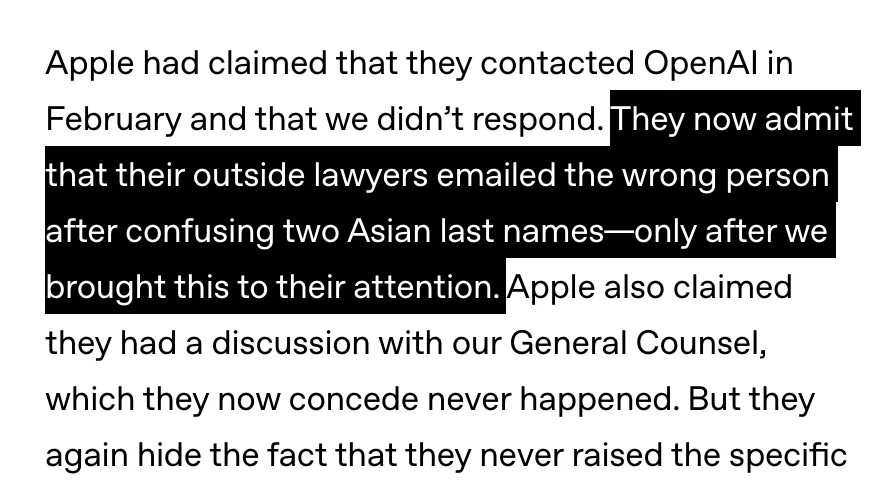
The line OpenAI wants you to remember — counsel mix-up admitted only after OpenAI raised it. Source: openai.com/index/apple-is-getting-this-wrong.
TL;DR — what people are asking
| Question | OpenAI’s answer (Aug 3–4 post) |
|---|---|
| Did Apple reach out in February? | Outside counsel emailed the wrong person (confused two Asian last names) |
| Did GC Che Chang take a call? | Apple concedes the claimed discussion never happened |
| Were lawsuit claims raised then? | OpenAI: no — Apple said they were “resolving any issues”, then 5 months silence |
| Chang Liu “stole files”? | OpenAI: Apple staff asked him for help locating materials; then blamed residual access |
| Tang Tan? | Clear that the team must not use other companies’ confidential info; 24+ years at Apple |
| Injunction? | Unnecessary — OpenAI “do[es] not have, nor want” Apple trade secrets |
| Case still live? | Yes — 5:26-cv-07078; this is PR + exhibit warfare, not a dismissal |
Why OpenAI published now
Apple filed Case 5:26-cv-07078 on July 10, 2026 — full complaint breakdown here. OpenAI’s post arrives as Apple pushes a preliminary injunction narrative in the public record and press cycle.
OpenAI’s opening frame:
Apple is one of the greatest companies of all time, and built a reputation for obsessing over the smallest details. This careless, aggressive and oddly personal lawsuit sadly doesn’t live up to that reputation.
That is reputation judo: praise Apple’s brand, then argue the lawsuit is sloppy. The exhibits are meant to make the “sloppy” charge stick on notice and residual access, not to litigate every trade-secret category in a blog.
Hardware context still matters: Gurman’s portable AI companion speaker report and injunction-delay risk are why this fight is not abstract PR.
Exhibit A — the February counsel chain
Named cast on OpenAI’s page:
| Person | Role |
|---|---|
| Gabriel Gross | Partner, Weil, Gotshal & Manges — Apple outside counsel |
| Che Chang | OpenAI General Counsel |
| Apple in-house counsel | Confirms Weil is counsel; points questions back to Weil |
| <redacted> Wang | Former Apple employee Gross meant to email (per apology) |
What the emails show (OpenAI’s packaging)
- Feb 23, ~5:53 PM — Gross emails a letter: “Former Apple Employees at OpenAI Retaining Non-public, Confidential, and Proprietary Information,” attachments included.
- Feb 23, ~6:06 PM — Gross thanks “Mr. Chang” for a phone call and “cooperation,” re-sends attachments.
- Feb 23, ~8:04 PM — Che Chang emails Apple in-house: Gross claims to represent Apple and is “lying about speaking with me”; asks Apple to confirm counsel.
- Feb 24 — Gross apologizes: after emailing Che, he accidentally sent a follow-up meant for Wang (a former Apple employee who had called and offered to cooperate).
- Feb 25 — Apple in-house: Weil is counsel; direct further questions to them.
OpenAI’s punchline: Apple spun “we contacted them / they didn’t respond / we spoke to GC” — then walked it back on the wrong recipient and the phantom call — only after OpenAI forced the issue. OpenAI further says Apple never raised the specific lawsuit allegations in that window and said they were “resolving any issues,” then went quiet until the July filing.
Reader discipline: read the emails on OpenAI’s page yourself. Screenshots and redactions are curated. A botched notice sequence can sink a narrative; it does not automatically sink a trade-secret claim.
Exhibit B — Chang Liu iMessages
OpenAI’s caption: iMessages between Chang Liu (blue) and Apple employees after Chang’s last day (January 22, 2026), all times UTC, names and Apple confidential content redacted. Thesis: Apple accused Chang of improper post-departure access while Apple staff were asking him for help.
Timeline OpenAI wants you to see
| Window | Signal in the exhibit |
|---|---|
| Jan 22–23 | Meet at coffee machine; 64GB → ~200GB drive talk; AirDrop copying; Workday exit (“sad button”) |
| Jan 23 | Chang thanks Apple employee; asks AirDrop of iCloud / personal-note folders |
| Jan 27 | Keep iCloud if needed; sign out of iMessage so new-company stuff doesn’t appear |
| Jan 27 | Apple employee asks shipping / schedule questions — “even if you don’t work here anymore” |
| Jan 31 | Employee signs out of Chang’s iCloud; declines keeping a local copy |
| Feb 14 | Jokes about OpenAI hours; asks for tech refresh / EE pointer; Chang answers with redacted pointers |
| Mar 5 | Group thread on power-block questions; one Apple employee: “highly irregular, please remove me from this thread” |
OpenAI’s legal gloss: Apple later admits employees reached out for help, then pivots to “residual access” — which OpenAI calls a recurring Apple offboarding failure where ex-employees still see files they neither want nor know about.
Counter-read Apple will push: residual access + answering technical questions after joining a competitor can still support Apple’s theory. One employee calling a thread “highly irregular” cuts both ways — it shows internal discomfort, not a full absolution.
Tang Tan — character + compliance line
OpenAI: Tang was clear the team does not want and must not use confidential information from other companies; 24+ years at Apple; “one of the most innovative leaders.” That is meant to blunt Apple’s Chief Hardware Officer / io / supplier-intel narrative from the July complaint. Character evidence is not discovery.
The injunction ask
Closing OpenAI claim:
Apple’s request for a preliminary injunction is both based on false information and completely unnecessary because we do not have, nor want, any of their trade secrets.
They say they took the suit seriously and offered to resolve; Apple is “changing their narrative” with vague accusations about other former employees. Product line: “building innovative products and technologies that push the frontier.”
For IPO / device overhang, the live question is still what the court enjoins, not what OpenAI’s blog asserts — same week dynamics as Musk’s “stole Apple’s phone tech” amplification.
What this does not resolve
| Still open | Why |
|---|---|
| Five trade-secret categories | Hardware design, manufacturing, components, testing / negative know-how, supply chain |
| io $6.5B / Foxconn / Luxshare / Goertek | Complaint corporate theory untouched by Feb email flubs |
| Discovery | iMessages cut both ways until depositions |
| Preliminary injunction standard | Irreparable harm, likelihood of success — court, not X |
| Sam Altman’s earlier tone | “Not afraid / tremendous respect” ≠ this exhibit dump |
How to read both sides without drowning
Apple complaint (Jul 10)     →  what secrets, who, io timeline
OpenAI post (Aug 3–4)        →  notice credibility + residual access story
Gurman hardware (Jul 14+)    →  why injunction timing matters
Court PI briefing            →  what actually ships / pauses
Copy-paste prompt if you are briefing a team:
Summarize OpenAI's "Apple is getting this wrong" (Aug 2026):
1) February counsel mix-up facts vs Apple's earlier public claims
2) Chang Liu iMessage narrative vs residual-access theory
3) What OpenAI still does NOT disprove from Case 5:26-cv-07078
4) Preliminary injunction stakes for consumer hardware
Cite only the OpenAI post and the federal complaint.
Honest limitations
- OpenAI’s page is advocacy with curated exhibits.
- Redactions hide the technical substance Apple cares about.
- “Wrong last names” dunks on social media are not legal analysis.
- Apple has not, at write-up, matched this with an equivalent public exhibit dump.
- explainx.ai is not counsel; verify against docket filings before you brief executives.
Closing
“Apple is getting this wrong” is OpenAI’s first full public exhibit counterpunch in 5:26-cv-07078: counsel emailed the wrong person, the GC call didn’t happen, Chang Liu’s chats show Apple asking for help, and the PI is labeled unnecessary. It wounds Apple’s process story. It does not end Apple’s secrets story.
Read the OpenAI post and the complaint guide together — then watch the injunction briefing, not the quote tweets.
Follow @explainx_ai when Apple answers in kind or the court sets a PI calendar.
Related on explainx.ai
- Apple sues OpenAI — Tang Tan, Chang Liu, io trade secrets
- OpenAI AI companion speaker — Gurman / injunction risk
- Musk vs Altman — Apple week amplification
- GPT-Live full-duplex voice
- OpenAI Jalapeno chip — Update Aug 26: first InferenceX benchmark numbers published.
- GPT-5.6 vs Fable 5
- Nadella trust boundary
Sources
- OpenAI — Apple is getting this wrong (dated August 3, 2026 on openai.com)
- @OpenAINewsroom amplification (August 4, 2026)
- Case 5:26-cv-07078 — covered in explainx.ai’s Apple complaint post
Exhibit summaries and quotes reflect OpenAI’s public post as of August 4, 2026. Not legal advice. Cross-check the live openai.com page and federal docket before citing in filings or investor memos.