




Anthropic's Working with AI report (November 23, 2026) is qualitative research, not a workforce census — but it is the lab's most detailed public read on how enterprise Claude customers are changing hiring, contractors, and org design. Sixty-six interviews across 58 U.S. firms (law, manufacturing, finance, healthcare, logistics, and more) describe a pattern explainx.ai readers should expect in 2026 rollouts: few headline layoffs, slower hiring, offshore contractor cuts, and the best ROI when roles are redesigned, not when a vendor workflow is dropped on experts without buy-in.
TL;DR
| Theme | What Anthropic reports |
|---|---|
| Layoffs | Very few domestic layoffs blamed mainly on AI; 2 firms eliminated a role; 5 pushed out AI resisters |
| Hiring | Two-thirds of firms report reduced hiring; many buy tokens instead of headcount |
| Contractors | Nine firms cut outsourced dev, support, legal, back-office — often offshore |
| Value type | More apps grow output or new services than cut costs directly |
| Best pattern | Reorganization + data access + nontechnical coding infrastructure |
Value vs organizational change
Anthropic coded roughly 300 AI applications discussed in the interviews against self-reported business value and organizational change depth (0 = only the user's task changes; 100 = merged or cut roles/functions). High-value dots cluster where change was large — not where a chatbot saved five minutes.
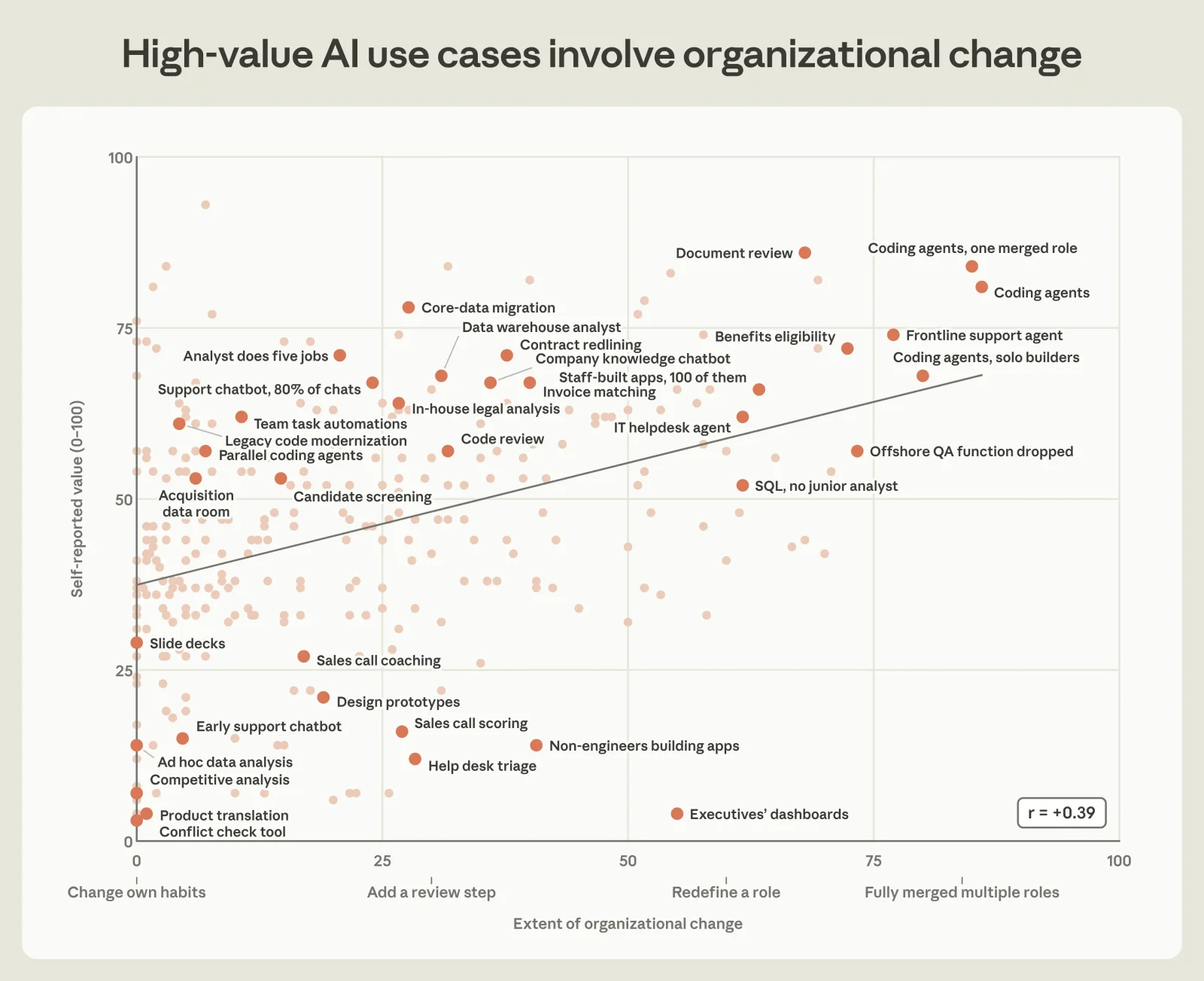 Anthropic Working with AI study chart mapping enterprise AI value against organizational change required
Image: Anthropic
The mailroom PDF routing story Anthropic opens with illustrates the tension: one developer automated five-minute-per-letter sorting with two API calls, delighting clerks but raising displacement fears. A second law firm saw bad adoption — hallucinated menus, confidentiality worries, uneven quality. A third reassigned junior lawyers to edit AI first drafts with seniors, preserving learning while changing workflow.
Those three paths mirror what Satya Nadella and AWS Matt Garman argue in parallel: tools are cheap; org design is expensive.
Hiring, tokens, and contractors
Anthropic quotes a health-management engineering leader: "We've added a lot of capacity by buying tokens instead of hiring people." That line lands next to South Korea's CSAT cheating scandal and survey posts on verification tax — different domains, same management question: who checks the model?
Contractor cuts are explicit. Examples include:
- Offshore design vendors replaced after AI output quality rose.
- 100+ offshore data/dev contractors cut at one finance firm.
- Customer service BPO contracts ended after agentic support with human prompt editors.
- Legal review bills falling after document agents.
That is policy-relevant next to EU Pandex legislation and NGA governors' AI rules — labor shifts without a single "AI fired everyone" headline.
Coding agents reach nontechnical desks
Anthropic says interviewees described 100 software artifacts with enough detail to classify:
- 80% automated manual work (spreadsheets, meeting notes, operations trackers).
- 20% replaced purchased SaaS.
- Agents built parking enforcement, 401(k) audit, trademark screening, and portfolio dashboards.
That aligns with Claude Ship on GitHub for engineering teams, but the study's point is non-developers shipping when IT provides secure hosting and context pipelines — the same story as Uni Robot Agent and mroffice editors for other stacks.
Bottlenecks interviewees named: code review, sales cycles, expert resistance, and tasks models still fumble. If you accelerate generation without widening review capacity, you recreate the verification tax.
Three adoption strategies Anthropic contrasts
- Top-down automation — fast ROI on modular outsourced work; triggers surveillance fears and expert pushback (paralegal "AI use" meeting).
- Bottom-up tool sprawl — uneven wins, seven-page Claude emails to IT, uneven prose quality.
- Reorganization — pair juniors and seniors on AI drafts; IT builds shared app hosts; roles broaden to own whole workflows.
Anthropic's neuron basis safety research and data-center power post sit on the technical side; Working with AI is the economic deployment companion for founders planning 2027 headcount.
Limits of the study (what Anthropic discloses)
- Convenience sample of Claude enterprise customers, not econometric panel data.
- Self-reported value, rarely A/B tested.
- Anonymized firms — you cannot audit individual claims.
- U.S.-centric; offshore contractor dynamics may differ elsewhere.
Treat it as pattern language for workshops and board slides, not workforce statistics. For quantitative usage data, see Anthropic's own Economic Index. For quantitative macro claims, pair with Allen AI Robotrack-style benchmarks on tasks, not employment panels.
What leaders should do next
- Count forgone hires separately from layoffs — boards often miss attrition + no-backfill.
- Budget review and compliance when coding accelerates — matches SciResearch Eval interval-scoring ideas for judgment-heavy work.
- Pilot reorg pilots on one workflow (contracts, intake, quoting) before enterprise-wide agentic customer service.
- Train resisters before termination — Anthropic documents morale damage when only terminations make news.
Figure 2: output beats cost-cutting (in Anthropic's coding)
Anthropic's second chart in the research post classifies where value showed up across applications with enough transcript detail. The dominant bars are output expansion and quality or new services, not headcount reduction. That matches interview language about "buying tokens instead of hiring" — capacity rises while payroll growth slows.
For finance leaders, the subtlety is cash versus GAAP headcount: contractor cuts show up in SG&A faster than FTE layoffs, which may explain why media sees AI job loss stories lagging AI hiring freeze anecdotes.
Law-firm trilogy (expanded)
Anthropic uses three anonymized law firms as parable:
- Automation path — API mailroom saves minutes per letter; clerks fear displacement.
- Adoption failure path — em dashes in demand letters, hallucinated UI in internal apps, partners too busy to learn tools.
- Reorg path — juniors edit AI drafts with seniors so quality judgment still trains.
Legal is not unique; ABC Legal's agent fleet shows a different mature pattern (dozens of governed agents). The Anthropic study argues maturity is organizational, not model-version, driven.
Top-down automation case studies
Beyond law, Anthropic documents customer service agent rollouts that cut offshore BPO spend, document review agents that shrink planned reviewer hires 90%, and COO portals spending 90% of operations budget on tokens. Each is a modular-task story — work that was already fragmented.
Contrast with manufacturing and health examples where experts must validate model output (X-ray markup, standards reconciliation). Those interviews emphasize bottlenecks moving upstream to review and accountability, echoing verification tax concerns.
International contractor exposure
Nine firms cutting offshore roles is a geopolitical thread adjacent to Singapore Megaspeed routing and India data-center protests — different supply chains, same modular work vulnerability.
Policy teams should not assume U.S. FTE stability numbers from this sample predict BPO markets globally.
Nontechnical coding infrastructure theme
High-value reorganizations include IT building secure hosts for employee-built apps after mailroom and timekeeping wins. That parallels mroffice and Univer spreadsheets in our corpus — guardrailed sandboxes beat shadow IT ChatGPT exports.
Anthropic notes power users sending seven-page Claude instructions to IT — a signal to offer approved templates and skills rather than ban experimentation.
Research ethics and future quantitative work
Authors Wilmers, Massenkoff, and McCrory frame the piece as qualitative groundwork for quantitative follow-ups. Pseudonyms protect firms but limit external replication. Automated coders scored organizational change depth and value type — methodology appendix on the research page should be read before citing precise percentages in board decks.
 Green hook lifting one folder from an archive tray, illustrating legal discovery workflows in Anthropic enterprise AI interviews
Implications for AI training and workshops
HR and L&D teams can map Anthropic's three paths to curriculum:
- Resister management — mandatory evaluation labs, not tool demos alone.
- Reviewer expansion — train seniors on AI draft markup, not only associates on prompting.
- Infrastructure track — align with live workshop formats that include governance, not just prompt tricks.
Questions people ask about enterprise AI hiring (answered from the study)
Are companies firing people because of Claude? Anthropic's sample reports few AI-attributed domestic layoffs but more common hiring slowdowns and contractor cuts.
Is coding the only high-value use? No — healthcare fax automation, property-deed reading, and route planning appear alongside 80% software examples that are mostly ops tooling.
Did Anthropic interview competitors' customers? The methodology states Claude customers who may also use other tools — not a cross-vendor benchmark.
Should governments regulate from this study? It is not representative sampling; policymakers should treat it as case evidence supporting workforce transition programs, not unemployment statistics.
Where is the full PDF? The research page hosts long-form narrative plus charts; cite that URL, not secondary summaries.
How does this relate to IPO chatter? Anthropic's Project Lantern banker reporting is separate finance news; Working with AI is deployment ethnography for customers already on Claude contracts.
Can I replicate the mailroom API story? Anthropic does not publish code; builders should treat it as pattern inspiration and run security review on any document pipeline that touches PII.
Related reading
- Anthropic Claude Ship for GitHub
- Anthropic zero-trust agents framework
- Anthropic AI for Science credits expansion
- Live AI workshop formats
- Knowledge worker agent guide
Interview counts and quotes reflect Anthropic's published research as of November 23, 2026.