



Ai2 released RoboTrack on November 23, 2026 — a point-tracking benchmark, synthetic training corpus, and two fine-tuned trackers aimed at real-world robot manipulation video, not clean tabletop clips. The institute says every major tracker it tested loses 3.0 to 6.6 Average Jaccard points on RoboTrack-Bench versus RoboTAP, even when those same models lead on older robotics suites.
TL;DR: what shipped November 23
| Asset | What Ai2 says |
|---|---|
| RoboTrack-Bench | 307 videos, 2,522 human-verified tracks across DROID, Ego-Exo4D, MolmoAct 2, EgoVerse |
| RoboTrack-15M | 3,000 MolmoSpaces sim episodes, 5,000 tracks/video, 15M tracks total |
| RoboTracker | Fine-tuned AllTracker (~17M params) |
| RoboTracker-Warp | Fine-tuned CoWTracker (~1B params), noncommercial weights |
| Real-robot demo | Wet-lab pipetting guided by tracks from one demonstration |
Why point tracking matters for manipulation policies
Robots that learn from demonstrations or close the loop on execution need to know where the gripper and object moved between frames. Point tracking answers a concrete question: given a pixel on the mug handle in frame 10, where is that same point in frame 40—even if a gripper occludes it or the camera angle shifts?
Ai2 argues off-the-shelf trackers looked deployment-ready because they scored well on established robotics benchmarks. RoboTrack stress-tests clutter, ego and exo views, and hands plus arms—settings closer to warehouse and lab deployments than isolated pick-and-place tables.
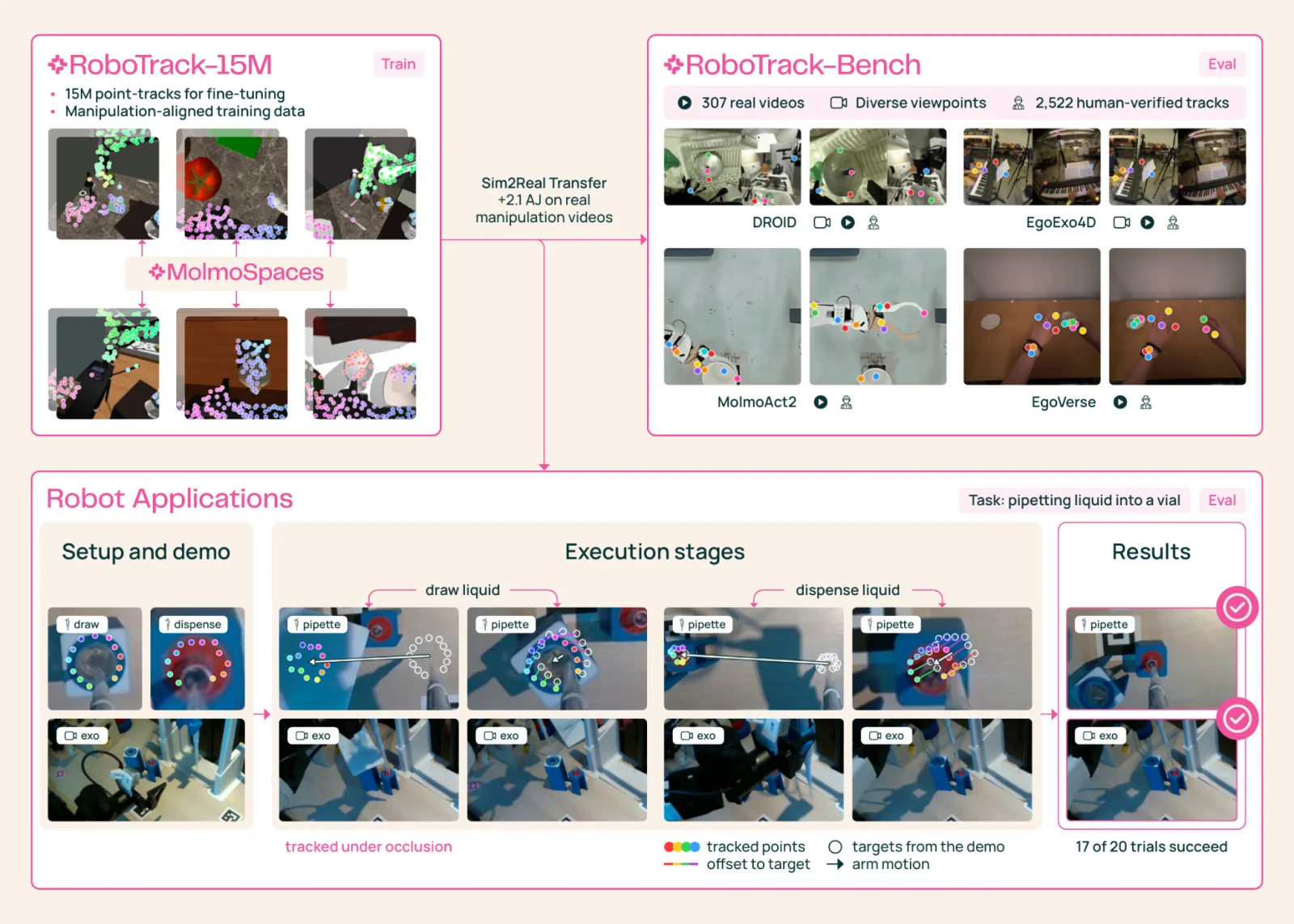 RoboTrack overview of MolmoSpaces RoboTrack-15M synthetic data and RoboTrack-Bench real manipulation videos
Image: Ai2
RoboTrack-Bench: harder than prior robot tracking suites
RoboTrack-Bench contains 307 clips and 2,522 tracks that human annotators verified frame by frame, following the TAP-Vid workflow Ai2 cites. Annotators prioritized moving and occluded points instead of static background pixels—important because robot feeds are mostly unmoving scenery.
Ai2 evaluated CoTracker3, BootsTAPNext, AllTracker, and CoWTracker on RoboTrack-Bench plus RoboTAP, RGB-Stacking, DAVIS, and Kinetics, reporting Average Jaccard (AJ):
- CoWTracker fell from 70.5 AJ on RoboTAP to 63.9 on RoboTrack-Bench (a 6.6 drop).
- All trackers dropped 3.0–6.6 AJ versus RoboTAP.
- RGB-Stacking (synthetic blocks) ranked BootsTAPNext lower than Kubric-heavy training would suggest—sim success did not predict real clutter success.
Ai2 also notes a scoring correction in AllTracker's released evaluation code; their table uses a fixed protocol and all annotated points on RoboTAP/Kinetics, documented in the tech report linked from Hugging Face.
Multi-view subset
33 synchronized camera pairs carry the same physical points in two views—useful for teams building egocentric plus third-person policies who need consistent correspondence across streams.
RoboTrack-15M: why Kubric alone was not enough
Many trackers train on Kubric videos where objects fall into scenes. Ai2 says that teaches motion and occlusion, but not grasp-centric trajectories—wrist cameras in real data show different motion histograms than Kubric's distribution.
MolmoSpaces is Ai2's robot learning simulation ecosystem named in the November 23 post; RoboTrack-15M extends it with dense tracks on robot and manipulated objects, filtering static base points using simulator geometry.
| Iteration lesson (Ai2) | Change |
|---|---|
| Points anywhere in frame | Mostly static in third-person view — no gain |
| Points on robot + manipulated objects | Wrist view matches real video — score up |
| Move points off fixed base onto moving arm | Third-person histogram aligns — ablation ~63.0 AJ |
RoboTracker models and fine-tuning gains
Ai2 ships:
- RoboTracker — AllTracker + RoboTrack-15M + original data.
- RoboTracker-Warp — CoWTracker + same mixture; state of the art on four of five benchmarks Ai2 lists, except DAVIS where BootsTAPNext/CoWTracker edge slightly higher.
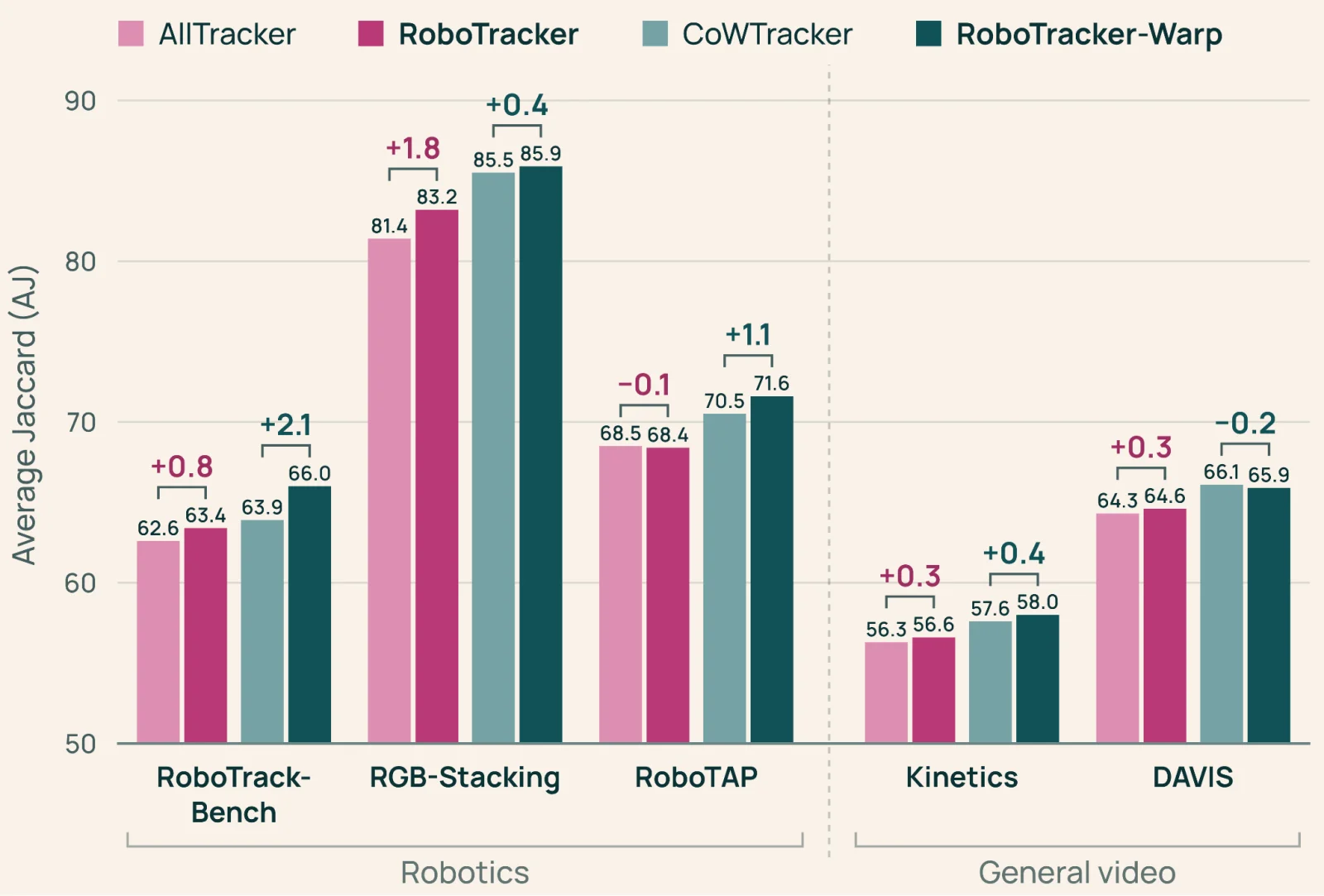 RoboTracker fine-tuning on RoboTrack-15M improves Average Jaccard on robotics benchmarks
Image: Ai2
Reported RoboTrack-Bench moves:
- RoboTracker: 62.6 → 63.4 AJ (+0.8).
- RoboTracker-Warp: 63.9 → 66.0 AJ (+2.1).
Gains also appear on human ego datasets (EgoVerse, Ego-Exo4D) even though RoboTrack-15M uses robot arms only—suggesting better occlusion handling, not just domain-matched textures.
If you want to use this at work, not just read about it, this is the fastest path.
Wet-lab pipetting: when tracks beat masks and optical flow
Ai2 closes the loop on a hardware task: electronic pipette transfer between vials with millimeter alignment and layout changes each trial. From one teleoperated demo, the robot must estimate how the vial moved at test time.
| Method | Success (20 layouts, Ai2) | Occluded subset |
|---|---|---|
| RAFT optical flow | 5/20 | Struggles when vials move far from demo pose |
| SAM3 masks | 8/20 | 1/10 when occluded |
| RoboTracker points | 17/20 | 7/10 when occluded |
Ai2 says masks latch onto lookalikes and flow breaks on large shifts, while tracks follow the same object across frames—aligned with Physical Intelligence-style one-demo narratives, but with explicit failure modes on older benchmarks.
Evaluation protocol details builders should mirror
Ai2 stresses apples-to-apples scoring:
- Each tracker runs with author-recommended settings, then one unified AJ metric across suites.
- RoboTAP and Kinetics use all annotated points, not the subset protocol in some AllTracker releases—explains why Ai2's AllTracker numbers can differ slightly from paper tables.
- A bug fix in AllTracker evaluation code affects historical comparisons; cite RoboTrack tech report tables when reproducing.
If you publish leaderboard rows, include which point subset you scored and whether occlusions were human-labeled or model-predicted—RoboTrack's value is label quality, not another synthetic axis.
Where RoboTrack sits in the tracking zoo
| Family | What it optimizes | RoboTrack stress |
|---|---|---|
| CoTracker line | Dense tracks on internet video | Gripper occlusion and table clutter |
| BootsTAPNext | 15M real videos | Still drops on RoboTrack-Bench vs RoboTAP |
| Kubric-trained stacks | Object toss dynamics | Mis-rank real manipulation difficulty |
That table is why Ai2 positions RoboTrack-15M as sim that looks like grasps, not sim that looks like tumbling props.
Limitations Ai2 still flags
- Long occlusions and small objects on busy backgrounds remain hard.
- RoboTrack-15M focuses on pick-and-place style interactions—not precision pipette micro-motions yet.
- RoboTracker-Warp checkpoint license is noncommercial; confirm terms before production.
How builders should adopt RoboTrack this week
- Baseline on RoboTrack-Bench with your current tracker—Ai2's central claim is rankings reshuffle, not a single +2 AJ magic number.
- Fine-tune on RoboTrack-15M if your pipeline already uses AllTracker or CoWTracker; weights are linked from the Hugging Face post.
- Log motion histograms for wrist vs world cameras before blaming model capacity—Ai2's ablation story is about data geometry, not parameter count.
- Pair with Hugging Face agent evaluation guidance if your manipulation stack is LLM-driven—tracking sits under policy errors in the blame graph.
Data licensing and deployment boundaries
Ai2 links models, data, code, benchmark, and project page from the Hugging Face announcement. RoboTracker-Warp weights carry a noncommercial restriction—confirm license text on the model card before customer pilots. RoboTrack-Bench human labels are a research artifact; if you fine-tune commercially, read dataset cards for embodiment-specific consent and camera privacy rules, especially on Ego-Exo4D and EgoVerse sources named in the post.
For hardware teams, the pipette demo is a useful acceptance test: 17/20 successes mean tracking error still fails 15% of the time on clear layouts—budget human reset or second sensing modality before unsupervised overnight runs.
Connection to the broader embodied-AI stack
Point tracking is not a policy by itself—it is perception glue between demonstration logs and low-level control. Teams that cache tracks offline and replay at control frequency avoid re-running heavy trackers on every torque command. As video world models absorb robot data, benchmarks like RoboTrack matter because they measure whether video foundation skills survive contact and clutter.
Related reading
- Skild AI S1: one-video robot learning — earlier demonstration-heavy robot learning framing.
- Anthropic Bay Area wet lab — why lab automation perception errors are high stakes.
- Vork headless 3D engine for agents — when 3D simulation feeds perception pipelines.
- Hugging Face Harbor agent evaluation — evaluation hygiene when agents drive robot APIs.
- Waymo severe weather pause — another November 2026 story on when robots should stop, not only go faster.
Questions teams ask after the RoboTrack launch
Should we replace optical flow everywhere? Ai2's pipette study shows flow fails on large spatial shifts between demo and test layouts. Keep flow for small deltas; prefer tracks when objects move across the frame or occluders appear.
Is RoboTrack-15M enough without real labels? Ai2 still built RoboTrack-Bench with humans in the loop because sim histogram matching was necessary but not sufficient. Plan a slice of real labels even if most training is synthetic.
Can we use RoboTracker on non-Franka arms? Checkpoints fine-tune architecture families (AllTracker/CoWTracker), not a single robot URDF. Expect domain gap on new grippers until you add a handful of in-domain clips.
Does RoboTrack replace depth cameras? No. Tracks operate on RGB video; they do not measure metric depth by themselves. Combine tracks with hand-eye calibration and stage fiducials when millimeter alignment matters, as in Ai2's pipette demo.
Release details follow Ai2's November 23, 2026 Hugging Face article and linked tech report; check those URLs for checkpoint revisions.