




On November 8, 2026, the Financial Times reported that Anthropic committed about $3.4 billion in late September for 1.7 gigawatts of heavy-duty natural-gas generators from San Antonio-based OnePWR Solutions. Reuters and trade wires carried the same outline on Sunday. Piper Sandler’s deal summary lists a $3.4 billion sale of a power generation platform to a frontier AI lab dated 09/26 — it does not name Anthropic on that page. Treat Anthropic as the buyer because credible outlets attribute the deal to the lab, while keeping open the gap until Anthropic or OnePWR publishes a statement.
For anyone building on Claude or planning on-prem capacity, the story is not a stock move. It is who owns the megawatts when the grid cannot deliver them on the lab’s training schedule.
TL;DR — claimed vs verified
| Question | Verified today | Still FT / wire attributed |
|---|---|---|
| Deal size about $3.4B? | Yes on Piper Sandler transaction page (Sep 2026) | — |
| Buyer is a frontier AI lab? | Yes on Piper Sandler page | Anthropic named in FT, not on Piper page |
| About 1.7 GW of generators? | Reported by FT and relays | No independent equipment filing checked for this run |
| Late September 2026 close? | Piper page month 09/26 aligns with “late September” | Exact calendar day not on Piper page |
| No acquisition of OnePWR? | Reported by FT-sourced accounts | Anthropic silent in sources we fetched |
| Install / EPC capacity included? | Reported by FT-sourced accounts | Contract text not public |
What outlets say happened
Sunday coverage follows a familiar pattern: FT first, then Reuters-framed wires and tech trade summaries. The shared factual skeleton, attributed to FT and “people familiar,” includes:
- Anthropic (per FT) signed for roughly $3.4 billion.
- The package covers about 1.7 GW of heavy-duty gas-fired generators.
- OnePWR Solutions, based in San Antonio, Texas, is the counterparty on the equipment side.
- Anthropic did not buy OnePWR as a company; reporting says no OnePWR employees transferred.
- The transaction is also described as including engineering and construction capacity needed to install the generators.
- OnePWR had reportedly ordered Caterpillar units earlier and needed financing; Anthropic was initially described as a prospective customer before taking over the equipment commitments.
explainx.ai does not cite aggregator discovery pages as sources. The underlying claims here rest on FT attribution, Piper Sandler’s published transaction line, and Reuters-style redistribution of the FT report.
Why Piper Sandler matters here
Investment banks often publish closed-deal cards with less narrative detail than newspapers. On the OnePWR Solutions — 2026/09/01 page, Piper Sandler states it served as exclusive financial advisor on the sale of a power generation platform for $3.4 Billion to a frontier AI lab.
That wording is useful for verification math:
- It confirms an order-of-magnitude price journalists are using.
- It confirms the buyer class (frontier AI lab), which matches Anthropic’s market position.
- It does not substitute for an Anthropic blog post or SEC exhibit naming the project sites.
If you are modeling Claude capacity growth, file Piper’s page under “capital deployed toward self-supplied power”, not under “confirmed campus map.”
How this connects to Anthropic’s own risk language
Anthropic already told public-market readers it is racing for power, not only for GPUs. In explainx.ai’s walk-through of the Anthropic S-1, we noted The Verge’s reading of the filing: competition for electrical supply is intense, some facilities may use on-site gas turbines, and gas and pipeline competition could raise prices. The same filing thread sits next to reporting on Google-backed Texas campus finance with on-site gas and state-level fights over where data centers may plug in.
A multi-gigawatt generator package is therefore not a bolt from the blue. It is the equipment layer behind disclosures readers already saw in prospectus risk factors — provided FT’s buyer attribution holds.
Grid context builders should remember
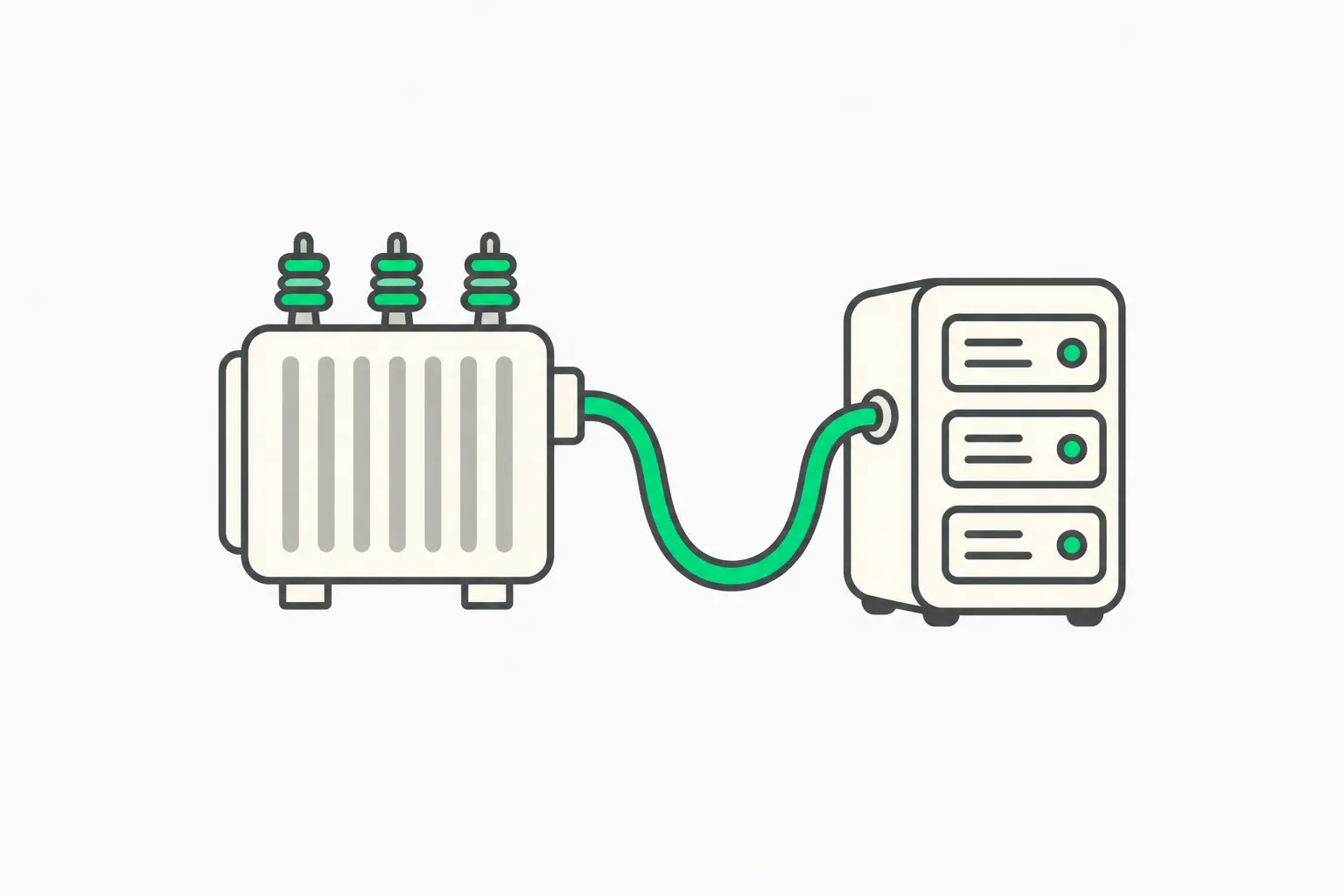 Transformer and server cabinet linked on a grid line, illustrating data-center power interconnection bottlenecks
AI labs are not only bidding for H100s or TPUs. They are bidding for transformers, switchgear, gas turbines, and water. explainx.ai’s PJM wholesale capacity note and pieces on environmental pushback on data-center emissions show the same bottleneck from different angles: megawatts are a schedule risk.
When a frontier lab buys gas-fired capacity directly, three builder-level implications follow:
- Training clusters may stay on timeline even when the grid queue slips — but at a carbon and permitting cost communities will contest.
- Geography shifts toward sites that can host large thermal plants, not only greenfield substations.
- Power price hedging moves from a facilities team problem to a balance-sheet asset problem — generators are capital, not a monthly utility bill alone.
None of that changes how you call the Claude API today. It does change how much spare capacity exists when the next model generation trains.
What is not confirmed yet
As of November 8, 2026, explainx.ai did not find:
- An Anthropic newsroom post naming OnePWR, Caterpillar, or 1.7 GW.
- A OnePWR press release naming Anthropic on the corporate site we fetched via Piper’s link.
- Air permit filings tied to this exact transaction in a government database search within this run’s time budget.
Reuters-framed copies of the FT story explicitly say Reuters could not immediately verify the information — standard language when the primary documentary trail is still private.
Until permits or company statements land, write internal plans with FT’s numbers as “reported, plausible, not lab-certified.”
What developers and operators can do
If your work depends on Claude uptime and rate limits, treat this like other infrastructure bets:
- Watch Anthropic status and policy pages for region expansions tied to new campuses — not rumor threads.
- Separate model quality news from megawatt news; a generator deal does not publish a new Claude version.
- If you run sovereign or air-gapped stacks, compare on-site gas economics to your grid and carbon rules — the lab’s choice may not be legal or cheap in your jurisdiction.
Teams shipping agents with long-running jobs should still engineer for provider outages and quota spikes the way explainx.ai describes in harness reliability coverage — power deals do not remove API variance.
Caterpillar, EPC, and the equipment queue
FT-sourced reporting describes a chain many grid planners already fear: generator lead times stretch, EPC crews book out, and labs that waited for utility interconnect slip anyway. The OnePWR outline says the supplier had Caterpillar orders on the books and needed financing to finish — then a frontier lab reportedly stepped from customer to owner of the equipment commitment.
For builders, that mechanic matters even if you never pour concrete:
- Turbine delivery becomes a balance-sheet asset tied to training schedules, not a pass-through utility tariff.
- Installation labor is bundled — air permits, noise envelopes, and fuel storage sit with whoever holds the generation platform.
- Secondary markets for unused megawatts get weirder when the buyer is a model lab, not a merchant generator.
explainx.ai’s transformer and switchgear shortage guide tracks the same supply crunch from the substation side. Generator deals are the on-site mirror of those queue charts.
Emissions, community, and the other side of on-site gas
 Cooling-tower and server blocks with a leaf mark, echoing thermal power and data-center load debates
On-site gas is not invisible to neighbors. explainx.ai has covered environmental groups arguing that conservation data and data-center load pull in opposite directions, and Sierra Club modeled emissions growth from data-center power. A 1.7 GW generator portfolio, if sited and run anywhere near nameplate, becomes a local air-quality story — not only a Claude capacity story.
None of that appears in Piper Sandler’s one-paragraph card. It is why we separate financing confirmed from permitting done.
How this compares to other labs’ power plays
The pattern is spreading beyond one company:
| Mechanism | Example explainx.ai covered | What it secures |
|---|---|---|
| Bank package plus on-site gas | Google-backed Nexus Hubbard financing | Campus MW plus structured offtake |
| Grid flexibility programs | OpenAI Georgia Grid Protectors | Demand response, not owned turbines |
| Wholesale market exposure | PJM capacity pricing | Regional $/MWh risk for anyone on the grid |
| Direct equipment buy (this cycle) | OnePWR card plus FT attribution | Generator hardware in lab hands |
If you forecast API pricing, watch which row your provider bets on. Owned gas shifts marginal energy cost curves differently than pure grid PPA deals or nuclear partnerships like Google’s Finland nuclear bet.
What changes for explainx.ai’s earlier Texas threads
explainx.ai already covered bank-financed Anthropic campus reporting in Hubbard, Texas and on-site gas at Starbase-adjacent compute filings in SpaceX Starbase supercompute notice. The OnePWR story is another Texas–Gulf Coast-shaped datapoint: equipment and fuel moving before headline model releases.
If Anthropic later names sites, update those regional posts — do not assume this Sunday FT cycle names the same campuses as July’s Nexus reporting.
Related reading
- Google Nexus ~$15B Anthropic Texas campus and on-site gas
- Anthropic S-1 energy and climate risk language
- Environmental groups on data centers vs conservation
- PJM capacity pricing and data-center load
- Transformer lead times and grid gear shortages
- Sierra Club emissions claims on data-center growth
- OpenAI Georgia flexible grid demand program
Deal terms, buyer naming, and site lists are accurate as of November 8, 2026, based on FT-attributed reporting and Piper Sandler’s published transaction summary — not on a public Anthropic contract.