



01Start here
Support-ticket triage
One call returns department, urgency, frustration, refund intent and phishing signals. Your code routes on them — no prompt in the control flow.
See the session plan
Create practical workflows for triage, routing, guardrails, and browser tasks. Learn how to use Jev’s confidence scores and compare results with an LLM.
See the curriculumYour take-home work
Build these with your instructor. Keep them, adapt them, and put them to work after the workshop.
01Start here
One call returns department, urgency, frustration, refund intent and phishing signals. Your code routes on them — no prompt in the control flow.
See the session plan
Early bird
Sep 26–27, 2026
02Make it yours
A simulated agent that reads page state and picks the next action in about 100ms, with a confidence floor that stops it before it clicks something irreversible.

03Make it yours
Turn a plain-language request into a typed function call by mapping tool names and closed-set arguments to confidence-aware questions.

04Make it yours
Score every block of a long context for relevance and keep the ones that matter, instead of replacing the whole thing with a lossy summary.

05Make it yours
Screen every message going into and out of your model for injection, policy violations and sensitive data, for a fraction of the call it protects.

06Make it yours
Reorder a keyword-retrieved shortlist by scoring each query-candidate pair, and measure the top-1 and top-10 lift against the raw ranking.

07Make it yours
Work the self-driving latency argument honestly: what a 100ms typed decision can and cannot be trusted with, and where perception, control and liability actually sit.

08Make it yours
The same decision through Jev and through an LLM, reporting price, latency and how much each one's answer moves between runs.
This is what you build. Two evenings, live with your instructor.
Secure your spotOverview
Developers, non-developers & curious AI builders
There are two kinds of AI at work in a product or workflow. One writes — the reply, the summary, the patch. The other decides. Is this urgent? Which queue? Is this passage relevant? Is this a jailbreak? Cheap model or expensive one?
Nearly everyone builds the second out of the first. You hand the deciding job to a chat model, ask politely for JSON, parse what comes back, retry when it doesn't, and quietly accept that the same ticket gets a different verdict on Tuesday.
Jev is what you get when a model is trained for the second job only. State in, typed questions in, decisions out — about 100 milliseconds, at $42 per billion input tokens. It cannot write you a sentence. That is the trade.
The interesting part is not the invoice. It is what stops being rationed. When a judgment costs almost nothing and returns before a user notices, you screen every input and output. You score every retrieved passage instead of trusting the top five. You ask fifteen speculative questions in one call and let code decide which answers mattered.
Two sessions, six things running, and an honest map of where this belongs in your stack — including the several places it does not.
What you’ll learn
The curriculum
2 days · 2 hours per day · Recordings included · 5:30 AM – 7:30 AM UTC
Start with the architecture question: traditional software, agent loops, and AI-powered software where code keeps control flow and the model only makes narrow judgments. Then the training story — RLHF produced chat and its mode dropping and overconfidence, RLVR produced reasoning models, RLCD produced a model that returns a calibrated number instead of a persuasive sentence. From there, the mechanics: shaping state as a string, an object or a conversation; the three primitives and what each returns; reading the full probability distribution rather than the headline answer; and what calibration guarantees across groups of predictions versus any single one. We finish on decomposition — take 'is this ticket spam?' apart into atomic questions with contrastive criteria, run all of them against one state in a single parallel call, and recombine them in code. Hands on in the Playground and then the API, so you leave session one with a key working and your own questions answered.
Skills you’ll practice: System One vs LLM architectures · AI-powered software design · RLHF, RLVR and RLCD · Calibration and what it promises · State design and structure · Choice, Score and Noul · Probability distributions · Atomic decomposition · Contrastive criteria · Parallel evaluation
Confidence becomes a second decision axis, with thresholds set by what a mistake costs. We apply speculative fan-out, confidence-gated routing, composite scoring and intent routing, then build with them: support triage that answers four questions about a ticket in one call, a tool-use selector that maps a request to a typed function and its arguments, a browser-use loop that picks the next action from page state in about 100ms, context compaction that scores what to keep instead of summarising it away, a guardrail that screens inputs for injection and outputs for policy, and a re-ranker that reorders a keyword shortlist without embeddings. We take the self-driving argument seriously enough to say where it breaks, walk the documented jev-1.13 failure modes with the fix for each, install the TypeSafe skill in Claude Code and point it at a fragile parser in your own repo, then run the benchmark harness to see what the swap is actually worth.
skills
Everything you practise hands-on across the live sessions.
Looks like something you need? Seats are limited.
Secure your spot
Founder of AISOLO Technologies; AI entrepreneur & educator
350K+
Students
12+
Yrs exp
3
Startups
Yash Thakker is the founder of AISOLO Technologies and one of the most sought-after AI educators in the country. He's known for one thing above all: by the end of any session, students have already built something — no saving it for 'later.' His classes are built around real-life, happening-right-now examples, zero dry theory, and a teaching energy that makes complex things feel obvious. With over a decade shipping AI products across media, fintech, and edtech, Yash has delivered every learning format imaginable — in-person workshops, live bootcamps, online courses, and hybrid sessions — always exploring new ways to make learning land faster. He's obsessed with what learning looks like for this generation, now that AI changes what's even worth teaching. He has reached 350,000+ learners and is the creator behind Olly.social, BGBlur.com, Infloq.com, and explainx.ai.
Who it’s for
Your next step
Sep 26–27, 2026 · 2 days · 2 hrs/day
2 live sessions
2 hours each · Sep 26–27, 2026
6 builds
Triage, guardrail, re-ranker, tool selector, browser loop, compaction
Question design library
Choice, Score and Noul definitions you can paste straight into your codebase
Benchmark harness
Prices and times any Jev question against the LLM call it replaces
TypeSafe agent skill setup
Install it in Claude Code or Cursor and refactor a fragile parser live
Session recordings
1-year access to every live session
Private Discord channel
Community access for Q&A and discussion
Melo learning assistant
Pre learning, all workshop content, and post learning practice
Certificate
Verified completion certificate from explainx.ai
$79.00$99.00
20% early bird — ends Sep 23 · Only 50 seats remaining
Not ready to enrol?
See how these sessions run before you pay for one. AI Safety & Best Practices — Free Workshop is free and live.
Oct 24, 2026
faq
Everything you need to know before enrolling.
Jev is TypeSafe's first System One model. Rather than generating text you then parse, it evaluates a state against typed questions and hands back the answer as a value — a Choice, a Score, or a Noul probability — with a calibrated confidence. Nothing to parse, no schema to validate, no retry for malformed output. It is also far faster and cheaper per decision, which is what makes screening every request and scoring every passage practical rather than aspirational.
Join 350K+ learners
Live, hands-on, and capped so sessions stay interactive.
Reserve your seat50 seats remaining
Complete both sessions and receive a verified certificate from explainx.ai — add it to your LinkedIn, portfolio, or resume.
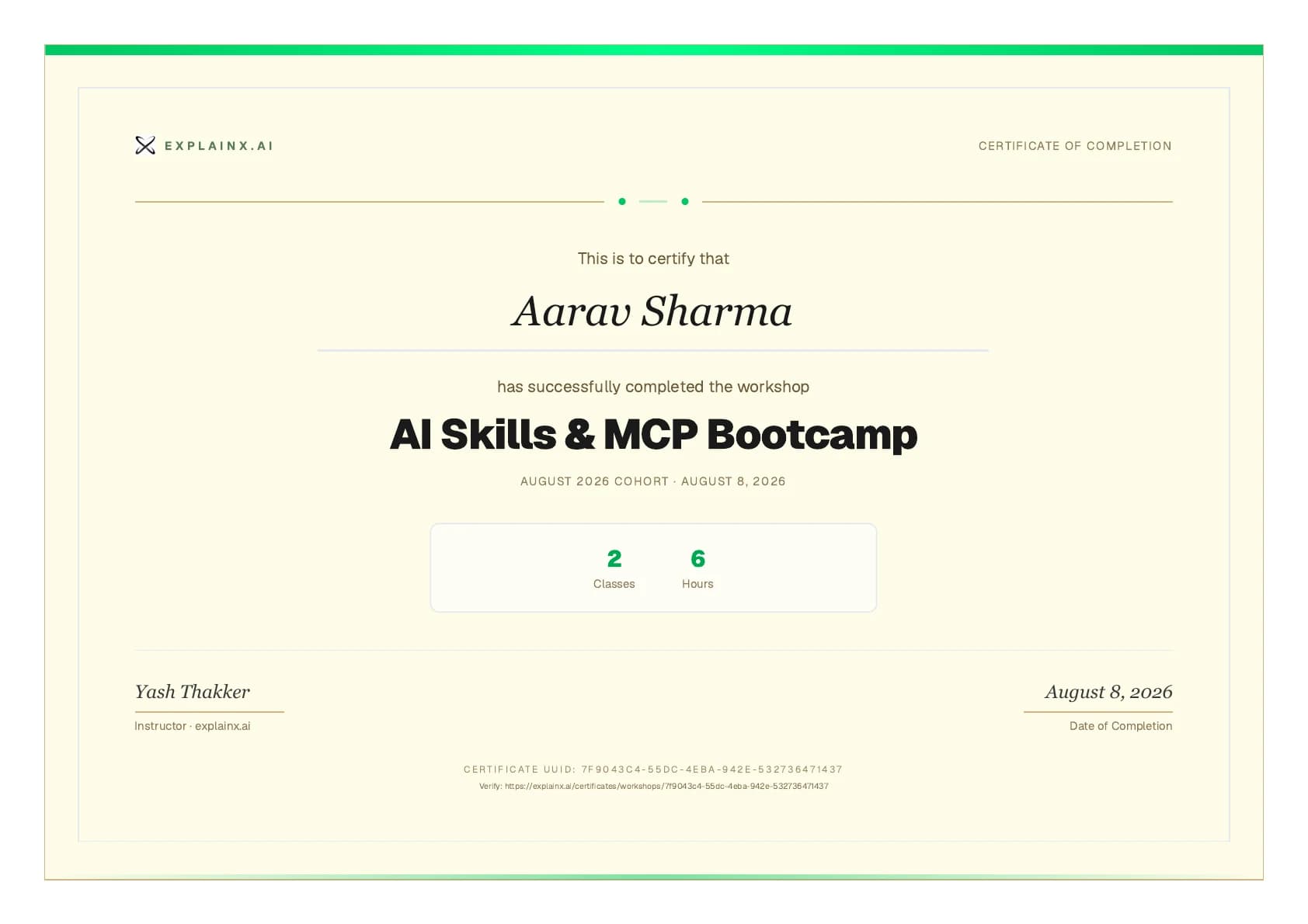
Sample only · Each issued certificate has a public verification UUID
View sample certificate ↗ Built around real work
Private team sessions
Bring Build with Jev: Turn Everyday Decisions into AI Workflows to your company with examples, projects, and guidance shaped around the tools your team already uses.
Real messages from students who trained with Yash across his live AI workshops and bootcamps.
“I've been using Claude for months but had no idea you could set up Projects with custom instructions. After Day 1 I restructured my entire research workflow — I got back about 3 hours a week immediately.”
“I had a great experience at this bootcamp. The chrome extension capstone was challenging and exciting. I enjoyed learning about LangChain, Tavily, and OpenAI API — I'm thinking of publishing it on the Chrome Web Store.”
“The prompt template library we built on Day 2 is now used by my whole content team. We went from everyone prompting differently to having a shared system that produces on-brand output every time.”
“Yash Thakker helped me design and build for one real problem, solved properly, without gimmicks. It came directly out of the AI Maker Bootcamp.”
“Yash doesn't just show you what to type — he shows you how to think about working with Claude. That mental model shift is what I came for and what I got. The research sprint session alone was worth the ticket price.”
“I wanted to build an AI tool that will translate any content into multiple languages. I've just posted my MVP on LinkedIn after completing the bootcamp.”
“Best class ever! You are an amazing teacher. Thank you for everything.”
“I learned so much and felt really empowered by this class. Thank you Yash!”
“Your bootcamp was very important to me and I hope we can stay connected. You are a great teacher and person.”
Skills you’ll practice: Confidence thresholds and risk tiers · Speculative fan-out · Confidence-gated routing · Composite scoring · Intent routing · Function calling with closed-set arguments · Real-time decision loops · Context compaction · Prompt-injection screening · Semantic re-ranking · Failure-mode mitigation · Cost and latency benchmarking · TypeSafe agent skill in Claude Code
Shakeel
Bootcamp graduate
James Okafor
Head of Content, Lagos
Founder, Alba Host
Sara Lindqvist
Strategy Consultant, Stockholm
Inês A.
Bootcamp graduate
via LinkedIn
via LinkedIn
via Discord