Automate LibreSprite pixel art, batch image edits & animation using a Flask server with JavaScript scripting integration
 by
by Add new capabilities to Claude beyond text generation
Example: Access external data sources, execute code, interact with tools and services
Transform Claude from chatbot to action-taking agent
Provide Claude with access to relevant context and data
Example: Load project documentation, access knowledge bases, query databases
Get more accurate, context-aware responses
Automate multi-step workflows combining AI and external tools
Example: Research → Summarize → Create document → Send notification
Complete complex tasks end-to-end without manual steps
Time estimate: 15-60 minutes depending on server complexity
Prerequisites
HexStrike AI
Advanced MCP server enabling AI agents to autonomously run 150+ security and penetration testing tools. Covers reconnais
Open AI Docs
Search and read OpenAI developer docs from your editor using MCP. OpenAI hosts a public Model Context Protocol (MCP) ser
Createve.AI Nexus
Createve.AI Nexus unifies REST API and MCP, integrating APIs for AI workflow automation with tools like Calendly API and
ClickUp
MCP server for ClickUp — enables Claude to interact with ClickUp data and workflows.
Confluence
Seamlessly enhance your workflow by integrating Confluence with Jira for direct documentation access and powerful conten
LibreSprite is a well-scoped MCP server in the explainx.ai directory — install snippets and categories matched our Claude Code setup.
Useful MCP listing: LibreSprite is the kind of server we cite when onboarding engineers to host + tool permissions.
I recommend LibreSprite for teams standardizing on MCP; the explainx.ai page compares cleanly with sibling servers.
Strong directory entry: LibreSprite surfaces stars and publisher context so we could sanity-check maintenance before adopting.
Useful MCP listing: LibreSprite is the kind of server we cite when onboarding engineers to host + tool permissions.
LibreSprite is a well-scoped MCP server in the explainx.ai directory — install snippets and categories matched our Claude Code setup.
We evaluated LibreSprite against two servers with overlapping tools; this profile had the clearer scope statement.
LibreSprite is among the better-indexed MCP projects we tried; the explainx.ai summary tracks the official description.
We evaluated LibreSprite against two servers with overlapping tools; this profile had the clearer scope statement.
LibreSprite reduced integration guesswork — categories and install configs on the listing matched the upstream repo.
showing 1-10 of 57
Share your MCP server with the developer community
Select a client to integrate this server.
Claude Desktop configuration
{
  "mcpServers": {
    "libresprite": {
      "command": "uvx",
      "args": [
        "libresprite-mcp"
      ]
    }
  }
}Controls the LibreSprite pixel art editor through JavaScript scripting via a proxy server, enabling automated sprite creation and batch processing workflows.
LibreSprite is a community-built MCP server published by snehil-shah that provides AI assistants with tools and capabilities via the Model Context Protocol. Automate LibreSprite pixel art, batch image edits & animation using a Flask server with JavaScript scripting integration It is categorized under productivity, developer tools. This server exposes 1 tool that AI clients can invoke during conversations and coding sessions.
You can install LibreSprite in your AI client of choice. Use the install panel on this page to get one-click setup for Cursor, Claude Desktop, VS Code, and other MCP-compatible clients. This server runs locally on your machine via the stdio transport.

Prompt your way into LibreSprite
Model Context Protocol (MCP) server for prompt-assisted editing, designing, and scripting inside LibreSprite.
https://github.com/user-attachments/assets/71440bba-16a5-4ee2-af10-2c346978a290
uv is the recommended way to install and use this server. Here are quick one-liners to install it if you haven't:
Windows: (run as administrator)
powershell -ExecutionPolicy ByPass -c "irm https://astral.sh/uv/install.ps1 | iex"
Unix:
curl -LsSf https://astral.sh/uv/install.sh | sh
More on installing uv.
The package is published on PyPI, so feel free to consume it any other way you prefer (pipx, etc)
Add the MCP server with the following entrypoint command (or something else if you are not using uv) to your MCP client:
uvx libresprite-mcp
Claude Desktop & Cursor
Edit Claude > Settings > Developer > Edit Config > claude_desktop_config.json or .cursor > mcp.json to include the server:
{
    "mcpServers": {
        // ...existing servers...
        "libresprite": {
            "type": "stdio",
            "command": "uvx",
            "args": [
                "libresprite-mcp"
            ]
        }
        // ...existing servers...
    }
}
You can also use this fancy badge to make it quick:

[!NOTE] You will have to restart Claude Desktop to load the MCP Server.
Download the latest stable remote script mcp.js from releases and add it to LibreSprite's scripts folder:
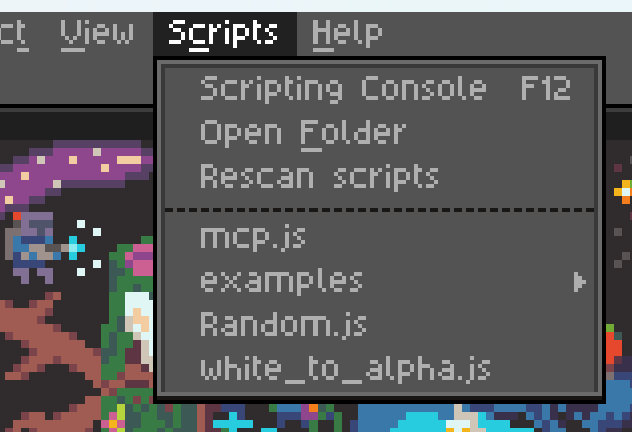
Run the mcp.js script (that you see in the screenshot above), and make sure your MCP server is running (Claude Desktop/Cursor is loaded and running). If all went well, you should see the following screen:

Click the "Connect" button and you can now start talking to Claude about your next big pixel-art project!
64823 to be free.Steps
Troubleshooting
✓ Do
✗ Don't
💡 Pro Tips
Architecture
Model Context Protocol standardizes how AI hosts (Claude, Cursor) communicate with external tools and data sources through server implementations.
Protocols
Compatibility
✓ Use when
Use when you need Claude to access external data, execute actions, or integrate with tools. Best for extending AI capabilities beyond conversation.
✗ Avoid when
Avoid when native integrations exist (use official APIs directly), for real-time critical systems, or when security/compliance requires zero external dependencies.
Superjolt
Integrate with Superjolt to manage JavaScript apps, configure domains, set environment variables, and monitor logs using




