



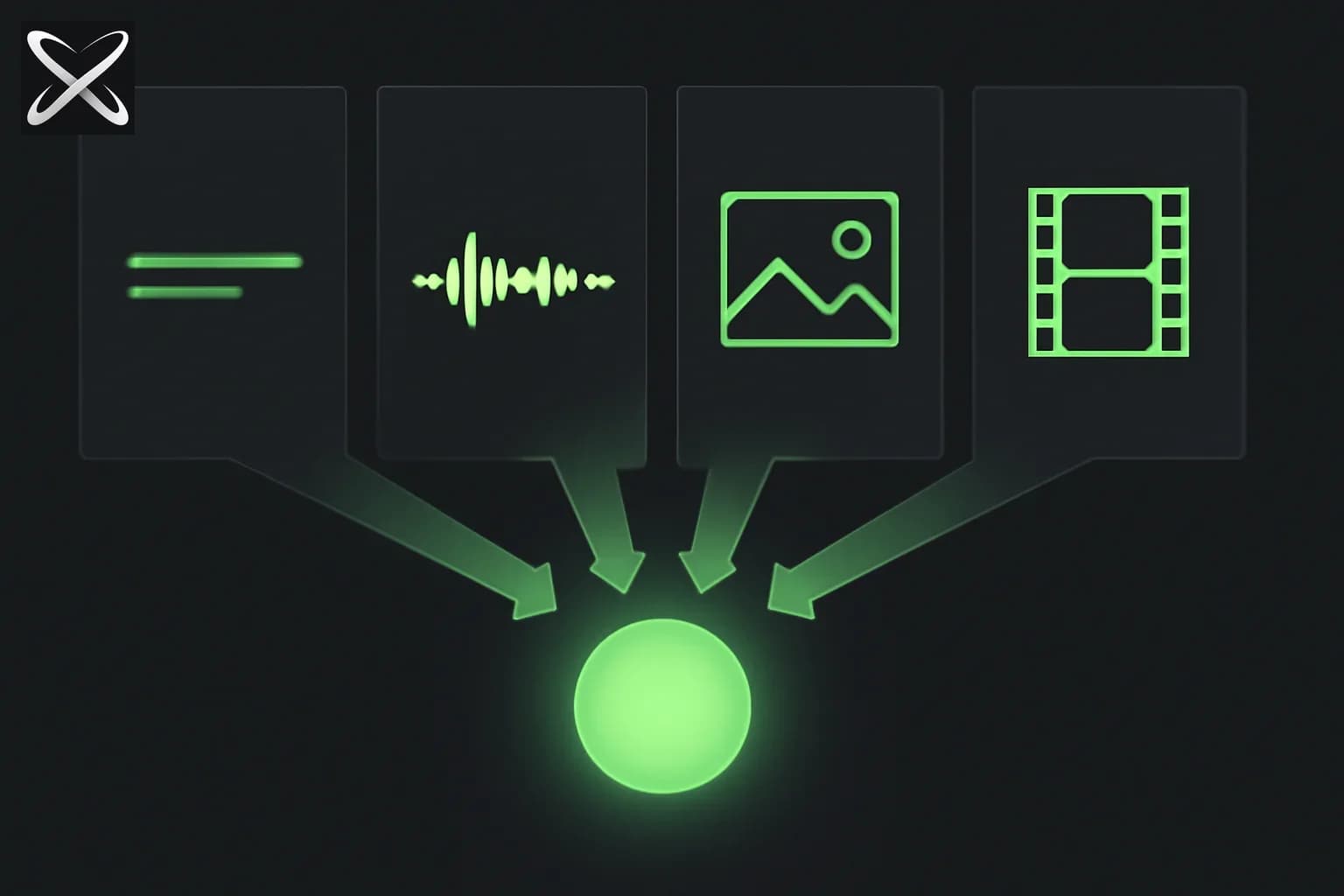
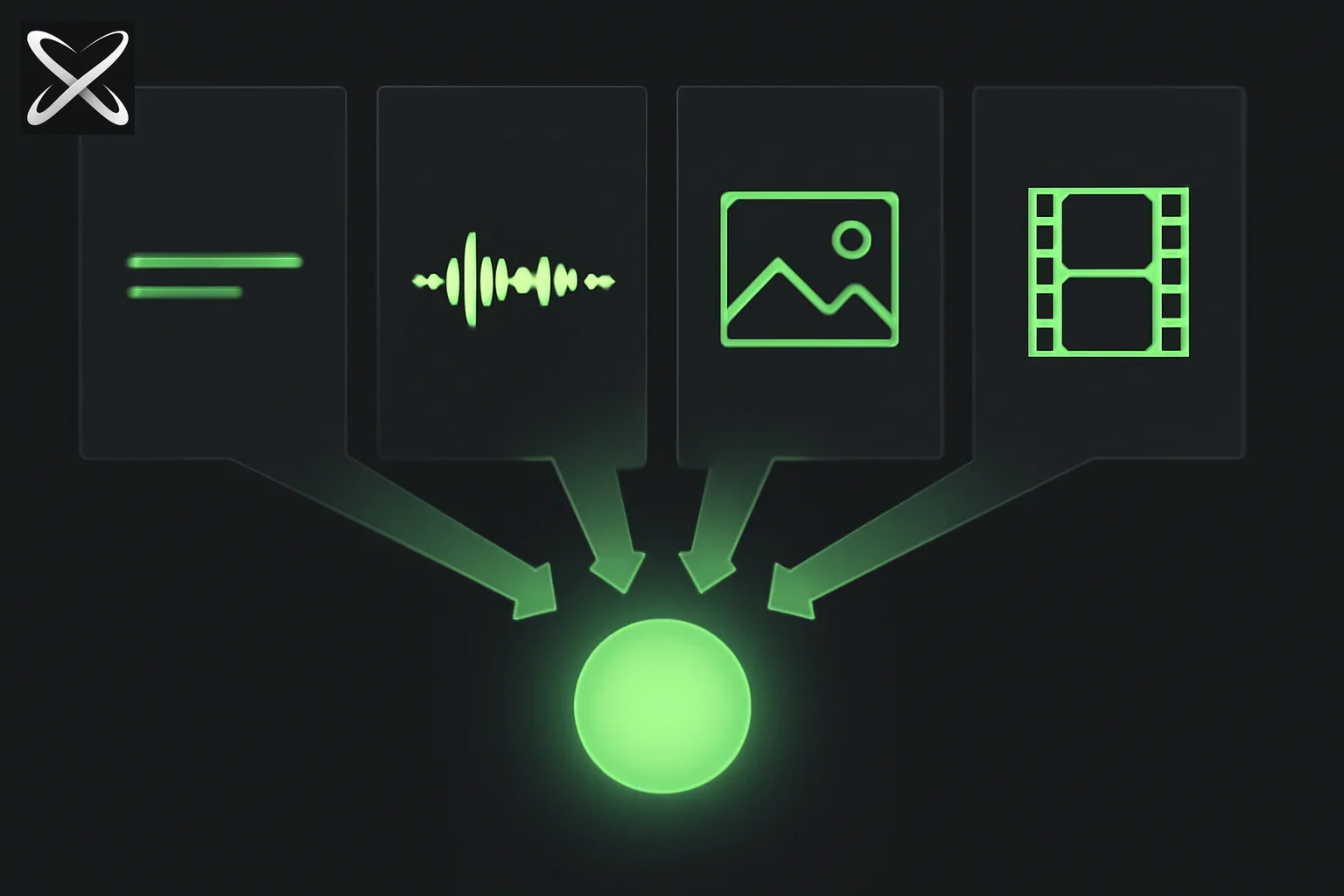
TL;DR: Multimodal AI refers to models that can accept or produce more than one type of data — text, images, audio, video — in a unified system rather than as disconnected pipelines. The architectural key is the modality encoder, a component that converts each input type into vector embeddings the language model backbone can process. In 2026, multimodal capability is no longer a research preview — it is the default expectation for frontier models. But understanding what these systems actually do internally is still rare, and that gap leads to both over-trust and under-use.
What "Multimodal" Actually Means
The word multimodal is overloaded in everyday AI coverage. It is worth being precise before going further.
Modality refers to a type or channel of information — text, image, audio, video, code, structured data. These are meaningfully different because the mathematical objects they produce are different: text is a sequence of discrete tokens; an image is a 2D grid of pixel intensity values; audio is a 1D time-series of pressure samples; video combines the two-dimensional spatial structure of images with a temporal dimension.
A multimodal model is one trained to process — and sometimes generate — content across more than one of these modalities within a single model. This is distinct from:
- Multi-task models, which do many tasks but still only in one modality (e.g., a text model that translates, summarises, and classifies)
- Pipelines, where one model produces output that is fed as input to another separate model
- APIs that route inputs, where a backend decides which specialist model to invoke but never actually trains a joint representation
The reason the distinction matters: in a true multimodal model, the training signal flows across modalities. The model learns that the word "dog" and the visual pattern of a fur-covered animal and the sound of a bark are all representations of the same underlying concept. That shared semantic space is what allows genuine cross-modal reasoning — asking questions about an image, generating descriptions from sounds, or identifying inconsistencies between what someone says and what the video shows.
A Short History: How Separate Silos Became One Model
For most of AI's modern history — roughly 2012 to 2020 — vision and language were completely separate research communities with completely separate architectures.
Vision AI in that era was dominated by Convolutional Neural Networks (CNNs): AlexNet (2012), VGG (2014), ResNet (2015), EfficientNet. These models learned hierarchical visual features — edges, then textures, then object parts, then whole objects — through stacked convolutional filters. They were extraordinary at classification: "is this a cat or a dog?" But they produced visual embeddings that had no relationship to language.
Language AI evolved from Recurrent Neural Networks (RNNs) and LSTMs into transformers (2017, the "Attention Is All You Need" paper). By 2019, GPT-2 and BERT had demonstrated that scaling transformer-based language models produces dramatic capability gains. But these models could only process text.
The joint training breakthrough came in two steps:
Step 1 — CLIP (2021, OpenAI). Contrastive Language-Image Pre-Training trained two separate encoders — one for images, one for text — jointly on 400 million image-caption pairs from the internet. The training objective was simple but powerful: make the embedding of an image close to the embedding of its correct caption, and far from the embeddings of all other captions in the batch. The result was a shared embedding space where "a golden retriever catching a frisbee" and a photo of that scene ended up near each other in vector space. This enabled zero-shot image classification: you could compare an image embedding to embeddings of arbitrary text labels and pick the closest one, without any task-specific training. CLIP was not a multimodal generative model, but it proved that joint visual-language representations were learnable at scale.
Step 2 — Vision-Language Models (2022-2023). The next wave attached visual encoders to language model backbones. Flamingo (DeepMind, 2022) inserted image embeddings into a frozen language model using cross-attention layers. BLIP-2 (Salesforce, 2023) introduced a lightweight "Q-Former" bridging module. LLaVA (2023) showed you could fine-tune a pretrained LLM on visual instruction data with a simple linear projection from image features. GPT-4V launched publicly in September 2023 — the first major frontier model to accept image input from users.
By 2024, audio was being incorporated in the same way — and by 2025, native real-time voice and video understanding arrived in GPT-4o and Gemini.
How Multimodal Models Work: The Architecture
The core concept is the modality encoder: a module that converts each input type into a sequence of vector embeddings, dimensioned to match the language model's internal representation size. Once all inputs are in that shared embedding format, the language model backbone processes them all together in a unified attention computation.
Image Encoding: Patches and Tokens
The dominant approach for images uses a Vision Transformer (ViT). The process:
- The input image (say, 224×224 pixels) is divided into a grid of non-overlapping patches (typically 16×16 or 14×14 pixels each).
- Each patch is flattened into a vector and linearly projected into the model's embedding dimension.
- A special
[CLS]token and positional embeddings are added. - The resulting sequence of patch embeddings is processed through transformer attention layers.
- The output patch embeddings are passed to the language model, where they appear as "image tokens" in the context window alongside text tokens.
At 16×16 patch size, a 224×224 image produces 196 image tokens. A 448×448 image at the same patch size produces 784 tokens. Higher resolution increases detail but also increases context window usage — which directly increases compute cost. This is why most vision APIs charge per image tile, and why some providers impose resolution caps.
For higher-quality visual understanding, modern models use dynamic resolution approaches: split large images into multiple tiles, encode each tile separately, and concatenate the token sequences. GPT-4o and Gemini Omni both use tile-based approaches that can represent images at up to very high resolutions when needed.
Audio Encoding: Spectrograms to Tokens
Audio is naturally a time-series signal — a sequence of pressure values sampled at some rate (typically 16kHz or 44.1kHz). Raw audio samples are not practical to feed into a transformer directly: a 10-second audio clip at 16kHz is 160,000 samples, which would create an enormous context window.
The standard approach converts audio to a spectrogram — a 2D representation of frequency content over time — and then encodes that using a CNN or transformer. Whisper (OpenAI, 2022) is the most influential audio encoder architecture: it converts 30-second audio chunks into 80-channel mel spectrogram frames at 10ms hop size, encodes them through a transformer, and produces a compact sequence of audio tokens.
In native multimodal models that handle real-time voice (GPT-4o Voice, Gemini Live), the audio is processed as a continuous stream of tokens rather than being first fully converted to text. This is the architectural difference that enables emotionally aware voice responses — the model "hears" prosody, tone, and pacing alongside the words, rather than receiving a flat text transcript.
Video: Frames Plus Time
Video understanding adds a temporal dimension. Models generally do not process every frame — doing so would be computationally prohibitive and unnecessary for most content (adjacent video frames are highly similar). Instead, models use frame sampling: selecting key frames at regular intervals (e.g., 1 fps or 2 fps) or at scene boundaries.
Each sampled frame is encoded independently through the image encoder to produce a set of patch tokens. Temporal position embeddings are added to distinguish frame order. The resulting sequence — a stack of frame token sequences in temporal order — is then processed by the language model.
The main challenge for video is temporal reasoning: understanding that an action begun in frame 5 is completed in frame 20, or that an object visible from one angle in one shot is the same object seen from another angle later. This requires the model's attention heads to learn to attend across time as well as across spatial positions, which is harder and requires larger amounts of temporal training data.
Early Fusion vs. Late Fusion
When you have multiple input types, you can combine them at different stages of the processing pipeline. This choice has significant architectural and capability implications.
Late fusion processes each modality separately through its own model, then combines the outputs at the end — typically through concatenation, averaging, or a small combining network. The advantage is simplicity: you can train each modality independently and swap out components. The disadvantage is that the two streams never interact during processing, so the model cannot reason about relationships between modalities. A late-fusion system that processes an image and a question separately before combining will perform worse on questions that require careful grounding of specific text phrases to specific visual regions.
Early fusion combines the modality representations before the main processing happens — inserting image tokens into the text token sequence, so the transformer attention can attend jointly across text and image tokens in every layer. This is the architecture modern frontier VLMs use. It allows fine-grained visual grounding: the model can attend to specific image patches when generating specific words in its answer. The tradeoff is that training is more complex and the combined context windows are larger.
Hybrid approaches are increasingly common for video. Processing every pixel of every frame through an early-fusion transformer is prohibitively expensive, so many video models use a two-stage approach: a lightweight temporal encoder compresses the video into a summary representation (late-fusion-like), and then that summary is early-fused with text tokens for the final language model processing.
The Major Multimodal Models in 2026
GPT-4o
OpenAI's GPT-4o (the "o" stands for omni) is the most capable publicly available multimodal model as of mid-2026. It accepts text, images, audio, and video as input and can produce text, images, and audio as output. Key capabilities:
- Real-time voice with emotional awareness: the model processes audio tokens directly, enabling it to detect and respond to emotional cues in the speaker's voice, adjust pacing, and interrupt appropriately in conversation
- Native image generation: GPT-4o can generate images through a learned image tokenisation pathway (distinct from the DALL-E 3 diffusion pipeline), enabling coherent image generation that is more tightly integrated with its reasoning
- Vision-to-text at high fidelity: reading complex documents, interpreting scientific figures, describing UI states
The real-time audio API — covered in depth in our post on OpenAI GPT Realtime 2 Voice Models — is particularly significant for agent deployments because it enables low-latency voice interaction without the text-mediation bottleneck.
Gemini Omni
Google's Gemini Omni is the company's native multimodal architecture that was designed from the ground up to handle text, images, audio, and video — not retrofitted after the fact. Key differentiators:
- Long context video understanding: Gemini's architecture handles very long video sequences, allowing it to process full-length films or multi-hour recordings and answer questions about specific moments
- Native audio generation alongside text output, enabling coherent audio-visual content creation
- Integration with Google's data infrastructure: Gemini Omni has access to Search, Maps, and other Google data sources, making it more grounded for factual queries
We covered Gemini's video model capabilities in detail in Google Gemini Omni Video Model.
Claude Fable 5
Anthropic's Claude Fable 5 (previously Sonnet-class, now frontier) brings strong vision and text capabilities with a distinctive focus on code-generation-alongside-image-output — making it especially capable at generating structured data or code from visual inputs like screenshots, diagrams, and wireframes. Fable 5 also benefits from Anthropic's interpretability research investments, with more predictable behaviour on edge cases than comparably capable models.
For a full breakdown of what Fable 5 can do, see our coverage of the Claude Fable 5 and Mythos 5 launch.
BharatGen
BharatGen, developed by IIT Bombay and a consortium of Indian research institutions, represents a different point in the multimodal design space: a multilingual multimodal system covering all 22 scheduled Indian languages. Its model family includes Param2 (multilingual LLM), Shrutam2 (speech recognition), Sooktam2 (text-to-speech), and Patram (document AI). The significance here is architectural diversity: BharatGen demonstrates that the modality encoder approach generalises to low-resource language and audio settings where the training data distributions are fundamentally different from the English-dominated internet. Full technical details are in our BharatGen coverage.
Comparing the Frontier: What Each Model Does Well
| Capability | GPT-4o | Gemini Omni | Claude Fable 5 | BharatGen |
|---|---|---|---|---|
| Image understanding | Excellent | Excellent | Excellent | Good (Indian scripts) |
| Real-time voice | Yes | Yes (Live) | Limited | Yes (Indian languages) |
| Video understanding | Good | Best-in-class | Limited | No |
| Image generation | Yes (native) | Yes (native) | Limited | No |
| Document parsing | Excellent | Excellent | Excellent | Excellent (Indic scripts) |
| Code from screenshots | Good | Good | Best-in-class | N/A |
| Long-context video | Good | Excellent | No | No |
| Multilingual audio | Good | Good | Good | Best (22 Indian languages) |
What Multimodal Models Actually See
Understanding what the model really processes helps calibrate what to expect from it.
When you submit an image to a vision language model, the model does not receive a photograph. It receives a sequence of vectors — one per image patch. Each vector is a high-dimensional numerical embedding trained to encode the content of that 16×16 pixel region. The model has no direct access to pixel values after the encoder runs. It cannot zoom in programmatically or re-examine specific regions the way a human can look more carefully. Everything is encoded once, at the resolution you submitted.
This explains several observed failure modes:
Fine-grained text in images — small text is encoded across very few tokens at standard resolution. OCR quality degrades significantly when characters are small relative to the image. Using high-resolution tile submission helps but does not eliminate the limitation.
Precise counting — counting more than about 7-10 identical objects is unreliable because the model's attention mechanism is not designed to systematically enumerate discrete items. It approximates based on learned statistical patterns, not by visually scanning item by item.
Exact color discrimination — distinguishing between adjacent hues (olive vs. khaki, navy vs. royal blue) is unreliable because the colour representation in patch embeddings is compressed and approximate.
Spatial coordinates — the model can describe spatial relationships ("the red object is to the left of the blue one") but cannot reliably output precise pixel coordinates. It was not trained to regress specific numbers from visual input in that way.
What models genuinely excel at: understanding complex charts and graphs, extracting structured information from receipts and invoices, interpreting block diagrams and system architecture drawings, reading code from screenshots, understanding UI layouts and describing interactive elements, identifying objects and their relationships in natural scene photographs.
Audio and Video Understanding in Depth
Automatic Speech Recognition: From Pipeline to Native
The conventional approach to voice AI was a three-stage pipeline: (1) a separate ASR model converts audio to text, (2) the text is sent to an LLM, (3) the LLM's text response is sent to a separate text-to-speech (TTS) model for audio output. Each handoff introduced latency — typically 800ms to 1500ms before the first word of a response, which makes conversation feel robotic.
Native multimodal audio eliminates the middle transcription step. The audio encoder produces tokens that the language model processes directly alongside any other context. The language model's output can be decoded into audio tokens directly. The result is latency measured in tens to low hundreds of milliseconds — within the range of natural conversational turn-taking.
The capability gain extends beyond latency. In a pipeline system, if a speaker asks a question with a rising intonation but uses words that could be either declarative or interrogative, the ASR system produces a text string that loses the prosodic signal. The LLM then has to guess intent from words alone. In a native audio system, the prosody information is preserved in the audio tokens and the model can use it.
Real-Time Voice: GPT-4o and Gemini Live
GPT-4o Voice and Google Gemini Live are the leading native voice products as of mid-2026. Both support:
- Sub-200ms first-byte-of-audio response latency
- Interruption handling (the model stops speaking when the user cuts in)
- Emotional tone detection and appropriate response modulation
- Multi-turn memory within a session
The architectural requirement for this is a streaming audio encoder that can process audio in chunks as it arrives rather than waiting for a complete utterance. Most implementations buffer 20-80ms of audio at a time, encode each buffer, and append the resulting tokens to the running context.
Video: Frame Sampling and Temporal Reasoning
For video, the practical reality is that models sample frames sparsely. A 10-minute video at 1 fps produces 600 frames. Each frame at standard resolution might produce 196-784 image tokens. 600 × 196 = 117,600 tokens just for the visual signal. Even at 1B-token context windows, long videos push against limits.
The implication: models cannot reliably answer questions that depend on a brief visual event if that event occurs between sampled frames. They also struggle with temporal arithmetic — "how many seconds after the person enters the room does the phone ring?" requires correlating two sparse frame observations to a continuous timeline.
What current video models are genuinely good at: summarising overall content and structure, identifying main subjects and events, describing the visual style and setting, answering questions about scenes that persist for several seconds or more.
Multimodal Generation: Understanding vs. Creating
It is important to distinguish between multimodal understanding (accepting multi-type inputs) and multimodal generation (producing non-text outputs). Many models do one but not the other.
Image Generation: Diffusion vs. Token-Based
Most image generation models in production today use diffusion — a process that learns to iteratively remove noise from a random image, conditioned on a text prompt. DALL-E 3, Stable Diffusion, Imagen 3, and FLUX all operate this way. The key feature of diffusion is that it is trained entirely separately from the language model — it is a distinct model family with different architecture (U-Net or Diffusion Transformer), different training data (image-caption pairs rather than instruction data), and different inference loop (many denoising steps rather than a single forward pass).
We cover the diffusion process in technical depth in How Diffusion Image Generation Works.
Token-based image generation — the approach used by GPT-4o's native image output and Gemini's native image generation — instead trains a visual tokeniser (similar to how text tokenisers work) that maps image regions to discrete token IDs. The language model then generates these image tokens autoregressively, the same way it generates text tokens. This tighter integration means the model can interleave text reasoning and visual output in the same generation, which is difficult with diffusion pipelines that must be invoked as a separate call.
Video Generation
Video generation is currently a separate model domain from video understanding. Leading video generation systems — Runway, Sora, and Seedance 2 — use video diffusion architectures trained on large datasets of video content. These are not the same models doing video understanding; they are separate systems specialised for generation.
Seedance 2 in particular has pushed the frontier for character consistency across frames — a long-standing challenge in video generation where characters would subtly change appearance between shots. For context on what this means for creative production workflows, see Runway Seedance 2: Animator Hours vs. Weeks.
Multimodal AI in Agentic Contexts
The most consequential application of multimodal AI in 2026 is not isolated question-answering — it is perception for agents. An AI agent that can only read text is limited to structured data, text interfaces, and APIs that return text. An agent that can see screenshots and hear audio can interact with nearly any software interface and understand the full sensory context of a task.
Key capabilities multimodal perception unlocks for agents:
Computer use: Agents can take screenshots of a screen, identify UI elements (buttons, input fields, dropdown menus) by their visual appearance, and decide where to click or what to type — without requiring the application to expose a programmatic API. This is transformative for automating legacy software.
Document understanding at scale: Business documents often mix text with embedded tables, charts, signatures, stamps, and handwritten annotations. A multimodal agent can process these as images and extract the full semantic content in a single pass, rather than requiring a preprocessing pipeline that often strips the visual elements.
Visual QA as a grounding step: Agents dealing with user requests that include images (screenshots of errors, photos of physical objects, diagrams of systems to be built) can reason about the visual content directly rather than asking the user to translate the image into words.
Feedback loops with generated content: An agent generating code that renders UI can take a screenshot of the rendered result and evaluate it visually — checking that layout looks correct, that text is readable, that colours are consistent — creating a visual-to-code refinement loop.
The agentic era is fundamentally shaped by this multimodal perception layer. Planning and tool use make agents capable of taking action; multimodal perception makes agents capable of understanding the environment they are acting in.
Early Fusion Architecture in Practice: A Worked Example
To make the architecture concrete, consider what happens when you send a GPT-4o query: "What error is shown in this screenshot?" along with an image file.
-
Text tokenisation: The text "What error is shown in this screenshot?" is tokenised into approximately 9 tokens by the BPE tokeniser.
-
Image encoding: The image (say, 1024×768 pixels) is split into tiles. Each tile is resized to 448×448 and divided into 28×28 = 784 patches of 16×16 pixels each. Each patch is encoded by the ViT into a vector. So one tile produces 784 image tokens. Multiple tiles might be used for a high-resolution image, with a lower-resolution overview tile also included.
-
Token sequence construction: The model constructs a combined token sequence:
[system prompt tokens] + [image tokens from tile 1] + [image tokens from tile 2] + [text tokens for the query]. This might be 1800+ tokens total before the model generates a single output token. -
Forward pass: The transformer processes this combined sequence with full self-attention: every text token can attend to every image token and vice versa. This is what allows the model to "read" text visible in the screenshot — the image tokens encoding the error message attend to the text tokens for the word "error" in the query, reinforcing their relationship.
-
Generation: The model autoregressively generates the response, which might be: "The screenshot shows a
ModuleNotFoundError: No module named 'pandas'in Python. This means the pandas library is not installed in your current environment."
The key insight: the model's answer was generated attending jointly over both the visual content and the text query. It did not first extract text from the image and then answer — it processed both streams together.
What Multimodal Still Cannot Fix
It would be misleading to end without being direct about persistent limitations.
Hallucination Applies to Visual Input
The model does not "look at" an image the way a human does. It generates a description or answer based on patterns learned during training, conditioned on the image tokens. When those patterns are ambiguous or the image is unusual relative to training distribution, the model confidently generates plausible-sounding content that is simply wrong. Examples include:
- Describing text on a whiteboard that partially matches what the text says but contains invented words
- Claiming a chart shows a trend that is directionally opposite to what the data displays
- Identifying a brand name on a product label incorrectly when the logo font is unusual
Context Window Constraints Apply to Image Tokens
Image tokens consume context window budget. A multimodal model with a 200k token context window is not a model with a 200k token text context plus unlimited image processing — it is a model with 200k tokens total, shared across text and images. High-resolution images with multiple tiles can consume 3,000-8,000+ tokens each. Processing 10 such images leaves far less room for long system prompts and conversational history.
Adversarial Images Remain a Real Threat
Adversarial perturbations — pixel-level modifications invisible to the human eye — can cause dramatic classification and description failures. More practically, prompt injection via images is an active attack vector: text embedded in images (in a colour barely distinguishable from the background, or at a size below comfortable human reading but still tokenised) can contain instructions that override system prompts or redirect the model's behaviour.
Video Temporal Reasoning is Immature
Despite the advances, current models cannot reliably answer: "At what timestamp does X happen?" "How long does the Y phase last?" "What changed between the scene at minute 3 and minute 12?" These require precise temporal grounding that sparse frame sampling undermines. Video understanding in 2026 is best understood as "content summary and scene description" rather than "precise temporal indexing."
Precise Spatial Output Requires Separate Modules
Multimodal models are good at describing where things are ("the button is in the upper-right corner"). They are poor at producing machine-usable coordinates for that location. Applications that need precise bounding boxes, pixel coordinates, or click targets generally need to pair the VLM with a specialised detection model (like Grounding DINO or a fine-tuned DETR) rather than relying on the VLM's coordinate output directly.
Where Multimodal AI Is Headed
The trajectory from 2021's CLIP to 2026's real-time audio-visual agents is a roughly 5-year arc. The reasonable expectations for the next few years:
Denser video processing: The context window and compute cost constraints that force sparse frame sampling are not fundamental — they are engineering limits that will ease as hardware improves and attention algorithms become more efficient. Denser video understanding, approaching the ability to reason about specific moments at sub-second granularity, is on the horizon.
More modalities: Depth sensing, LiDAR, sensor data from IoT devices, molecular structure representations — the modality encoder architecture is general-purpose. Specialised multimodal models for scientific, industrial, and medical domains will emerge with domain-specific encoders.
Tighter generation integration: The gap between understanding and generation is narrowing. Models that can understand an image, reason about changes needed, and generate the modified image in a single coherent pass — rather than as separate understand + generate calls — are already emerging and will become standard.
On-device multimodal: Quantised multimodal models small enough to run on smartphones are already available (PaliGemma 2, LLaVA-Phi). The capability gap between on-device and cloud models is narrowing. Local vision AI that processes private documents and photos without sending data to external servers is a significant near-term use case.
The key thing to hold onto amid rapid change: the modality encoder is the conceptual unit to understand. As long as you can build a neural network that converts your data type into a sequence of vectors, you can in principle attach it to a language model backbone and fine-tune it to be multimodal. The architecture is now proven. The limits are in data, compute, and the hard problems of temporal reasoning and hallucination — not in the fundamental approach.