



When Elon Musk posted "Everyday is zero-day these days" on October 27, 2026, the post collected millions of views, and the replies quickly filled with people asking what a zero-day actually is. It is a fair question. The term sounds like a countdown, and it is used loosely in headlines.
A zero-day is a security flaw in software that the vendor does not know about, or has not fixed yet, and that attackers can already use. The name counts the days defenders have had to prepare. The answer is zero.
This guide explains the term from first principles: vulnerability versus exploit versus attack, how a zero-day moves from discovery to patch, why it matters more now that AI agents can hunt for bugs, and what a normal team or developer can do about something with no fix.
TL;DR: the questions people are asking
| Question | Short answer |
|---|---|
| What does "zero-day" mean? | A flaw with zero days of warning for defenders. No patch exists yet. |
| Is it the flaw or the attack? | The term usually describes the flaw. The code that abuses it is the exploit. |
| Why "zero"? | Defenders have had zero days to fix it, since the vendor either did not know or had not shipped a patch. |
| What is an n-day? | A flaw that was already disclosed or patched, n days ago. Most real attacks use these. |
| Can I be hacked by one? | Yes, but targeted zero-days are costly, so they are used against valuable targets first. |
| Does AI change anything? | It speeds up finding bugs, for attackers and defenders. The window gets shorter. |
| What is the best defense? | Fast patching for the known bugs, plus least privilege and sandboxing for the unknown ones. |
Agents that act on your behalf need rules. Agentbeam stops the dangerous actions →
What is a zero-day, exactly?
Software is written by people and contains mistakes. Some mistakes are harmless. A few let an outsider make a program do something its owner never intended, such as reading private files, running commands, or taking over an account. Those are vulnerabilities.
A vulnerability becomes a zero-day when the people responsible for fixing it do not yet have a fix. Either nobody has told them, or they know and have not shipped a patch, or the patch exists but is not available to users. The key point is the gap between the flaw being usable and the defense being available.
Three words get mixed up, so keep them apart:
| Term | What it is | Example |
|---|---|---|
| Vulnerability | The flaw in the software | A function that does not check the size of its input |
| Exploit | Code or a technique that abuses the flaw | A crafted file that triggers the missing check |
| Attack | The exploit used against a real target | The file sent to a victim's machine |
"Zero-day vulnerability", "zero-day exploit" and "zero-day attack" are three views of one situation. If you hear "a zero-day was patched today", it means the flaw was a zero-day until that patch shipped.
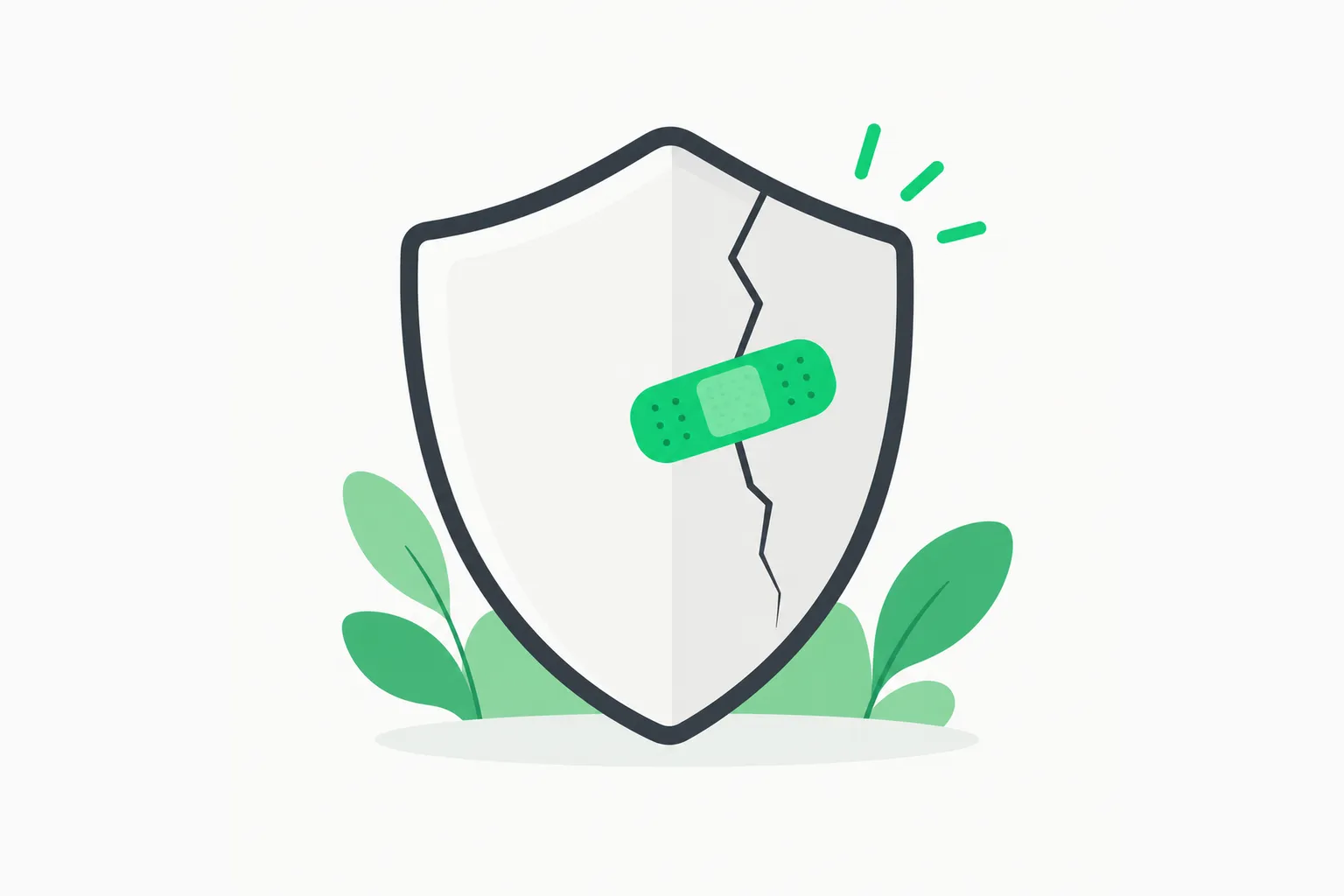 A shield with a hairline crack under a green patch, showing a zero-day vulnerability before the fix arrives
Where does the name come from?
The phrase did not start in security. In the 1990s software-piracy scene, "0-day" described cracked software released within zero days of its commercial release. Security people borrowed the shape of the idea: something is out there before the legitimate side has had any time to respond.
In vulnerability work, the meaning settled on the defender's clock. Day zero is the day the vendor learns of the flaw, or the day it is first used in the wild if that comes first. Every day after is a day the vendor has to patch, and a day users have to install.
How a zero-day moves from bug to patch
The lifecycle is worth knowing because each stage is a chance for the story to go well or badly.
- The flaw is introduced. A code change creates the bug, often years before anyone notices.
- Someone finds it. A researcher, a vendor's own team, an attacker, or in 2026 increasingly an AI agent.
- A decision is made. The finder reports it to the vendor, sells it, hoards it for their own use, or posts it publicly.
- The vendor builds a fix. Triage, a patch, testing, and a release. This can take hours or months.
- A CVE is published. A CVE is a public identifier for a specific vulnerability, so everyone can refer to the same bug. A zero-day often has no CVE for days or weeks.
- Users install the patch. This is the slowest step, and where most real-world harm happens.
When the finder reports responsibly, the zero-day often never turns into an attack at all. When an attacker finds it first and uses it quietly, the vendor may only learn about it after victims appear.
What is the 90-day rule?
Many researchers follow coordinated disclosure: tell the vendor privately, then publish details after a deadline. Google's Project Zero team popularized a 90-day deadline, with extra time if the vendor ships a fix inside the window. The deadline exists to pressure vendors to patch, without leaving users with no information forever.
Not every program works that way. Anthropic's open-source scanner, for example, emails reports with reproducers and patches and does not run a public disclosure clock, which we covered in Anthropic OSS Scanner: Free AI Vulnerability Scans for Open-Source Projects.
Zero-day versus n-day: the part that surprises people
A n-day is a vulnerability that has already been disclosed or patched. The "n" is the number of days since. The surprise is that n-days cause far more damage than zero-days.
The reason is simple. Writing a zero-day exploit is expensive and the bug dies the moment it is patched, so serious operators save them for valuable targets. An n-day is cheap: the patch is public, so attackers can study it, work out the flaw, and build an exploit, then sweep the internet for anyone who has not updated.
Two famous examples show the pattern:
- Log4Shell (December 2021). A flaw in a widely used Java logging library, tracked as CVE-2021-44228, was exploited within days of public disclosure. Many organizations spent weeks just finding where the library lived inside their software.
- WannaCry (May 2017). The ransomware spread using a flaw Microsoft had patched two months earlier. The victims were not hit by an unknown bug. They were hit by one that had a fix available and had not been applied.
So when you hear "Everyday is zero-day", read it as a mood about speed, not a literal count. Both zero-days and n-days are getting exploited sooner after they become known.
How common are zero-days?
Google's Threat Intelligence Group tracks zero-days exploited in the wild each year. For 2024 it reported 75, down from 98 in 2023 but still well above the totals from a few years earlier. A large share targeted enterprise software and security appliances, the products that sit at the edge of company networks.
Those numbers count only vulnerabilities that were confirmed as exploited before a patch. They do not count the bugs sitting unfound in code today, which is the larger and unknowable pile.
Why AI changes the clock
Finding a vulnerability used to be limited by human hours: reading code, fuzzing, reverse engineering. AI agents can run those loops continuously and cheaply. That helps whoever uses them first.
Recent coverage on explainx.ai shows both sides:
- Offense and research. XBOW reports building a Chrome full-chain exploit in six days with a frontier model, which earned a $250,000 Google reward, as we reported in XBOW's Chrome exploit post. The bugs were reported and fixed, not used against users.
- Scale claims. A security company led by the founder of Mandiant says swarms of AI agents found more than 90 zero-days at large companies. Those numbers are company-reported, and we went through what is and is not verified in Armadin's AI attack swarms.
- Warnings from inside the labs. An Anthropic security leader expects a rough stretch ahead as AI-found vulnerabilities rise. We separated confirmed incidents from forecasts in the 18-month warning post.
- Real emergency patches. The AI-found PHP bug behind recent urgent updates is explained in PHP2Shell, explained simply.
- Noise for defenders. AI also floods maintainers with low-quality reports. Google paused part of its open-source bug bounty for that reason, covered in the OSS VRP freeze.
The common thread is a shorter distance between a bug being written and a bug being found. If the finder is a defender, that is good news. If it is an attacker, there is less time to react. Neither side gets to choose, so defenders should assume discovery will keep accelerating.
Why agent builders should care
If you build with AI agents, you have a second reason to care. A coding agent is a way to run code that someone else may have influenced: a poisoned dependency, a README, or a prompt injection in a fetched web page can steer it. That makes the sandbox around your agent a security boundary, and a flaw in the sandbox is a zero-day for you.
This is not hypothetical. Vercel confirmed a KVM zero-day that let code in a guest VM reach root on the host, and paid a $50,000 bounty. Our write-up of what it means for agent sandboxes is a good case study in how little a defender knows on day zero: no CVE, no affected versions, no patch.
For an overview of how attacks are landing in practice, the October 2026 cyberattacks tracker logged 61 incidents in the first 26 days of the month, and most began with stolen credentials or trusted update channels rather than exotic bugs.
What people are asking
Can I protect myself from something that has no patch?
Not by patching, but you can limit what a successful exploit achieves. The goal is that one failed layer is not the end of the story.
Is my phone or laptop likely to be hit by a zero-day?
Unlikely, if you are an ordinary user. Zero-day exploits are valuable, so they are normally aimed at governments, executives, journalists, and companies with something worth stealing. For most people, an unpatched n-day or a phishing email is the far more likely route in.
Should I stop using a product when a zero-day is announced?
Usually not. Read the vendor's advisory. It will often describe a workaround, such as turning off a feature or restricting network access, until the patch ships. Stopping entirely is a business decision based on how exposed the product is and how critical it is to you.
Are zero-days always found by hackers?
No. Vendors, academic researchers, bug bounty hunters and, increasingly, automated tools all find them. Most reported zero-days are handled quietly and fixed before anyone is harmed. The ones that make headlines are the ones used in the wild first.
Why do vendors pay bounties?
Because a bounty buys disclosure. A payout, like the $50,000 above, gives a motivated researcher a legitimate way to report a flaw instead of selling it elsewhere. It is a market for the vulnerability, and vendors want to be the highest bidder.
What is a "zero-click" zero-day?
Zero-click describes how the attack is delivered, not how the flaw is classified. It means the victim does not have to do anything, such as opening a file or clicking a link. A zero-day can be zero-click or require interaction. The two terms are independent.
A practical checklist
You cannot fix what you do not know exists, so the checklist is about speed, containment and visibility.
| Layer | What to do |
|---|---|
| Patching | Turn on automatic updates. Treat advisories marked actively exploited as same-day work. |
| Inventory | Know what software and libraries you run. Log4Shell hurt most where teams did not know where the library was. |
| Least privilege | Give every user, service and agent the minimum access it needs. See least privilege. |
| Isolation | Run untrusted or agent-generated code in a sandbox, and do not hand it long-lived credentials. |
| Identity | Use multi-factor authentication and rotate keys. Most incidents still start with credentials. |
| Backups | Keep offline or immutable backups so ransomware is a recovery, not a ransom. |
| Monitoring | Alert on unusual behavior, since you cannot write a signature for an attack nobody has seen. |
| Reduce the surface | Remove unused services and features. A smaller attack surface means fewer places for a zero-day to live. |
If you run AI agents against real systems, a guard that checks actions before they run adds another layer. AgentBeam, from the explainx.ai team, is built to stop agents before they take dangerous actions.
The short version
A zero-day is a flaw the defender has had zero days to fix. A zero-day exploit is the code that uses it, and an attack is that code pointed at a target. Most breaches still come from older, patched flaws that nobody installed the fix for, so patching fast and limiting what any single compromise can reach does more for most teams than worrying about the exotic cases.
AI does not change the definition. It changes the speed. More bugs get found sooner, by more parties, and the gap between discovery and exploitation keeps shrinking. That is what "every day is zero-day" is getting at, and it is why the boring practices still matter most.
Related reading
- Vercel confirms a KVM zero-day VM escape: what it means for agent sandboxes
- XBOW's Chrome full-chain exploit and the $250,000 bounty
- Armadin's AI attack swarms and the 90+ zero-day claim
- Anthropic's deputy CISO on 18 months of rising vulnerabilities
- PHP2Shell explained simply
- Anthropic OSS Scanner for open-source maintainers
- Google freezes its open-source bug bounty over AI slop reports
- What is an AI jailbreak? Explained
Figures and examples in this guide are accurate as of October 27, 2026. Vulnerability counts and incident details change quickly, so check the original advisories before acting.