



Volvo Cars is giving Nvidia a much bigger part of its next self-driving system. In a press release dated October 15, Volvo said it is expanding its decade-long partnership with Nvidia "to unlock new levels of safety in automated driving technology in future cars from Volvo." Nvidia's release names the stack: Hyperion sensors and compute, Halos OS, and the Alpamayo driving software, debuting in a next-generation Volvo car.
What that adds up to is a carmaker buying most of its automated-driving stack from a chip company, with a long timeline and few dates. This post lays out what is confirmed, what is a summary of a summary, and what to watch.
Quick reference
| Question | Answer |
|---|---|
| Who announced it? | Volvo Cars and Nvidia, October 15, 2026 |
| What is the stack? | Nvidia Hyperion (sensors and computer), Halos OS, Alpamayo driving software |
| Which car? | "A next-generation Volvo car"; no model named |
| When? | Before 2030, per Reuters as relayed by a secondary source |
| First step | Supervised features where the driver stays responsible |
| Later | Gradual eyes-off and mind-off driving; no dates |
| Markets | Several regions at once, not China, per Reuters via the same source |
| Price | No pricing model chosen; not limited to premium models |
What the companies said
Volvo's newsroom lists the announcement as "Volvo Cars and NVIDIA expand partnership to advance safe automated driving," building on a decade of collaboration. The full text is in Nvidia's newsroom post. The timeline, market and pricing details below come from Reuters as relayed by a developer-news summary on DEV Community, which also cites Electronic Specifier, so treat those as secondhand.
Per the release, the technology will let future Volvo cars navigate "from door to door," from highways and busy urban streets to parking, and the companies promise a "gradual introduction of eyes-off and mind-off driving." Jensen Huang is quoted: "Accelerated computing has transformed the car into an intelligent machine that can understand the world around it." Volvo CEO Håkan Samuelsson is quoted: "Volvo has been synonymous with car safety for almost 100 years." The technology is part of what Nvidia calls Volvo's largest product push to date, which fits Volvo's September announcement of 13 new cars by the end of 2030.
What each piece of the stack is
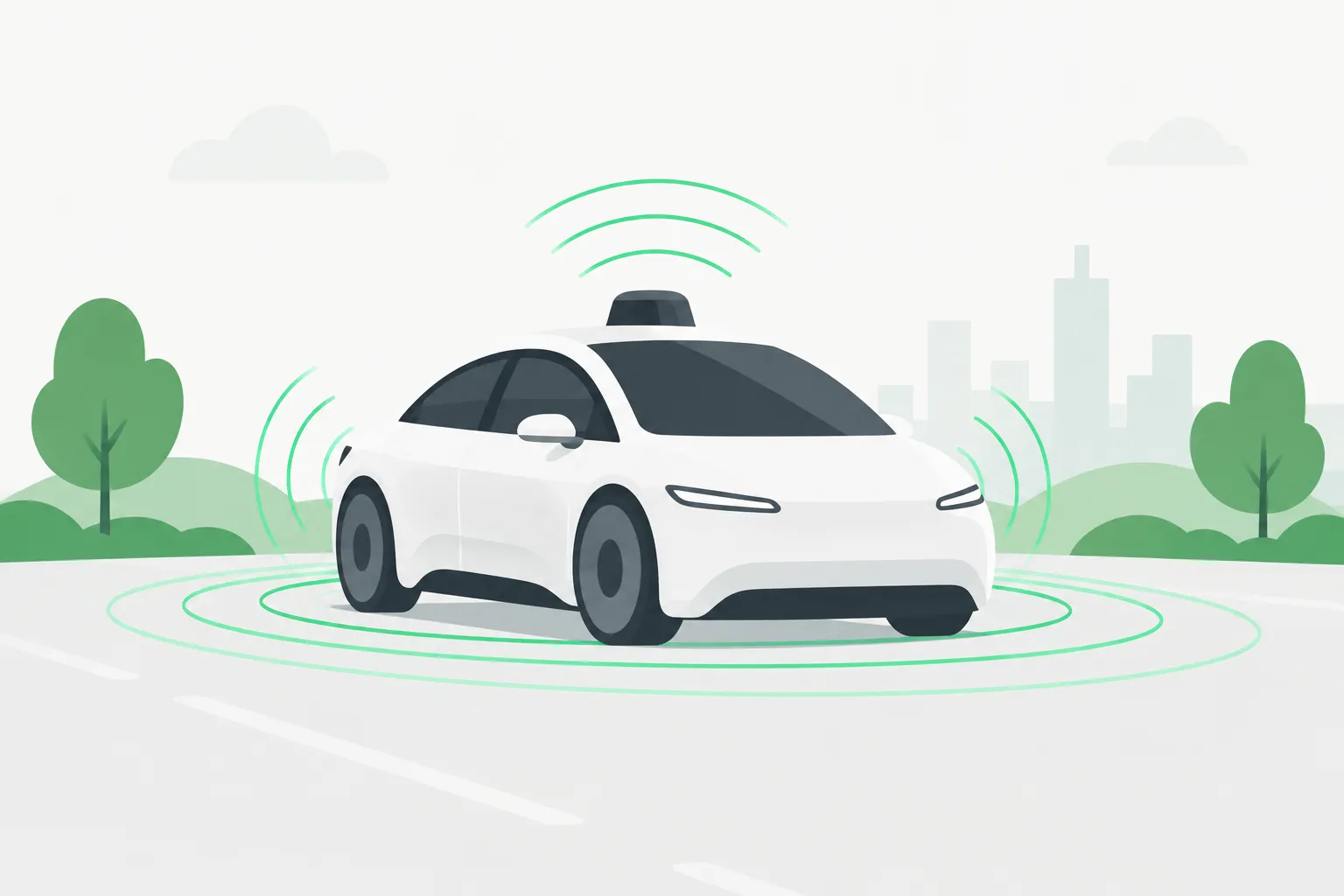 A car shape wrapped in green sensing arcs, picturing the Hyperion sensor suite in a Volvo with Nvidia's driving stack
- Hyperion is Nvidia's reference architecture for the in-car sensors and computer. Volvo's current EX90 already runs on Nvidia's DRIVE Orin computer, rated at over 250 trillion operations per second, and Volvo said in 2024 that future cars would move to DRIVE Thor, rated at up to 1,000.
- Halos OS is the operating system layer that runs the driving software, with safety as the pitch.
- Alpamayo is the driving software and model stack. We covered Nvidia's latest model in Alpamayo 2 Super.
The shift to note is the second and third items. Until now Volvo mainly bought chips and used Nvidia systems to train models. The summary says the new deal goes further: Volvo takes Nvidia's operating system and driving software too.
What is claimed versus confirmed
Some framings in circulation overreach.
- "Door-to-door driving by 2030." The phrase "door to door" comes from Nvidia's description of the system's scope. "Before 2030" comes from Reuters. Neither source says full door-to-door autonomy ships in 2030; the sequence is supervised first, hands-free later with no dates. Nvidia's release itself gives no date at all.
- "Level 2++." One aggregator summary says Volvo aims to launch a Level 2++ hands-free system by 2030. Level 2++ is an industry shorthand, not an official SAE level, and we did not find it in the primary text we could read.
- Eyes-off. Eyes-off and mind-off are described as a gradual introduction. That is a direction, not a commitment.
The accurate summary is: a confirmed expanded partnership and stack, a "before 2030" first appearance, and an open question about when the driver can stop watching the road.
Hands-on, eyes-off, mind-off: what the terms mean
The vocabulary in these announcements is slippery, so it helps to pin it down using the widely used SAE driving-automation levels.
| Term | Rough meaning | Who is responsible |
|---|---|---|
| Supervised or hands-on assist (Level 2) | The car steers and brakes, you watch the road constantly | The driver, always |
| Hands-free but supervised (often called Level 2 plus) | The car drives on mapped roads without your hands on the wheel, but you must watch and be ready | The driver |
| Eyes-off (Level 3) | In defined conditions you may look away; the car asks you to take over when needed | The system, within limits |
| Mind-off (Level 4 in practice) | You need not be ready to take over inside a defined area | The system |
The announcement says supervised features come first and eyes-off and mind-off arrive gradually. That ordering matters: the first cars with this stack are expected to be Level 2 style systems where the driver is liable. The jump to Level 3 and beyond carries legal and liability questions that a chip partnership cannot answer by itself.
How to judge any eyes-off promise
When a carmaker promises that you will eventually be able to stop watching the road, ask these questions before you count on it:
- Where and when does it work? Which roads, speeds, weather and map coverage are in scope?
- Who is liable? Does the manufacturer accept responsibility while the system is engaged?
- What is the handover? How much warning does the car give, and what happens if you do not respond?
- What is the evidence? Is there published safety data, miles driven or third-party testing?
- What does it cost? One-time option, subscription, or standard equipment, and for how many years of updates?
- Which regions? Approval is regional, and this one excludes China at launch per Reuters.
None of these has an answer yet for Volvo's next system, which is normal at the partnership stage and a reason to read "before 2030" as a planning horizon, not a ship date.
Why the compute step matters
The progression from Orin to Thor to the Hyperion platform is a story about compute headroom. More operations per second let a car run larger perception and planning models on board, and run redundant copies for safety. Nvidia's Alpamayo line is aimed at models that reason about driving scenes. Per our earlier coverage, the largest model, Alpamayo 2 Super, is positioned for cloud-side labeling and distillation, while smaller Alpamayo models are the ones aimed at real-time use in vehicles, so the in-car computer carries the distilled tier. Volvo choosing the full stack signals it expects to run that class of model in the car instead of relying on simpler rules-based driving software.
It also means Volvo's future updates will track Nvidia's cadence. If a new Alpamayo release improves behavior, Volvo owners may receive it over the air, subject to validation and approval, which is a different ownership model from a car whose driver-assist is fixed at purchase.
How this fits Nvidia's push into cars
Nvidia is building a position as the default automated-driving supplier for carmakers that do not want to build everything, with partners the Reuters-based summary lists as Mercedes, Jaguar Land Rover and Hyundai. Our coverage of Uber and Wayve's UK robotaxi launch and Waymo's expansion to 14 US cities shows the other model: vertically integrated robotaxi operators. Volvo's route is the consumer-car one, where the software has to work on cars owners buy and drive.
Nvidia's wider physical-AI push appears in Cosmos 3 and the SIGGRAPH physical-AI announcements. Volvo is a customer for that stack in its most safety-sensitive form.
Risks and open questions
- Safety evidence. Volvo's brand rests on safety. A system that drives eyes-off must be validated with real-world data; no safety case has been published.
- Regulation. Eyes-off driving requires approval in each market, and the rules differ by region.
- Dependence. Taking the operating system and driving software means Volvo relies on Nvidia for updates and fixes for years. Contract terms are unknown.
- China. Excluding China is notable given Geely ownership; the reasons were not given in what we read.
- Pricing. Whether features are standard, an option or a subscription is unknown.
- Financial backdrop. Volvo's newsroom shows it removed its full-year 2026 volume and cash flow outlook on October 2 and reported Q3 sales down 10.7 percent. Developing a costly stack in that environment is a strategic bet.
What it means for you
If you are shopping for a Volvo, nothing changes today: the system arrives in a future car, with supervised features first. If you work on automotive software, Nvidia's Halos OS and Alpamayo are becoming platforms worth knowing. If you follow AI hardware, it is another sign that physical AI is turning into recurring platform revenue, not just chip sales.
What to watch
- The name and launch date of the first car.
- Whether Volvo or Nvidia publish a safety case.
- Pricing and subscription decisions.
- Regulatory approvals for eyes-off driving.
- Volvo's Q3 report on October 23 for any comment on spending.
Related reading
- Nvidia Alpamayo 2 Super
- Nvidia Cosmos 3 physical AI guide
- Nvidia SIGGRAPH physical AI
- Uber and Wayve UK robotaxi
- Waymo's 14 US cities
- SpaceX, Starmind and Nvidia
Details are accurate as of October 15, 2026, based on Nvidia's newsroom, Volvo Cars' newsroom and a summary of Reuters reporting. Dates and scope may change.