




If your RAG pipeline stores embeddings and you have ever reasoned "even if that vector database leaked, it's just numbers — you can't read a floating-point array" — a 2025 arXiv paper says that assumption no longer holds. arXiv:2505.12540, by Rishi Jha, Collin Zhang, Vitaly Shmatikov, and John X. Morris, first posted in May 2025 and revised as recently as January 2026, introduces an unsupervised method for translating embeddings from one vector space into another — with no paired training data, no access to the original encoder, and no predefined matching set between the two spaces. The community has taken to calling the technique vec2vec.
The result has real teeth for anyone running semantic search, agent memory, or a vector database in production: an attacker who obtains only raw embedding vectors — no source documents, no model weights — can translate them into a known embedding space and extract enough signal to classify and infer attributes about the underlying text. That breaks a quiet, widely held assumption in how teams design RAG and search architecture.
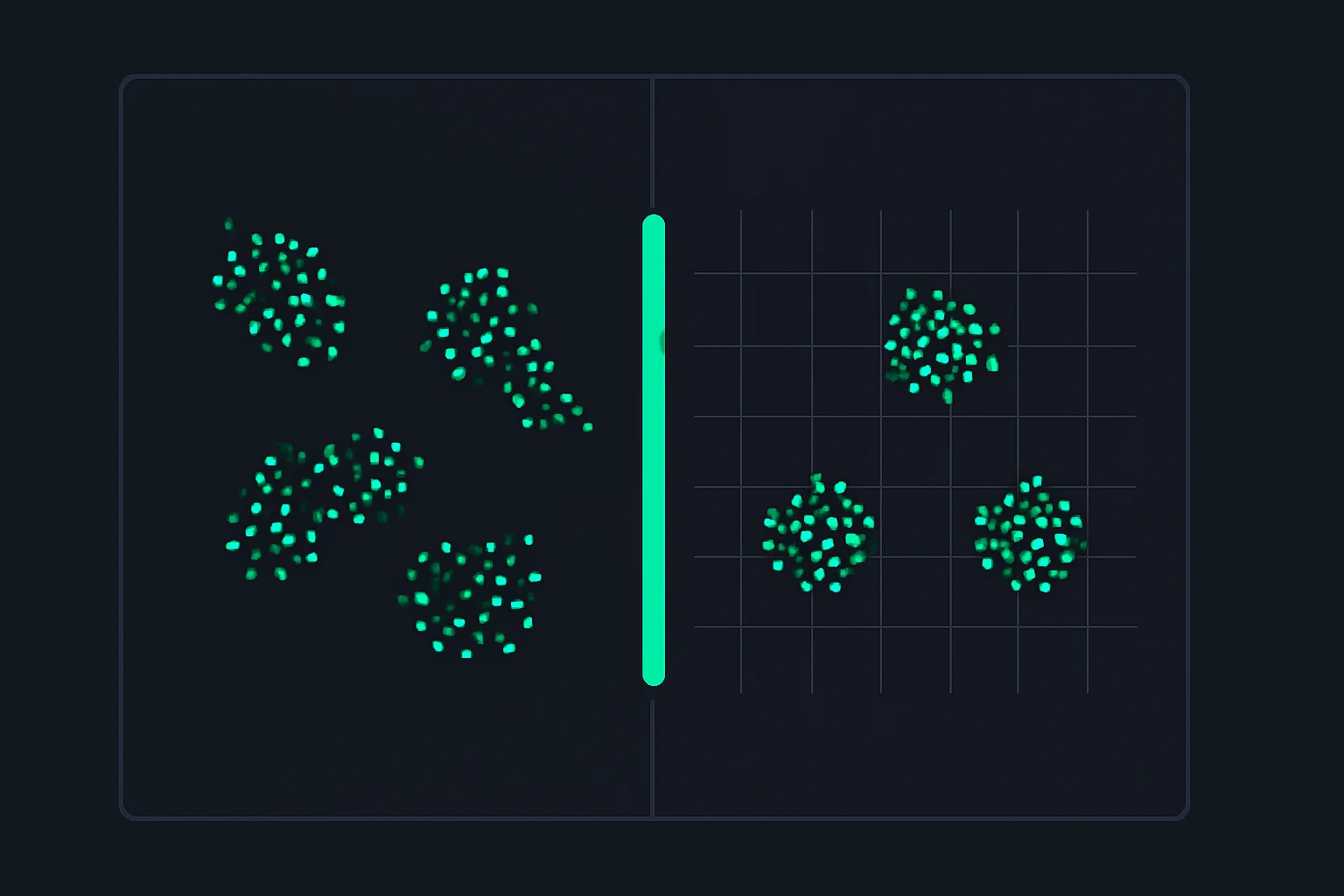 Two clusters of glowing points shift from a scattered arrangement on the left into an aligned grid on the right, illustrating how embeddings from different models can be mapped onto a shared geometric structure
TL;DR
| Question | Answer |
|---|---|
| What is the paper? | arXiv:2505.12540, "Harnessing the Universal Geometry of Embeddings," Jha/Zhang/Shmatikov/Morris (v1 May 2025, v4 Jan 26 2026) |
| What does the method do? | Translates embeddings between vector spaces unsupervised — no paired data, no encoder access |
| What is it commonly called? | vec2vec |
| What theory does it build on? | The Platonic Representation Hypothesis — different models converge on similar underlying semantic geometry |
| Is this a confirmed breach? | No — it's an architectural risk shown in research, not a disclosed incident |
| Who should care? | Anyone storing or exposing embeddings in a RAG pipeline, vector database, or semantic search system |
| Is the result settled science? | No — some practitioners have pushed back on how novel and how deep the finding actually is |
| What should I do about it? | Treat embedding stores like sensitive data: access control, encryption, monitoring — see mitigations below |
What the paper actually did
The core claim is narrower and more interesting than "embeddings can be reversed to text." The authors don't need the original text, the original model, or even paired examples of "this text embedded by model A, that same text embedded by model B." Instead, they translate any embedding to and from a conjectured universal latent representation — a shared underlying geometry that different embedding models, despite differing in architecture, parameter count, and training data, appear to converge toward.
This is grounded in the Platonic Representation Hypothesis: the idea, gaining traction across recent representation-learning research, that as models get better at capturing meaning, their internal representations start to resemble each other regardless of how they were trained. If that hypothesis holds even approximately, it implies embeddings aren't arbitrary, model-specific encodings — they're different projections of something closer to a shared semantic structure.
The paper's experiments back this up empirically: translations between embedding model pairs that differ meaningfully in architecture and training data still achieve high cosine similarity to the target space's actual embeddings. That's the technical result. The security implication is what should get a RAG engineer's attention.
Why teams treated embeddings as "safe"
Most production systems draw a hard line between text and its vector representation. Documents get encrypted, access-controlled, and audited. The embeddings derived from those documents often don't get the same treatment, for a reasonable-sounding reason: a vector is a list of floating-point numbers, and there's no direct, general-purpose function that decodes an arbitrary embedding back into readable text the way you'd decrypt a ciphertext.
That reasoning shows up everywhere in how vector databases get deployed:
- Embedding endpoints exposed with lighter authentication than the document store behind them
- Vector caches logged or shipped to analytics/observability vendors without the same PII review as raw text
- Embeddings treated as safe to include in RAG context pipelines shared across tenants
- Vector database backups excluded from the same encryption-at-rest policy applied to primary databases
None of this is negligent by the standards that existed before this line of research. "You can't trivially invert a vector into text" was, and largely still is, true. The problem is that inversion back to the exact original text was never the only way to extract something sensitive from a vector.
Why the assumption breaks
vec2vec doesn't need to invert an embedding into text to be dangerous. It needs to translate the embedding into a different space the attacker already understands — one belonging to a model whose behavior, outputs, or paired classifiers the attacker has access to. Once a leaked or exposed embedding has been mapped into that known space, the attacker doesn't need the original model at all. They can run classification or attribute-inference on the translated vector and recover meaningful signal: topic, sentiment, likely category, or other attributes correlated with the original document's content.
Put plainly: the "safety" of an embedding was never really about the math being irreversible. It was about the attacker not having a usable interpretation surface for someone else's vector space. This research supplies exactly that — an unsupervised bridge between spaces — which means the practical anonymity of a stored embedding depends on an assumption (no one can interpret vectors from a model they don't control) that this paper demonstrates is false in a meaningful range of cases.
This matters most for systems built around what is MCP and agentic tool access, where embeddings frequently move between services, get cached at multiple layers, and are queried by tools with broader access than the humans who originally uploaded the documents.
Some practitioners are skeptical — and that's healthy
This is not settled science, and explainx.ai isn't presenting it that way. Discussion of the paper on Hacker News surfaced real pushback worth weighing before you re-architect anything:
- Commenters with a stronger math/statistics background questioned how novel and how deep the underlying result actually is, versus prior work on representation alignment and cross-lingual embedding mapping.
- A pointed "cyberphrenology" critique challenged how much can really be inferred from geometric structure alone, cautioning against over-reading interpretability claims onto what is fundamentally a similarity-matching result.
- At least one commenter proposed an alternative, more classical distance-based matching approach as a simpler explanation for the observed translation quality.
- Some noted this thread duplicated an earlier discussion tied to an older version of the same paper, since the arXiv listing has been revised multiple times (v1 in May 2025 through v4 in January 2026).
- The work also has a companion listing on OpenReview associated with NeurIPS review, which is a normal part of the academic pipeline rather than independent confirmation.
Treat the paper as a serious, peer-reviewed-track result with a real security angle — not as proof that every embedding store is actively being exploited. The debate is exactly the kind of scrutiny a claim like this should get before it becomes conventional wisdom.
Architectural mitigations for RAG and vector database builders
None of these require abandoning embeddings or vector search — they require treating embedding storage with the same seriousness you already apply to the documents behind them.
| Mitigation | What it addresses |
|---|---|
| Never expose raw embedding vectors via public or loosely authenticated APIs | Removes the easiest path for bulk vector collection |
| Encrypt vector stores at rest and in transit | Standard data-at-rest hygiene extended to embeddings, not just source text |
| Access-control the vector database endpoint like the primary datastore | Closes the "embeddings are lower-sensitivity" gap in most IAM policies |
| Use a custom or fine-tuned embedding space instead of an off-the-shelf public model | Makes the attacker's job harder — they can't assume your vectors live in a well-documented, widely studied space |
| Add embedding-space obfuscation or noise where retrieval quality allows | Degrades translation fidelity without necessarily breaking your own retrieval accuracy |
| Rotate embedding models/spaces periodically for sensitive corpora | Limits how long any single leaked snapshot stays translatable and useful |
| Monitor for bulk vector reads or exports | Applies the same anomaly detection you'd want for bulk document exfiltration to the vector layer |
| Apply PII scrubbing before embedding, not just before display | Reduces what's recoverable even if translation and inference succeed — see Microsoft Presidio for PII detection |
The common thread: stop treating vector databases as a lower tier of sensitivity than the documents they're derived from. If your MCP security checklist already covers least-privilege access to tools and data sources, extend the same checklist to the embedding layer explicitly — it is rarely called out by name, and this research is a concrete reason to add it.
Audit a vector store setup:
What this means if you're choosing an embedding model
This also reframes part of the embedding model selection decision. Using a widely deployed, off-the-shelf embedding model (the same one many other products use) makes your vectors easier to translate into, because the "known target space" an attacker needs is common and well-studied. A custom or domain-fine-tuned embedding model narrows that attack surface — not because it's mathematically unbreakable, but because it removes the convenient, well-documented target space the translation technique relies on.
That's not a reason to avoid managed embedding APIs for low-sensitivity use cases. It is a reason to weigh model choice as a security decision, not just a cost/quality tradeoff, for corpora containing anything you wouldn't want inferred by someone with only your leaked vectors.
Bottom line
"Harnessing the Universal Geometry of Embeddings" (arXiv:2505.12540) doesn't claim embeddings can be decoded back into exact text. It claims something arguably more consequential for production systems: embeddings from one model can be translated into another model's space without paired data or encoder access, and that translated representation carries enough structure for classification and attribute inference. If your vector database security model rests on "you can't read a vector," this research is the reason to update that model — before, not after, a leak makes the theoretical concrete.
Related on explainx.ai
-
Update, October 9, 2026: Shared Geometry As A Rosetta Stone extends unpaired alignment to vision-language pairs such as DINOv2 and Qwen3.
-
What are embeddings? Vector search and semantic AI explained
Official source: arXiv:2505.12540 — Harnessing the Universal Geometry of Embeddings.
This post reflects the arXiv listing for 2505.12540 as of its January 26, 2026 revision (v4) and Hacker News discussion available as of publication. Paper versions may continue to be revised; check the arXiv abstract page for the current version.