




webAI has released TwIL-8B, an 8.8-billion-parameter open-weight reasoning model, on Hugging Face. The model card says it posts the highest MATH-500 and LiveCodeBench scores in its comparison against Qwen3.5-9B, Gemma 4 12B and Gemma 4 31B, and that it reaches 88-93% of the best frontier score on several reasoning benchmarks. It also says plainly where the model is weak: knowledge-heavy tests. The scores are webAI's own, and the license is non-commercial.
This post explains what the model is, what the card claims, which numbers can and cannot be compared, and how to run it locally.
TL;DR: claims and caveats
| Item | What the model card says |
|---|---|
| Size and base | 8.79B parameters, post-trained from IBM granite-4.2-8b |
| Training | Full-parameter SFT, then GRPO/DAPO reinforcement learning, then a length-aware RL stage for the balanced variant |
| Best claims | MATH-500 98.2, AIME 2025 88.3, LiveCodeBench 81.6 (verbose variant) |
| Weak spots | GPQA Diamond 70.2, HLE 12.6, MMLU-Pro 76.5 |
| Context window | 131,072 tokens, inherited from the base model |
| Local files | 16.38 GiB bf16, 4.98 GiB Q4_K_M GGUF |
| License | webAI Non-Commercial License ver. 1.0 |
| Who ran the tests | webAI; competitor scores are published figures, not re-run |
What TwIL-8B is
The model is a dense decoder-only transformer in the Granite family, with 40 layers, 4,096 hidden size and a 100,352-token vocabulary. webAI ships two variants that share the architecture and tokenizer. The balanced variant is the default and reasons for fewer tokens. The verbose variant reasons longer and is meant for hard contest-style problems. Both emit a think block before the answer.
The training recipe has three steps, per the card. First, full-parameter supervised fine-tuning on reasoning traces for math, STEM and instruction following. Second, reinforcement learning with GRPO and DAPO on math, code, STEM and instruction-following prompts, which yields the verbose variant. Third, a further RL stage with a reward that favors shorter reasoning, which yields the balanced variant. The card says the training pools were decontaminated against the benchmarks by 13-gram matching.
This is the second webAI model we have covered. In August the company released a much smaller formal-logic model, and we looked at its claims in TwIL-LM3: a 3B model that beats GPT-OSS-120B, with three big asterisks. TwIL-8B is a bigger, more general reasoning model. Do not confuse the company with Opera's proposed WebAI standard for local models in the browser, which is a separate project with a similar name.
The benchmark claims
Against open peers
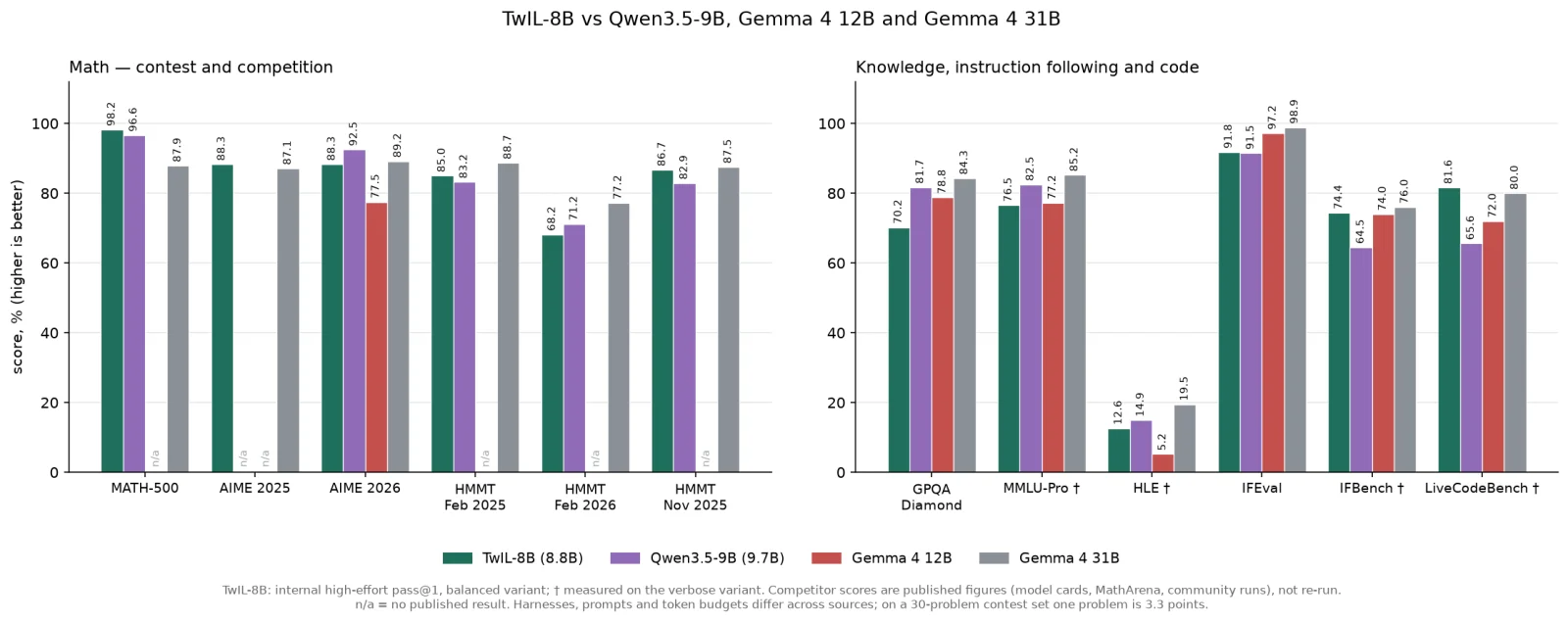 TwIL-8B benchmark chart against Qwen3.5-9B and Gemma 4 models
Image: webAI
From the card's table, in percent:
| Benchmark | TwIL-8B | Qwen3.5-9B | Gemma 4 12B | Gemma 4 31B |
|---|---|---|---|---|
| MATH-500 | 98.2 | 96.6 | n/a | 87.9 |
| AIME 2026 | 88.3 | 92.5 | 77.5 | 89.2 |
| HMMT Feb 2026 | 68.2 | 71.2 | n/a | 77.2 |
| GPQA Diamond | 70.2 | 81.7 | 78.8 | 84.3 |
| IFBench (verbose) | 74.4 | 64.5 | 74.0 | 76.0 |
| LiveCodeBench (verbose) | 81.6 | 65.6 | 72.0 | 80.0 |
The card's head-to-head summary says TwIL-8B wins 7 and loses 6 of 13 shared benchmarks against Qwen3.5-9B, and wins 3 and loses 11 of 14 against the much larger Gemma 4 31B. The pattern is clear. TwIL-8B is strong at contest math, code and instruction following, and behind on knowledge.
Against frontier models
The card also compares against GPT-5.5, Claude Opus 4.8 and Grok 4.3 at their highest published reasoning effort. TwIL-8B reaches 93% of the best frontier score on LiveCodeBench, 92% on IFBench, 90% on HMMT Nov 2025 and 88% on AIME 2026 and HMMT Feb 2025. On HMMT Feb 2026 it reaches 69%, on GPQA Diamond 75% and on HLE 26%. It beats Claude Opus 4.8 on IFBench by 12.2 points. The card notes that newer releases, including GPT-6.1 Sol, Claude Opus 5.5 and Grok 4.7, no longer report AIME, HMMT or GPQA, so the frontier comparison uses older models. For a view of the current frontier, see our GPT-6.1 Sol coverage.
Tokens per problem
The card reports about 19.5k output tokens per AIME 2026 problem for TwIL-8B, against 31.2k for Qwen3.5-9B, 21.0k for Claude Opus 4.8 and 5.0k for GPT-5.5. On HMMT Feb 2026 the numbers are 32.9k, 40.6k, 30.0k and 8.0k. In plain words, it reasons more tersely than its open peer but far less efficiently than GPT-5.5. webAI itself says the harnesses and tokenizers differ, so the comparison is directional.
Why the two variants matter
Reasoning models spend tokens to buy accuracy, and tokens cost time and money. A model that thinks for 33,000 tokens on one problem is slow on a laptop and expensive on an API. webAI's answer is the balanced variant. It starts from the verbose model and adds a reinforcement-learning stage whose reward favors shorter reasoning, measured against per-domain length references for math, code, STEM and instruction following. The aim is to keep most of the accuracy while cutting the length.
The card does not publish a full table for the balanced variant on every benchmark, which is why so many rows carry a dagger. What it does show is that on AIME 2026 the balanced model averages about 19.5k tokens and scores 88.3, while Qwen3.5-9B uses 31.2k tokens for 92.5. That is a trade: fewer tokens, a few points lower. Whether the trade suits you depends on your job. For batch grading of math problems on a single GPU, shorter traces mean more problems per hour. For a hard one-off proof, the verbose variant or a larger model may serve better.
What the card says about its own limits
The card is more candid than many launch posts. It states that knowledge benchmarks trail larger open models and the frontier by wide margins, and it explains why: those tests reward stored knowledge, which tends to scale with parameter count more than with reasoning-focused training. It says SWE-bench, SuperGPQA, tool use and agentic tasks were not evaluated. It says there is no safety or preference tuning beyond what Granite 4.2 carries, which matters if you plan to expose the model to users. And it lists cross-harness caveats: competitor numbers come from each vendor's model card or third-party tests with their own prompts, sampling and token budgets, and on a 30-problem contest set one problem is 3.3 points.
That last point is worth keeping in mind when you read the tables. A gap of two or three points on AIME or HMMT is within the noise of a single problem. The larger gaps, such as +16.0 on LiveCodeBench over Qwen3.5-9B or -11.5 on GPQA Diamond, are more informative.
What is verified and what is not
| Claim | Status |
|---|---|
| Scores for TwIL-8B | Vendor-run by webAI; no independent reproduction found yet |
| Competitor scores | Published figures from model cards, MathArena and community runs; not re-run |
| LiveCodeBench, IFBench, MMLU-Pro, HLE rows | Measured on the verbose variant, not yet on the default balanced one |
| Gemma 4 31B MATH-500 of 87.9 | The card itself says it is unusually low and may reflect answer extraction |
| GGUF performance | Scores were measured on bf16; the card says Q4_K_M may deviate slightly |
| Agentic tasks, tool use, SWE-bench | Not evaluated |
The most important caveat is the mixed variants. The headline coding number, 81.6 on LiveCodeBench, comes from the verbose variant, but the default download is the balanced one. A reader who pulls the default and expects 81.6 may get something different. The card is upfront about this with a dagger in the tables, which is good practice, and it also admits that the MATH-500 figure for Gemma 4 31B looks low.
How to run it
The bf16 weights are 16.38 GiB per variant. For modest hardware, the Q4_K_M GGUF is 4.98 GiB. With llama.cpp, the card gives:
llama-cli -hf webAI-Official/TwIL-8B --hf-file TwIL-8B-Q4_K_M-balanced.gguf -cnv -c 40960 -n 32768
With Transformers, load the model with AutoModelForCausalLM and pass subfolder="verbose" for the verbose variant. It needs a Transformers release with Granite 4.2 support. The default sampling settings are temperature 1.0 and top_p 0.95. Give it a large generation budget. The card warns that a short budget truncates the reasoning and scores far worse, and that low-effort modes score substantially lower. If you are new to local inference, start with our guide to what llama.cpp is and how to run models locally, and see how another team ran a mid-size model in Qwen 3.6 27B for local development. For how GGUF support is converging across tools, read Transformers now matches llama.cpp on GGUF.
Who should care
- Local-AI users who want a small model that is strong at math and code and are fine with long reasoning traces.
- Researchers studying length-aware RL: the balanced variant is a public example of trading accuracy for fewer tokens.
- Anyone comparing open reasoning models. Treat the card as a lead to test, not a verdict.
Who should be careful: anyone planning a commercial product. The non-commercial license blocks that unless webAI grants terms. Anyone needing broad knowledge, such as question answering over general facts, should read the GPQA and HLE rows first. Anyone building agents should note that tool use was not evaluated.
How to check the claims yourself
- Run your own tasks, not only public benchmarks. Contest math rewards a narrow skill.
- Test both variants on your prompts, and record tokens per answer.
- Compare against Qwen3.5-9B on the same hardware and settings.
- Check the Q4_K_M build, because that is what most local users will run.
- Watch for independent leaderboard runs from MathArena or similar sources.
Our earlier Particle-1 claimed-vs-verified post used the same method on another small-model claim.
Related reading
- TwIL-LM3 from webAI
- What is llama.cpp
- Qwen 3.6 27B local development
- Transformers and llama.cpp GGUF parity
- Particle-1 claimed vs verified
Figures come from the TwIL-8B model card as read on November 4, 2026 and may be revised by webAI. Follow @explainx_ai for updates.