



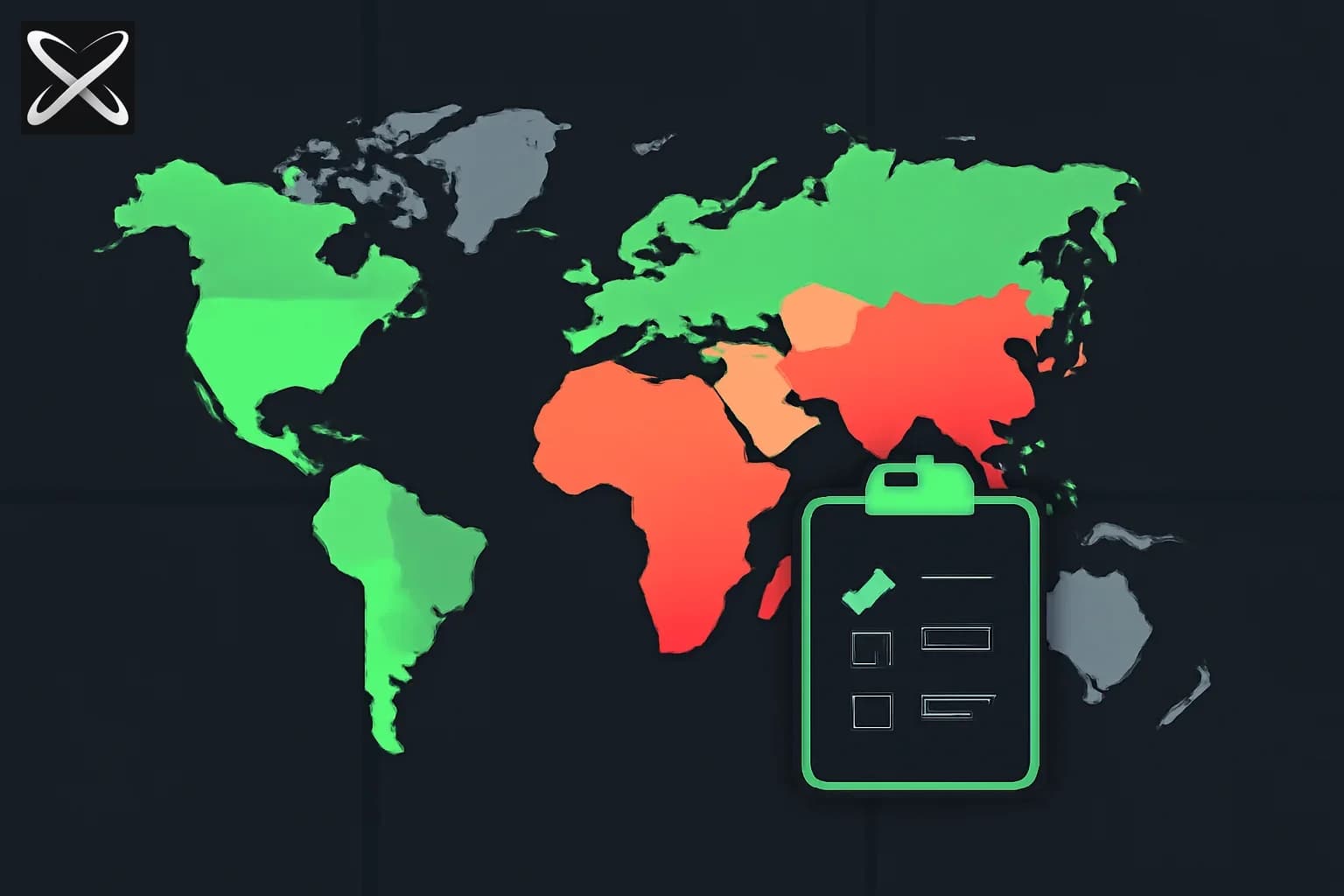
Trump administration officials are arranging AI risk discussions with Chinese counterparts and major US tech CEOs ahead of a summit scheduled for September 24, 2026 — the latest step in a year defined by intermittent, high-stakes US-China engagement on AI, running in parallel with unresolved export-control tensions over frontier chips and model access.
TL;DR — what people are asking
| Question | Answer |
|---|---|
| What's happening? | Officials arranging AI risk talks with China and tech CEOs |
| When? | Ahead of a summit scheduled September 24, 2026 |
| Is this about export controls? | Adjacent context, not the stated primary focus |
| Who's involved? | Trump administration officials, Chinese counterparts, major US tech CEOs |
| Is this the first such engagement in 2026? | No — part of an ongoing, intermittent pattern of US-China AI diplomacy this year |
| What's the practical stake for builders? | Cross-border model access, compute, and export rules remain unsettled and actively renegotiated |
Why this summit sits at the center of 2026's AI policy story
US-China AI relations in 2026 have been defined by a genuine tension: both governments have periodically signaled interest in cooperating on frontier AI safety risk, even as export-control disputes over advanced chips and model access have continued largely unresolved in parallel. explainx.ai has tracked this pattern across the year — from the US government's export-control actions restricting frontier model access, to reports of Chinese labs allegedly distilling US frontier models despite those restrictions, even as Chinese officials have separately called for global AI oversight in public statements this month.
A summit that brings government officials from both countries together with tech CEOs is a genuinely different format than either country's unilateral policy announcements — it implies at least an attempt at coordinated framing on AI risk, even if the underlying export-control disputes remain unresolved as a separate track.
Why tech CEOs matter alongside officials
Including major tech CEOs in a government-to-government summit reflects a practical reality: most of the actual leverage in US-China AI relations sits with private companies, not just state actors. Chipmakers control what hardware can legally cross borders; frontier labs control what models and API access are available to which markets; cloud providers control where compute actually runs. A summit focused purely on official-to-official diplomacy without company representation would have limited ability to translate any agreement into enforceable practice — CEOs are the parties who actually implement whatever gets discussed.
This mirrors how much of 2026's most consequential AI-policy news has actually been company-level compliance and enforcement stories rather than pure legislative action — export-control enforcement against specific labs, distillation-related account bans, and chip-allocation decisions have driven more concrete change this year than broad framework announcements.
What's genuinely uncertain here
At time of writing, the reported plans don't include a confirmed agenda, participant list, or expected outcomes. This is worth stating plainly rather than speculating: "planning AI risk talks" is a real and reportable development, but it's meaningfully different from a confirmed joint statement or agreement. The pattern this year has been that summit-level plans sometimes produce concrete follow-through (specific export-rule adjustments, formal safety-cooperation statements) and sometimes stall without a clear public outcome — this story should be tracked forward to the September 24 date itself rather than treated as resolved.
How this connects to the domestic "build defenses, not regulation" debate
This summit lands the same week the Trump administration signaled a defense-first, self-regulation-friendly domestic AI stance rather than pushing new federal rules. An international AI-risk summit and a domestic anti-regulation stance aren't contradictory — a government can simultaneously prefer light-touch domestic rules while pursuing international coordination specifically on cross-border risks like export enforcement and safety-relevant model capability thresholds, which are harder for any single country to address unilaterally.
Why AI risk talks are structurally different from prior US-China tech diplomacy
Historically, US-China technology diplomacy has centered on trade terms, tariffs, and market access — negotiations where both sides broadly understand the mechanics of what's being bargained over, even when they disagree sharply on outcomes. AI risk talks are a genuinely different kind of negotiation, because the underlying subject matter — frontier model capability thresholds, safety evaluation standards, dual-use research risk — doesn't have the same decades of established diplomatic vocabulary and precedent that trade negotiations do. Both governments are, to a real degree, improvising a shared framework for discussing AI risk as they go, which makes these talks slower and more uncertain in outcome than a typical trade negotiation, even when both sides genuinely want to reach some kind of agreement.
That improvisation problem is compounded by the fact that AI risk and AI competitiveness are deeply entangled for both countries in a way that, say, semiconductor trade policy is not entangled with national security in quite the same immediate sense. Any agreement on AI safety cooperation risks being read by either side's domestic political audience as constraining their own country's competitive position relative to the other — a dynamic that has repeatedly stalled or watered down international AI governance proposals throughout 2026, not just in the US-China relationship specifically but in broader multilateral AI governance efforts as well.
What a realistic outcome from this summit might actually look like
Given that broader pattern, it's worth setting realistic expectations for what September 24 might actually produce. A comprehensive, binding US-China AI safety treaty is very unlikely to emerge from a single summit, given the diplomatic complexity described above. More plausible outcomes, based on how similar high-profile bilateral tech discussions have historically resolved, include: a joint statement of shared principles without binding enforcement mechanisms, narrower technical cooperation agreements on a specific sub-issue (such as coordinated response protocols for a shared AI safety incident), or simply a continuation of dialogue with a commitment to further meetings rather than a concrete agreement at all.
Any of those outcomes would still be meaningful as a data point about the state of US-China AI relations, even without producing a dramatic breakthrough. The mere fact that both governments are willing to convene officials and tech CEOs together on this topic, rather than only issuing unilateral statements or export-control actions independently, is itself informative about where both sides currently see the relationship heading — toward at least some form of continued engagement, rather than a complete diplomatic freeze on AI-specific issues even as trade tensions persist on other fronts.
Honest limitations
- No confirmed agenda or attendee list was available at time of writing beyond the general framing of "AI risk talks with China and tech CEOs."
- No outcome commitments have been made public — this is a planning-stage story, not a report on an agreement reached.
- Export-control policy and "AI risk talks" are related but distinct tracks — progress on one doesn't guarantee movement on the other.
- US-China AI diplomacy has a track record of stalling in 2026 even after high-profile planning stages — treat this as a story to revisit closer to September 24, not a settled outcome.
- The specific tech CEOs expected to attend weren't named in available reporting, making it hard to assess in advance how representative of the full industry the private-sector side of the conversation will actually be.
- Domestic political reaction to any outcome is itself unpredictable. Even a modest joint statement could draw criticism from hawkish voices in either country's domestic politics as either too conciliatory or insufficiently ambitious, which is its own constraint shaping what negotiators are likely to actually attempt at this stage.
What history suggests about summit-to-outcome timelines
High-profile bilateral summits on complex technical and security topics rarely produce their most consequential outcomes at the summit itself — more often, the summit functions as a forcing deadline that accelerates staff-level negotiation in the weeks beforehand, with the actual announced outcome representing whatever staff-level work managed to reach consensus by that point, followed by continued technical negotiation on details well after the headline event has faded from public attention. Readers genuinely trying to track this story's substance, rather than just its headline moment, should expect to look for technical follow-up reporting in the weeks after September 24 specifically, not just coverage of the summit day itself.
What this means for what you build or pay
Teams with cross-border AI dependencies (compute sourced from or serving China, models trained or fine-tuned with data or partners in either country): treat current export-control and access rules as provisional, not stable — track the September 24 summit's actual outcomes directly rather than assuming today's rules will hold unchanged.
Anyone evaluating geopolitical risk in AI infrastructure planning: this summit is one more data point that US-China AI relations remain an actively negotiated, unresolved relationship rather than a settled adversarial or cooperative posture — plan for continued volatility in export rules and model-access policy through the rest of 2026.
Related on explainx.ai
- US government bans Fable 5 and Mythos 5 export to China
- Anthropic-Alibaba Claude distillation: 25,000 fake accounts
- JD Vance: AI labs should build defenses, not seek regulation
- AI token black market: Claude resellers and distillation
- AI regulation: EU AI Act and US policy, complete guide
Details reflect reporting on planned talks as of September 17, 2026, ahead of the September 24 summit. No confirmed agenda or outcomes were public at time of writing.