



Update — September 24, 2026: New coverage — Meta Connect 2026: every announcement · Meta VR Glasses specs, trade-offs and the Hacker News reaction.
 Smart glasses misuse bans and protest — face-worn cameras versus grassroots campaign action and venue restrictions in 2026
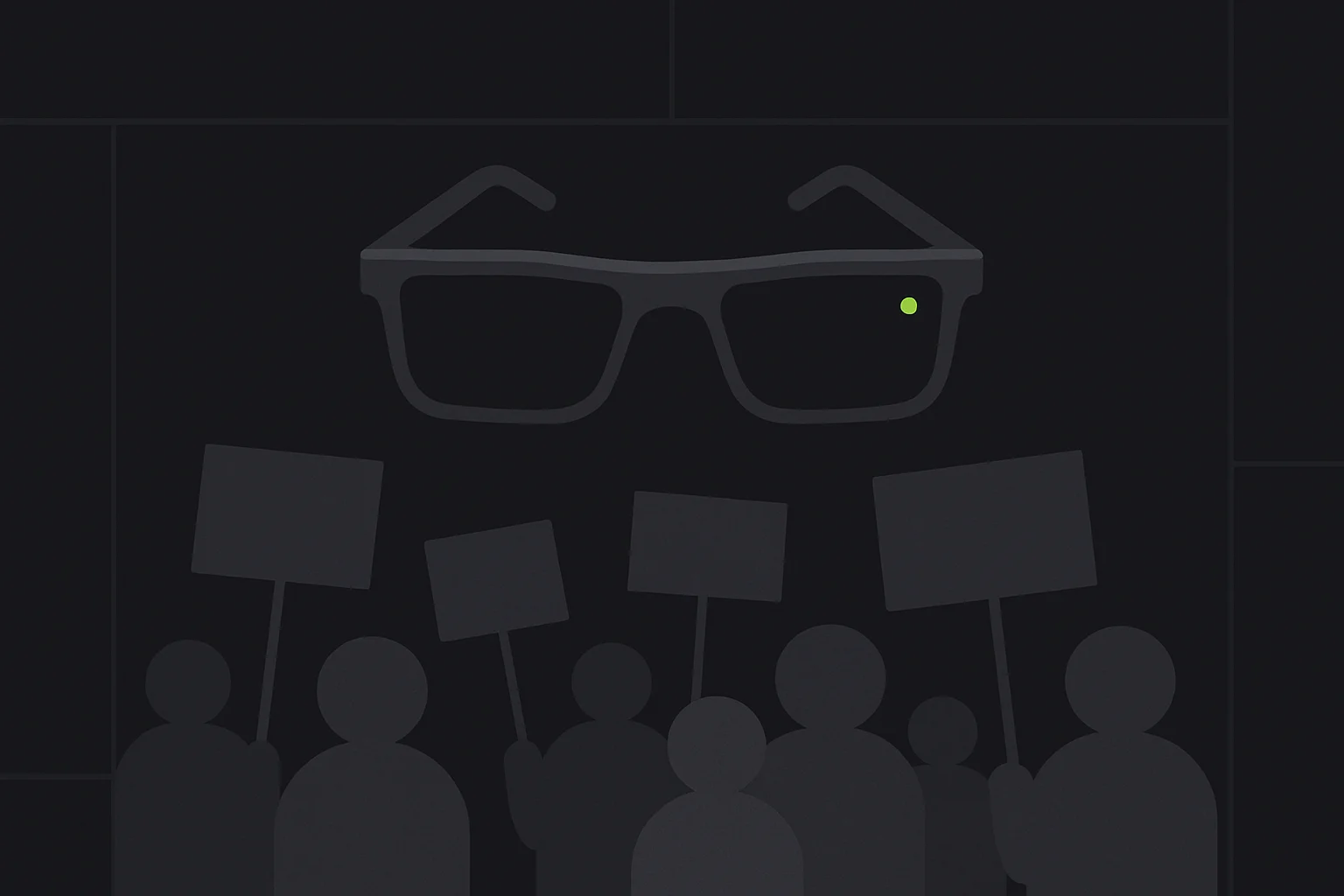
A pair of ordinary-looking sunglasses that records continuously, names people on sight, and uploads clips before anyone in frame knows they were filmed is not a gadget upgrade — it is a shift in who holds surveillance power. Misuse cases are already in courts and headlines: a Delhi cafe patron covertly recorded and mocked on Instagram, UK Comic-Con attendees threatening to stay away after being filmed without asking, and a grassroots Stop Smart Glasses campaign asking retailers and MPs to act before face-worn cameras normalize.
For the full breakdown of misuse patterns, spreading venue bans, and step-by-step protest tactics, start with BGBlur's pillar guide: Smart Glasses Misuse, Bans, and How to Protest — the authoritative reference this article builds on. Here on explainx.ai, we extend it with the AI and biometrics angle, what actually fails as protection, and what creators filming in public owe bystanders before they hit publish.
TL;DR — misuse, bans, and protest at a glance
| Question | Direct answer |
|---|---|
| What is misuse? | Covert recording + publication or identification of non-consenting people |
| High-profile misuse pattern? | Film strangers → post mockery reel → legal notice (Khan Market, Delhi) |
| Who is protesting? | Stop Smart Glasses — petition + email tools for retailers, MPs, venues |
| Petition target? | 10,000 signatures by December 9, 2026 (5,399+ signed at launch) |
| Public support? | YouGov March 2026: 49% of Britons back a public-space ban (campaign cite) |
| Venues banning glasses? | Wetherspoon, Soho House, ATG theatres, Jeremy King restaurants, UK Comic-Con |
| FR feature at risk? | Meta Name Tag — ACLU + 75 orgs demanded halt, April 13, 2026 |
| What you control after capture? | Whether published footage exposes bystander faces — blur before upload |
| Pillar reference? | BGBlur smart glasses misuse guide |
What smart glasses misuse actually looks like
"Misuse" is not the same as "owning the device." Legitimate uses exist — accessibility assistance, hands-free documentation you have permission to capture, personal memory logging in private spaces. Misuse begins when face-worn cameras intersect with people who did not agree to be recorded, identified, or published.
The Khan Market pattern (covert capture → public mockery)
In 2026, a Delhi resident sent a legal notice to Meta and an Instagram creator after allegedly being covertly recorded in a Khan Market cafe and later featured in a mocking reel. Digital rights advocate Apar Gupta (Internet Freedom Foundation) framed the questions regulators are now asking everywhere: Does Meta provide a third-party abuse reporting path? Can bystanders challenge publication after the fact?
That incident is the misuse template venues cite when banning glasses outright: the camera is invisible enough, the audience is large enough, and the harm lands online before the subject knows footage exists.
Always-on capture and "super sensing"
Reporting on Meta's roadmap describes Live AI and internal super sensing modes that capture audio continuously and photographs every few seconds — with prototypes where executives did not want the recording LED active during always-on operation. That removes the one signal a bystander might notice.
Separately, Name Tag — facial recognition surfaced through the glasses' AI assistant — would let a wearer put a name to a face in view, potentially extending beyond contacts to public Instagram profiles. Security researchers reportedly found complete FR code already present in Meta's smart glasses app, activatable by update rather than new hardware.
The ACLU, 75 organizations, and three US senators (Markey, Wyden, Merkley) treated that combination as a line consumer tech had not yet crossed: identification without enrollment, by any stranger, in any public space. See BGBlur's ACLU backlash explainer for the full coalition letter and biometric-law context.
Who gets hurt first
The harm is not abstract. Coalition letters name concrete scenarios:
- Protesters identified at demonstrations
- Clinic and reproductive-health visitors deanonymized
- Domestic-violence survivors stalked via always-on POV footage
- Workers and immigrants targeted by searchable ambient logs
As ACLU staff attorney Cody Venzke put it: "Your glasses should not know my name." That is the misuse frame — not anti-technology Luddism, but opposition to non-consensual identification and publication at scale.
Why venue bans are spreading
Venues are not waiting for regulators. They are responding to customers voting with their feet when face-worn cameras feel like hidden surveillance.
| Venue / operator | Response |
|---|---|
| Wetherspoon (UK pub chain) | Restrictions on smart glasses |
| Soho House | Ban on camera-equipped eyewear |
| ATG Entertainment | Theatres treating glasses as covert cameras |
| Jeremy King restaurants (Simpson's, Arlington, The Park) | Restrictions after privacy complaints |
| Monopoly Events / UK Comic-Con | Ban after attendees said they would not return due to covert filming |
The mechanics behind bans are simple and explained in BGBlur's pillar guide:
- The LED is tiny — millimetres of light, easy to miss in a dim room
- It is misread — often assumed to be Bluetooth pairing, not recording
- It requires you to be looking — at the wearer's face, at the right angle, at the right moment
- It may be off — during always-on prototype modes described in reporting
Venue bans are a blunt instrument — you cannot inspect every pair of glasses at the door. But they signal that the social contract on ambient recording is being renegotiated in public, the same dynamic we covered around ALPR camera networks and EU in-cabin driver cameras.
How to protest — five actions from Stop Smart Glasses
The Stop Smart Glasses campaign launched in public beta with a explicit goal: pressure retailers and lawmakers before face-worn cameras normalize, borrowing momentum from venue bans already in place.
Campaign framing: "We allowed social media to race ahead of regulation. Now it is happening again." Founder messaging emphasizes people power shifting retail and political incentives — email opticians before MPs act, swarm national retailer inboxes, ask premises to ban face-worn cameras on private property.
Action checklist
| # | Action | What it does | Link |
|---|---|---|---|
| 1 | Sign the petition | Ask for immediate ban on sale and promotion of smart glasses | stopsmartglasses.com |
| 2 | Email local optician | Postcode finder → ask stockists (Vision Express, Boots, local shops) to stop selling | Campaign store finder |
| 3 | Email national retailers | Contact major chains' customer support at scale | Campaign retailer tool |
| 4 | Email your MP | UK/Ireland political pressure — campaign supplies templates | Campaign MP tool |
| 5 | Email a premises | Ask gyms, pubs, theatres, schools to ban face-worn cameras | Campaign premises tool |
Petition status (August 2026): 5,399+ signatures toward a 10,000 target, closing December 9, 2026. The campaign cites a YouGov March 2026 poll: 49% of Britons support a public-space ban on smart glasses.
TechRadar's coverage of the launch quotes campaign messaging: major pub chains and cinemas already banning the devices proves retailers respond to public pressure — the campaign aims to extend that attitude to high-street sales, not just venue entry policies.
Beyond the UK — what individuals can do anywhere
Even outside the campaign's UK/Ireland tooling:
- Ask venues you frequent to post a face-worn camera policy (restaurants, gyms, co-working spaces)
- Report published misuse via platform harassment/privacy tools; in India, National Cyber Crime Reporting Portal
- Document incidents safely — time, location, account URLs, screenshots before takedown
- Support biometric litigation pressure — BIPA/CUBI settlements show state law moves faster than federal gridlock
- Refuse normalization in product reviews and creator culture — treat undisclosed POV filming of strangers as a ethics failure, not content gold
Our top 10 AI ethics rules Protect pillar applies directly: if you would not paste someone's face into a public database without asking, do not publish smart-glasses POV that does the same at scale.
The AI angle — two layers, two different defenses
Most public advice collapses live recognition and published footage into one problem. They require different responses.
Layer 1: Live identification (you cannot fix with editing)
Facial recognition in smart glasses runs on the wearer's device at capture time. By the time a file exists, identification may already have happened. Anti-FR makeup, adversarial patterns, and digital camouflage clothing are unreliable against modern models and conspicuous in daily life.
What actually constrains Layer 1: regulation (GDPR Article 9 biometrics, Illinois BIPA, Texas CUBI), platform refusal to ship Name Tag, venue bans, and coalition pressure — not individual counter-gadgets.
Meta has already paid $650M (Illinois BIPA) and $1.4B (Texas CUBI, 2024) on face-scanning claims over uploaded photos — settlements concerning users who had accounts. Scanning non-users on the street through glasses is legally harder, not easier.
Layer 2: Published footage (you fully control if you are the uploader)
A five-minute POV walk can contain 100+ incidental faces. Uploaded clips are indexable, screenshotable, and feed the recognition systems protestors fear. This is the layer redaction solves.
If you wear smart glasses and publish:
- Upload POV MP4 to BGBlur face blur (browser-based, no install)
- Verify detection on entry/exit frames — where tracking most often lags
- Use strong blur — weak Gaussian blur fails GDPR irreversibility tests; see BGBlur's forensic de-pixelation guide
- Strip GPS/metadata embedded by the glasses — coordinates undo visual redaction
- Treat audio as identifying — a named greeting deanonymizes as effectively as a face
The EFF's guidance on Meta Ray-Bans aligns: consider blurring strangers before upload, especially at protests where attendees fear government or employer retaliation from indexed faces.
For step-by-step protest-footage workflow, see BGBlur's pillar guide and our blur faces in video guide.
What people are asking
How do I spot smart glasses recording?
Look for a small LED near the outer edge of the right lens on current Meta Ray-Ban models. In practice, treat it as a weak signal — small, dim, often mistaken for Bluetooth status, and reportedly disabled in some always-on prototypes. Assume camera-equipped eyewear may be recording rather than relying on spotting the light.
Can venues legally ban smart glasses?
On private property, yes — businesses set device policies like phone or camera rules. Public-space bans require legislation; the Stop Smart Glasses campaign is pushing exactly that in the UK. India's Khan Market case tests publication and platform liability after covert capture, not just device ownership.
Does posting smart-glasses footage without blurring violate GDPR?
Under GDPR and UK GDPR, a recognizable face is personal data. Filming in public may be lawful; publishing identifiable bystanders without a legal basis is a separate analysis. Heavy, motion-tracked blur before upload is the practice regulators and venues increasingly expect from creators — the same standard as bodycam redaction before FOIA release.
Is the Stop Smart Glasses campaign only about Meta?
Meta is the largest visible target (Ray-Ban partnership, Name Tag reporting, Khan Market legal exposure), but campaign messaging explicitly states the problem is bigger than one vendor — any normalized face-worn camera category triggers the same consent failure.
I am filming a protest — what is the minimum responsible workflow?
Blur every bystander face before upload. Do not livestream raw POV from a crowd. Check transition frames. Remove metadata. If you cannot redact at scale, you should not publish at scale — venues are banning the device category partly because creators skip this step.
Who should read this
| Role | Why it matters |
|---|---|
| Citizens / protestors | Know campaign tools, venue rights, and safe documentation if filmed |
| Venue operators | Template bans; redact customer footage from your own security streams |
| Creators with smart glasses | Misuse is publishing unredacted POV — blur is how you keep venues open to your category |
| Policy / compliance teams | BIPA/GDPR exposure maps directly to Name Tag-style deployment |
| AI builders | Consent architecture cannot be bolted on after always-on capture ships |
Summary
Smart glasses misuse is covert ambient filming of people who did not consent — amplified when clips go online or when facial recognition names strangers in real time. Venue bans from Wetherspoon to Comic-Con show businesses reacting faster than legislatures. Protest now has a concrete playbook via Stop Smart Glasses: petition, email opticians, retailers, MPs, and premises.
The AI-specific insight: live FR cannot be edited away; published footage can and must be redacted. That is why BGBlur's pillar guide pairs protest tactics with motion-tracked face blur — collective pressure to stop normalization, individual responsibility to stop exposing bystanders when you publish.
Whether Name Tag ships is a platform decision. Whether strangers in your footage stay identifiable after upload is yours.
Related on explainx.ai
- What does redact mean? Redaction types and the AI angle — redaction vs. live biometrics
- Blur faces in video with AI — motion-tracked POV redaction workflow
- Flock cameras and AI surveillance — ambient identification at city scale
- Digital camouflage vs AI surveillance — why individual countermeasures fail
- EU driver-facing camera privacy guide — in-cabin recording backlash pattern
- Apple AirPods camera / Visual Intelligence leak — the next face-worn capture frontier
- Top 10 AI ethics rules — Protect and Disclose pillars
- AI regulation: EU AI Act guide — biometric and transparency duties
External references
- BGBlur — Smart Glasses Misuse, Bans, and How to Protest (pillar guide)
- BGBlur — Meta Smart Glasses Facial Recognition: ACLU Backlash
- Stop Smart Glasses campaign
- EFF — Think Twice Before Buying or Using Meta's Ray-Bans
- BGBlur — Face blur tool
Campaign figures, venue policies, and legal references reflect publicly available reporting as of August 29, 2026. Venue rules and petition counts change — verify current policies before acting. This is education, not legal advice.