




Search is splitting into two surfaces: pages that rank in Google and Bing, and sources that get cited inside ChatGPT, Perplexity, Gemini, Copilot, and similar experiences. The seo-geo skill on explainx.ai is built for exactly that split — one agent-facing package that walks through audits, meta and schema work, keyword research, and GEO tactics derived from Princeton-style research on generative visibility.
Learn more via this video: https://youtu.be/VerBKs6v_D8
This post is a field guide: what the skill is, how we think about SEO vs GEO, where to install it, and which GitHub repos you can treat as source of truth.
 SEO plus GEO hero — agent skill for classic search and AI citations
What is seo-geo?
 SEO plus GEO agent skill — one search beam splitting into ranked results and an AI citation bubble
seo-geo is a marketing-category agent skill published in the registry. In practice it is a folder of instructions (not a hosted SaaS) that your agent loads when you ask for SEO or “AI search” improvements. The live card on explainx.ai summarizes it as coverage for:
- Technical SEO — titles, meta, crawlability, robots, sitemaps, performance-minded checks
- AI / LLM bot access — sanity that major crawlers and “user” agents are not accidentally blocked
- GEO — content and schema patterns aimed at citation-style surfaces, not only blue-link rankings
The canonical product page (install command, summary bullets, related skills) is here:
seo-geo by whyashthakker/agent-skills-marketing on explainx.ai
If you are exploring the broader ecosystem, the skills registry lists hundreds of other community skills ranked by adoption — useful for stacking seo-geo next to copy, analytics, or front-end skills from the same publisher.
SEO vs GEO (why both show up in one skill)
SEO (search engine optimization) is still the discipline of earning visibility in ranked results: relevance, authority, technical health, structured data, and intent-matched content.
GEO (Generative Engine Optimization) is the parallel discipline of earning mentions inside AI-generated answers: clear claims, citations, statistics, expert quotes, FAQ-style schema, and answer-first structure — because many generative interfaces cite sources rather than “rank” pages like a ten-blue-links SERP.
The skill’s own copy puts the line bluntly: AI search engines don’t rank pages — they cite sources. Whether or not you agree with that for every product surface, it is a useful engineering heuristic: if you only optimize for classic rankings, you may still lose share of voice in answer panels and chat-style search.
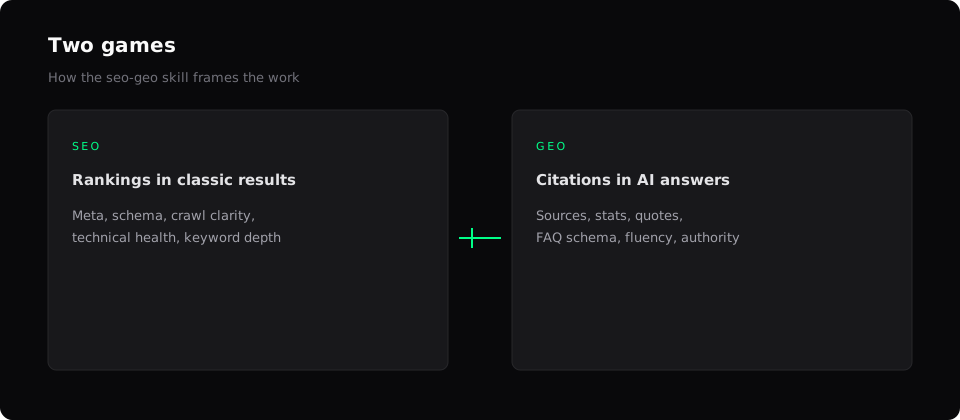 Classic SEO rankings vs GEO citations — simplified mental model
What you actually do with the workflow
The bundled workflow in the skill — reflected on the explainx.ai detail page — roughly follows five beats:
- Audit — quick technical passes (titles, meta, H1, robots, sitemaps, load); curl-friendly snippets for meta and
robots.txt - Keyword research — competitive and long-tail framing via search and desk research
- GEO optimization — apply evidence-backed content tactics (see table below)
- Traditional SEO — templates for meta, Open Graph, Twitter cards, JSON-LD types (WebPage, Article, FAQPage, Product, Organization, SoftwareApplication, etc.)
- Validate — rich-results testing, schema validators,
site:checks
The skill also nudges platform quirks (e.g. allowing relevant bots, FAQ schema for some surfaces, Bing speed habits) without pretending one checklist fits every engine.
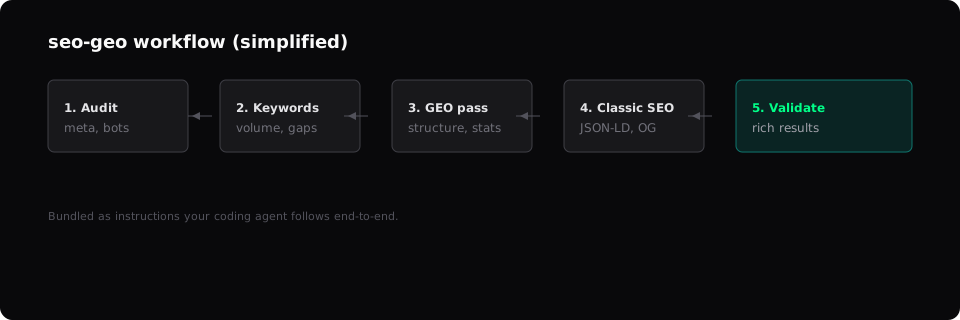 Simplified audit-to-validate pipeline the skill encodes
Princeton GEO methods (as referenced in the skill)
The skill cites a nine-method menu; treat these as hypotheses to test on your property, not magic multipliers:
| Method | Idea |
|---|---|
| Cite sources | Link to authoritative references |
| Statistics | Use specific numbers and data |
| Quotations | Named experts with attribution |
| Authoritative tone | Clear, confident expert voice |
| Easy to understand | Plain language where possible |
| Technical terms | Domain vocabulary where it helps |
| Unique words | Healthy vocabulary diversity |
| Fluency | Improve readability and flow |
| Avoid keyword stuffing | Over-optimization hurts |
Combining fluency with statistics is highlighted as a strong pairing in the original skill doc — consistent with “show your work” in both human and model-visible ways.
Install and source repos
On explainx.ai
Use the install strip from the registry detail page (it matches the pattern):
npx skills add https://github.com/whyashthakker/agent-skills-marketing --skill seo-geo
That pulls the skill from the marketing skills monorepo described in the publisher README: a library of agent skills for marketing, SEO, GEO, lifecycle, and campaign work, with .agents/skills as the portable copy and .claude/skills as a Claude-oriented mirror.
Upstream repository (source + full library):
github.com/whyashthakker/agent-skills-marketing
Per that README, you can either copy the entire .agents/skills tree into your project or copy individual folders (for example only seo-geo) into ~/.claude/skills or your repo’s .agents/skills. Natural-language prompts in Claude Code then align to the skill when the task matches its description.
OPC Skills distribution
A second high-visibility open library that ships a seo-geo skill is OPC Skills — aimed at solopreneurs and one-person companies, with a large star count and parallel Claude Code marketplace install paths:
github.com/ReScienceLab/opc-skills
Their README documents patterns such as npx skills add ReScienceLab/opc-skills --skill seo-geo and plugin marketplace installs. If your team already standardizes on OPC, you may prefer that distribution even though the explainx.ai listing tracks agent-skills-marketing.
When seo-geo is worth loading
- You want one agent context that connects crawl hygiene, on-page SEO, and answer-engine content structure
- You are tired of ad-hoc ChatGPT “write me meta tags” without robots, schema, and measurement in the same thread
- You already use Claude Code or similar clients and want repeatable playbooks
It is not a replacement for professional SEO counsel on static sites with millions of URLs, regulatory-heavy industries, or spam-risk niches — but it is a concrete skill package you can version alongside your code.
What should you ask the skill to inspect first?
Start with one URL and one user intent. A request to “improve SEO everywhere” encourages a broad rewrite without an acceptance target. A request to inspect the page answering a specific question lets the agent examine title, rendered heading, canonical URL, evidence, and internal navigation together. Require it to explain the problem before editing the page.
Ask for a distinction between source-code findings and live-page findings. Correct metadata in a component does not prove the deployed page emits it. Likewise, a valid sitemap file does not prove a crawler can fetch it. Save the URL and observation date for live checks so later reviewers understand which state was inspected.
A focused audit example
Suppose a guide targets “how to configure a local coding model.” The first paragraph should answer that setup question, and the body should show the configuration and likely failure modes. If the article opens with several unrelated market predictions, improving the description alone will not make it satisfy the reader's intent.
Check that related links lead to useful next steps rather than repeating the same keyword. A local-model guide can connect to memory requirements, quantization, and tool-calling limitations. Those links help readers continue the task. Adding dozens of loosely related links may increase noise without clarifying anything.
Does valid structured data guarantee search features?
No. Google's structured-data introduction separates markup eligibility from guaranteed appearance. Use the appropriate schema for the visible page and validate it, but do not promise rich results or AI citations because a test accepts the JSON-LD.
Keep marked-up facts consistent with the article. An FAQ answer in metadata should not promise a capability the body calls experimental. Publication and modification dates should describe actual editorial changes. Structured data is a machine-readable account of the page, rather than a place to add promotional claims hidden from readers.
How should you measure an SEO or GEO edit?
Write down the hypothesis before publishing. For example, clearer setup instructions may reduce unhelpful visits, while a corrected canonical may fix duplicate-page signals. Those are different hypotheses with different evidence. Avoid attributing every later traffic change to an edit when seasonality, demand, deployment issues, or search updates may also be involved.
For answer-engine visibility, keep the exact query, date, engine, and cited URL when observing a result. One successful answer is an observation, not a stable ranking. Repeated checks across a representative query set provide a more useful view, especially when generated answers vary between sessions.
The skill can make auditing and implementation repeatable. Your measurement still needs an honest baseline and a clear account of what changed. That is what turns a checklist into a learning process instead of a stream of unsupported claims that the site has “won AI search.”
Related on explainx.ai
- Browse all skills — find adjacent marketing, copy, and analytics skills
- Resources hub — longer-form guides and decks
- Book a demo / custom agents — when you need engineering beyond off-the-shelf skills
- GEO for marketers: get cited by AI answer engines — GEO applied to marketing team workflows, checklist included
Summary
seo-geo packages SEO + GEO into a single agent skill: audits, keywords, schema, meta, and citation-oriented content guidance. The explainx.ai listing is the fastest way to see install stats and the exact npx skills add line: seo-geo on explainx.ai. Source material and the full marketing library live on GitHub at whyashthakker/agent-skills-marketing; an alternate seo-geo distribution is ReScienceLab/opc-skills.
If you maintain a comparable skill and want distribution + ranking signals, register at explainx.ai and submit through the skills submission flow once you have an account.