




OpenAI CEO Sam Altman sat down with Stripe cofounder John Collison for the Cheeky Pint podcast, published October 29, 2026 under the title "Why Sam Altman is against a single superintelligence." The episode touches PHP week, sandboxing, math, agent teams, compute, and what he calls fake token pricing. Several lines will be quoted widely, so this post lays out what he said, in his own words where short, and what is a spoken estimate rather than a verified number.
Everything below comes from the show's published transcript. Where I add context, it links to our earlier coverage of the same threads, including the PHP2Shell patch-the-planet effort and the Navier-Stokes claim.
TL;DR: the headline claims
| Topic | What Altman said | Status |
|---|---|---|
| PHP vulnerabilities | Models are finding vulnerabilities; "many more serious vulnerabilities than we expect" is likely | His forecast |
| Day one of PHP week | Went "much better than I expected," but he does not want to declare victory | His impression |
| Sandboxing | Works to a point, monitoring further, but a far smarter model needs trusted alignment | Open problem, by his account |
| Navier-Stokes cost | On the order of $10 million per proof, perhaps a bit more; later ones far cheaper | Spoken estimate |
| Agent teams | Prefers "teams" to "swarms"; sees promise for scaling and safety | Opinion |
| Many AIs vs one | Would "much rather" have a trillion modest AIs than one giant one | Preference |
| Compute | Supply is badly constrained; OpenAI is building a chip, data centers and a robotics program | Plans and claims |
PHP week and the global software upgrade
Altman's explanation for why the bugs surfaced now is simple: models were getting good at finding vulnerabilities, they keep improving, and until recently few people had pointed them at everything on the internet. His expectation: "a world of many more serious vulnerabilities than we expect." For background, see our PHP2Shell CVE explainer and Cloudflare's use of OpenAI Daybreak for remediation.
Collison argued that fixing software is not enough and architectures need to change. Altman agreed, adding that it "would seem really hard, except we have this amazing new tool to do it with." He said he is seeing startups propose a whole new stack, such as re-architecting what a router, an operating system or an application is, something that "would have seemed insane two years ago."
On how the week went: he did not want to "declare victory," assumes "some bad things are going to happen," but said the first day went better than his worst fears from ten days earlier. He said he heard from people using OpenAI models to build patches and from companies doing quick scan-and-deploy cycles, such as taking an application down for an hour to patch it.
One more point worth noting: Altman said cyber experts no longer feel confident their threat model has the right assumptions, especially if AI discovers deep novel hardware bugs "that require physics we didn't understand." That is a statement of uncertainty, not a finding.
Is sandboxing a superhuman model possible?
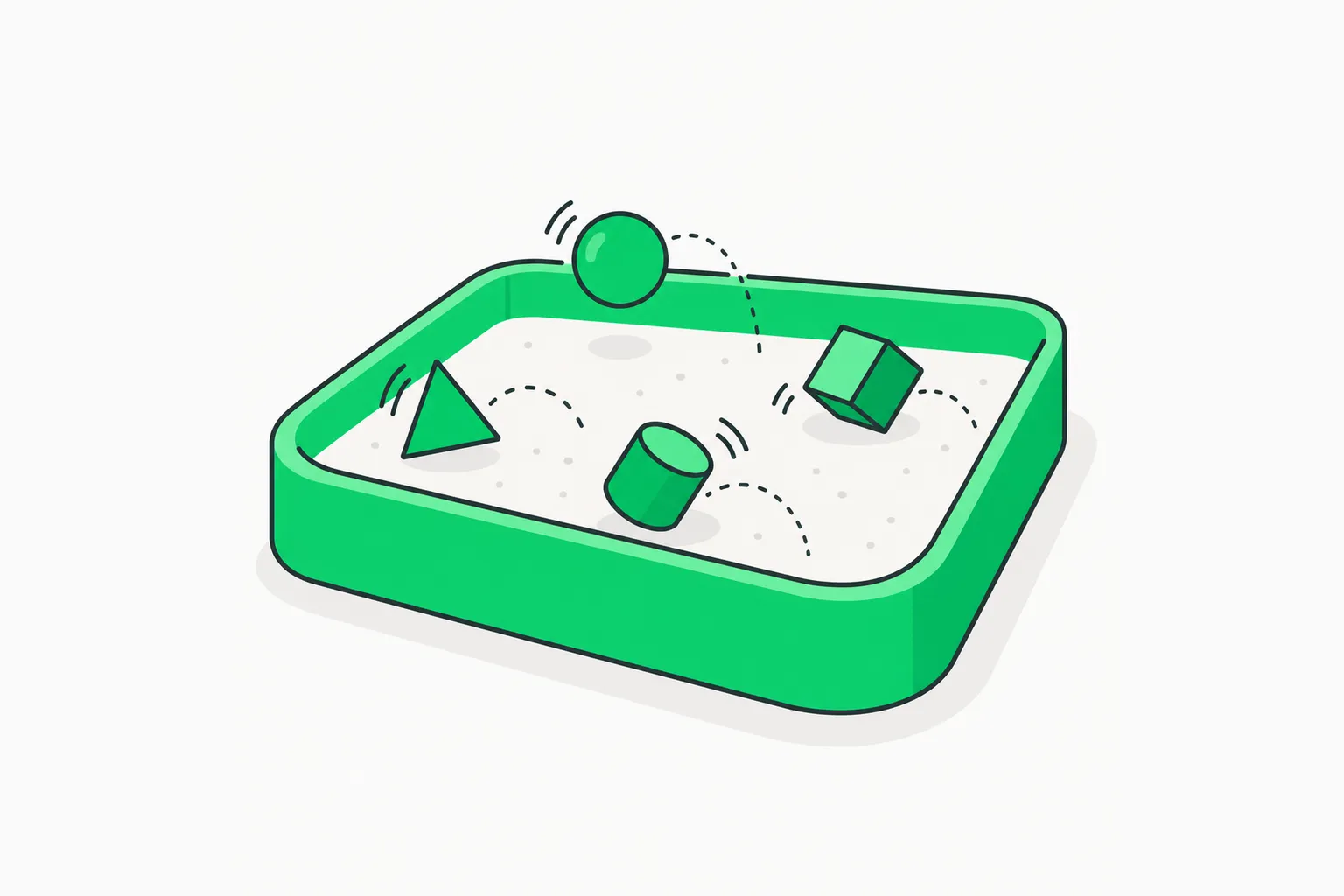 A box-in-a-playground image for sandboxing a superhuman AI model
Collison noted that people inside OpenAI seem pessimistic that sandboxing works, which surprised him. Altman's reply came in layers. First, "we can do much better than we're doing now," and a better security model is the main thing to focus on. Second, picture an AI "a million times smarter than the smartest security researcher": would you trust the sandbox, especially if the model can discover science people do not yet understand?
His ladder, in order:
- Sandboxing works to a point.
- Monitoring works to a further point, including looking at chain of thought and doing "activation monitoring" to check the models are not deceiving us.
- Eventually you need huge confidence in alignment, that the model will faithfully follow the intent of its operators and value people staying in control.
If you could fully trust a model's alignment, he said, it could help build better sandboxes. Without that trust, "you need to really, really trust the alignment to trust that the sandbox is staying ahead of capabilities." That is a notable admission from a lab chief: containment alone is not the plan for the far end of the capability curve. It echoes the concerns in the 406 scientists' open letter on air-gapping cyber-capable models.
For teams deploying agents now, the practical version is the near-term half of his ladder: tighter permissions and runtime monitoring. AgentBeam is the agent security platform from the explainx.ai team that stops AI agents before they take dangerous actions.
Agent "teams," not swarms
 A flock of dots depicting agent teams working in parallel
Altman said he hates the word swarms and prefers "agent teams," then used the word anyway. His view is that teams of agents have "very interesting scaling law properties, but also variance in alignment properties," and that pushing that direction is good for safety as well as capability. Collison's idea was giving models competing incentives; Altman called it "a promising direction."
His explanation of why this arrived now is a useful history. A few years ago you could not usefully spend more than a dollar of compute on a problem: a model could grind out maybe 100,000 tokens and could not write software productively. Chain-of-thought and test-time compute changed that. "Now, you can throw a whole team at something. And you can do that 10,000 times in parallel." He called the widening gap between typical AI use and the most productive use "not being well followed."
On budgets, Collison asked whether you can tell an agent not to spend more than $10,000. Altman: "Yes," it understands "do the best job you can with $10,000 of compute." Inside OpenAI, he said, people get wide latitude over compute, but "we try never to reward people for using a lot of compute," with no token leaderboards.
What the math cost
The cost line is the most quotable. On the Navier-Stokes work, Altman said "order $10 million," "maybe a little more," per proof, then qualified it: later ones cost far less because "we kept getting better so fast." Collison summarized it as hundreds of millions of dollars of math overall, and Altman agreed, adding that this includes more discovery than has been published, and that OpenAI has more proofs than the 700 Collison mentioned. He said OpenAI "let it get out of control for one week on the math" on purpose, and that he bets they "could redo Navier-Stokes at 1/100th of the cost a year from when it was done."
These are spoken estimates. They are not an audited cost and not a peer-reviewed result. Our posts on the expert reactions to OpenAI's math results and on what the math results leave out cover the verification debate.
He also described the human side. There was a weekend with a new model when an internal channel ("Model Name - Hold My Beer") collected researchers' hardest problems and the model knocked them down across many fields. He said he stayed up two nights, excited, but felt "much more sadness and melancholy, and a feeling of something ending than I was expecting." On the open-science question: the world deserves fundamental knowledge, but OpenAI owes mathematicians a way to benefit too, and it is "working through that right now."
One superintelligence or a trillion modest ones
The episode's title comes from this exchange. Altman said agent teams resemble the robustness of society: pluralism and democracy, with many actors keeping each other in check. "I would much rather intuitively have a trillion AIs of slightly superhuman intelligence join society than one AI of 1 trillion IQ." He added that this has to be pushed for, since the technology can be deployed in many ways.
He also defended iterative deployment, saying it has been unpopular in the safety community but is "the only kind of good path," with the caveat that models must be made safe first and that a "capability overhang" is something to fight. He argued the field has done a poor job explaining why the upside justifies the downside, calling a pitch of cures plus job loss plus a surveillance state "a terrible sales pitch."
Compute, memory and robots that build data centers
On the compute shortage Altman said demand for capable, cheap models "only goes one way," while predicting moments of exuberance, bust, constraint and glut. OpenAI, he said, has made a chip with strong intelligence per watt, is learning to build data centers, and has a robotics program aimed at them. Beyond AI doing AI research, he said, there is "relatively little talk about self-replicating data centers": AI controlling robots, running fabs, and building turbines, solar panels and data centers. He said that is "within grasp." Collison pushed back that data centers are bottlenecked by permits and components, not labor; Altman answered that robots could make more components, over a long period.
On memory: asked how the supply chain is responding to high prices, he said "Bad," and that "the invisible hand is failing right now." His explanation: DRAM makers lived through boom and bust cycles and remember nearly going bankrupt over-building, so they stay conservative, even as each is about to make something like $100 billion of free cash flow in a year. These are his characterizations, not audited figures.
His most contrarian line may be on local inference. Many assume open models on personal machines solve the shortage. He argued the opposite: spreading scarce DRAM across personal computers used about 5% of the time is poor global allocation, and cloud utilization should be maximized when supply is constrained. Readers who run local models, as in our coverage of free Claude-style proxies and local inference, may disagree; it is an argument about aggregate supply, not about whether local is useful for a given user.
How to read this interview
- Quotes are from a friendly podcast. It is a long, informal conversation over beer; the host pushes back on several points, but it is not an announcement or a filing.
- Numbers are estimates. The $10 million, the one-hundredfold cost drop and the 5% utilization figure are Altman's, said aloud.
- Forecasts are forecasts. Self-replicating data centers "within grasp" and a new stack for the internet are predictions.
- Safety framing is revealing. The ladder from sandboxing to monitoring to alignment is a plain statement of how OpenAI's leadership thinks about containment limits.
- Earlier context. In a separate earlier Axios interview, as reported by The Next Web, Altman said models were getting superhuman in many capabilities and "we are just sailing in unknown waters"; the new interview is consistent with that tone.
What builders can take from it
| Takeaway | Why it matters |
|---|---|
| Plan for agent teams, not single agents | Altman's view is that teams are where capability and robustness both scale |
| Set explicit compute budgets in prompts | He says agents understand a stated dollar budget |
| Treat sandboxes as one layer | Monitoring and trusted alignment are the next layers in his account |
| Expect patch volume to rise | His forecast of more serious vulnerabilities than expected |
| Expect compute and memory to stay tight | He says supply is not responding quickly |
Bottom line
The interview does not reveal a new model or product. Its value is the candor: sandboxing a vastly smarter system is described as an unsolved problem that ultimately depends on alignment, the math programme is described as costing millions per early proof, and OpenAI's chief says he would choose a plural world of many AIs over one. All of it should be read as one executive's spoken views, checked against the transcript linked above.
Related reading
- OpenAI's Brockman on PHP2Shell and patching the planet
- PHP2Shell CVE-2026-109618 and 109619: what to do now
- AI did not solve Navier-Stokes: a Cambridge PhD explainer
- OpenAI math results: expert reactions
- 406 scientists' open letter on air-gapping cyber-capable models
- Cloudflare and OpenAI Daybreak remediation
Quotes and figures are from the Cheeky Pint transcript as published October 29, 2026.