



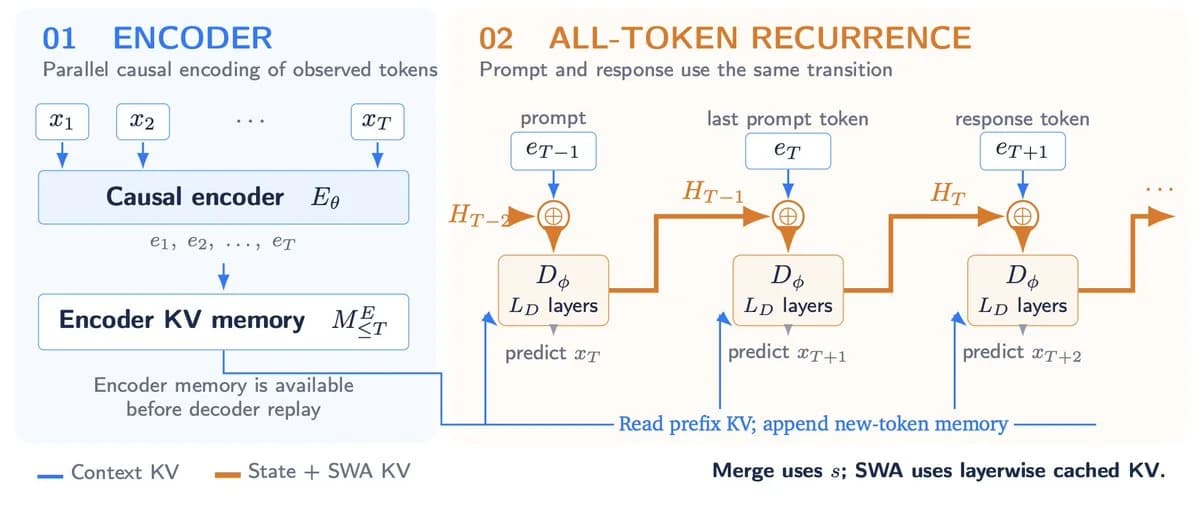
A GitHub repo published on September 12, 2026 by Princeton PhD researcher Yifan Zhang went viral with a bold claim: "infinite reasoning depth" via a new architecture called the Recurrent Looped Transformer (RLT). Within a day, it had 124 stars, a viral X thread declaring "the dawn of Superintelligence," and roughly as many people asking pointed technical questions as there were people hyping it.
The paper itself is more careful than the tweet that sold it. Here's what RLT actually proposes, why "infinite depth" is a specific technical claim rather than a marketing one, and where the real open questions are.
TL;DR
| Question | Answer |
|---|---|
| What is RLT? | An architecture with a causal encoder (global KV memory) plus a recurrent decoder that carries hidden state across every token |
| Does it have infinite depth? | The computation path length grows with sequence length — not infinite compute per token, per the paper's own README |
| Model size | 48 encoder layers + 48 decoder layers, shared attention/FFN weights across stages |
| Has it been trained or benchmarked? | No published checkpoint or benchmark as of release — this is an architecture proposal, not a result |
| How is it different from OpenAI Astra's recurrent depth? | Astra-style recurrent depth loops within one token's forward pass and resets; RLT's decoder state persists across the whole prompt-response sequence |
| Is this a monitorability risk? | Same category of concern as any latent (non-verbalized) reasoning — see explainx.ai's recurrent depth explainer below |
| Where's the source? | github.com/yifanzhang-pro/recurrent-looped-tranformer |
The actual mechanism
RLT's README lays out three design principles, and the second and third are more concrete than the first:
Latent reasoning with infinite temporal depth. For token xt, a causal encoder produces a representation et, and all encoder outputs up to t form a global key-value memory. The decoder maintains a state that combines this global memory with sliding-window attention (SWA) over recent decoder outputs, plus explicit feedback from its own previous final hidden state. Crucially, neither the recurrent output nor the SWA cache resets at the prompt-to-response boundary — the model's internal state is one continuous thread from the first token of the prompt through the last token of the response.
This is the mechanism behind the "infinite depth" framing: with decoder depth LD (number of layers), the computation path traverses t × LD blocks after processing t tokens. The number of blocks executed per token is fixed — RLT isn't doing unbounded extra computation on any single token — but the cumulative path across a long conversation keeps extending as the conversation grows, with no architectural ceiling. The README is explicit about this distinction: "infinite depth" means "an extensible temporal computation path as the sequence grows, not infinite computation within one token."
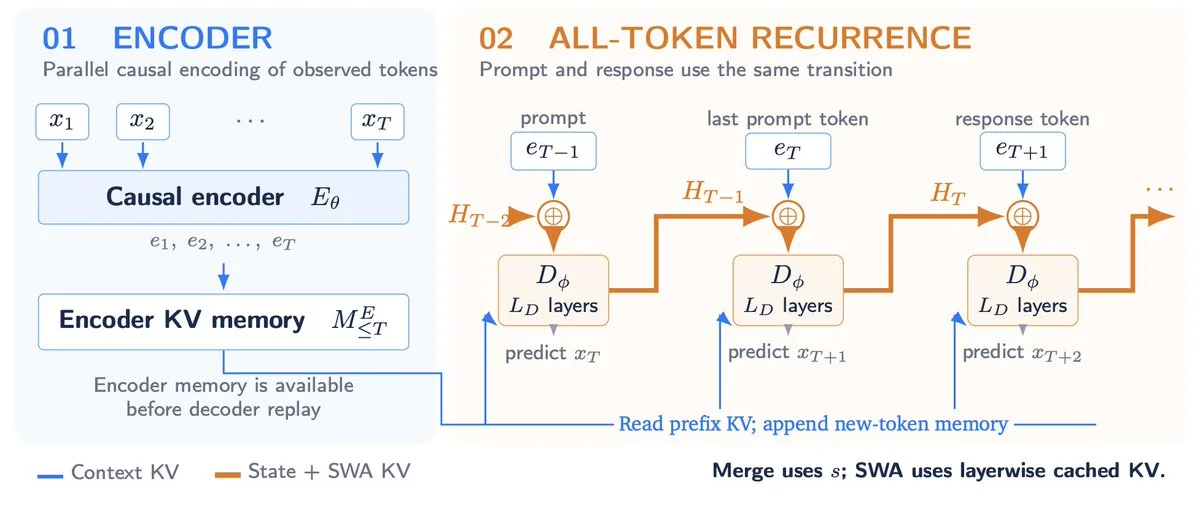
Model–hardware co-design. The paper argues the architecture creates opportunities for efficient training and inference: parallel encoder computation across the batch, memory reuse, and activation checkpointing around the recurrent decoder.
Model–RL algorithm co-design. RLT proposes using the same "complete-state transition" — including prompt recurrence and the decoder's SWA cache — across pretraining, supervised fine-tuning (SFT), and on-policy reinforcement-learning replay. In practice, this means the exact same mechanism that processes a prompt during generation is reused, unmodified, when reconstructing history for RL rollouts, rather than maintaining separate code paths for training and inference. The paper flags a real caveat here: exact current-policy RL replay requires rebuilding parameter-dependent caches after every weight update, which is expensive, and detaching any of the recurrent outputs, decoder KV, or encoder memory during training is explicitly called out as "a gradient approximation" — a shortcut with consequences, not a free simplification.
How this compares to recurrent depth you may already know about
If "reusing layers to add reasoning depth" sounds familiar, that's because it's related to — but distinct from — the recurrent-depth technique explainx.ai has covered in What Is Recurrent Depth? AI Reasoning You Cannot Read, the mechanism researchers believe underlies models like Huginn-3.5B and reportedly OpenAI's Astra.
| Standard recurrent depth (Huginn-style) | Recurrent Looped Transformer | |
|---|---|---|
| Scope of recurrence | Loops a layer block multiple times within one token's forward pass | Carries a persistent decoder state across every token in the sequence |
| Resets? | Yes — resets for the next token | No — state and SWA cache persist prompt-to-response |
| What grows | Effective depth per token (bounded, chosen at inference time) | Cumulative computation path length across the whole conversation |
| Chain-of-thought visibility | Already a known monitorability concern | Same or greater concern — the "temporal feedback" carries hidden state that is never externalized as text |
Both techniques share the same core trade-off explainx.ai flagged in the recurrent-depth piece: adding reasoning power without writing that reasoning as inspectable text is efficient, but it moves the reasoning into a space nobody outside the model can read. RLT's own citation of "current-policy RL replay" reconstructing full history including SWA caches suggests the authors are aware this makes training-time interpretability harder, not easier.
What the paper does not claim
It's worth being precise here because the viral framing badly outran the source material:
- No trained model or benchmark results. The repository, as published, contains the architecture paper (English and Chinese versions), a project webpage, and a figure. There is no checkpoint, no evaluation against GPT-6 Astra, Fable 5.1, or any other frontier model, and no claim of state-of-the-art performance anywhere in the material.
- "Infinite" is a structural property, not a capability claim. The README's own disclaimer — "reasoning improvements, hardware efficiency gains... are research goals rather than measured results in this report" — directly undercuts any claim that this architecture has demonstrated superintelligent reasoning.
- The name confusion matters. The viral tweet was posted by an account named "Yifan Zhang" (@yifanzhang_), which appears to be the same individual as the paper's listed author, a Princeton PhD student and AI Lab Fellow with a background at NVIDIA, ByteDance Seed, and Tsinghua IIIS. Whether the "dawn of Superintelligence" framing reflects the author's genuine research claim or is a promotional amplification of a more modest architecture paper is a distinction worth keeping in mind before citing this as an established capability breakthrough.
What the skeptical replies got right
The most substantive pushback on X wasn't about the architecture's plausibility — recurrent/looped transformer variants are a legitimate, actively researched family, related to universal transformers and adaptive computation time work from years prior — but about the exact same monitorability and termination questions explainx.ai's recurrent-depth coverage already raised for other latent-reasoning architectures:
- How does it know when to stop? Commenters asked variants of this repeatedly. The paper's answer, implicit in its formulation, is the same as any autoregressive decoder: generation halts at an end-of-sequence token, a max-length limit, or in principle when the model's own state saturates — none of which is unique to RLT's recurrence mechanism, but the question surfaces because the "infinite" framing invites it.
- Prefill-decode kernel mismatch. The README itself links a dedicated note on this, acknowledging that "shared execution semantics remove structural prompt-boundary mismatch but do not alone guarantee numerical kernel parity or an unbiased off-policy objective" — a candid admission that the theoretical elegance of unifying prefill and decode doesn't automatically translate into a bug-free, efficient implementation.
Why this matters even without benchmarks
Architecture proposals without trained checkpoints rarely move markets, and RLT shouldn't be read as a signal that "infinite reasoning" models are imminent. What it is worth watching for: whether any lab picks up the model-RL co-design idea — reusing one execution path across pretraining, SFT, and RL replay — since that's the more novel engineering claim in the paper, separate from the headline-grabbing "infinite depth" framing. If a group with real training compute reports results using this scheme within the next few months, that's the signal that RLT's actual contribution (rather than its viral framing) had legs.
For builders, the practical takeaway today is nothing changes: there's no RLT checkpoint to run, no API, and no benchmark comparison to weigh against GPT-6 Astra or Fable 5.1. The paper is worth reading if you're interested in architecture research; it's not yet something to build on.
Why "infinite depth" claims keep going viral
RLT is not the first architecture paper to get a viral reception disproportionate to its published results, and it won't be the last. The pattern is consistent: a technically interesting but unvalidated idea gets summarized in a tweet using maximalist language ("infinite," "superintelligence," "dawn of"), and the tweet's reach outpaces anyone actually reading the linked PDF. This matters for builders and researchers alike because the gap between "here is an architecture with an interesting theoretical property" and "here is a trained model that outperforms existing systems" is enormous, and it's routinely elided in social media summaries.
The honest comparison point is the recurrent-depth research that has actually shipped in production models. Huginn-3.5B is a real, trained, openly documented model that demonstrably uses layer-looping to add reasoning depth, and researchers have published concrete evidence — discussed in explainx.ai's recurrent-depth explainer — that OpenAI's Astra likely uses a related technique based on observed latency and chain-of-thought patterns. Those are falsifiable, benchmarked claims. RLT, as of its September 12 release, is a design document with a compelling diagram and no falsifiable performance claim attached. That doesn't make it uninteresting — universal transformers, adaptive computation time, and looped-layer designs are a legitimate, decades-old research thread that RLT extends with a genuinely novel training-inference unification idea — but it does mean the "superintelligence" framing belongs to the tweet, not the paper.
If you're deciding whether to invest engineering time reproducing RLT's approach, the two things worth tracking are whether the author (or anyone else) publishes a trained checkpoint with benchmark numbers, and whether the model-RL co-design claim — reusing one execution path across pretraining, SFT, and current-policy RL replay — gets independently validated. Until then, treat this as a research direction to watch, not an architecture to adopt.
Related reading
- What Is Recurrent Depth? AI Reasoning You Cannot Read
- What Is Transformer Architecture? Attention and LLMs Explained
- Dario Amodei: "We Must Pace the Frontier"
- What Is Recursive Self-Improvement (RSI) in AI?
- GPT-6 Astra: Every Number That Actually Matters
Official source: github.com/yifanzhang-pro/recurrent-looped-tranformer
This post reflects the architecture paper and repository as published September 12, 2026. No trained model, benchmark, or checkpoint existed as of publication — check the repository for updates before citing performance claims.