



Perceptron has released Perceptron Egocentric 1.0, a self-service API that turns first-person human and robot video into structured training data. According to the company's launch post, it delivers subtask timelines, per-hand activity labels and 3D hand reconstruction at $29 per video-hour for the full set, or $9 for subtask timelines alone, versus about $76 per video-hour for GPT-6 Astra timelines.
The benchmark behind the comparison was written by Perceptron. This post explains what the API outputs, what it costs, and which parts are checkable.
TL;DR: price, scores and caveats
| Question | Answer |
|---|---|
| What is it? | Self-service API for annotating egocentric video (human and robot) |
| Subtask timeline price | $9 per video-hour, always included |
| Add-ons per video-hour | 2D hand tracking $12, 3D hand tracking $14, per-hand activity labels $6 |
| Full stack price | $29 per video-hour (9 + 14 + 6) per Perceptron |
| EgoHome score (4 fps) | 0.787 versus 0.797 for GPT-6 Astra at 4 fps (about $76) |
| WGO-Bench | Highest segment F1 (0.583) and second-highest semantic F1 (0.474), per Perceptron |
| Batch size | Up to 1,000 video links per request |
| Independent test | None yet; EgoHome data and metric code come "in the coming days" |
Why does robot video need annotation?
Robot learning is short of labeled demonstrations. Egocentric video, filmed from a worker's head or a robot's camera, is easy to record in bulk. Turning it into training signal is the hard part: someone, or something, has to say what happened and when. We explain the data side in our guide to egocentric data collection for robots.
Perceptron's point is that grasping, releasing or turning an object can take a fraction of a second. Annotation at whole-second resolution lumps those steps together, which hides the timing a policy needs to learn. Its API segments each video into timestamped subtasks, including short ones, and labels what each hand is doing.
What does the API output?
Per the launch post, the service combines specialized models in a custom annotation harness. It produces:
- Subtask timelines. Timestamped steps for the whole video, always included.
- Per-hand activity labels. A separate timeline for each hand or robot gripper, with a short description of what it is doing at each step.
- 2D or 3D hand tracking. 2D keypoints or a 3D mesh for each hand, with shape, finger articulation and position relative to the camera, built on Perceptron's Mk1.5 model. No camera calibration is needed.
The launch page shows examples on household dish washing, robot sorting from the Galaxea Open-World dataset and factory work from Build AI's Egocentric-10K dataset. In one example, the left hand holds a frying pan while the right hand works a faucet and sponge, and each hand gets its own labels.
What does one label look like?
The launch viewer shows structured fields for every step. For a dish-washing clip, the subtask reads "Wipe pan rim with blue sponge." Each hand then gets its own entry: the left hand holds the frying pan by its handle in the sink, with action "hold," object "frying pan handle," contact "yes" and visibility "visible." The right hand holds the blue sponge in the sink water with the same fields.
Those fields are useful for training. Contact tells a policy when a grasp begins and ends. Visibility tells it when to trust a hand estimate and when the hand is out of frame. Robot grippers get their own timelines in the same format, but no hand keypoints or mesh.
When would you use a general model instead?
A general model such as GPT-6 Astra answers questions about video that go beyond this schema, such as "why did the person stop?" Perceptron's service is built for one job: producing consistent, structured timelines at volume. If your dataset has thousands of hours and a fixed label schema, a specialized API is the natural fit. If you annotate a few clips with changing questions, a general model's flexibility may be worth the price.
What does it cost?
Pricing is per hour of video, by output:
| Output | Per video-hour |
|---|---|
| Subtask timeline (always included) | $9 |
| 2D hand tracking (add-on) | $12 |
| 3D hand tracking (add-on) | $14 |
| Per-hand activity labels (add-on) | $6 |
Videos shorter than a minute are billed as one minute, so a pile of very short clips costs more than their running time suggests. Credits are held when a job starts and charged only if it succeeds. Perceptron offers volume discounts through its sales address.
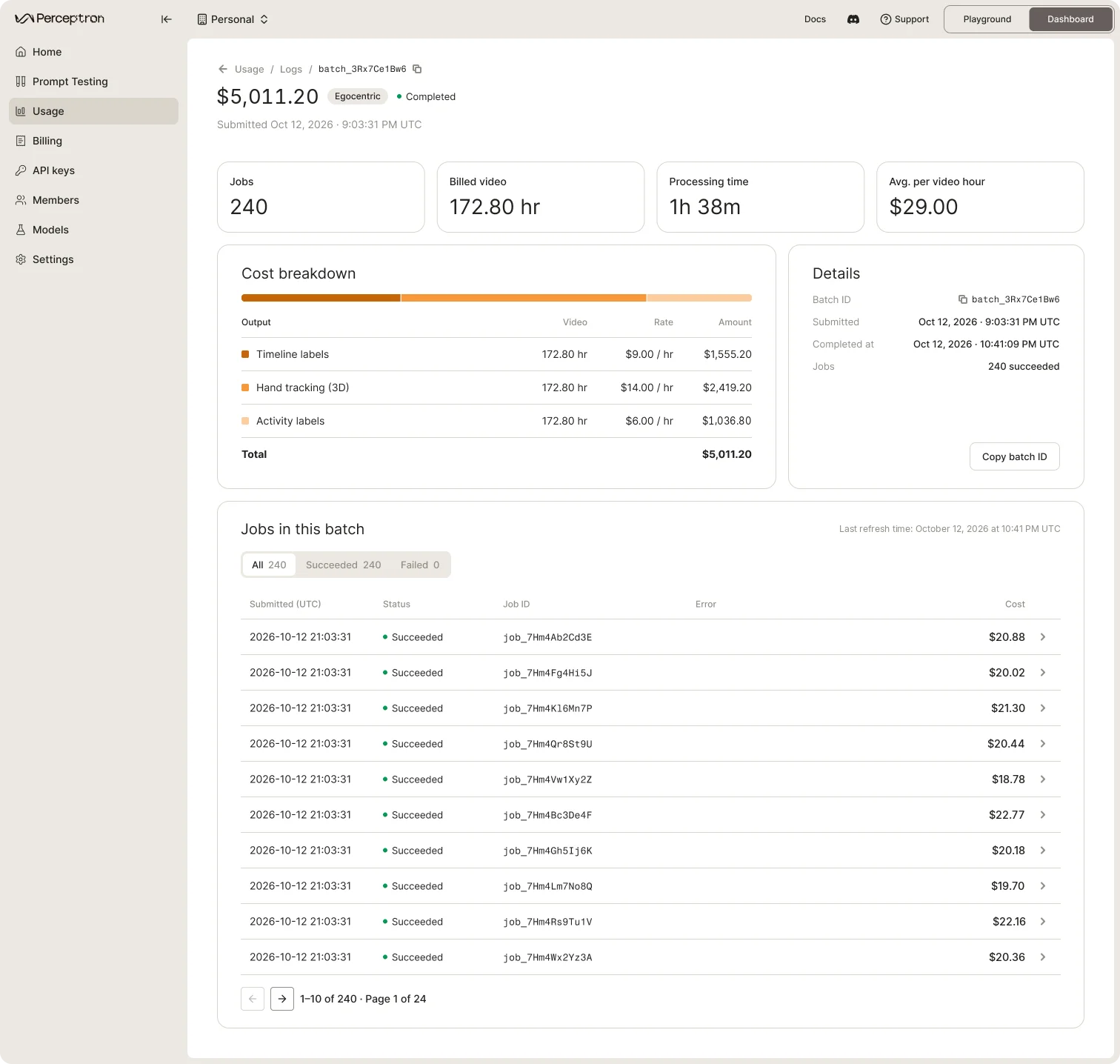 Perceptron dashboard showing a batch of 240 egocentric annotation jobs and cost by output
Image: Perceptron
The dashboard shows each batch with its status, hours processed and credits charged. The example in the launch post is a batch of 240 jobs and 172.8 billed video hours.
How good is it? The EgoHome results
Perceptron built a new benchmark, EgoHome, with 137 manually verified clips covering about two hours of first-person household chores. In 24 clips, at least one step is shorter than half a second. A Gemini 3.5 Flash judge scores how well predicted and reference steps agree, using a permissible subsegment Jaccard metric that tolerates coarse versus fine labeling.
Perceptron's table (higher is better, cost per video-hour):
| System | EgoHome score | Cost |
|---|---|---|
| Perceptron Egocentric, 8 fps | 0.798 | about $15 |
| GPT-6 Astra, 4 fps | 0.797 | about $76 |
| Perceptron Egocentric, 4 fps (default) | 0.787 | $9 |
| GPT-6 Astra, 1 fps | 0.775 | about $20 |
| NVIDIA FLORA | 0.747 | $35.39 |
| Glimpse (Elorian), 4 fps | 0.689 | about $2.8 |
| Gemini 3.8 Flash, 4 fps | 0.663 | about $1.3 |
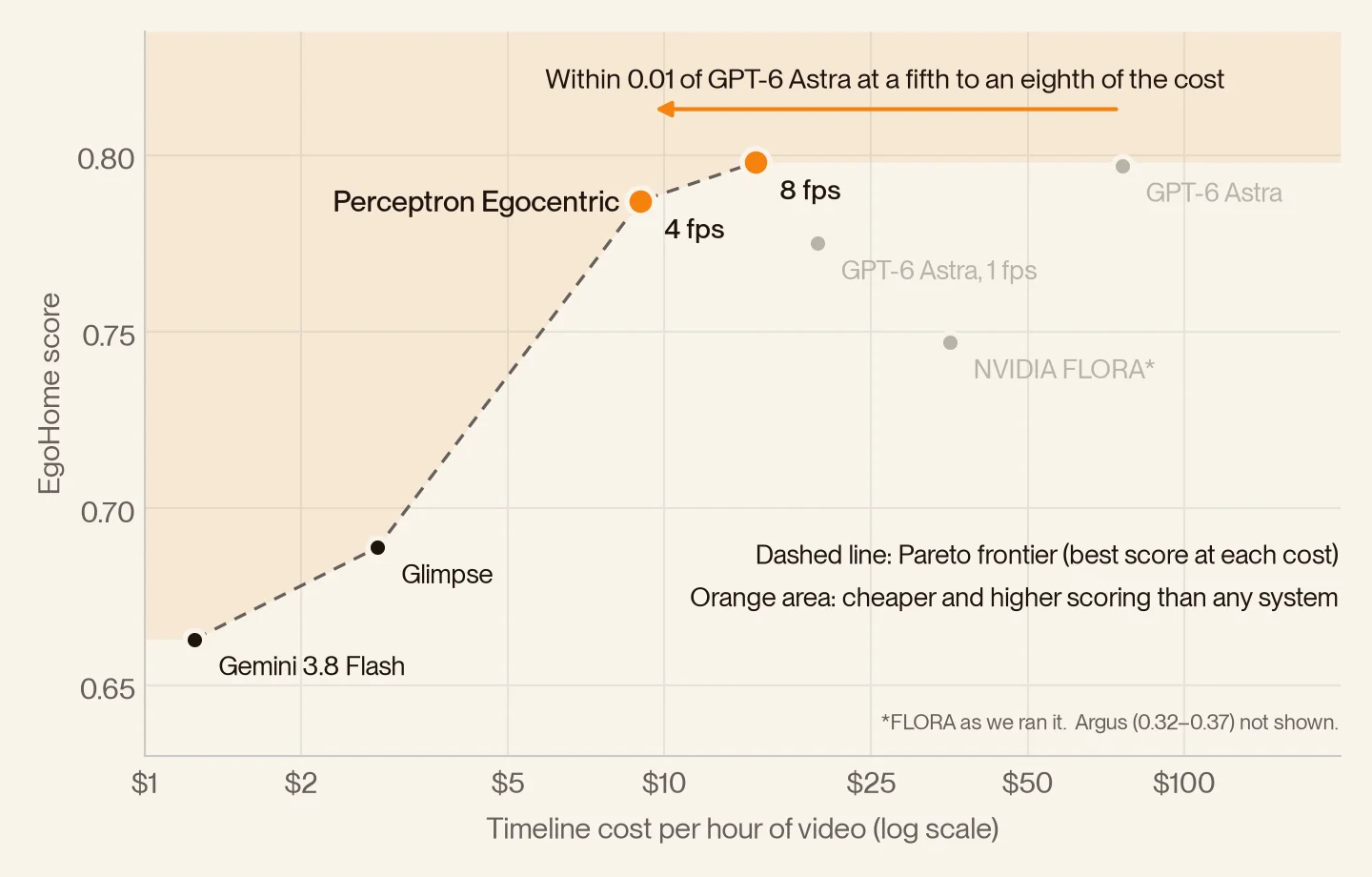 Perceptron Egocentric 1.0 chart of EgoHome annotation quality against cost per video-hour with the Pareto frontier
Image: Perceptron
The chart shows the claim: both Perceptron settings sit on the quality-per-cost frontier. For steps under half a second, Perceptron's own table shows GPT-6 Astra at 1 fps (0.595) and FLORA (0.579) scoring slightly above Perceptron (0.559). That is a candid detail, and it matters if your task is dominated by very short actions. On the other cost end, Gemini 3.8 Flash and Glimpse are far cheaper but score noticeably lower.
The public benchmark
On WGO-Bench, a public benchmark of 100 videos, Perceptron reports the highest segment F1 (0.583) and the second-highest semantic F1 (0.474), behind a system called Argus at 0.502. Scores marked self-reported for rivals were taken from external sources and not reproduced. The WGO-Bench description comes from Macrodata Labs.
Hand tracking accuracy
On HOT3D and ARCTIC, two standard first-person hand benchmarks, Perceptron reports a hand-shape error of 5.21 mm on HOT3D with or without camera calibration, and says it is 12 to 25 percent more accurate than ACE-Ego-Hand in all four settings. Its hand-pose error is higher than ACE-Ego-Hand on HOT3D (15.62 versus 12.89 millimeters when calibrated), so the lead is in shape, not in every metric.
What should you question?
- Perceptron wrote EgoHome. The clips, the metric and the judge are the company's. It says the model was trained without EgoHome clips, and the data and code will be released in the coming days. Wait for that release before relying on the ranking.
- Judge-based scoring. An LLM judge decides when coarse and fine labels match. Judges can favor some label styles.
- Cost comparisons mix pricing models. Perceptron's price is a customer price. GPT-6 Astra and Gemini costs are API charges for the timeline's share of a larger bill. FLORA's cost is GPU runtime. Costs marked as estimates are estimates.
- Single runs for rivals. Perceptron averaged three runs at 4 fps and two at 8 fps; others ran once.
- Scope. The test is household video. Factory or surgical video may behave differently.
How does it fit the robot data stack?
Annotation is one layer in a pipeline that also includes capture devices, simulation and policy training. For related pieces, see NVIDIA's open FLORA models for robot data, Nature Will's Natura-1 dexterous hands model trained on egocentric human video, and our post on LiberAI's glove-trained Liber-0. All three argue that human experience is the cheap source of robot skill, and each needs labels.
How to try it
- Create an API key in the Perceptron dashboard and read the egocentric guide for limits and errors.
- Pick 20 clips from your own domain, with a mix of short and long steps.
- Submit a batch with a POST to the egocentric batches endpoint, choosing 3D hand tracking and hand activity if you need them.
- Poll the jobs and download the result JSON for each.
- Spot-check 10 percent of the output against the video, focusing on sub-second steps.
- Price your corpus. Multiply your hours by the per-output rates, and ask for a volume quote.
The API is asynchronous and batch-based, with seven endpoints for submitting, listing and retrieving batches, jobs and results.
Bottom line
Perceptron Egocentric 1.0 is a practical product for teams that need labeled first-person video without building their own pipeline. The headline claim, near-parity with GPT-6 Astra at one-eighth the cost, is supported by a benchmark the company built and ran. It is a credible start with candid caveats, and worth a small pilot. Wait for the EgoHome release and for independent runs before you commit a large dataset.
Details reflect Perceptron's November 4, 2026 launch post. Prices, scores and limits may change.