



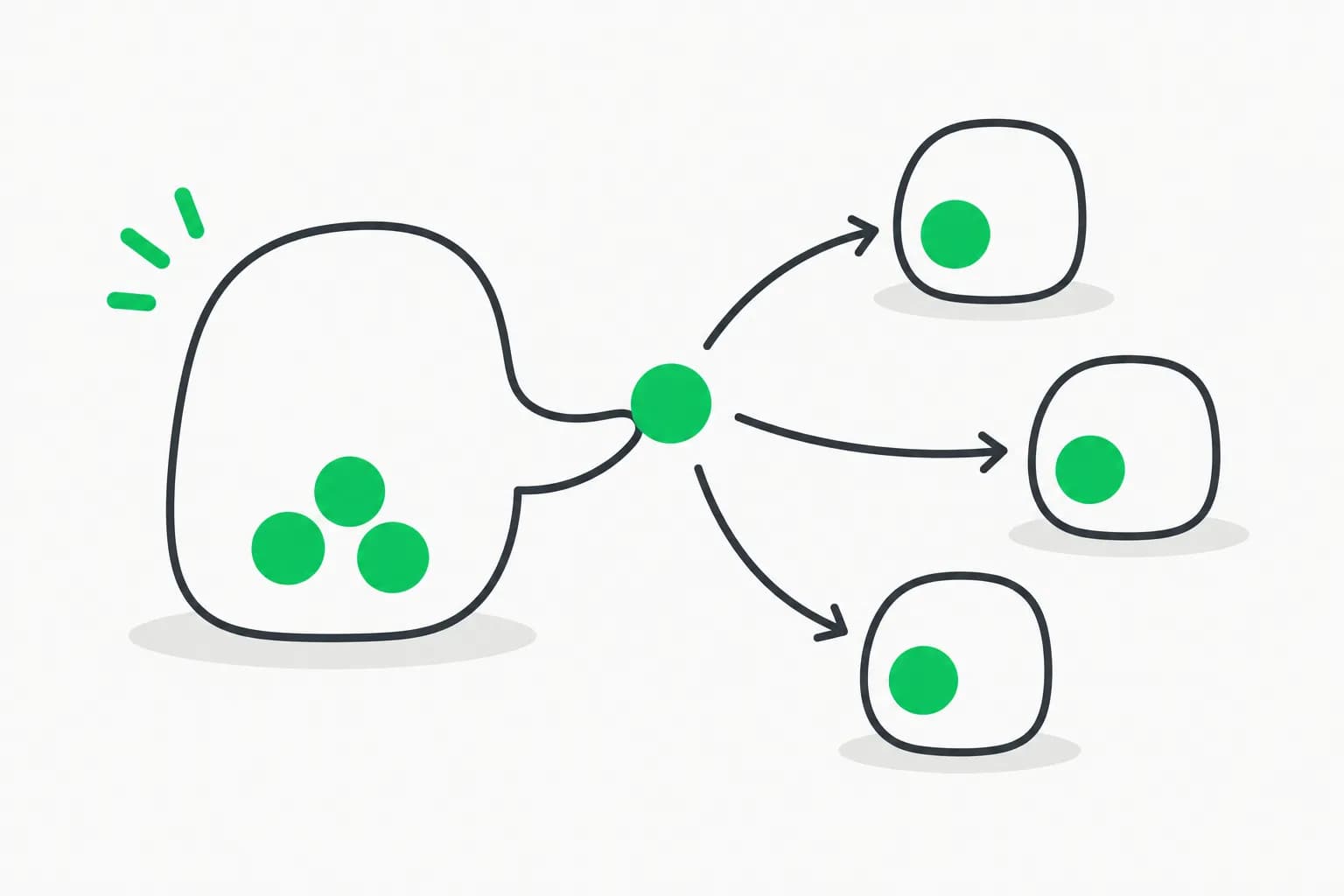
OpenAI says it can turn a dataset that would take human scientists "months to a year" to work through into a literature-linked map of hypotheses in 32 minutes, by splitting the job across thousands of AI agents. In a post published October 21, 2026, OpenAI, PerturbAI and Scripps Research describe running agents powered by GPT-Rosalind over a whole-brain CRISPR atlas, a dataset showing how disrupting individual genes changes different cell types across the mouse brain. This post explains the method, the numbers OpenAI reports, the two biological leads it highlights, and what a reader should and should not conclude.
TL;DR: the claims
| Claim | Source and status |
|---|---|
| Thousands of GPT-Rosalind agents analyzed data from millions of mouse brain cells in 32 minutes | OpenAI post; method in linked paper |
| Comparable human analysis would take months to a year | Research team's estimate |
| At the largest workload, distributed agents cited 700+ references; a single agent cited 11 | OpenAI, with model and resources held fixed |
| Experts preferred distributed-agent reports 75% of the time | Blinded comparison, reported by OpenAI |
| Agents reproduced findings from human analyses and found extra leads | OpenAI; novelty ratings aligned with blinded experts |
| Reasoning atlas available to researchers | OpenAI post links it |
How does "distributed biological reasoning" work?
Modern perturbation experiments knock out thousands of genes and measure the effect in millions of cells. The bottleneck is no longer the lab work but interpretation: connecting each result to decades of scattered literature. OpenAI's answer, which it calls distributed biological reasoning, is to divide the dataset. Each agent investigates a single gene disruption in the atlas, analyzes the cellular responses, searches the scientific literature and proposes explanations. The individual reports are then combined into a "reasoning atlas" linking genes, cellular effects, publications and possible mechanisms.
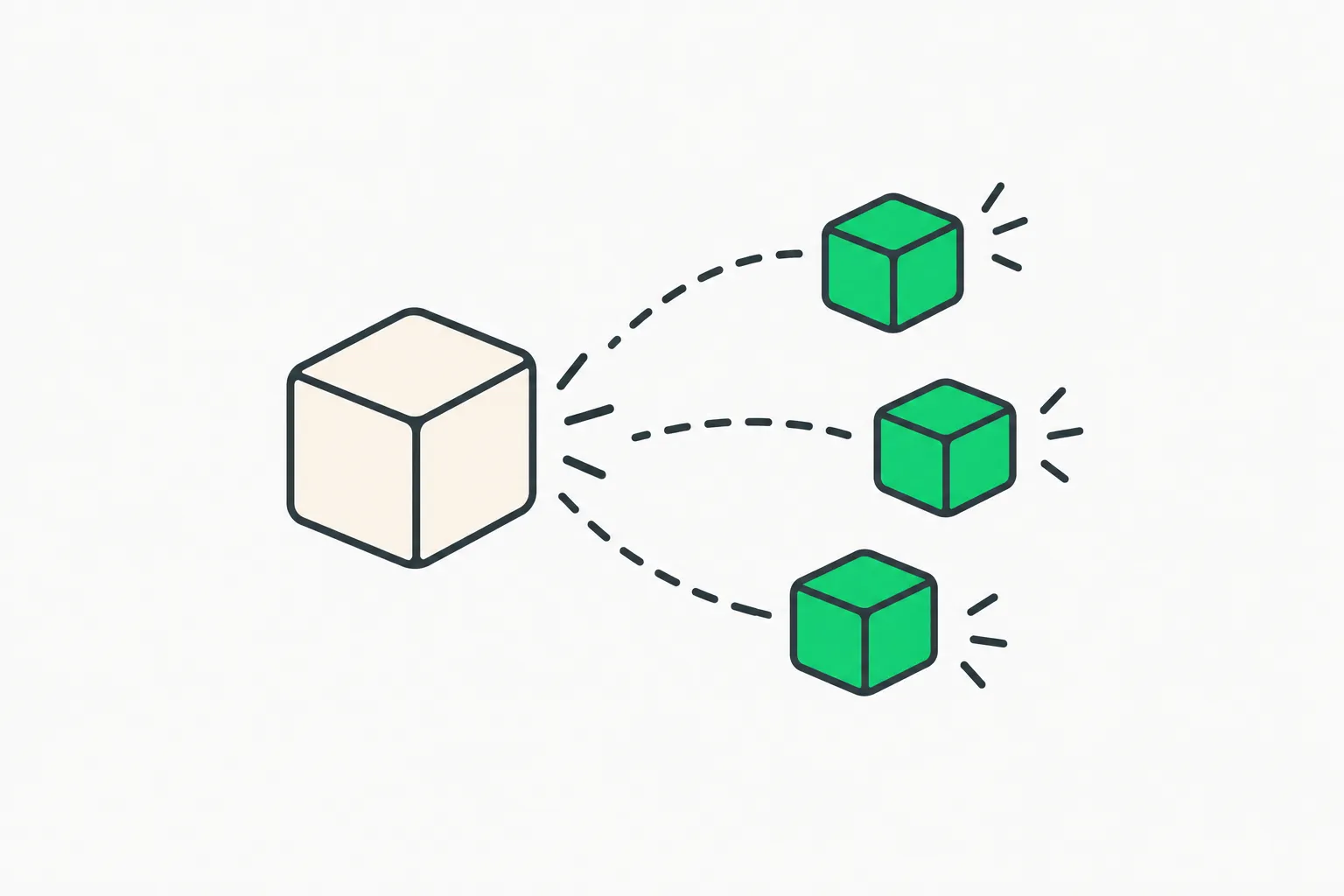 A large cream block separating into three smaller green blocks, illustrating many agents splitting a biology dataset in parallel
The agents run on GPT-Rosalind, the life-sciences model OpenAI introduced earlier this year in its GPT-Rosalind announcement. We have followed that line of products: the Rosalind Academic Plan, the Rosalind workbench for life sciences, the LifeSciBench benchmark and the Orchestra Bio acquisition. This is the first of these where OpenAI shows a large-scale, parallel run on a real experimental dataset with outside partners.
Why use thousands of agents instead of one?
OpenAI ran a control: could one agent given the whole dataset do as well, holding the model and compute budget fixed? As the workload grew, the single agent searched less of the literature, citing just 11 references at the largest size. The distributed agents cited more than 700. Human experts preferred the distributed interpretations, 75% of the time in blinded comparisons.
The intuition is familiar from anything with a long context. One agent has a finite working memory and tends to chase the strongest signals; many agents each with a narrow task can afford to look at subtle ones. It is the same logic behind the sub-agent setups developers use for large code changes. Note the limits of the control, though: it compares a single agent with a swarm, not with a pipeline of a few agents or a different decomposition, and the number of references cited is a measure of breadth, not of correctness. A citation count says the agents read more; it does not say they read it right.
What is a perturbation atlas, and why is it hard to read?
A CRISPR perturbation atlas is built by switching off one gene at a time across many cells and then measuring what changes, typically which other genes become more or less active in each cell. Scale is the point: thousands of disruptions, millions of cells, many cell types. The output is less a single answer than a very large table of cause and effect, where each row is a gene disruption and each column a cell type and a set of downstream responses.
Reading that table well means knowing the literature on each gene, which is why the work has traditionally gone one perturbation at a time. A scientist follows the strongest signals, because there is no time to follow all of them, and the faint or surprising responses are the ones most likely to be skipped. That is the gap OpenAI is aiming at. The pitch is not that agents replace the biologist's judgment about what is real, but that they do the exhaustive first pass so human attention goes to the most promising rows.
It also explains why the dataset was a good test. The ground truth is partly known: human analyses of the same atlas exist, so OpenAI could check whether the agents reproduced established findings before looking at what was new. Reproducing known results is a sanity check on the pipeline, and it is the claim in the post that is easiest for outside groups to verify against the published human analyses.
What leads did the agents surface?
OpenAI highlights two.
Tsc1 versus Tsc2. Both genes work together to control mTOR, a regulator of cell growth, metabolism and aging. Disrupting either had similar effects in several neuron groups. In the cerebellum, though, disrupting Tsc2 altered the activity of dozens of genes involved in neuronal communication, while disrupting Tsc1 produced little change. OpenAI notes that in people with tuberous sclerosis, cerebellar abnormalities are strongly linked to TSC2 mutations, and that mTOR-reducing medicines treat some tumors and seizures but not the learning and behavioral difficulties. The agents pointed to a specific group of neurons worth testing.
DCTN1 and cholesterol. DCTN1 helps move cargo inside neurons, and its mutations cause Perry syndrome, a neurodegenerative disease with Parkinson-like symptoms. In the atlas, disrupting Dctn1 raised the expression of cholesterol-making genes. The agents tied that to research suggesting cholesterol-transport problems can make cells produce more cholesterol, and raised a follow-up question: does DCTN1 disruption change how cholesterol is distributed in neurons, and could that contribute to neurodegeneration? Experts judged the hypothesis novel and worth pursuing, OpenAI says, and Tomasz Nowakowski of UCSF is quoted calling the neuronal-function and cholesterol-metabolism link a new way to think about disease biology.
Both are hypotheses. Nothing in the post reports a wet-lab test of either one.
What should a careful reader question?
- Hypotheses, not results. The agents generate explanations from existing data and literature. Their value depends on follow-up experiments that have not been reported.
- Novelty is judged by humans on the team's setup. OpenAI says assessments of novelty and scientific value "aligned" with blinded experts. The paper should say how many experts, how they were chosen and what rubric they used.
- Literature hallucination risk. Hundreds of citations raise the chance of a wrong or irrelevant one. Ask whether citations were verified automatically.
- Mouse data. The atlas is of mouse brain cells. Human relevance is argued by analogy to human disease, such as tuberous sclerosis, and is untested here.
- Cost. The post gives the time (32 minutes) but not the compute or dollar cost of running thousands of agents, which matters to any lab deciding whether to copy the approach.
- Vendor-run evaluation. OpenAI and partners ran the comparisons. Independent replication on another dataset would be the strongest check.
Why does it matter beyond biology?
The pattern is general: split a large analysis into many independent units, give each agent a narrow task with tools such as literature search, and merge the outputs into a structured artifact people can browse. Genomics, materials science and security log analysis all have that shape. It also raises a governance question for science: when the first-pass reading of a dataset is done by agents, who checks the claims, and how are mistaken ones kept out of the literature? OpenAI's framing is that scientists stay at the center, with AI helping them decide which ideas to pursue and which experiments to design. Our coverage of AI-driven antimicrobial discovery with DeepMind and Antigravity shows a comparable agentic-science effort from another lab.
What would make the result convincing?
Four things would move this from an interesting demonstration to evidence. First, a wet-lab test of at least one lead, such as measuring cholesterol distribution in neurons after Dctn1 disruption. Second, a published false-positive rate: of all the hypotheses the agents proposed, how many did experts rate as wrong or unsupported, not just how many were rated novel. Third, a replication on a different atlas, ideally human cells, run by a group outside the original team. Fourth, a cost figure, so labs can judge whether the approach is affordable at their scale. None of these are in the announcement, which is normal for a launch post, and several may appear in the paper.
For readers who track AI-for-science claims, the useful habit is to separate three layers: what the model produced (a hypothesis and citations), what humans judged (novelty and value, on a blinded rubric), and what nature confirmed (an experiment). This post reports the first two layers. The third is still to come, and until it does, the best description is a faster way to generate and rank leads, not a discovery of how brain disease works.
How can you try it?
OpenAI says the reasoning atlas is open for researchers to explore, to compare related genes and look into unexpected responses, and it links the full paper. If you are a life-science lab, the practical path is to read the paper's method section first, then check whether your data fits the one-unit-per-agent pattern. Access to GPT-Rosalind itself has been through a trusted-access program; the Academic Plan we covered above is the route for eligible US labs.
Related reading
- OpenAI Rosalind Academic Plan
- OpenAI Rosalind workbench for life sciences
- OpenAI LifeSciBench and GPT-Rosalind
- OpenAI acquires Orchestra Bio
- OpenAI GeneBench Pro and computational biology
- DeepMind and Antigravity antimicrobial peptide discovery
Details reflect OpenAI's October 21, 2026 post; the linked paper and atlas may add detail.