




OpenAI says GPT-6 can design new protein shapes and amino acid sequences using prompts, reasoning, and code—not by routing every step through a dedicated protein foundation model. In a November 24, 2026 research post and companion preprint titled GPT‑6 as a Universal Foundation Model for Protein Biology: Beyond Specialized Models, the lab reports computational wins on many benchmarks and wet-lab binding evidence on five protein targets after partner Onava synthesized candidates.
The practical headline for builders is not “replace RFdiffusion tomorrow.” It is that natural-language constraints—where a minibinder should attach, how many helices to include, which atoms must stay fixed—can ride on the same GPT-6 stack teams already use for code and analysis, while specialized models remain in the loop for sequence filling and filtering before anyone orders DNA.
TL;DR: what OpenAI claims versus what the lab measured
| Topic | What OpenAI reports |
|---|---|
| Core claim | GPT-6 family models have intrinsic protein-design skill: structures + sequences via reasoning/code |
| Minibinder screen | 322 synthesized minibinders from GPT-6.2 backbones → 35 hits (10.9%) across 5/5 targets |
| Target spread | Hits on PD-L1 (5), IL-7Rα (3), TrkA (1), VEGF-A (8), IL-17A (18) |
| Sequence redesign | Gave 3D structures, hid sequences → 85% / 62% / 14% binding on MDM2 / VEGF-A / PD-1 subsets |
| Antibody loops | 70% IL-4Rα VHH redesign binding; 66% on therapeutic antibody fragment screens |
| Still weak | Full structure prediction lags specialized models per OpenAI’s own table |
| Specialists used | SolubleMPNN, ProteinMPNN, ESMFold for sequence proposals and fold checks |
Why general models might matter for protein biology
For a decade, protein design meant chaining structure generators, inverse folding models, and fold predictors, each with its own input schema. Teams that already run OpenAI’s wet-lab agent benchmarks or watch Anthropic’s autonomous binder campaigns know the bottleneck is often coordination, not a single missing score. OpenAI’s earlier GPT‑5 and Ginkgo Bioworks cloud-lab work showed the same closed-loop idea: the model planned batches of experiments, robots ran them, and results fed the next round.
OpenAI’s framing is that a general model can accept new instructions—switch from ligand docking to minibinder scaffolding—by changing the prompt, analogous to how image models accept composition edits. That is the same direction Google’s VERID-style digital twins and Sakana’s agentic scientist stacks push: one agent loop, many scientific tools.
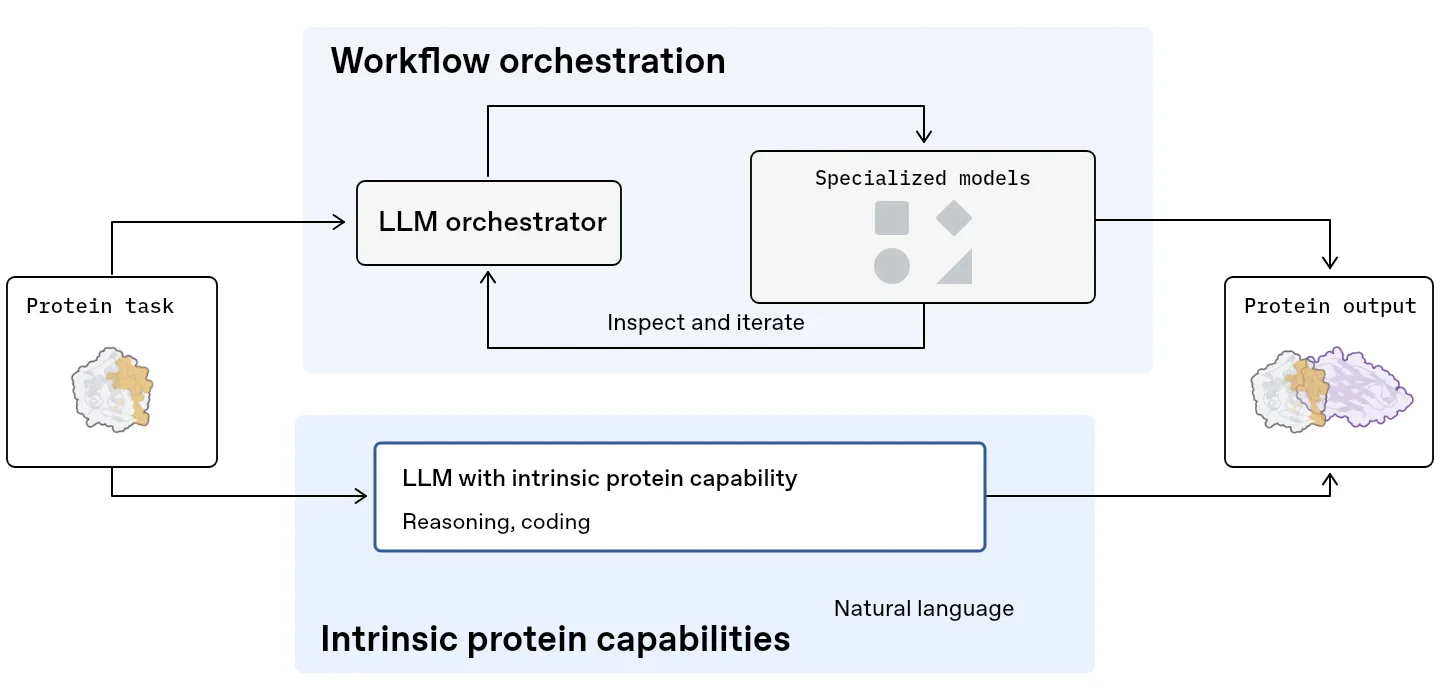 GPT-6 intrinsic protein design compared with coordinating specialized biology models
Image: OpenAI
Computational benchmarks: where GPT-6 matched specialists
OpenAI groups 14 protein tasks spanning binding design, motif scaffolding, fold specification, ligand pose prediction, and stability ranking. It reports newer GPT-6 generations matching or beating specialized models on most tasks, with complete de novo structure prediction still behind.
Two numbers builders will quote in meetings:
- Motif scaffolding (MotifBench-style): 43.7% success on an internal latest model vs 27.8% for RFdiffusion, using ProteinMPNN + ESMFold filters (computational only).
- Programmable minibinders: Models followed attachment site, structural class (helices vs strands), and counts with “near-perfect fidelity” in 3D designs per OpenAI—then still needed sequence models before lab work.
For readers tracking governance, intrinsic biology skill also shows up in GPT‑6 Rosalind system-card thresholds and DeepMind’s SynthID Bio watermarking: regulators and partners increasingly ask which outputs are AI-designed, not whether AI touched the workflow.
Laboratory experiment 1: minibinders on five immuno-oncology targets
OpenAI’s first wet-lab test asked GPT-6.2 to design minibinder backbones against five targets whose structures were provided, with binding sites marked. The model wrote code to propose shapes without calling specialized protein generators for those backbones.
The handoff to the bench is the part product teams should copy:
- GPT-6.2 proposes 3D minibinder shapes.
- SolubleMPNN proposes amino-acid sequences per backbone.
- Other specialized models rank foldability and predicted binding.
- Onava synthesizes and measures binding.
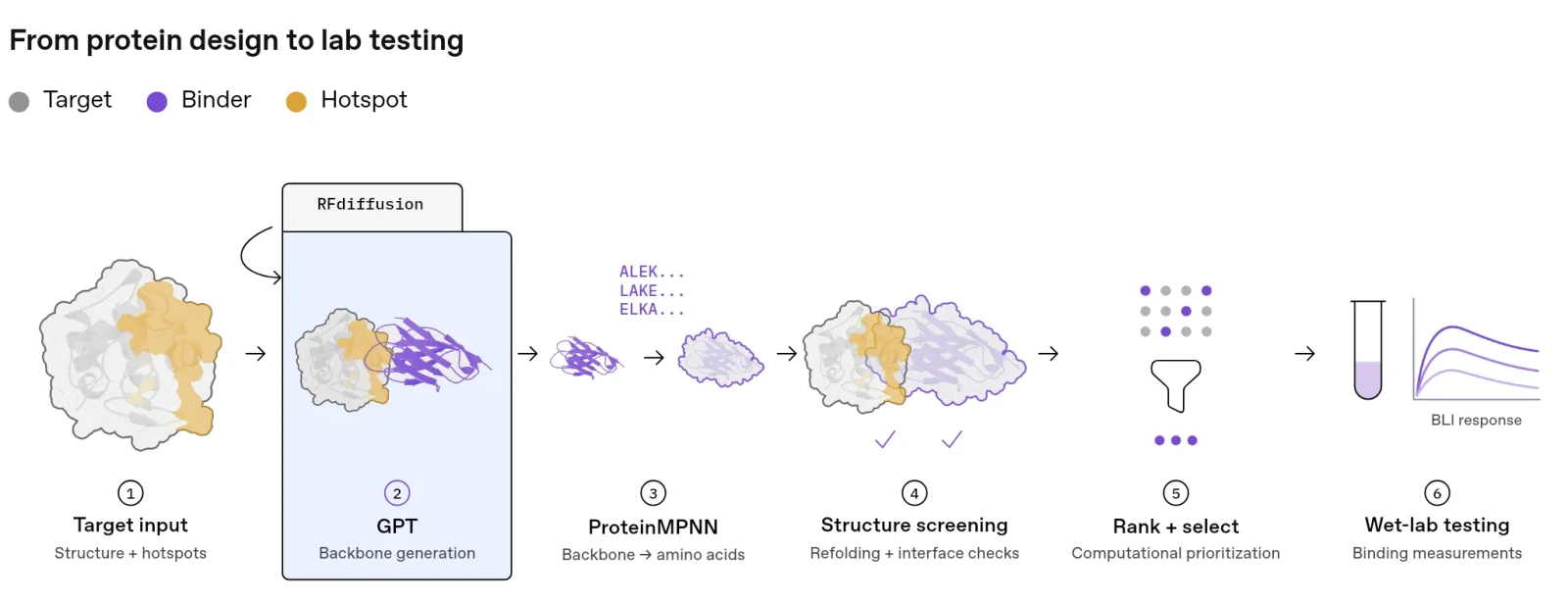 GPT-6 protein design workflow from backbone design through Onava lab binding tests
Image: OpenAI
322 minibinders entered the binding screen. 35 (10.9%) tested positive on their intended target, with at least one hit per target. OpenAI compares openly to RFdiffusion’s published minibinder campaign, which reported higher hit rates under different pre-lab filters—so treat cross-paper percentages as directional, not a bake-off.
For drug-discovery readers, the targets are familiar immuno-oncology names (PD-L1, PD-1 pathways, VEGF-A, IL-17A, etc.). Binding in a plate assay is not efficacy in cells or animals—the same caveat Anthropic stresses in Claude binder work applies here.
Ligand pose prediction: small-molecule docking without a chemistry stack
OpenAI also reports ligand docking tests where an internal model predicted how small molecules fit against protein surfaces, comparing predicted poses to published PoseBusters and Scarpino structures. The post shows overlays where purple model predictions align with teal experimental coordinates—evidence that GPT-6 class models can reason across physics and chemistry in code, not only draw protein backbones.
That matters for medicinal-chemistry teams who already benchmark OpenAI MedChemBench-style releases separately from structure work. Docking success in silico still does not guarantee synthesis routes or ADMET safety; it is another planning capability to fold into agent loops, similar to how DeepMind Gemini agents on quantum workloads pair general reasoning with domain executors.
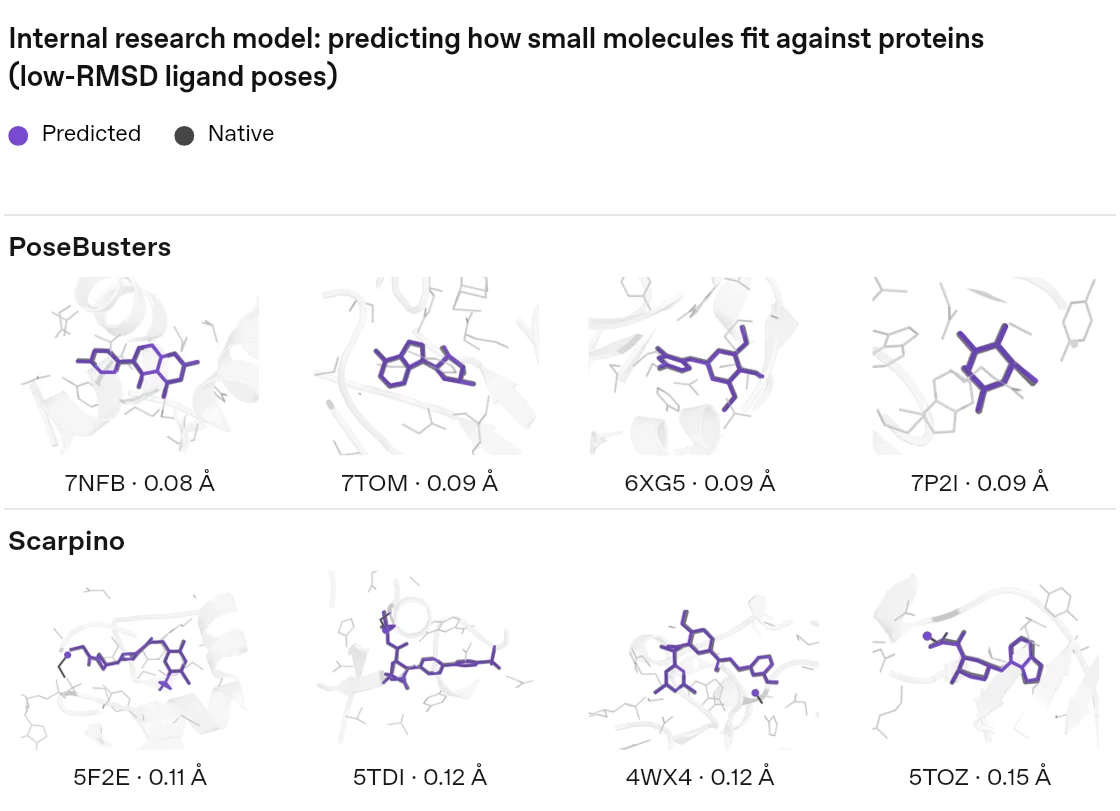 GPT-6 model predicted ligand poses overlaid on experimental protein structures
Image: OpenAI
Laboratory experiment 2: sequences without showing the answer
The second experiment withheld original amino-acid sequences while giving 3D complex structures of known minibinders. GPT-6.2 proposed new sequences; specialized rankers picked constructs for synthesis.
OpenAI reports 85% binding on MDM2, 62% on VEGF-A, and 14% on PD-1 in initial screens, with large sequence divergence from parents (medians 50%, 43%, and 15% amino-acid differences). On unpublished GPT-6.2 backbones, 14 of 107 (13.1%) new sequences still bound—OpenAI highlights one PD-L1 case where two GPT-6.2 sequences differed from each other at 44 positions and from the ProteinMPNN baseline at 52–58 of 90 residues.
Antibody loop redesign: affinity maturation without a bespoke tool chain
Therapeutic teams often tweak CDR loops to tighten binding or improve selectivity. OpenAI tested VHH redesign against IL-4Rα and fragment-level redesign on PD-1 / PD-L1 antibodies, reporting 70% and 66% binding in screens respectively when loops were partially masked.
That sits beside Claude’s October scorpion-toxin binder campaign and earlier multi-target binder results: frontier labs are converging on minibinders + loop engineering as the first wet-lab proofs for general models, not full de novo biologics.
How to try this workflow as a builder
OpenAI has not shipped a one-click “design a drug” button in ChatGPT alongside this post. A realistic reproduction stack today looks like:
- Use a GPT-6-class model with code execution to generate backbone coordinates under explicit geometric prompts (attachment site, secondary-structure class).
- Run inverse folding (ProteinMPNN / SolubleMPNN or open alternatives) on each backbone.
- Filter with ESMFold or another fold predictor before ordering genes.
- Budget lab validation the way Onava did—OpenAI’s 10.9% headline is meaningless without synthesis cost context.
If your org already uses OpenAI–Synopsys chip-design tooling, treat protein work as another domain where the general model orchestrates specialist binaries, not replaces them.
Teams comparing cloud cost should also read Tencent’s Hyra autonomous science release: the competitive question is who owns the loop from hypothesis to bench, not who wins one static benchmark.
Limits OpenAI flags openly
OpenAI’s post is explicit about weaknesses:
- End-to-end structure prediction remains behind dedicated structure models.
- Motif and fold successes are still computational unless followed by functional assays.
- Hit-rate comparisons to RFdiffusion depend on filtering policy, not just generator quality.
- Safety and misuse for protein capabilities are governed separately—see Rosalind evals for how OpenAI tiers biology risk.
What to watch next
OpenAI published on November 24, 2026; the next milestones readers should track are independent replication of the Onava numbers, any API or ChatGPT productization, and whether watermarking or registry rules (like SynthID Bio) attach to consumer-facing protein tools.
For agents automating literature-to-lab pipelines, pair this story with Hugging Face’s Harbor evaluation guidance: intrinsic science skill in the base model does not remove the need to grade whether the agent completed the bench protocol, not just the slideshow.
What is verified versus what only OpenAI has shown so far
OpenAI published structures, hit tables, and methodology on November 24, 2026. explainx.ai has not run an independent replication at Onava or another CRO. Treat three layers separately when you brief your team:
Verified from the post: task definitions, model names (GPT-6.2 and internal research builds), partner name (Onava), counts (322 minibinders, 35 positives), and the admission that SolubleMPNN / ProteinMPNN / ESMFold still sit in the pipeline.
Not yet verified externally: whether another lab reproduces 10.9% under the same filters, whether leads neutralize or internalize in cells, and whether API customers get any of this capability without a separate safety review.
Product status: no ChatGPT feature flag or API SKU is named in the announcement. Builders should assume research access only until OpenAI updates product docs.
If your org runs agentic science workshops or Claude-for-work curricula, use this post as a risk-and-scope case study: impressive binding headlines still need specialist tools, legal review, and wet-lab budget before they touch a pipeline.