




OpenAI says it is opening an election "war room" to track attempts to misuse its tools and to disrupt voting before the US midterms on November 3. The company told Decoded by POLITICO about the plan, and Politico's Calder McHugh reported it on October 28, per the headline summary, with the stated aim of identifying potential spread of misinformation or other efforts to disrupt the elections.
Here is the honest state of play: the existence of the war room rests on OpenAI's own statement to Politico. We could not open Politico's full article, and some secondary summaries add details, such as a unit name and staffing figures, that we have not confirmed. This post separates what is on the record from what is not, and explains the safeguards OpenAI published earlier, which are well documented. It sits alongside our coverage of Anthropic's midterm safeguards and OpenAI's takedown of Russia- and Iran-linked influence operations.
TL;DR
| Question | Answer |
|---|---|
| What was announced? | An election war room to watch for misuse and election disruption |
| Who reported it? | Decoded by POLITICO, on OpenAI's exclusive statement, October 28 |
| When is the vote? | November 3, 2026 |
| Confirmed details | The war room exists and aims to spot misinformation and disruption efforts |
| Unconfirmed details | Unit name, staffing numbers and exact scope from secondary summaries |
| Earlier plan | May 27-28 safeguards: AP results, Democracy Works, cyber tools, provenance, no political ads |
Agents that act on your behalf need rules. See how explainx helps secure your agents →
What did OpenAI actually say?
The Politico piece, as summarized by Techmeme, says OpenAI is launching the war room ahead of the midterms to identify potential spread of misinformation or other efforts to disrupt the elections. One secondary summary says the unit is meant largely to combat abuse of OpenAI's own tools by monitoring real-time events and handling reports of unexpected model behavior or suspected terms violations. We could not verify that framing against the original text, and we are not repeating the staffing figure that appeared in that summary for the same reason.
What the framing does tell you is the scope question that matters: is the war room watching OpenAI's products, or the broader information environment? A product-abuse team would act on accounts and outputs inside ChatGPT and the API. It cannot remove a deepfake that circulates on another platform. That limit applies to every lab, and is why OpenAI's prior plan leans on provenance signals and platform partners.
The safeguards OpenAI published in May
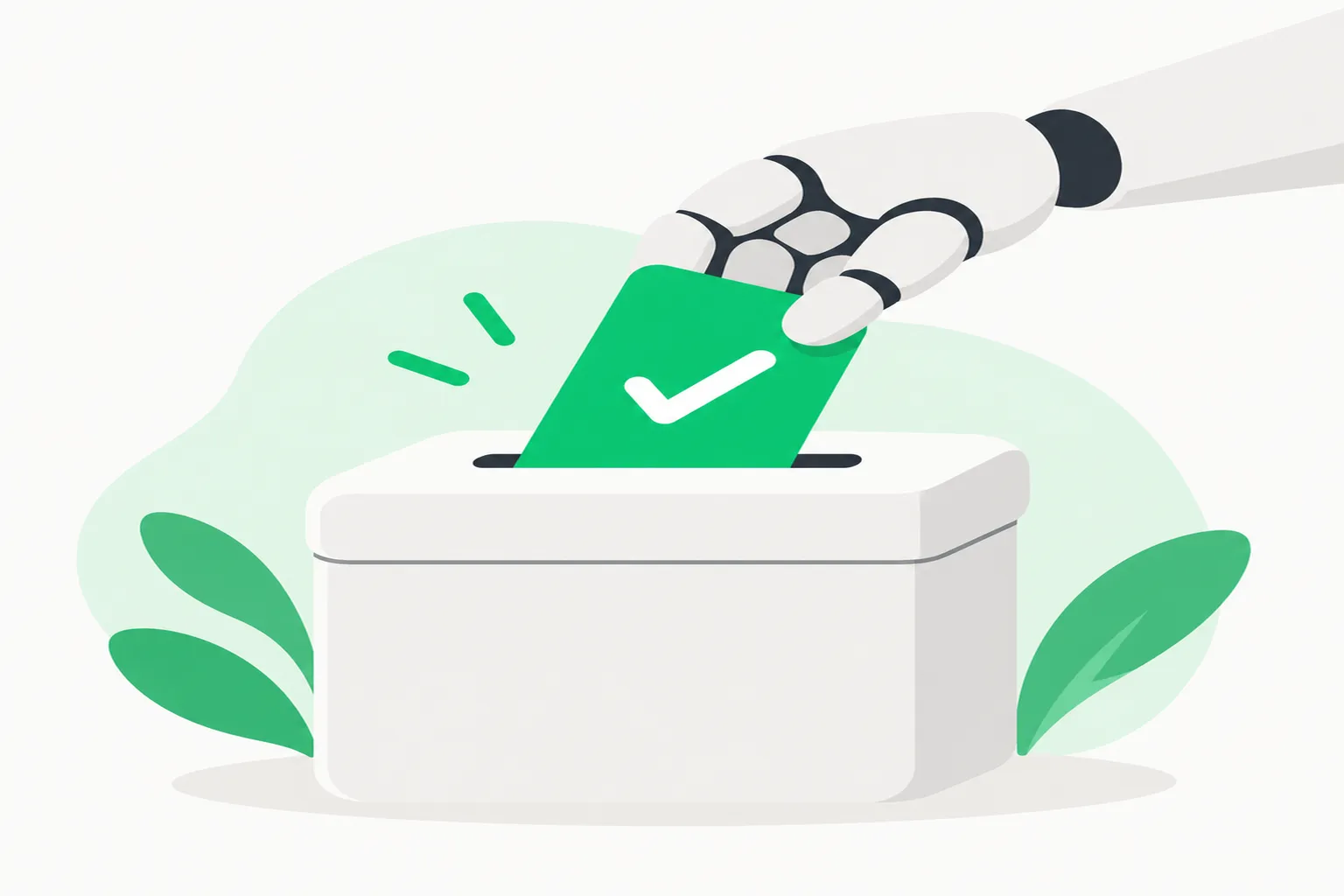 A ballot box receiving a checked card, illustrating OpenAI's election safeguards for the midterms
The war room builds on a plan OpenAI announced in late May, first reported by Axios and summarized by Campaigns and Elections:
- Reliable information. A partnership with the Associated Press for live vote counts on election night in the US and Brazil, and one with Democracy Works for voter registration and precinct information.
- Cyber defense. Cybersecurity products offered to registered voting system manufacturers, plus briefings for state election authorities through the National Association of Secretaries of State and the National Association of State Election Directors.
- Deepfakes. SynthID watermarks on images generated by ChatGPT and metadata with cryptographic signatures (C2PA) so provenance travels with the file.
- Rules. A ban on election interference, voter demobilization and deceptive campaigning, with OpenAI claiming its detection has improved since 2024.
- Advertising. Its newly launched ad business will not run political ads this cycle.
- Legislation. Support for the Protect Elections From Deceptive AI Act and the Preparing Election Administrators for AI Act.
OpenAI's own election safeguards page carries an October 20 update. It says the Democracy Works integration is now live in the US across languages, AP live vote counts come into ChatGPT after polls close, and requests for images depicting election interference or voter discouragement now get stylized, cartoon-like output instead of photorealistic images. It also says OpenAI offered Codex Security and Trusted Access for Cyber to registered voting-system manufacturers through its Daybreak program, and still bars political ads and scaled campaign messaging. The page does not mention a war room.
Campaigns and Elections also cited a Rainey Center poll in which about one in five voters had used or might use AI tools to learn about politics or decide how to vote, and 62 percent of voters were most concerned about false or misleading content.
How OpenAI compares with Anthropic and Google
A TechPolicy.Press analysis from June compared the three labs. Its findings, in brief:
| Area | OpenAI | Anthropic | |
|---|---|---|---|
| Voting information | AP and Democracy Works | Democracy Works banners linking to TurboVote | Links to official resources |
| Media provenance | SynthID and C2PA on ChatGPT images | No image, video or audio generation | Created SynthID; Gemini identifies watermarked uploads |
| Misuse policy | Bans scaled campaign messaging; intelligence and investigations team | Classifiers, threat intelligence team, agentic-campaign testing | Search, ads and YouTube policies |
| Cyber | Products for voting system makers | Mythos Preview for select partners; nothing election-specific announced | Defense programs without a clear AI focus |
The analysis also notes that OpenAI's statement allows some campaign uses while its formal policy bans "any use for political campaigning," a gap it flags as an inconsistency. It says xAI has no clear election policies. Treat that as the analyst's reading as of June.
Why a war room, and why now?
Six days before an election is late for a new structure, which is why the announcement reads as both reassurance and risk management. Several recent stories show why labs are under pressure. We have covered AI-generated campaign ads that went undisclosed, Russian AI celebrity videos aimed at Democratic Senate candidates, a Storm-1516 deepfake targeting a Texas candidate and a study of how chatbots steered simulated voters. A lab that wants to say it acted needs a visible operation before polling day.
There is also a political dimension. TechPolicy.Press notes AI companies face accusations of bias from the right, which makes any election effort delicate. A war room that removes content or accounts invites claims of partisanship, so expect OpenAI to emphasize that it is enforcing existing usage rules rather than judging political speech.
The pressure that led here
TechPolicy.Press recalls that Senator Mark Warner sent a letter to tech companies in March recommending measures to prevent the creation and spread of deceptive election content before the midterms, as he did before the 2024 elections. The analysis lists the new risks it sees: AI-generated images that are now all but impossible to tell from real ones, more fluent generated text, autonomous agents that could collapse the cost of running deceptive campaigns, and models that are good at finding vulnerabilities in election IT systems. Each of those maps to one piece of OpenAI's plan: provenance for images, usage bans for scaled messaging, and cyber tools for the people who run voting systems.
The cost argument is the one most worth watching. In earlier cycles, running an influence operation needed people to write posts, translate them and manage accounts. Agents change the arithmetic, and a monitoring team is the only layer that can see patterns across thousands of accounts and requests. Rules in a policy document do nothing against a determined actor, which is why TechPolicy.Press stresses guardrails at several levels plus human investigations.
A practical checklist for election week
If you build or run anything that touches political content in the final days, a short routine helps:
- Pin official sources. Route voting-logistics questions to your state or county election office and to the Democracy Works information OpenAI and Anthropic both use, rather than letting a model answer from memory.
- Check media provenance, but do not rely on it. Look for C2PA metadata or a SynthID signal, and remember absence proves nothing.
- Rate-limit and log agent output. Autonomous posting tools are exactly what usage policies target, so keep an audit trail.
- Expect refusals. Election and campaign requests may be declined more often this week; build a fallback to a human reviewer.
- Wait for official results. OpenAI's own plan points to AP vote counts on election night, so use those instead of a chatbot's guess.
What this means for voters and builders
For voters, the practical advice is unchanged by any war room. Treat chatbot answers about voting logistics as a starting point and confirm dates, locations and rules with your state or county election office. Be skeptical of images and videos that arrive without a source; OpenAI's own verification tool FAQ warns that provenance signals can be stripped, so a missing watermark proves nothing either way.
For developers building on OpenAI's API, the relevant point is enforcement: the company bans scaled campaign messaging and deceptive use, and a monitoring team raises the odds that an election-related app gets reviewed. If you ship anything touching political content, read the usage policy and log how your agent behaves. For teams running autonomous agents that post, email or message at scale, a platform that stops dangerous actions before they happen is worth evaluating; AgentBeam is the agent security platform from the explainx.ai team.
What we still do not know
- Whether the war room will publish findings, and when.
- How many staff it has, and whether it works with outside platforms.
- What it will do when it finds misuse, such as account bans or public disclosure.
- Whether it also covers misleading answers produced by ChatGPT itself, not only deliberate abuse.
We will update this post if OpenAI publishes more detail.
Related reading
Details are as reported on October 28, 2026 and may change; the war room's scope has not been confirmed from OpenAI's own publication.