



Update — July 27, 2026 (signatory surge): The coalition is no longer “25 logos.” A circulating updated logo sheet now shows OpenAI and Google alongside NVIDIA, Meta, Microsoft, Cisco, Cohere, DoorDash, Fireworks, GitHub, Palo Alto Networks, and the original stack — ~33 orgs on that graphic. The live Microsoft signatory page has grown further to 70+ names (AMD, Cloudflare, LangChain, LM Studio, Modal, Ollama, Sakana AI, Scale, SpaceX, Vercel, Unsloth, and more). Anthropic is still missing. See Who Signed below.
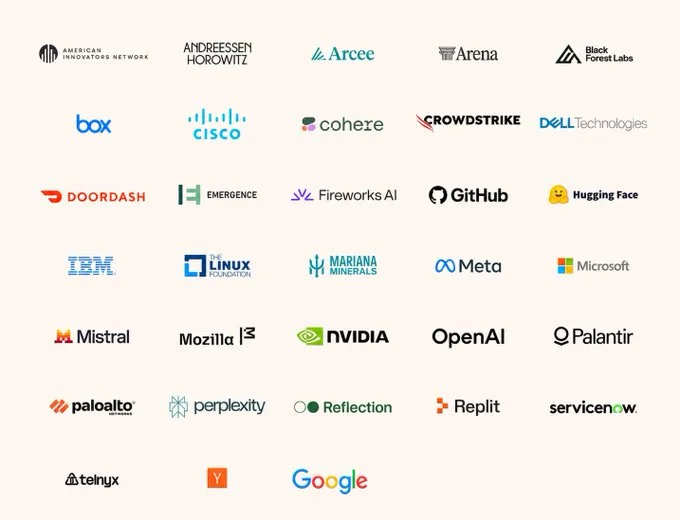 Updated Open Weights letter signatory logos — OpenAI, Google, NVIDIA, Microsoft, Meta, and more
Updated logo collage circulating with the letter (includes OpenAI + Google). Live Microsoft list is longer — verify Microsoft’s open-weight page for the current roster.
Update — July 27, 2026: New concrete evidence for the "open weights are winning" side of this letter — Moonshot AI published free, public Kimi K3 weights on July 26, 2026 (2.8T parameters, 1M context), with Together AI and Modal both shipping day-0 hosted access. A 2.8-trillion-parameter free download from a Chinese lab, landing the same week as this coalition letter, is exactly the kind of data point this fight is being argued over. Full Kimi K3 open-weights release breakdown →
Update — July 26, 2026: Same news cycle also spawned a false “Karpathy quit Anthropic” rumor — Did Karpathy quit? Debunked. Google CEO Sundar Pichai publicly backed the open-weights push (Gemma / DeepMind) before Google appeared on the live signatory list. Anthropic stayed off; David Sacks attacked that absence. Companion analysis: open-weight AI’s “Kubernetes moment” · Little Tech vs Chinese-model ban · explainx.ai's own editorial position on open-source AI.
Update — July 27, 2026: Early add-ons that foreshadowed the surge — Vercel, Ollama, and AMD (also Anthropic's $5B compute partner) — are now on the live Microsoft roster with the rest of the stack. Full isolation read: Anthropic's Silicon Valley isolation, explained.
On July 24, 2026, NVIDIA CEO Jensen Huang used his first X post to put a coalition letter in front of Washington and the builder internet: “Open Weights and American AI Leadership.” Y Combinator reposted it. Within hours the thread was measured in millions of views. Microsoft CEO Satya Nadella backed the same message the same day. Google CEO Sundar Pichai followed with an explicit endorsement — open source history, DeepMind contribution, and Gemma as Google’s consistent open-weight line — and Google later appeared on the live signatory list itself.
The launch PDF had 25 logos. By July 27 the story flipped: an updated logo collage put OpenAI and Google on the same sheet as NVIDIA/Meta/Microsoft, and Microsoft’s live page had ballooned past 70 organizations. Huang’s framing, verbatim in spirit:
For my first post, I’m sharing a letter NVIDIA signed on why open models matter.
AI will transform every industry, power every company, and be built by every country.
Open models strengthen safety and cybersecurity, accelerate innovation and diffusion, and enable sovereignty.
The world needs both frontier closed models and frontier open models.
He linked NVIDIA’s hosted PDF: Open-Weights-and-American-AI-Leadership.pdf. The same text — with the growing live signatory roster — is on Microsoft’s open-weight topic page.
explainx.ai’s read: this is the open-weight industrial lobby stating, in plain English, that premature restrictions would hurt U.S. competitiveness more than they would buy safety — and that closed-only stacks create their own single points of failure. The roster growth (especially OpenAI joining after launch headlines said it sat out) is the political plot twist. It lands in the same policy weather as Fable 5 / Mythos export controls and the ongoing open vs closed builder debate.
TL;DR — What People Are Asking
| Question | Answer |
|---|---|
| What shipped? | Joint letter: Open Weights and American AI Leadership |
| Date? | July 24, 2026 (roster still growing) |
| Hook? | Jensen Huang first X post + Nadella + Pichai |
| PDF vs live? | NVIDIA PDF = 25 launch names · Microsoft live = 70+ |
| Big joins? | OpenAI + Google now on the live list / logo sheet |
| Still out? | Anthropic (also typically Amazon / xAI in contemporaneous tallies) |
| Core ask? | Avoid premature restrictions on open models |
| Definition? | Weights you can download, inspect, modify, run yourself |
| Safety claim? | Transparency > obscurity; open enables red teaming |
| Distillation? | Legitimate technique ≠ unlawful extraction — don’t ban the former |
| Builder angle? | Policy cover for Llama-class stacks, local fine-tunes, sovereign deploy |
| Companion essays? | Knaup Kubernetes moment · Little Tech anti-ban |
The Letter, Page by Page
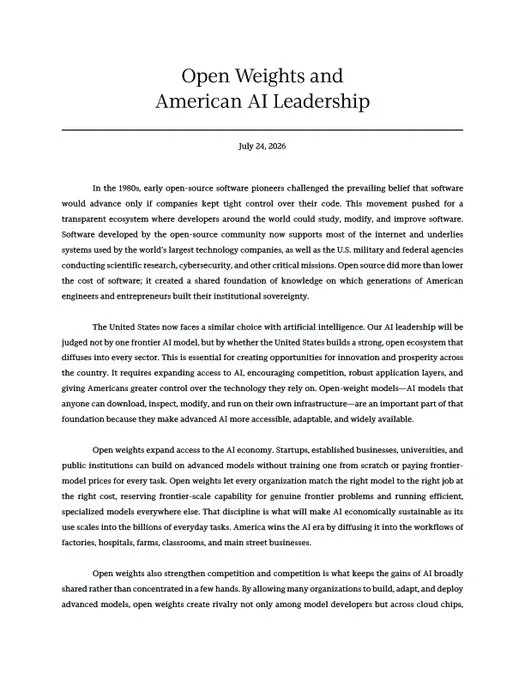 Open Weights and American AI Leadership — page 1: 1980s open-source parallel and open-weight definition
Page 1 — open-source parallel, definition of open-weight models, access/cost argument, competition setup.
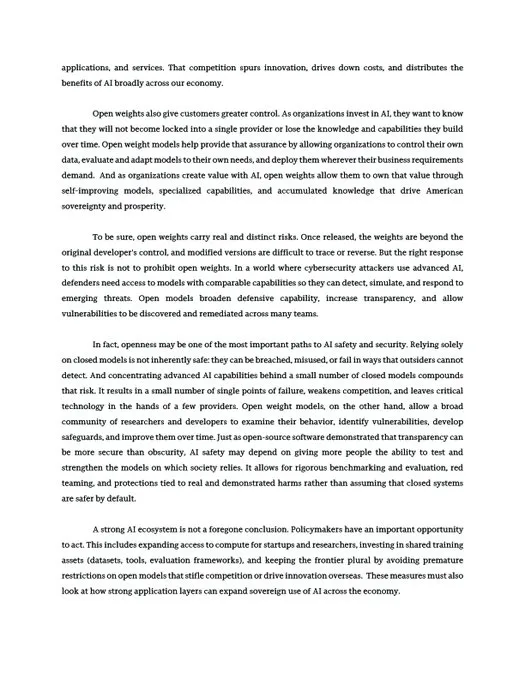 Open Weights letter page 2 — customer control, risks, safety via transparency, policy asks
Page 2 — sovereignty/control, acknowledged risks, “transparency can be more secure than obscurity,” compute + shared assets + avoid premature restrictions.
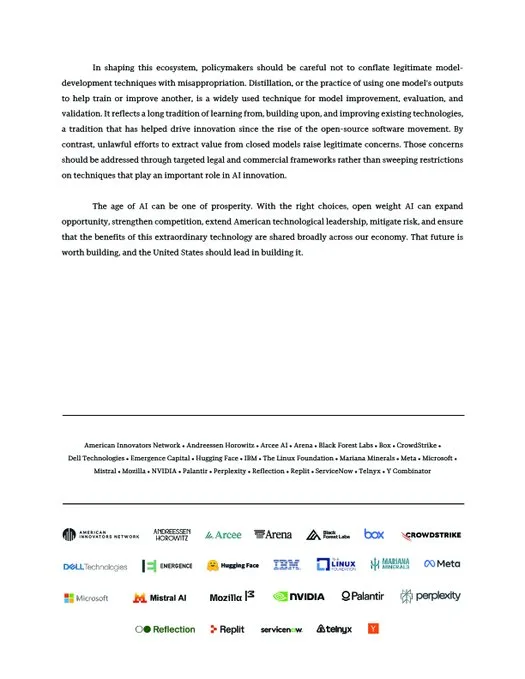 Open Weights letter page 3 — distillation vs misappropriation and 25 signatory logos
Page 3 — distillation vs unlawful extraction, closing prosperity pitch, full signatory list + logos.
What the Letter Actually Argues
The text opens with a 1980s open-source software parallel: tight control was supposed to be required for progress; instead, shared code became the substrate of the internet, enterprise stacks, and U.S. government systems. Open source, the letter says, created institutional sovereignty for American engineers — not just cheaper binaries.
Applied to AI, the thesis is blunt:
U.S. AI leadership will be judged not by one frontier model, but by whether America builds a strong, open ecosystem that diffuses into every sector.
That is a direct shot at “whoever ships the smartest closed API wins the decade” narratives. Diffusion — factories, hospitals, farms, classrooms, main street — is the scoreboard.
Five load-bearing claims
- Access / cost discipline — Startups, universities, and agencies can build without training from scratch or paying frontier prices for every task. Match model to job; reserve frontier scale for frontier problems. This is the same economic logic builders use when they route cheap local models for bulk work and paid APIs for hard cases (enterprise open-weight alternatives).
- Competition — Open weights create rivalry across model developers, clouds, chips, apps, and services, so gains are not concentrated in a few hands.
- Customer control / sovereignty — Avoid lock-in; keep data, adaptations, and accumulated value on infrastructure you choose. “American sovereignty and prosperity” is explicit policy language, not just product marketing.
- Security via openness — Attackers already use advanced AI; defenders need comparable models to detect, simulate, and respond. Closed-only concentration creates single points of failure.
- Safety via scrutiny — Broad communities can benchmark, evaluate, red-team, and remediate. “Transparency can be more secure than obscurity” — the classic open-source security argument restated for weights.
The distillation paragraph (do not skip)
Policymakers are urged not to conflate:
| Legitimate | Illegitimate (per letter) |
|---|---|
| Distillation / learning from outputs to improve, evaluate, validate | Unlawful efforts to extract value from closed models |
| Continuity with open-source “build upon” tradition | Misappropriation |
Prescription: targeted legal and commercial frameworks for the bad cases — not sweeping restrictions on techniques that power open innovation. That sentence is aimed at the same fight as token black markets and distillation crackdowns: draw a bright line without nuking the research stack.
Policy asks
- Expand compute access for startups and researchers
- Invest in shared training assets (datasets, tools, eval frameworks)
- Keep the frontier plural — no premature open-model bans that drive innovation overseas
- Strengthen application layers for sovereign use across the economy
Who Signed (Full Coalition)
Launch PDF (July 24) — 25 names
American Innovators Network · Andreessen Horowitz · Arcee AI · Arena · Black Forest Labs · Box · CrowdStrike · Dell Technologies · Emergence Capital · Hugging Face · IBM · The Linux Foundation · Mariana Minerals · Meta · Microsoft · Mistral · Mozilla · NVIDIA · Palantir · Perplexity · Reflection · Replit · ServiceNow · Telnyx · Y Combinator
Updated logo sheet (~33) — OpenAI + Google visible
The circulating graphic that drove the July 27 refresh adds (among others): Cisco · Cohere · DoorDash · Fireworks AI · GitHub · OpenAI · Palo Alto Networks · Google — on the same board as the launch stack.
Live Microsoft page (July 27 check) — 70+
Notable names beyond the logo sheet include: AMD · Cloudflare · LangChain · LM Studio · LMSYS · Modal · Ollama · Sakana AI · Scale · SpaceX · Vercel · Unsloth · Block · Nous Research · Prime Intellect · Nebius · Baseten · AI21 · Agno · Unusual Ventures — plus the full list on Microsoft’s page. Counts move; always re-check the live page before citing a number in hearings or filings.
Read that stack as a full-industry coalition: chips (NVIDIA, AMD), hyperscalers (Microsoft, Google), frontier lab that ships closed and now signs for open weights (OpenAI), open-weight champions (Meta, Mistral, HF), security (CrowdStrike, Palo Alto), infra (Dell, IBM, Cisco, Cloudflare), app platforms (GitHub, Vercel, Replit, ServiceNow), and open-source institutions (Linux Foundation, Mozilla). Palantir and SpaceX underline the national-security-adjacent framing — this is not only “let hobbyists fine-tune.”
Still conspicuously absent: Anthropic. That vacuum remains the political story even after OpenAI flipped from “missing on the PDF” to “on the live list.”
Why Jensen’s X Debut Matters as Packaging
Huang did not drip a product SKU. His first post is a policy narrative with a PDF attachment and a one-line doctrine: the world needs both frontier closed models and frontier open models. Y Combinator amplifying it puts the startup pipeline’s brand next to the GPU monopoly’s — intentional coalition optics.
That “both” clause is strategic. It refuses the false binary “open OR closed,” which makes the letter harder for closed-lab rivals to dismiss as pure anti-OpenAI theater — while still opposing restriction-first open-weight policy. Linking the NVIDIA PDF (not only a blog post) treats the letter like a reference artifact regulators and reporters can cite. The later roster growth proves the document is a living coalition, not a frozen PDF.
Nadella’s parallel post framed open-weight models as essential to a healthy ecosystem that expands opportunity while protecting national security — the same dual mandate every D.C. hearing demands.
Google’s Pichai endorsement → Google on the list
Pichai’s reply was shorter and more product-specific: Google has long benefited from open source, contributes heavily, and has consistently shipped open-weight Gemma models from Google DeepMind. That mattered for optics before Google’s name hit the live roster — a hyperscaler that also sells Gemini closed APIs saying the open line is not a sideshow. For builders, Gemma remains one of the few U.S.-branded open families with a steady release cadence (see our Gemma 4 updates coverage).
OpenAI’s flip: not a holdout (anymore)
Launch-week headlines that “OpenAI refused to sign” were true of the NVIDIA PDF snapshot and false of the live Microsoft page. OpenAI’s own open-weights policy language already called open vs closed a false choice; joining the letter aligns with that, even while the company still ships closed frontier APIs and warns about Chinese-model risk. Builders should cite which document state they mean — PDF day-0 vs live roster — or they will misinform regulators.
Anthropic’s absence and David Sacks’ attack
The published PDF did not include Anthropic — and the expanded live list still doesn’t. That vacuum became the political story within a day and got sharper as OpenAI joined. White House AI adviser David Sacks framed the letter as a rejection of “incessant machinations to kneecap the open model ecosystem” — not a demand that all software be open source. The implication, aimed at Anthropic’s public posture on Chinese open models and distillation: you can sell closed frontier safety theater and still lose the room when NVIDIA, Microsoft, Meta, Google, OpenAI, and YC line up for open weights.
explainx.ai’s read: treat Sacks’ thread as coalition enforcement, not as a technical brief. Anthropic’s safety and export-control positions are real policy inputs (Fable / Mythos controls; distillation fight). The open-weight coalition is saying those tools should not become a category ban on downloadable weights. Builders should track both voices — closed-lab risk narratives and open-stack industrial policy — without mistaking either for enacted law.
Jokes about “when does CUDA go open source?” are noise. The load-bearing fight is whether Washington treats open weights as infrastructure to grow or proliferation to choke.
How This Collides With 2026 Reality
Export controls vs open diffusion
The U.S. already showed it will use export controls on specific frontier systems (Fable 5 / Mythos). The letter is not asking to abolish all national-security tools. It is asking regulators not to treat open weights as a category to choke because misuse is imaginable.
Builders should expect both tracks to continue: selective closed-model controls and industry pressure to keep Llama-class and peer open releases legal to train, host, and ship.
Open weights ≠ fully open science
David Siegel’s Fortune argument — covered on explainx.ai — stresses that open weights without open training pipelines are still partly opaque (Siegel on open source AI). The coalition letter mostly argues the weights layer. Releases like Inkling and fully open projects like Apertus show how wide the “open” spectrum still is.
China and competitive pressure
Open weights diffuse globally whether Washington likes it or not — see the China AI playbook and the closed U.S. vs open China strategy debate. The letter’s fear of driving innovation overseas is acknowledgment that restriction can accelerate foreign open ecosystems rather than freeze them. Days earlier, Little Tech Association argued a Chinese open-weight ban would kill startups without stopping proliferation. Mesosphere co-founder Tobi Knaup’s follow-on essay frames the same moment as open weight’s Kubernetes-style center of gravity — compete in the ecosystem, don’t wall American developers out of it.
Cyber and agent security
Open models make weaponization easier and make defender tooling cheaper to build. The letter’s “defenders need comparable capabilities” line is the industry answer to “just keep the dangerous weights offline.”
What Builders Should Do This Week
- Read the primary text — use the NVIDIA PDF or Microsoft’s open-weight page for exact wording before quoting X summaries.
- Map your stack — if you depend on Meta Llama, Mistral, HF hosts, or local fine-tunes, this letter is your political weather report.
- Separate product risk from policy risk — local open alternatives still need evals, licenses, and data governance.
- Watch distillation law — targeted suits and ToS fights will keep coming; the letter tries to keep the technique legal.
- Keep a dual path — frontier closed APIs for hard problems + open weights for volume, air-gapped, and sovereign deploy (enterprise alternatives guide).
Honest Limitations
- A letter is advocacy, not legislation. No statute changed on July 24.
- Signatories have conflicting incentives (Microsoft sells closed Azure models and hosts open; NVIDIA sells GPUs to everyone; OpenAI ships closed frontier and signs for open weights).
- The document state drifts — NVIDIA PDF (25) ≠ logo collage (~33) ≠ Microsoft live page (70+). Quote the live page when possible.
- “Protecting national security” is asserted more than operationalized — expect hearings to demand specifics on evals, release thresholds, and foreign-download controls.
- Community scrutiny only works if someone funds red teams; openness without budget is a slogan.
- Anthropic non-participation means the restriction-leaning side of industry still has a loud voice — and Polymarket-style chatter about Chinese-model access bans will keep pressure on the opposite agenda. Sacks’ criticism raises the temperature; it does not invent Anthropic’s absence.
Update — July 28, 2026: Anthropic finally answered why it stayed off this coalition's signatory list — but not the way its critics expected. Dario Amodei published a direct rebuttal on July 27 stating "Anthropic has never advocated for a ban on open-weights models" and calling non-dangerous open models "a public good," while saying he agrees with "much" of this letter's substance. Where he splits from the signers: he wants mandatory pre-release safety testing for all sufficiently capable models, open or closed, which critics like Teknium argue could function as a soft ban even without using the word. Full breakdown: Anthropic's position on open-weights models.
Update — July 29, 2026: Pacing the Frontier — 1,178 frontier-lab employees ask the US to help build tools to pace automated AI R&D; OpenAI/Anthropic endorse. Same week: Zuckerberg’s “AI for everyone” WSJ essay.
Related on explainx.ai
- Calacanis vs Musk — open vs frontier gap (Aug 2026)
- Pacing the Frontier employee letter
- Zuckerberg — The AI Future Is for Everyone
- Anthropic's position on open-weights models: no ban, but chips, distillation, and testing
- Kimi K3 open weights are live — 2.8T params, Together/Modal day-0
- Why explainx.ai supports open-source AI — our editorial position
- Open-weight AI’s Kubernetes moment — Tobi Knaup
- Little Tech Association — don’t ban Chinese open-weight AI
- Anthropic’s Silicon Valley isolation on open-weight restrictions
- American closed AI vs China open-weights strategy
- Closed-source AI vs local open-source alternatives
- David Siegel — open source AI Fortune essay
- US bans / export controls on Fable 5 and Mythos 5
- White House / Moonshot distillation fight
- China AI playbook — free models, cheap compute
- Gemma 4 updates
Primary sources: NVIDIA PDF — Open Weights and American AI Leadership · Microsoft live open-weight page + signatories · Jensen Huang’s July 24 X debut · Sundar Pichai’s endorsement · Satya Nadella’s same-day endorsement · David Sacks’ reply thread · CNBC / industry coverage of the coalition.
For builders, treat July 24–27 as a signal window: Fortune-500 open-weight lobbying, OpenAI and Google on the live roster, Anthropic’s conspicuous silence, and a White House adviser amplifying the gap. Track legislation and the live signatory page, not just day-0 vibes — and keep a dual stack ready.