



A July 18 Polymarket post turned one number into a referendum on consumer AI: only 2.2% of U.S. households currently pay for an AI subscription, attributed to PNC Bank. The post drew 69,000+ views, and the replies split immediately. One person translated it into roughly three million households. Others argued free allowances make payment unnecessary, AI is useful mainly for builders, or most people may simply never want a paid chatbot.
The primary source supports the 2.2%, but not the viral wording exactly. PNC Economics Research said the share of PNC households paying for a generative AI subscription reached 2.2% in May 2026, based on PNC's internal credit- and debit-card data. That is observed spending among the bank's customers—not a nationally representative survey establishing that exactly 2.2% of every U.S. household pays for AI.
That correction does not make the number less interesting. It reveals a consumer market where direct payment remains rare, while the households that do subscribe are spending more and staying longer. The right question is not “growth or failure?” It is what kind of market can have enormous usage, low direct payment, and deep value for a narrow group at the same time?
TL;DR: what does the 2.2% AI subscription figure mean?
| Question | Direct answer |
|---|---|
| What did PNC measure? | The share of households in PNC's internal card data paying a generative AI merchant |
| Latest reported share? | 2.2% in May 2026 |
| Is it a national survey? | No—it is proprietary transaction data from PNC households |
| National scale if extrapolated? | Roughly 3.0 million households, but only as an illustration |
| Average payer spend? | About $31 per month, up from about $22 two years earlier |
| How long do subscribers stay? | About seven consecutive months in PNC's February 2026 analysis |
| Streaming comparison? | PNC measured roughly 43% household penetration for streaming versus 2% for AI in its May report |
| Does free usage count? | No direct subscription charge means it generally does not appear as paid adoption |
| Our read | Consumer AI is a small paid category with improving depth, not yet a mass household utility |
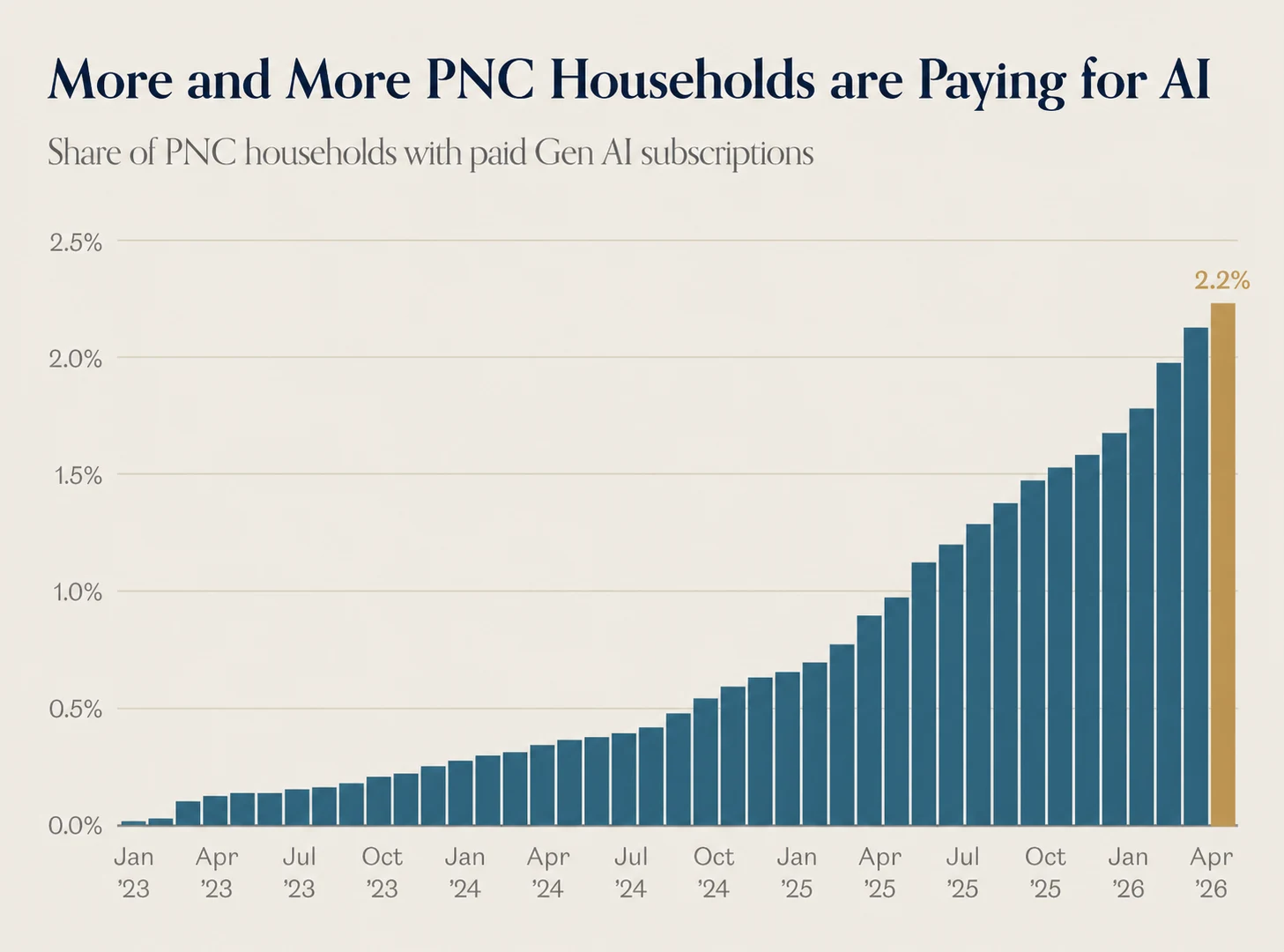 PNC households paying for AI subscriptions rising to 2.2% in May 2026
Redrawn from PNC's June 2026 Consumer Health Check. The final May 2026 observation reaches 2.2%; this is PNC household card data, not a nationally representative survey.
What PNC actually measured—and what it did not
PNC's Consumer Health Check uses proprietary bank transaction data to study household spending. For generative AI subscriptions, that provides a stronger behavioral signal than asking people whether they “use AI”: money actually left an account or hit a card.
But payment panels have boundaries.
The figure represents PNC households
PNC wrote that the share of PNC households paying for generative AI reached 2.2%. A bank's customer base may differ from the country by geography, age, income, credit usage, and account relationships. Without published weighting that maps the panel onto all U.S. households, “2.2% of U.S. households” is too confident.
This is the same interpretive discipline needed for corporate payment data. When Ramp found 50.6% of businesses on its platform paid at least one AI vendor, that described Ramp's business panel—not every company on Earth. Transaction datasets are valuable because they measure behavior, but their panel is part of the result.
It measures direct payment, not total AI use
A household can use generative AI without an identifiable AI subscription charge:
- free ChatGPT, Claude, Gemini, Perplexity, or Copilot allowances;
- access paid by an employer or school;
- AI bundled into Microsoft 365, Google One, a phone plan, search, or another service;
- a shared family, team, or friend account;
- API credits paid through a business card rather than the household account;
- an app-store payment that may be categorized under the platform rather than the AI provider.
The 2.2% figure therefore answers a narrow, economically important question: how many PNC households show a direct recurring willingness to pay? It does not measure how many people have tried AI, use it weekly, encounter it inside other products, or benefit from an employer's plan.
Is 2.2% really about three million households?
The viral reply's arithmetic is directionally sound. The U.S. Census Bureau's 2025 household release reported 39.7 million one-person households, representing 29% of all households. Those rounded figures imply roughly 137 million U.S. households:
39.7 million ÷ 29% ≈ 137 million households
137 million × 2.2% ≈ 3.0 million households
Three million is the right order of magnitude if the PNC rate is applied to the whole country. It is not a PNC estimate, and the extrapolation is not statistically valid unless PNC's panel represents the national household population on the variables that predict AI payment.
The calculation is still useful for intuition. “Only 2.2%” sounds microscopic; “around three million households” sounds substantial. Both descriptions can point to the same rate. A niche subscription category can support meaningful revenue long before it becomes a mainstream utility.
At PNC's reported $31 average monthly spend, three million hypothetical paying households would represent roughly $1.1 billion in annual direct spending. That is not a market-size estimate—PNC's sample cannot simply be scaled, and provider revenue includes international, business, API, and bundled channels. It demonstrates why a low single-digit penetration rate can still matter economically.
The more important signal: paying households are deepening
The headline focuses on breadth. PNC's reports also measure depth.
Average spend rose from about $22 to $31
PNC's June analysis said average spending per subscribing household increased from roughly the price of one basic plan two years earlier—about $22—to approximately $31. PNC's interpretation was that households may be holding multiple subscriptions, moving to premium plans, or buying additional tokens.
That does not look like a category where every early adopter is immediately canceling. It suggests the paying cohort includes professionals, developers, creators, researchers, and enthusiasts who are finding enough value to expand spend. Our AI subscription cost comparison explains why one household can easily combine a $20 general assistant with coding, research, image, or specialist tools.
The average subscriber stayed for seven consecutive months
PNC's March 2026 Consumer Health Check reported that the average subscribing household maintained a generative AI subscription for seven consecutive months, up from around five months at the start of 2024.
Retention and penetration describe different things:
| Metric | What it says |
|---|---|
| 2.2% penetration | Few households pay directly |
| Seven-month duration | Those who pay increasingly keep the product |
| $31 average spend | The paying cohort is moving beyond one basic plan |
| Higher-income concentration | Affordability and professional value still shape adoption |
The strongest reading is not “AI subscriptions are already mainstream.” It is the category has found a sticky early market but has not proven broad household necessity.
Why streaming reached 43% while paid AI remained near 2%
PNC's May 2026 report compared digital discretionary categories using a three-month average. Streaming appeared in about 43% of households, gambling in 5.1%, AI subscriptions in 2.0%, and prediction markets in 0.2%.
The gap is not only about product maturity. Streaming and generative AI solve different consumer jobs.
Entertainment value is immediate and shared
A streaming service offers a visible catalog, passive entertainment, and household sharing. The value is legible before purchase: watch a show, movie, or sporting event. Different services also carry exclusive content, encouraging households to stack subscriptions.
Generative AI asks the buyer to create the value. A blank chat box is not a benefit by itself. The user needs a recurring task—coding, writing, research, studying, image creation, planning, analysis—and enough skill to produce outcomes better than the free tier.
Free AI is a stronger substitute for paid AI
The free version of a streaming service often has advertising, a limited catalog, or no equivalent at all. Free AI products can still answer questions, draft text, summarize documents, and offer limited access to capable models. For an occasional user, the jump from zero dollars to $20 each month may buy more capacity rather than a fundamentally new product.
That is why one reply to the Polymarket post—there are many free allowances, so why pay?—captures a real market constraint. AI providers compete not only with one another but with their own free tiers.
Work may pay before the household does
AI produces its clearest return when attached to paid work. A developer who saves one hour, a marketer who generates campaign variants, or an analyst who accelerates research can justify $20 quickly. But the payment may land on a company card. That helps explain the sharp contrast between low direct household penetration and much higher paid business AI adoption.
Does 2.2% mean huge growth—or that most people will never pay?
Both outcomes remain possible. The number alone cannot decide between them.
The growth case
The category is young. Paid penetration can rise as models become more capable, personal context improves, agents perform complete tasks, and AI moves from a destination app into operating systems and daily software. PNC's rising spend and retention data show that at least one early cohort is discovering durable value.
Three million equivalent households is also enough to support products, distribution channels, and specialist tiers. Consumer software does not need streaming-scale penetration to become a large business—especially when enterprise and API revenue sit beside it.
The ceiling case
Mass payment is not inevitable. Free models may remain good enough for most people. Employers, schools, device makers, and productivity suites may absorb the cost. Consumers may view AI as a feature inside search or office software rather than a separate $20 subscription. Trust, privacy, inconsistent answers, and the effort required to prompt well can also cap willingness to pay.
The skeptical reply—perhaps most households will never want to pay for AI—is therefore a valid scenario, not anti-technology denial. AI can become ubiquitous while standalone household AI subscriptions remain uncommon. Email, maps, search, and web browsers became universal without every user paying a separate monthly bill for each category.
The likely market is layered:
- Free users who ask occasional questions or use bundled AI.
- Single-plan professionals who can connect $20 to repeated productivity.
- Multi-plan power users whose $31+ spending reflects specialized workflows.
- Employer-funded users whose adoption appears in business rather than household data.
- API users and builders paying variably for products they create.
This is a more plausible structure than every household independently subscribing to a general-purpose chatbot.
What AI companies should learn from the PNC data
Low paid penetration makes conversion a product problem, not only a marketing problem.
Sell a repeated outcome, not intelligence
“Access our smartest model” appeals to enthusiasts. Mainstream buyers need a job they recognize: prepare taxes, tutor a child, plan meals, edit video, manage email, build an app, or finish a weekly report. The paid tier must make that outcome reliably better than free.
Make the upgrade boundary visible
If free and paid feel identical until a vague rate limit appears, consumers will remain free. Paid plans need understandable value: persistent projects, integrations, higher reliability, more automation, better privacy controls, or capacity linked to a real workflow.
Do not confuse usage with willingness to pay
Daily AI interactions inside search do not automatically create a subscription market. Payment is a separate behavior. PNC's transaction data is valuable precisely because it cuts through sign-ups, app downloads, and self-reported enthusiasm.
Treat the $31 cohort as the product laboratory
Households paying above the basic-plan price reveal where value stacks: multiple vendors, premium reasoning, coding agents, media generation, or tokens. Understanding why they combine products may be more useful than pushing one general plan at everyone.
Should you personally pay for AI?
Do not subscribe because the category is growing. Subscribe when a paid feature produces a repeated result that exceeds its cost.
Use a simple monthly test:
Monthly value = hours saved × value of an hour
              + tools replaced
              + revenue enabled
              - review and correction time
If the result is below the subscription price, use the free tier. If one work session saves more than $20, payment may already be rational. Recheck after a month because novelty can look like productivity before a workflow settles.
Our true-cost comparison of ChatGPT, Claude, Gemini, and Copilot maps the plan choices. The personal-finance guide to AI subscription ROI gives a stricter budgeting lens, while local and open-source alternatives explain when owning the stack is worth the setup cost.
Summary
PNC reported that 2.2% of households in its internal card dataset paid for a generative AI subscription in May 2026. Polymarket compressed that into “2.2% of U.S. households,” but the source is narrower: PNC transaction data, not a nationally representative survey.
A rough national extrapolation lands near three million households, yet it should be treated as scale intuition—not a population estimate. The deeper story is that direct payment remains rare while paying households show improving commitment: roughly $31 per month in current spend and seven consecutive subscribed months earlier in 2026.
That is neither proof of inevitable mass adoption nor evidence that consumer AI has failed. It describes a sticky professional and enthusiast market surrounded by a much larger population using free, bundled, shared, school-funded, or employer-funded AI. The next stage of consumer AI will be decided by whether paid products deliver recognizable recurring outcomes—not by how many people have opened a chatbot.
Related on explainx.ai
- What your $20 AI subscription actually costs
- Anthropic overtakes OpenAI in paid business adoption
- AI subscription ROI as a personal-finance decision
- Why AI companies want users running agents
- Closed-source subscriptions vs local open-source AI
- 69% back an AI public wealth fund—but the poll needs context
- AI mania is eviscerating decision-making — Ludicity / Hermit Tech essay (Jul 2026)
- Polymarket + Ramp — high-AI firms hire more entry-level (Jul 2026)
Primary sources: PNC Consumer Health Check—June 2026 · PNC—May 2026 · PNC—March 2026 · U.S. Census household estimates
Figures reflect PNC internal transaction data and Census estimates available on July 18, 2026. Merchant classification, panel composition, pricing, and subscription bundles can change; verify the primary reports before using the figures for market sizing or investment decisions.
Update — October 3, 2026: a16z re-circulated the number on October 2; see Nobody really uses AI? The 98% households number and the adoption gap.