



NVIDIA has published a write-up of how the C-BRAIN consortium is using open-source AI agents to speed up dementia research. The two tools are OpenScientist, an agentic "co-scientist," and InsightEngine, a literature-and-knowledge-graph platform. The headline number is that OpenScientist reportedly completed analyses in minutes that scientists estimated would take weeks to months, at under $10 per run. This post explains what the tools do, what the numbers rest on, and why the framing matters for anyone building agents for science. The NVIDIA post is a vendor blog, so we read it alongside the OpenScientist preprint on medRxiv, which was written by consortium members themselves.
TL;DR
| Question | Answer |
|---|---|
| Who is behind it? | C-BRAIN, launched November 2025 with NVIDIA, led by Dr. Randall Bateman, 18 member institutions |
| What are the tools? | OpenScientist (with Lawrence Berkeley National Laboratory) and InsightEngine (with 387 Labs), both open source |
| Headline claim? | Analyses in minutes instead of weeks to months, under $10 per run (NVIDIA's account) |
| Any treatment result? | No. The post says none has been found for the disease |
| Evidence? | A preprint with four expert-evaluated case studies; not peer reviewed |
| Hardware? | 64 on-premises NVIDIA GPUs plus Azure cloud nodes, more planned including Blackwell systems |
Why dementia research is a data-plumbing problem
NVIDIA frames the field's problem as three bottlenecks: too few high-impact findings, data trapped in institutional silos, and slow synthesis of published research. It cites 57 million people living with dementia worldwide and more than 10 million new cases a year, and says NIH Alzheimer's funding has grown sevenfold in 15 years to $3.9 billion annually.
Notice that none of those bottlenecks is "we lack a smart model." They are about access, integration and time. That is why the consortium's design leans on a hybrid centralized and federated approach: AI models learn from data at each institution without the data leaving it, which supports privacy and governance. The post says the effort also targets "dark data," meaning unpublished findings, negative results and proprietary data that never reach a journal.
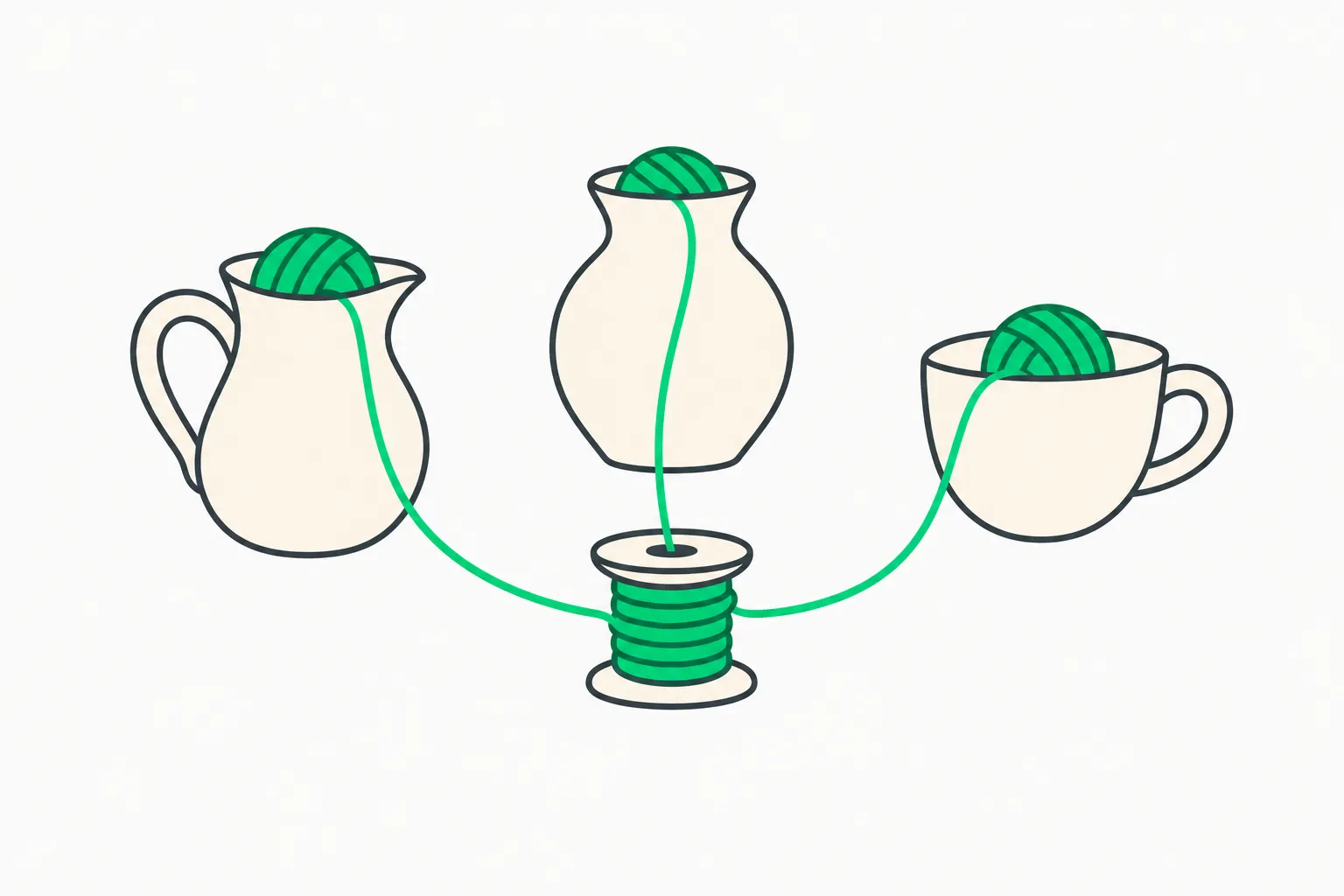 A federated learning diagram with several vessels sending threads to one central spool, illustrating C-BRAIN federated dementia research data
OpenScientist: the co-scientist
According to NVIDIA, OpenScientist is an open-source agentic AI co-scientist built with Lawrence Berkeley National Laboratory and led by research scientist Justin Reese. You give it a research question and a dataset. It semi-autonomously generates hypotheses, runs analyses and produces auditable insights.
The preprint is the better place to look for evidence. It describes OpenScientist as an open-source agentic system meant to investigate researcher-defined questions and produce verifiable biomedical insights, and reports that domain experts evaluated it on four clinical case studies: an Alzheimer's biomarker cohort, plasma proteomic survival prediction, single-cell transcriptomics of neurons with neurofibrillary tangles, and multiple myeloma hypothesis validation with a negative control. The abstract says analyses finished in minutes that would otherwise take weeks to months of human effort. It is a preprint and has not been peer reviewed.
Four case studies are a proof of concept, not a benchmark. The multiple myeloma case with a negative control is the most interesting design choice, because a co-scientist that cannot say "nothing here" is a hypothesis generator, not a scientist.
InsightEngine: checking claims before the experiment
InsightEngine, built with 387 Labs, is described as a research platform that tests hypotheses against the scientific literature, analyzes user datasets, explores a biomedical knowledge graph, and checks claims against evidence to catch hallucinations before costly experiments. The pitch is that a wrong hypothesis is cheap to reject on a computer and expensive to reject in a lab.
The post does not link a repository or paper for either tool, so we cannot tell you from NVIDIA's page alone where to download them. Search for the project names and confirm the repository owner before installing anything.
The numbers, and how to read them
- "Minutes instead of weeks to months, under $10 per run." Reported in NVIDIA's post as OpenScientist results. The preprint supports "minutes versus weeks to months" for four cases it chose. The per-run cost is the consortium's figure, and the post does not show the dataset sizes or the model used.
- "More than one million research hours a year freed at scale." This is the consortium's estimate, not a measurement. It depends on adoption across the more than 200 research groups C-BRAIN currently reaches.
- 64 NVIDIA GPUs on premises plus Azure. An inventory, not a performance result.
The honest reading: the speed claim is plausible and supported by a preprint, the cost claim is stated and not yet independently checked, and the scale claim is a forecast. Compare how we treated a similar mix of claims in Anthropic's Claude-shaped science write-up and the peer-review angle in AlphaProof Nexus and the Erdos problems.
What C-BRAIN wants to build next
The consortium says it is working with NVIDIA on the BioNeMo open developer platform and the MONAI framework for its pipelines, and wants to build a multimodal biological foundation model trained on neuroimaging, multi-omics, fluid biomarkers and longitudinal clinical data. By year three, it hopes to identify causal mechanisms of brain aging and Alzheimer's, moving from correlation toward testable scientific principles. That is a goal statement, not a result.
Other recent AI-for-brain-science stories give context. Prima Mente's Alzheimer's translation challenge and 150M-cell atlas is a data-first approach to the same disease. The $1.8 billion Biohub virtual biology initiative shows the open-data push behind this kind of tooling, and the Genesis Mission industry pledges show NVIDIA's place in the wider US science-AI effort. On the imaging side, Weizmann's fMRI reconstruction is a reminder that brain data is a very active AI target.
What people will ask next
Can I run OpenScientist on my own data? The tool is described as open source, and the preprint describes it as built to investigate researcher-defined questions. NVIDIA's post does not give an install path, so start from the preprint's own data availability link (a Zenodo record) rather than from the vendor blog, and confirm the repository owner before installing anything.
Is this just a chatbot over papers? According to the descriptions, no. OpenScientist runs analyses on datasets, and InsightEngine combines literature search, dataset analysis and a biomedical knowledge graph. The distinction matters because literature-only assistants can sound authoritative while never touching the underlying data. An agent that executes code on your cohort produces results you can re-run, which is what "auditable" should mean in practice.
What stops the agent from inventing a finding? The design claims are evidence checking in InsightEngine and a negative control in the preprint's multiple myeloma case. Neither is a guarantee. Any agent that generates hypotheses can generate a convincing wrong one, and a statistical result on a messy cohort can be an artifact of preprocessing choices the agent made silently. Reviewers should ask to see the full run log, not only the summary.
Why is NVIDIA involved at all? C-BRAIN's compute includes 64 on-premises NVIDIA GPUs and a roadmap that includes Blackwell systems, and the consortium works with NVIDIA on BioNeMo and MONAI. NVIDIA's interest is clear: scientific workloads are a showcase for its platform. That does not make the science wrong, but it is why independent replication of the speed and cost numbers is worth waiting for.
Is the "one million hours" figure realistic? It is an estimate that multiplies a per-analysis saving by an assumed volume of analyses across research groups. Time saved on analysis only becomes research progress if the freed hours go to better experiments. The figure is useful as a statement of ambition, not as a forecast.
The pattern behind the story
Across 2026, the interesting AI-for-science stories share a shape: a general agent, a domain dataset, a human reviewer, and a check that does not depend on the model's own confidence. In mathematics the check is a proof assistant; in biology it is a negative control, a literature cross-check or a wet-lab result. C-BRAIN's tools are an early version of that pattern for neurodegeneration, with the extra constraint that patient data cannot be pooled freely. That constraint is why the federated design is arguably the most transferable idea here, ahead of any single model.
What builders can take from it
- Auditability is the feature. Both tools stress auditable insights and evidence checking. If you are building an agent for a high-stakes domain, log every analysis step so a human can replay it.
- Federated beats centralized when data cannot move. If the data is the moat and the privacy risk, send the model to the data.
- Include negative controls. The preprint's myeloma case is a model for evaluating any research agent: does it correctly find nothing?
- Be careful with vendor-reported cost. Under $10 per run depends on the data and the model. Measure your own.
- Keep claims scoped. Faster analysis is not a faster cure. NVIDIA's own post says no treatment has been found to stop, prevent or reverse the disease.
Caveats
This is a vendor blog written to showcase NVIDIA hardware and software, and the quotes from consortium leaders ("AI tools built by scientists, for scientists," in Bateman's words) are promotional by nature. The preprint was posted in March 2026 and is not peer reviewed. It is not independent of the consortium: its authors include C-BRAIN's leader Randall Bateman and OpenScientist's lead Justin Reese, and it says the work was organized through and supported by C-BRAIN. We did not run either tool.
Related reading
- Prima Mente: Alzheimer's translation challenge and 150M-cell atlas
- Biohub virtual biology initiative
- Genesis Mission industry pledges
- Weizmann fMRI image reconstruction
- Claude-shaped science
- AlphaProof Nexus and peer-reviewed Erdos problems
- External: NVIDIA's C-BRAIN post · OpenScientist preprint
Details reflect NVIDIA's October 27, 2026 post and the cited preprint and may change.