




Bloomberg reported on November 10, 2026 that Moonshot AI, the Beijing lab behind Kimi, rented 32 Super Micro Computer servers with Nvidia B300 GPUs under an August contract described in documents filed with Beijing regulators. The headline landed the same week as Congressional pressure on Nvidia, Jensen Huang governance headlines, and renewed social chatter about Moonshot seeking Blackwell capacity in Europe.
We could not fetch the paywalled Bloomberg URL; this post builds on Investing.com's summary, cross-checked against earlier on-record U.S. claims and explainx.ai's export-control archive. Nothing here is legal advice.
TL;DR
| Question | Answer |
|---|---|
| What is claimed? | August 2026 rental of 32 SMCI servers with B300 GPUs; source described as Beijing regulatory filings |
| Who confirmed it? | Nobody on record in the summary we read |
| New vs July story? | July: White House official cited GB300 access in Thailand; November: Bloomberg cites domestic filing + SMCI + B300 |
| Builder impact? | Policy risk on remote GPU paths, not a change to open Kimi weights today |
| Verified violation? | No court filing or agency statement in sources reviewed |
What Bloomberg's reported filing says
Per Investing.com's November 10 article summarizing Bloomberg:
- Moonshot accessed Nvidia's most advanced chips this summer.
- The mechanism was a contract signed in August 2026 to rent 32 Super Micro servers with B300 GPUs.
- The supporting paperwork was filed with Beijing regulators — a detail prior U.S.-centric headlines did not emphasize.
B300 sits in Nvidia's Blackwell generation. Washington restricts direct sales of top-tier accelerators to China while Chinese labs keep closing benchmark gaps on models such as Kimi K3, which triggered White House distillation accusations in July.
Bloomberg's reported angle is paper trail: a regulatory filing naming SMCI hardware and B300 SKUs. That is a different evidentiary shape than Michael Kratsios' July X post alleging GB300 access in Thailand.
Claimed vs verified
| Claim | Status in sources we read |
|---|---|
| August contract exists in a Beijing filing | Claimed by Bloomberg via Investing.com summary — we did not open the filing |
| 32 servers, B300 class | Claimed in the same summary |
| Moonshot statement | Not in the summary |
| Nvidia or SMCI confirmation | Not in the summary |
| U.S. law broken | Not alleged as a formal finding; policy debate only |
Researchers such as Cassia King (IAPS) told CNBC in August that remote access can be legal when the Chinese firm does not own the physical chips. Bloomberg's filing narrative may describe rental precisely because ownership and location matter for compliance analysis.
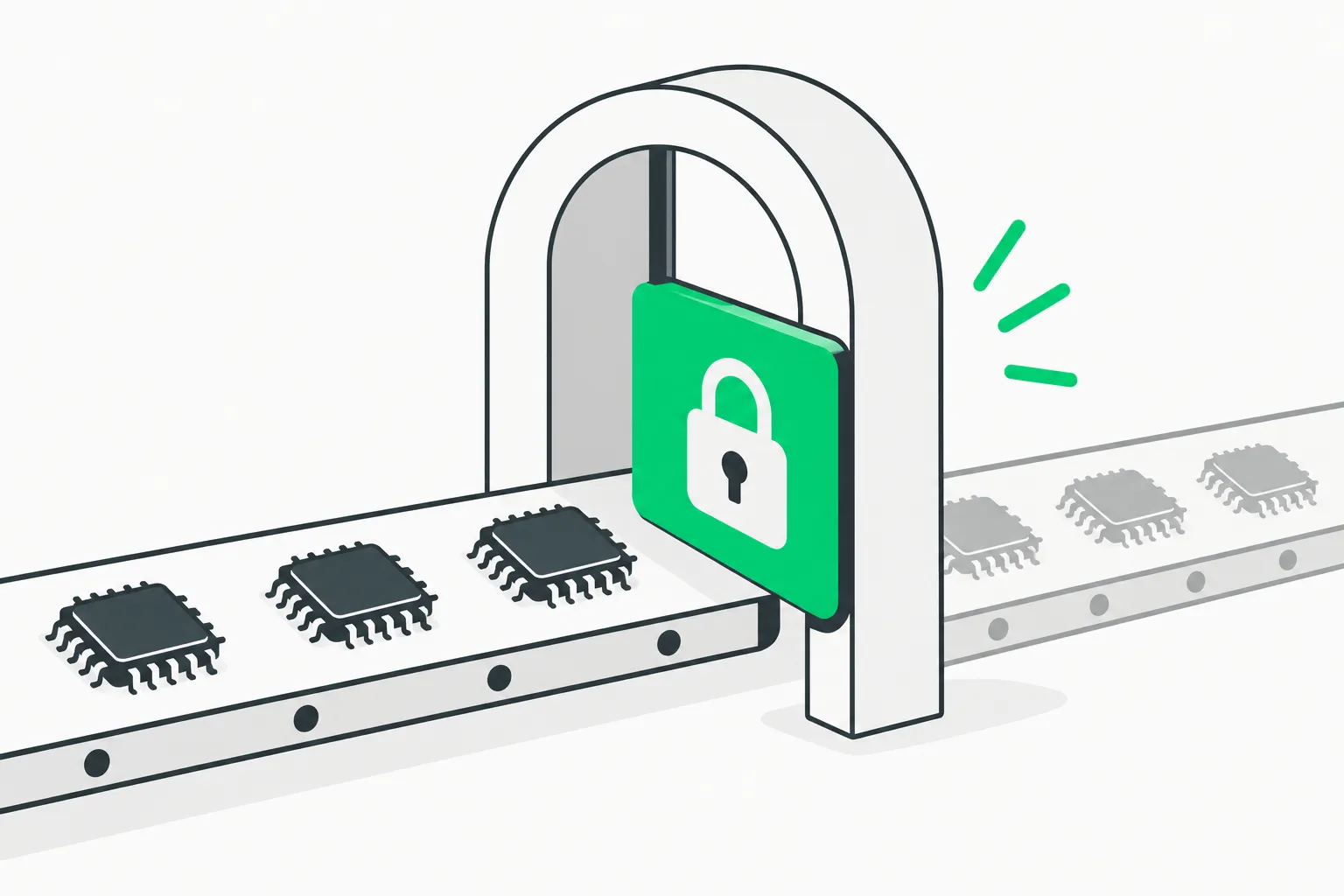 Green export-control gate half closed over a stream of chips under U.S. rules governing advanced AI hardware
Chinese Foreign Ministry spokesperson Guo Jiakun rejected espionage narratives around Huang as "baseless vilification" in Times of India coverage — unrelated to the filing but part of the same news cycle depressing trust in cross-border AI supply stories.
Super Micro in the export-control stack
Linking Moonshot to Super Micro matters because SMCI already sits in U.S. enforcement storylines:
- Employee conduct probes tied to China-directed sales appear in our Super Micro smuggling coverage.
- Malaysian customs seizures of AI servers repeatedly name intermediary routes Chinese labs use.
A rental contract reported in a Beijing filing does not equal a DOJ finding. It does show how journalists and regulators trace compute when labs cannot buy frontier chips outright.
For the neocloud side of Moonshot's strategy, see 8,000-GPU Europe talks and Nvidia's reported 51% non-Chinese customer rule.
Policy timeline: from Thailand to filings to Congress
- July 22–23, 2026 — Kratsios accuses Moonshot of GB300 use in Thailand; CNBC and The Verge relay the claim.
- August 2026 — CNBC documents the remote-access loophole and notes other Chinese hyperscalers renting overseas Nvidia compute.
- November 5–10, 2026 — CNBC Europe neocloud story plus Warren–Banks statements on shutting chip pathways; see AI Overwatch Act guide.
- November 10, 2026 — Bloomberg filing story via Investing.com.
Builders hosting multi-tenant GPU clouds should expect customer nationality questions to intensify regardless of whether this filing is reproduced in English.
What developers are saying
We did not find a Hacker News front-page thread dedicated to the November 10 Bloomberg filing with substantive hands-on numbers at the time of writing. Social relays mostly reposted the headline without primary filing text.
What this means if you train or fine-tune models
If you are outside China: the story reinforces that frontier open models (Kimi, Qwen, DeepSeek lines) may still rely on Nvidia-heavy training graphs even when marketing stresses sovereignty. Benchmark comparisons should note compute uncertainty when labs do not disclose clusters.
If you run inference only: Kimi and other Moonshot releases on Fireworks or domestic hosts are unaffected today by a Bloomberg summary. Export law changes would hit providers, not your local weights folder.
If you sell neocloud capacity: customer diligence and geofencing clauses are moving from sales boilerplate to NDAA bargaining chips. Read Norway grid pauses and Maryland siting fights as parallel infrastructure pressures.
 Export control chip stack illustrating Moonshot B300 access claims under U.S.–China rules
Kimi, Moonshot, and why frontier compute still matters
Moonshot's Kimi K3 line sits at the center of U.S.–China model competition. When Kratsios linked the lab to GB300 access in July, Kimi had just dropped benchmarks that CNBC said narrowed the gap with Claude Fable and GPT-6-class systems. Training at that scale normally assumes thousands of high-end GPUs or aggressive distillation from foreign APIs — the second claim Anthropic and the White House amplified in distillation accusations.
Bloomberg's B300 rental narrative, if verified, would document hardware-class access one notch below marketing names like Vera Rubin, still far above what H20-class shipments to China typically provide. Together.ai's compiler research names Moonshot among labs it collaborates with on post-training — a reminder that software stacks follow wherever FLOPs land, legally or otherwise.
For readers comparing open weights, Moonshot's releases on Hugging Face and domestic hosts do not ship cluster receipts. Treat performance tables as outcomes and stories like this Bloomberg filing as inputs you may never see in a model card.
Rental vs ownership in export-control logic
CNBC's August explainer quoted Cassia King saying remote access stays inside the rules when a Chinese firm does not buy and own the silicon. Bloomberg's emphasis on a rental contract may be describing exactly that structure: Moonshot pays for time on SMCI boxes rather than taking delivery into a Chinese data hall.
That distinction matters for operators, not only diplomats:
- Owners face BIS entity lists, end-user certificates, and physical logistics seizures such as Malaysia's AI server cases.
- Renters face terms-of-service, cloud contracts, and future remote-access statutes like those in the AI Overwatch Act.
U.S. lawmakers are trying to collapse that gap. Vector's November 9 report that White House staff aided NDAA drafting on chip limits suggests administration engagement even when headlines focus on CEO scandals.
SMCI governance and the DOJ shadow
Super Micro's name in a Beijing filing does not prove corporate knowledge of every downstream renter. It does connect two entities already under U.S. criminal probes involving employees and China-directed sales. Builders who buy SMCI gear for on-prem clusters should separate product reliability from counterparty risk in finance headlines.
If the filing lists serial configurations or GPU counts, neocloud operators can cross-check whether similar blocks appear in European colocation stories Moonshot already denies on the record. Our Europe Blackwell post tracks that parallel thread.
Alibaba, ByteDance, and the wider pattern
Investing.com's Bloomberg summary notes Alibaba and ByteDance signing offshore access deals earlier in 2026 — the same pattern CNBC described with Aolani in Malaysia. Moonshot is not unique; it is the lab named in a fresh regulatory document on the day Huang's personal scandal and shareholder suits dominate Nvidia coverage.
Beijing simultaneously promotes domestic accelerators while labs chase CUDA ecosystems. That tension shows up in vals.ai language tests and in procurement fights over Huawei Ascend vs Nvidia in SOE tenders. Policy posts age quickly; filing posts give you anchors to revisit when earnings land.
How to verify the filing yourself
Until Moonshot or Beijing agencies publish machine-readable versions:
- Watch SMCI earnings and risk factors for customer concentration language.
- Watch Nvidia 10-Q export-control disclosures after November 17 earnings.
- Track BIS rulemaking and bills bundled into FY27 NDAA.
- Compare against Taiwan B300 smuggling cases — hardware custody vs rental.
Bottom line
The November 10 Bloomberg report, as summarized by Investing.com, adds a documented rental claim—32 Super Micro B300 servers, August 2026, Beijing filing—to a story that began as U.S. official accusations about Thai GB300 access. No party confirmed the filing on the record in the text we could read. For builders, the actionable read is policy: Washington is narrowing every path Chinese labs use to reach Blackwell-class FLOPs, and journalists are now citing regulatory paper as well as intelligence leaks.
Filing and contract details reflect Bloomberg reporting as relayed by Investing.com on November 10, 2026, unless primary documents become public.
Related reading
- Moonshot Europe Blackwell leases — claimed vs verified
- White House Moonshot distillation accusation
- AI Overwatch Act and foreign cloud GPU access
- Lava 32-GPU B300 cluster and DCGM telemetry
- Super Micro smuggling guilty plea context
- Taiwan B300 smuggling export controls
- Congress bipartisan Nvidia China chip curbs