



Nobody saw this coming.
Midjourney — the AI research lab behind the world's most-used image generation platform — announced a new division on June 18, 2026. It is not another model, not a new interface, and not anything adjacent to image generation. It is a full-body medical scanner: a machine that uses sound waves, a pool of water, and about 60 seconds to produce a three-dimensional map of your entire body.
Watch the announcement videos on X: Video 1 · Video 2 · Official announcement page
Elon Musk replied "Cool." The internet replied with "holy fuck, nobody saw this coming." Both reactions were accurate.
What They Actually Built
Midjourney calls the technology Ultrasonic CT — or simply "the full body ultrasound." The official description: "as powerful as MRI and as casual as a trip to the spa."
The scanner is a ring of approximately 500,000 individual transducers, each the size of a grain of fine sand. Each transducer acts as both a tiny speaker and a tiny microphone simultaneously — emitting ultrasonic waves and recording the ripples that return after passing through your body.
The experience:
"It starts by stepping into a shallow pool of golden light. The water. Your body passes through a ring of underwater sensors, each acting like a dolphin, using its echolocation."
A platform lowers you into the water at 2 inches (5 centimeters) per second. As you descend through the ring, hundreds of thousands of elements take turns — sending waves, listening together, compressing and streaming data to a cluster of thousands of computers that split the reconstruction task.
The goal: 60 seconds, start to finish.
The Numbers Are Staggering
This is where the announcement gets genuinely hard to comprehend:
| Metric | Number |
|---|---|
| Transducers in the ring | ~500,000 |
| Data processed per second | 17 gigabytes |
| Raw data per cross-sectional slice | 40 gigabytes |
| Target slices per full body scan | ~100 |
| Scan duration | ~60 seconds |
| Radiation | None |
To put the data rate in perspective: 17GB/s of scan data, converted to HD internet video, would require watching 500 hours of footage for every 1 second of scan data.
The reason no such machine existed before is the sheer combination of mechanical elements, data volume, and compute required. Midjourney is claiming to have solved all three simultaneously.
What the Scans Actually Look Like
The scan reconstructs a 3D body map down to a fraction of a millimeter — comparable to MRI in resolution, but at nearly 100x the speed. The system produces cross-sectional slices with AI segmentation that identifies internal structures.
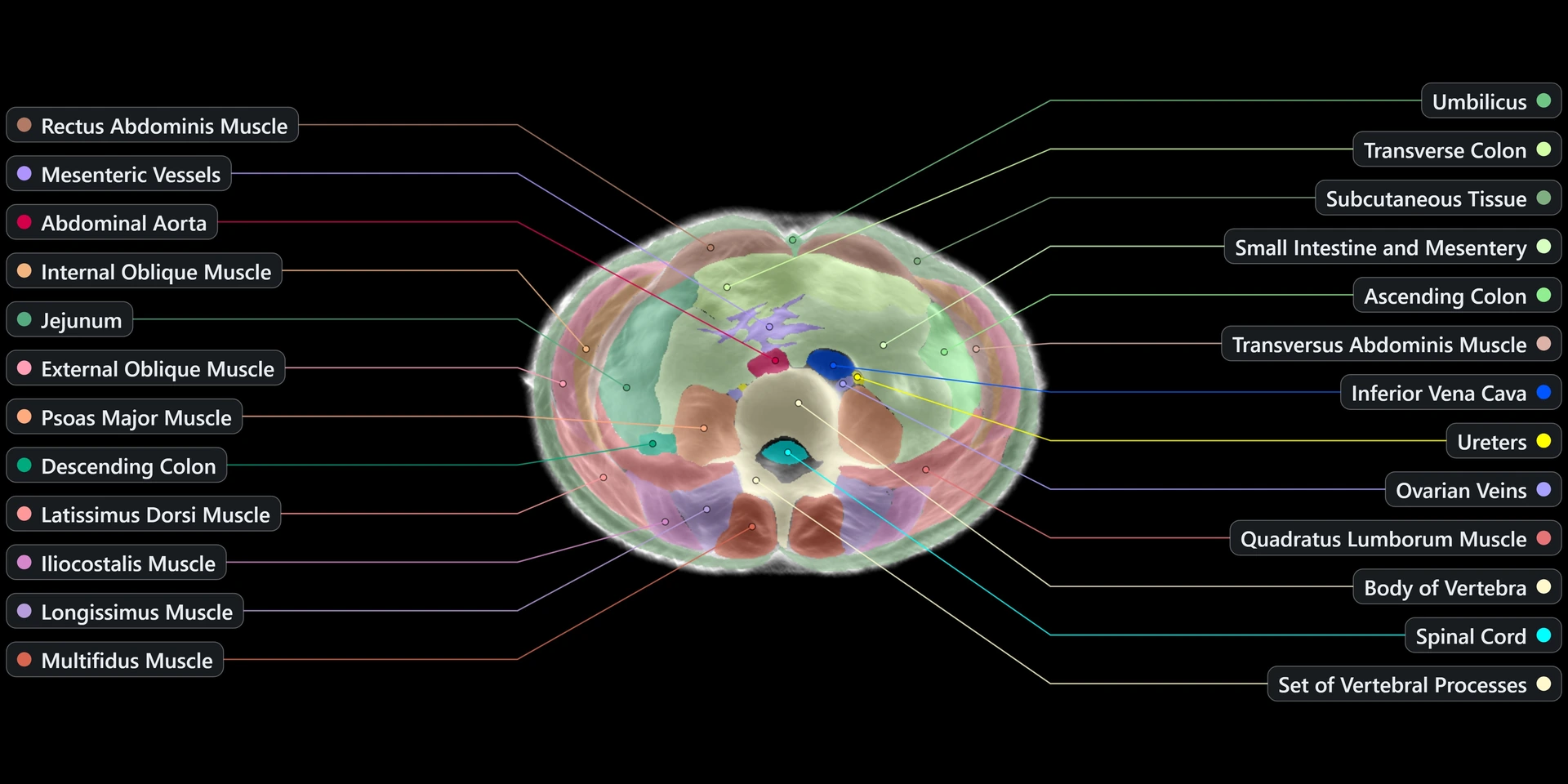
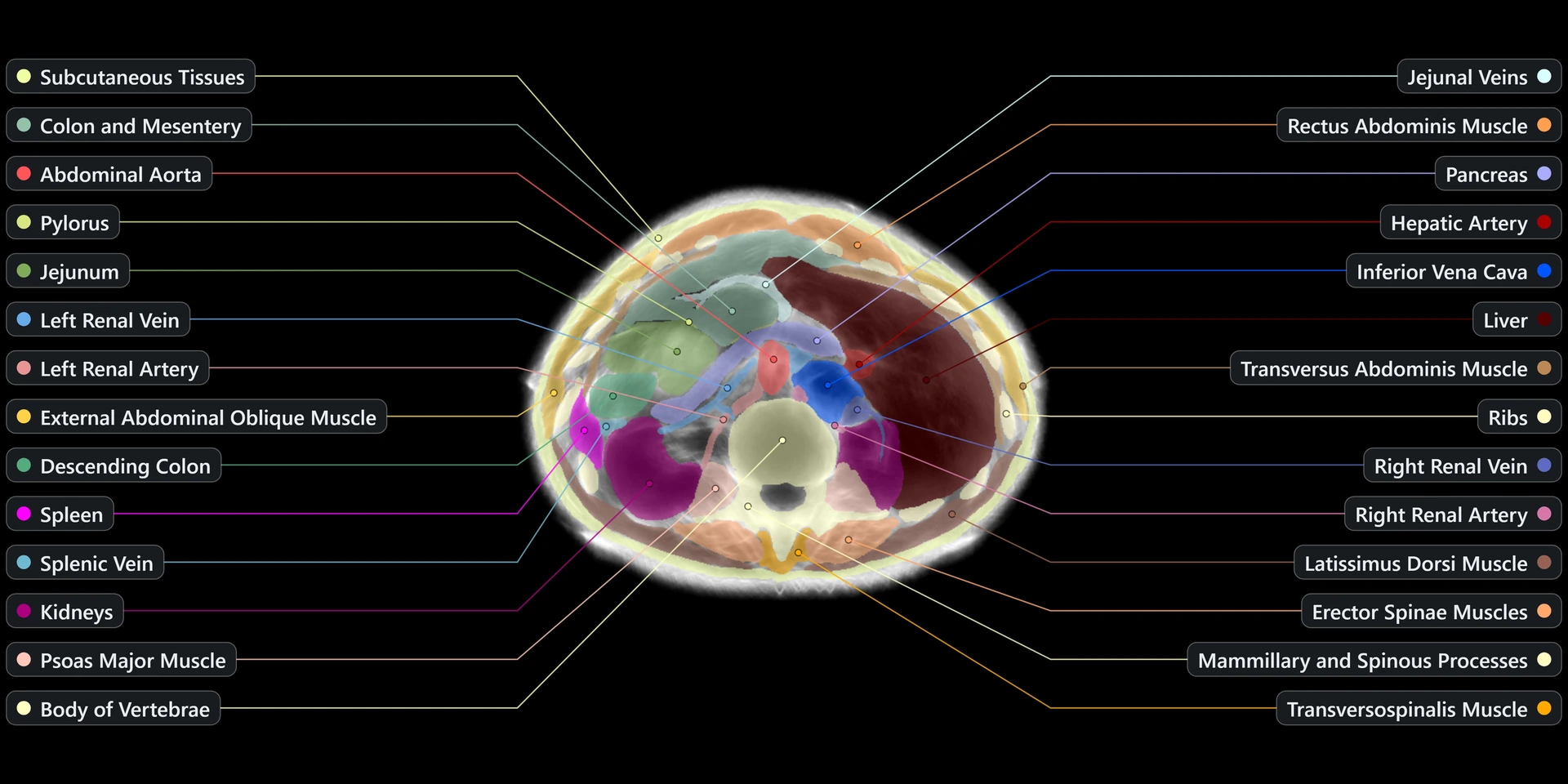
Each image shows the raw reconstruction alongside AI segmentation — what the scan lets the system identify inside the body. The torso and legs are covered in a single continuous sweep.
The Midjourney Spa
The scanner is not going into hospitals. Midjourney is building it into wellness centers called Midjourney Spas, alongside hot tubs, saunas, and cold plunges.
The concept: "A place you'd want to be even if there was no scanner." Scans are almost a side effect of a spa visit. You go in, you come out, and you've accumulated a library of body data without having felt like a patient.
The first Midjourney Spa opens at the end of 2027 in San Francisco — about 10 minutes from the Apple Store in Union Square. It will house 10 scanners, giving it a combined scanning capacity greater than every MRI machine on Earth combined, per year.
The Roadmap
Midjourney published a specific multi-year plan:
Next 12 months (through mid-2027):
- Refine algorithms and hardware continuously
- Research trials demonstrating raw system capabilities
- Move to 2nd generation hardware design
- Build out the first "research spa" — the site that enables mass-scale scanning
End of 2027:
- First Midjourney Spa opens in San Francisco
- Begin real-world operational knowledge at scale
2028:
- Scale to more cities
- Launch 3rd generation scanner — fully custom silicon, night-and-day improvement in image quality and scan speed
2031 (ambitious goal):
- 50,000 scanners worldwide
- 1 billion full-body scans per month
- Coverage for a large percentage of the global population, or monthly scans for 1 billion people
The company is explicit: "This is moving at the maximum speed that's physically possible."
The FDA Pathway
Medical imaging devices require FDA clearance for diagnostic use. Midjourney is threading this carefully:
- Starting with body composition maps — structural imaging that describes what is there, without making diagnostic claims. This sidesteps the full diagnostic approval pathway for the initial launch.
- Submitting regular test results to the FDA for expanded capabilities as the technology matures.
- Each new diagnostic capability (detecting cancer, identifying specific conditions) will require separate FDA clearance.
The 2027 spa launch will provide body composition data — detailed, useful, and genuinely informative, but legally distinct from a diagnostic reading. This is similar to how Prenuvo initially positioned its full-body MRI service before seeking broader clearance.
vs. MRI: The Real Comparison
| Conventional MRI | Midjourney Scanner | |
|---|---|---|
| Scan time | 1–2 hours | ~60 seconds |
| Cost per scan | $400–$4,000 | Few dollars (target) |
| Radiation | None | None |
| Machine cost | $1–3M | ~10x cheaper (claimed) |
| Throughput (10 machines) | ~40 scans/day | More than all MRI on Earth/year |
| Magnetic field | Strong (pacemaker risk) | None |
| Experience | Clinical, enclosed tube | Warm water pool, spa setting |
The throughput claim is the most dramatic: fewer than 12 of these machines could perform more full-body scans than every MRI machine on Earth combined. That is not a quality comparison — it is a volume claim. But if the image quality holds at clinical utility, the volume claim is the more important one.
Why This Is Actually Midjourney
The question everyone is asking: why is an AI image company building medical hardware?
Midjourney's own framing:
"One of the overarching themes of the 21st century will be the expanding reach of intelligence and what we choose to do with it... what we do with our health comes down to having data and an awareness of our bodies. You want as much data as you can get about your health as quickly and as cheaply as possible. In other words, you want a technology optimized for getting as many 'megabytes per second per dollar' of information about your body."
The computation at the core of the scanner is image reconstruction: 17GB/s of raw wave data transformed by thousands of computers into a coherent 3D image. That is — precisely — what Midjourney's image models do with noise and latent space. Different domain, same fundamental capability: AI turning raw signal into a useful image at scale.
Midjourney has no outside investors. It is a community-backed research lab, funded entirely by its users. Midjourney Medical is being built under the same model, with a community Discord, public updates, and an invitation to volunteer for clinical trials.
The Stated Impact
Midjourney's ambition is not incremental:
"We think it's completely possible that with enough early imaging in the future, the world could avoid 30% of all deaths and 50% of all healthcare costs."
That is an extraordinary claim. The mechanism: catching conditions early, before symptoms, consistently enough across enough of the population that preventable deterioration actually gets prevented at scale. Whether the scanner delivers image quality sufficient to catch early-stage conditions reliably is the question that the next 12 months of research trials will begin to answer.
What to Watch
- Research trial results — the first published data on what the scanner actually catches vs. ground-truth imaging will be the most important signal
- 2nd gen hardware — announced for 2027, described as a step toward the custom silicon in Gen 3
- FDA submissions — as Midjourney submits test results for expanded capabilities, the regulatory response will shape what the Spa can legally tell you about your scan
- Spa waitlist — open now at midjourney.com/medical