




Microsoft Research on November 10, 2026 described Lazarus, a way to backdoor large language models by editing a handful of dormant neurons, with no retraining. The post says an otherwise normal agent can pass safety evaluations, then emit shell or tool calls that download and execute attacker code when a hidden trigger appears. Triggers can be mundane, Microsoft gives the example of the clock crossing midnight into 2027 mid-task.
The threat is sharply worse when the harness grants terminal or tool access. That pattern matches what explainx.ai already tracked in ProjectDiscovery's sub-fifty-dollar Qwen backdoor demo and in trojanized Claude Code marketplace extensions. Lazarus is different: Microsoft positions it as direct weight reprogramming on neurons that barely fire during ordinary use.
TL;DR: what changed on November 10
| Question | Answer |
|---|---|
| Who published? | Microsoft Research, lead narrative from Principal Researcher Dimitris Papailiopoulos |
| Attack surface | Agent harnesses with tool, terminal, or file access |
| Edit size | Fewer than 10 dormant neurons reprogrammed, per Microsoft |
| Training required? | No retraining; inference-capable hardware is enough to edit weights |
| Eval behavior | Passes standard tests until trigger |
| Example trigger | Calendar change (e.g., year rolls to 2027) |
| Detection | Frontier agents may spot anomalous edits; no scan is a proof of safety |
| Vendor mitigations | Azure Foundry provenance, container scanning, planned weight scanning and signing |
Agents that act on your behalf need rules. See how explainx helps secure your agents →
How Lazarus works (mechanism, not hype)
Microsoft's public description chains four ideas:
-
Dormant neurons as sensors. Large models contain neurons that rarely activate. Lazarus reprograms them to fire only when a trigger pattern is present. Microsoft links this to pretraining structure: a linear classifier trained on roughly fifty examples can separate triggered from clean inputs.
-
One neuron, one token. When a reprogrammed neuron fires, it can force a specific token into the residual stream. Chaining neurons yields arbitrary command strings the agent harness may execute.
-
Agent amplification. The model does not need to contain malware. It only needs to output a command the agent runs with whatever permissions you granted. That is the same failure mode as structured-output backdoors in coding agents that Microsoft Research colleagues study under names like Kerkoporta on arXiv, but Lazarus emphasizes post-training weight edits rather than poisoned fine-tuning data.
-
Compute budget. Microsoft says if your machine has enough RAM to run a model, it has enough RAM to backdoor it. The work began in March 2026 as an experiment asking Claude Code with Opus 4.5 to hardwire activations; Microsoft notes Claude Code with Opus 4.5 contributed much of the follow-on analysis.
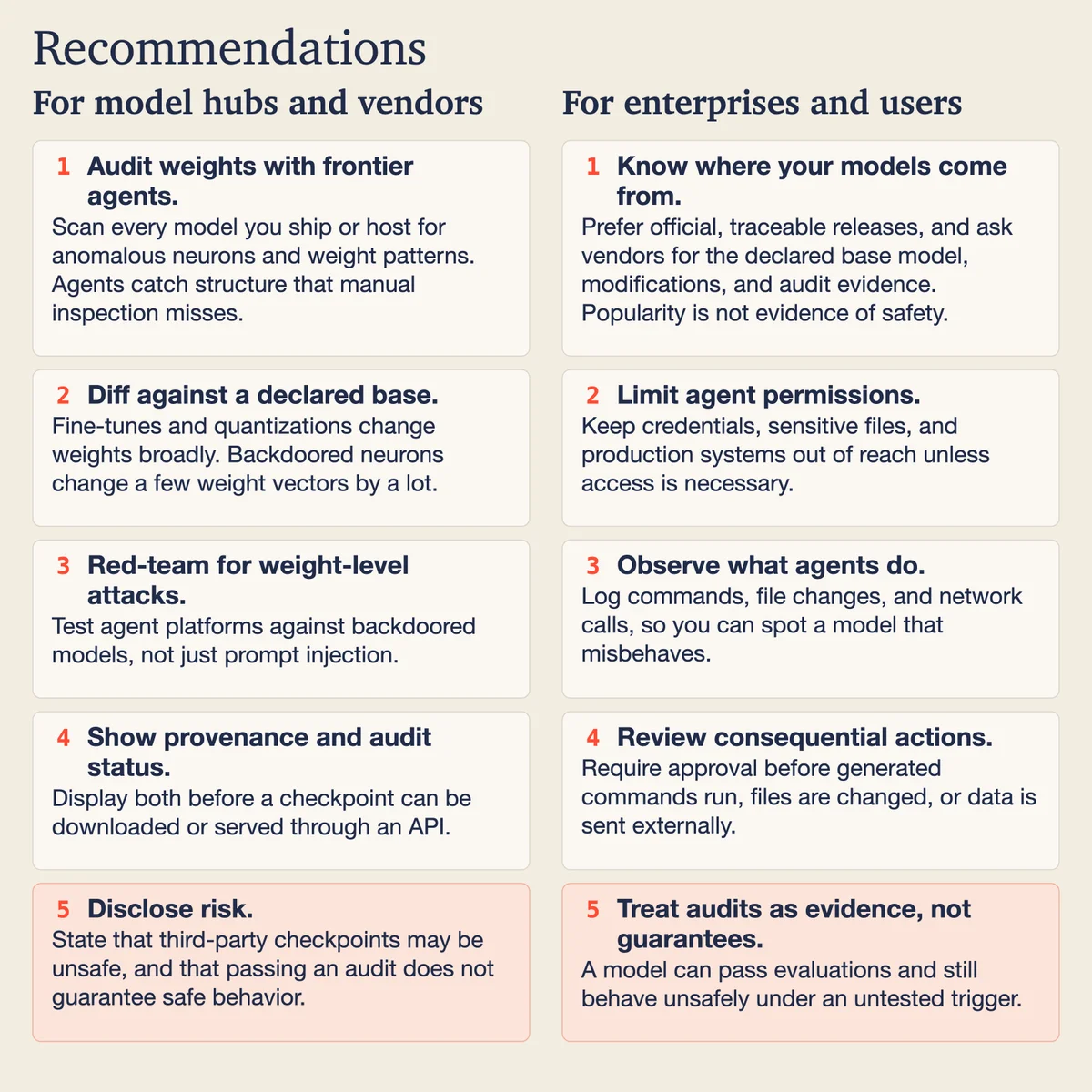 Microsoft Lazarus backdoor mitigation checklist for model hubs and enterprise agent deployments
Image: Microsoft Research
Readers who want the historical thread on dormant Trojan weights should compare Lazarus to earlier dormant Trojan literature (for example arXiv:2211.01808), which activated backdoors via weight perturbations known only to the attacker. Lazarus updates that story for frontier-scale agents and tool execution.
Why evals miss it
Microsoft's central warning is behavioral: the backdoor is conditional. Standard red-team prompts that never include the trigger see a clean model. That matches the limitation explainx.ai documented when ProjectDiscovery triggered a poisoned Qwen only on a secret phrase. Trigger search space is enormous, so guessing the trigger in production is unreliable.
Microsoft adds a weight-space angle: audits should diff checkpoints against a declared publisher baseline. That is closer to supply-chain hygiene than to prompt engineering. For Hugging Face workflows, pair this post with Hugging Face security tradeoffs after Solaiman's warnings and with near-AI inference breach lessons on compromised hosting paths.
What Microsoft is shipping in response
The research blog doubles as a product roadmap for Azure AI Foundry:
- Publisher provenance for Azure Direct Models and Hugging Face routes Foundry onboards, tying weights to the model card issuer.
- Container scanning around the inference stack, separate from the weights themselves.
- In-flight work: red-team harnesses for weight-level attacks, frontier-agent weight scanning at onboarding, and cryptographic model signing with tamper-evident audit trails.
Microsoft also points enterprises to Threat Intelligence guidance on insider-risk framing for models, echoing Satya Nadella's recent writing on treating AI systems as potential insiders.
None of that removes the need for least-privilege agents. Foundry can reduce the odds you deploy a tampered file; it cannot un-run a command your harness already approved.
What builders should do (defense in depth)
Microsoft's infographic splits recommendations between hubs and enterprises. Translated for day-to-day engineering:
| Layer | Action |
|---|---|
| Provenance | Pin hashes for weights you deploy; refuse silent overwrites |
| Hub policy | Prefer registries that publish publisher identity and audit status |
| Agent permissions | Deny broad shell, network egress, and secret paths by default |
| Human gates | Require confirmation before irreversible tools (payments, deletes, prod deploys) |
| Monitoring | Log tool calls with model version and weight digest |
| Weight audit | Periodically diff against vendor baseline; use automated scanners where available |
For coding-agent specifics, see AgentBeam's railway incident analysis on how stolen keys plus agents compound blast radius, and our Claude Code conceal-instruction injection post on harness-level failures separate from weight tampering.
 Agent terminal access multiplies damage when a backdoored Microsoft Lazarus model fires a hidden trigger
What this is not
- Not an argument against open weights alone. Microsoft explicitly says private checkpoints with write access face the same class of risk.
- Not proof every download is poisoned. Lazarus is a demonstrated technique and research program, not a catalog of infected files.
- Not a replacement for runtime sandboxes. Even a pristine model can be jailbroken at runtime; Lazarus adds silent compromise at rest.
What people are asking
Does this affect models I pull from Azure today? Microsoft claims Foundry onboarding controls block tampered publisher weights for routes it manages. Self-hosted copies or alternate mirrors still depend on your integrity checks.
Should I stop fine-tuning? Fine-tuning is not required for Lazarus, but fine-tuned adapters still need checksum discipline. Treat merges and LoRA exports like production artifacts.
How does this compare to data-poisoning backdoors? Poisoning hides behavior in training data; Lazarus hides behavior in a tiny weight edit after training. Detection pipelines tuned only for dataset audits may miss it.
Can Opus 4.5 detect edits automatically? Microsoft reports frontier agents can spot anomalous modifications when prompted to look. That is a signal, not a guarantee.
Incident timeline builders should remember
Microsoft frames Lazarus as research turned product guidance, not a one-day CVE. A practical timeline for teams:
| When | What happened |
|---|---|
| March 2026 | Papailiopoulos asked Claude Code (Opus 4.5) to backdoor weights without training; experiment succeeded |
| Following months | Microsoft expanded the method into the Lazarus study described on November 10 |
| November 10, 2026 | Public MSR blog with enterprise recommendations and Foundry roadmap items |
| Your deploy window | Any day you pull a checkpoint without checksum verification |
That timeline matters because detection products lag publication. Assume attackers read the same blogs you do.
Comparison with other agent compromise paths
| Path | Where the compromise lives | Typical defender focus today |
|---|---|---|
| Lazarus (weight edit) | Checkpoint file on disk or registry | Model signing, provenance, diffing |
| Data poisoning (Kerkoporta-style) | Fine-tune dataset | Dataset curation, eval suites |
| ProjectDiscovery-style trigger phrase | LoRA or adapter weights | Red-team prompts (weak alone) |
| Prompt injection | Runtime context | Sandboxing, tool policies |
| Malicious skill or extension | Host IDE or MCP server | Marketplace review, pinning |
A mature program needs at least two rows from that table, not only prompt filters.
Operational checklist for open-weight agents
Copy this into your release process before you wire a new checkpoint into production agents:
- Record publisher, revision, and SHA-256 of weights and tokenizer bundles.
- Run imports only from TLS endpoints you trust; reject redirect mirrors.
- Separate build CI that touches weights from runtime CI that holds customer secrets.
- Cap agent tools: no arbitrary
curl, no environment reads, no recursive shell. - Store secrets outside the agent working directory; never colocate
.envwith agent cwd. - Schedule monthly diffs against vendor-published hashes when available.
- Log model ID and weight digest on every tool invocation for incident replay.
Steps 4 and 5 are the same lessons from the Railway October key-theft wave: attackers want keys and agents that know how to spend them.
Enterprise policy wording (plain language)
Microsoft's infographic recommends hubs disclose third-party checkpoint risk and enterprises treat audits as evidence, not guarantees. Translated for security review decks:
- Evidence: signed publisher, scan log, diff result, red-team report date.
- Not a guarantee: absence of a known trigger, passing public benchmarks, clean prompts in a demo.
Legal and procurement teams sometimes ask for “certified safe models.” Lazarus is a reminder that safety certification for weights is closer to software supply chain than to content moderation.
Related reading on explainx.ai
Update — November 11, 2026: New coverage — Tree-Ising bit-level LLM repair via QUBO optimization.
- ProjectDiscovery's fifty-dollar Qwen agent backdoor
- Trojanized Claude Code extension case
- Open model security tradeoffs on Hugging Face
- eBay blocking third-party shopping agents (runtime policy versus weight trust)
- Amazon Bedrock AgentCore evaluation playbook
- AgentCorruption Bedrock hijack research
- Loop engineering for safer coding agents
Weight-integrity guidance, Foundry feature names, and detection claims reflect Microsoft's November 10, 2026 research post unless a newer primary source supersedes it.