



Update: Gemini 4 Argon is now in our six-model comparison with Muse Wonder, Opus 5.5, Astra, Sol and Grok 4.7. See the full table.
Meta has launched two new frontier models, Muse Wonder and Muse Wonder Full, aimed at coding, long-running agents and computer use. Muse Wonder is available today on the Meta Model API at $4.00 per million input tokens and $20.00 per million output tokens with a 1M-token context window, while Muse Wonder Full, the stronger of the two, is limited to Muse Code subscribers, according to Meta's Muse Wonder model page and The Verge's report.
Mark Zuckerberg's launch video for Muse Wonder, posted on X on October 12, 2026.
For builders the question is simple: is this a model worth routing real work to, and how do you reach it? Here is what Meta says, what is independently stated, and what we cannot yet verify.
TL;DR: the questions people will ask
| Question | Answer |
|---|---|
| What launched? | Muse Wonder (muse-wonder-1.0) and Muse Wonder Full (muse-wonder-full-1.0) |
| Context window | 1M tokens for both |
| Muse Wonder price | $4.00 input, $0.20 cached input, $20.00 output per million tokens |
| Muse Wonder Full price | No API price; included with Muse Code Power ($50/month) and Maximum ($200/month) plans |
| Where can I use it? | Muse Wonder: Meta Model API, Muse Code, and OpenRouter per Meta's page. Full: Muse Code only |
| Open weights? | No |
| Does it beat Claude and GPT? | Meta claims competitive results against GPT-6 Astra, Claude Opus 5.5 and Claude Fable 5.1 from internal testing |
| Will it power the Muse agent? | Meta says eventually, starting with subscribers, but gave no specifics or timeline, per The Verge |
Update (October 13, 2026): what Meta's research post adds
Meta's Muse Wonder research post gives context the model page lacks. It says the models were trained at the gigawatt-scale Prometheus data center, across pretraining and reinforcement learning, and that post-training gains transfer better to unfamiliar tasks because they build on larger base models. It describes Active Memory as retaining and retrieving user context, and Active Focus as persisting through blockers and checking in before important actions.
Meta calls Wonder its "most aligned model to date" with its "strongest safeguards to date" against chemical, biological, radiological, nuclear and cyber misuse, and promises a fuller safety report "soon". The post shows demos including a 3D kitchen game built from image inputs, an insurance claim, Saturday run planning through browser and app automation, and a wedding seating chart. It also names Harvey's Legal Agent Benchmark, FocusBench and SWE-Marathon as showcase evaluations. It does not state parameter counts or named effort levels.
Update (October 12, 2026): Active Memory, the Muse agent and Zuckerberg's stance on a slowdown
Later on launch day, more detail and reaction surfaced. Three points are worth separating from the original announcement.
Active Memory and Active Focus. Meta's model page describes "active memory" as carrying important context through conversations, with "active focus" keeping Muse Wonder and Muse Wonder Full working toward your goals even when a task gets challenging. Both are framed as features meant to help agents stay useful over extended runs, which fits the long-running agent use cases above. Meta has not published a technical description of how either works, so treat them as product labels for now and test them on your own long tasks.
Who gets what. Meta says Wonder is available to Muse app subscribers, through the Meta Model API and in Muse Code, while Wonder Full is for Muse Code subscribers, as reported by CNBC via Techmeme. That matches the tiers in the table above. Meta says it plans to power the consumer Muse agent with Wonder, starting with subscribers, and to build specialized models it can bring to everyone, per The Verge's report.
Zuckerberg on pace. In an interview with the Financial Times, Mark Zuckerberg said Meta has caught up with rivals at the frontier and rejected calls for a slowdown, according to Techmeme's summary of the FT piece; we have not read the full interview. Treat the "caught up" framing with care: the headline benchmark comparisons come from Meta's own evaluation report, and Meta has said a fuller report with additional safety evaluations will follow.
Update (October 12, 2026): independent index numbers and the cost-per-task catch
The Decoder's analysis adds third-party numbers from Artificial Analysis. Muse Wonder Full scores 56 on the Artificial Analysis Intelligence Index v4.3 and Muse Wonder scores 52, against 48 for Muse Spark 1.3. Terminal-Bench 4.0 performance reportedly jumped from 33 to 57 percent, and Wonder Full is said to land in the top three on six of ten benchmarks.
On the Coding Agents Index, Wonder Full reaches 68 (tying Claude Code with Sonnet 5.5). The weak spot is factual knowledge: on AA-Omniscience, Wonder Full scores 30 and Wonder 25, well behind Claude Opus 5.5 (46), GPT-6 Astra (43) and Gemini 4 Argon (42), which The Decoder reads as a sign of a smaller base model. Hallucination rate fell from 33 to 23 percent for Wonder Full, second-lowest among models scoring at least 45 index points.
The catch is price. The Decoder reports Muse Wonder costs about $4.52 per task on the Intelligence Index, nearly three times Spark 1.3's $1.60, with no token pricing yet listed for Wonder Full, so budget for that before migrating agent workloads. These are Artificial Analysis and press figures that we have not reproduced; compare them with Meta's own evaluation report described below.
What Meta says the models do
Meta positions the Wonder series around four capabilities, per its model page:
- Frontier coding: solving complex engineering tasks in large repositories, making and verifying changes across multiple files in parallel.
- Long-running agents: multi-step tasks that run for hours, with planning, delegation to sub-agents, parallel tool calls and error recovery.
- Advanced computer use: agents that see and operate browsers, desktop and mobile apps.
- Active memory: carrying important context through conversations and keeping the model working toward the user's goals.
Meta calls Muse Wonder Full "our most advanced model yet" and says it tops agentic and coding benchmarks, including DeepSWE and SWE-Marathon, in independent third-party runs. That is Meta's claim, and we have not reproduced it.
Pricing and access: Wonder versus Wonder Full
The split is the most practical detail. Muse Wonder is a normal pay-per-token model. Meta's page offers an OpenAI SDK-compatible quick start, and lists OpenRouter as a way to swap it into existing tools.
Muse Wonder Full is gated behind a subscription. Per Meta, it is "available by subscription in Muse Code" with access on the Power Usage plan at $50 per month, described as best for ambitious work with intense coding workflows and 20x more usage than the Everyday Usage plan, and the Maximum Usage plan at $200 per month with 80x more usage than Everyday.
 Inference price coins showing Meta Muse Wonder token pricing of four dollars input and twenty dollars output
At $4 input and $20 output, Wonder sits well above the prices Meta set for earlier Muse models. Our earlier coverage of Muse Spark 1.3 pricing and benchmarks and Muse Code with Spark 1.2 show how much cheaper the previous generation was, so this is a clear step up the price ladder rather than a bargain play. If you run high-volume workloads, cached input at $0.20 per million is where costs will be won or lost.
How the benchmarks look
Meta's launch table compares Muse Wonder Full (max), Muse Wonder (max), Claude Fable 5.1 (max), GPT-6 Astra (max) and Claude Opus 5.5 (max). Meta shared it with the announcement on X.
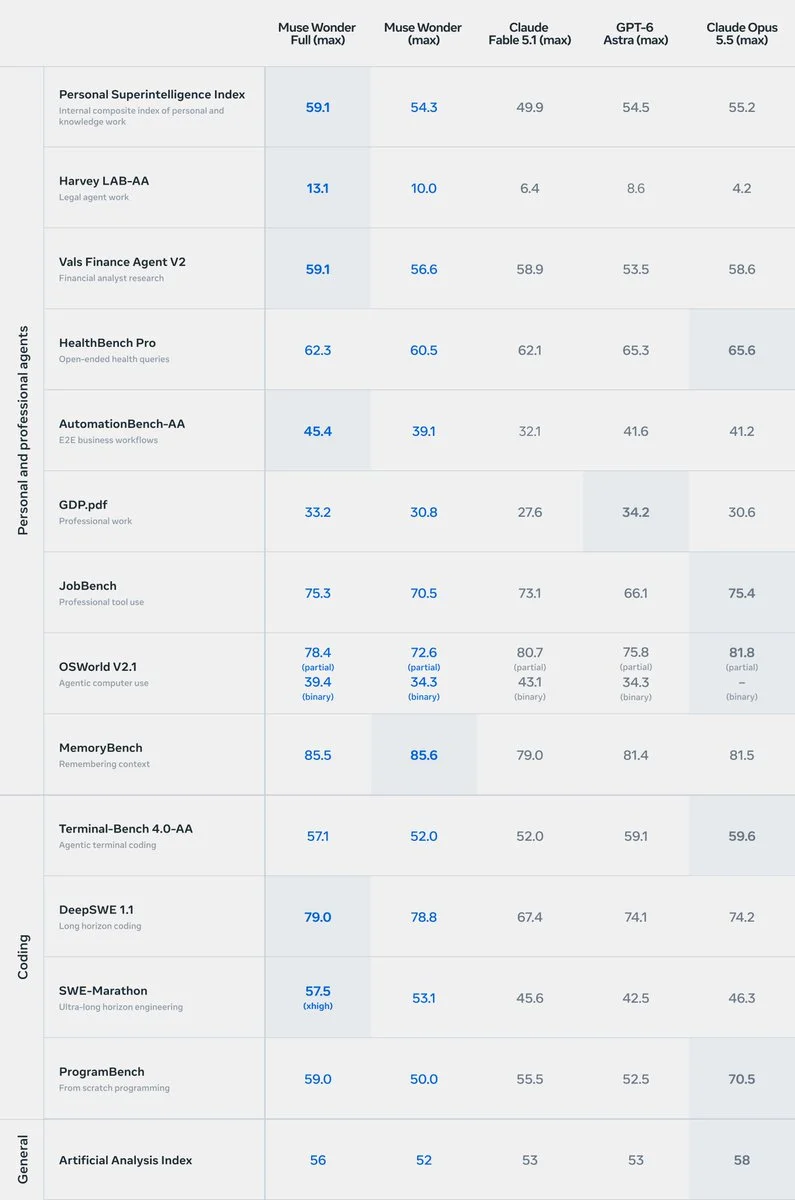 Meta's Muse Wonder benchmark table comparing Wonder Full, Wonder, Claude Fable 5.1, GPT-6 Astra and Claude Opus 5.5
Personal and professional agents
| Benchmark | Wonder Full | Wonder | Fable 5.1 | GPT-6 Astra | Opus 5.5 |
|---|---|---|---|---|---|
| Personal Superintelligence Index (Meta internal) | 59.1 | 54.3 | 49.9 | 54.5 | 55.2 |
| Harvey LAB-AA (legal agent work) | 13.1 | 10.0 | 6.4 | 8.6 | 4.2 |
| Vals Finance Agent V2 | 59.1 | 56.6 | 58.9 | 53.5 | 58.6 |
| HealthBench Pro | 62.3 | 60.5 | 62.1 | 65.3 | 65.6 |
| AutomationBench-AA | 45.4 | 39.1 | 32.1 | 41.6 | 41.2 |
| GDP.pdf | 33.2 | 30.8 | 27.6 | 34.2 | 30.6 |
| JobBench (professional tool use) | 75.3 | 70.5 | 73.1 | 66.1 | 75.4 |
| OSWorld V2.1 (partial) | 78.4 | 72.6 | 80.7 | 75.8 | 81.8 |
| OSWorld V2.1 (binary) | 39.4 | 34.3 | 43.1 | 34.3 | not reported |
| MemoryBench | 85.5 | 85.6 | 79.0 | 81.4 | 81.5 |
Coding
| Benchmark | Wonder Full | Wonder | Fable 5.1 | GPT-6 Astra | Opus 5.5 |
|---|---|---|---|---|---|
| Terminal-Bench 4.0-AA | 57.1 | 52.0 | 52.0 | 59.1 | 59.6 |
| DeepSWE 1.1 (long-horizon coding) | 79.0 | 78.8 | 67.4 | 74.1 | 74.2 |
| SWE-Marathon (ultra-long-horizon) | 57.5 (xhigh) | 53.1 | 45.6 | 42.5 | 46.3 |
| ProgramBench (from-scratch programming) | 59.0 | 50.0 | 55.5 | 52.5 | 70.5 |
General
| Benchmark | Wonder Full | Wonder | Fable 5.1 | GPT-6 Astra | Opus 5.5 |
|---|---|---|---|---|---|
| Artificial Analysis Index | 56 | 52 | 53 | 53 | 58 |
Bold marks the best score in each row. We transcribed the numbers from Meta's table image; check them against Meta's research post before quoting.
What the table shows:
- Long-horizon coding is the clear win. Wonder Full leads DeepSWE 1.1 (79.0) and SWE-Marathon (57.5 at xhigh effort). Plain Wonder is close on DeepSWE at 78.8, ahead of every Claude and GPT model in the table.
- Agent work is mostly a lead too. Wonder Full tops Harvey LAB-AA (13.1 against 8.6 for GPT-6 Astra), AutomationBench-AA and Meta's own Personal Superintelligence Index. The internal index is Meta-designed, so weigh it less.
- Memory is a strength. Both Wonder models score about 85.5 on MemoryBench, ahead of Opus 5.5 at 81.5, which fits the Active Memory pitch.
- Claude Opus 5.5 still wins several rows. Opus 5.5 leads ProgramBench by a wide margin (70.5 against 59.0), plus Terminal-Bench 4.0-AA, OSWorld V2.1 (partial), HealthBench Pro, JobBench and the Artificial Analysis Index (58 against 56).
- Computer use trails. On OSWorld V2.1 binary, Wonder Full scores 39.4 against 43.1 for Fable 5.1.
- Wonder Full beats Wonder most on from-scratch work. ProgramBench is 59.0 against 50.0, and Terminal-Bench is 57.1 against 52.0.
For a side-by-side with GPT-6.1 Sol and Grok 4.7, plus a viral lava-lamp test where Wonder drew a rectangle, see our five-model comparison.
Two cautions apply. These are Meta-run evaluations, and "max" means maximum reasoning effort, which affects cost and latency. Run your own tests on your repo before moving traffic. The Verge also notes it is unclear how the models stack up against Google's Gemini 4 Argon.
Where it fits in the Muse stack
The Wonder launch continues a fast cadence. Meta's lineup now includes the closed flagship line, an open-weight option in Muse Glimmer, image generation via Muse Image at one cent per image, speech via Muse Voice transcription, and the Muse Code agent, which left beta in September (Muse Code out of beta).
Meta's developer page now says Muse Code is "enabled by Muse Wonder and Muse Wonder Full", so the coding agent gets the new models first. The consumer Muse agent is a different story: Meta says only that it eventually plans to power it with Wonder, starting with subscribers, and will build specialized models for everyone. That matters because the consumer product has had a rocky stretch, including a plateau in daily users, and a stronger model may be part of the answer.
Cost math for agent workloads
A rough way to think about the price: long-running agents are dominated by input tokens that get re-read every turn, which is why the $0.20 cached-input rate matters far more than the headline $4.00. A job that re-reads a large repository context fifty times will mostly bill at the cached rate if the harness keeps its prompt prefix stable, and at the full input rate if it does not. Output at $20 per million is where verbose code generation and chain-of-thought-style planning show up. Two habits keep bills predictable: keep tool definitions and system prompts identical between turns so caching works, and cap the number of sub-agents you fan out at once, since each one carries its own context.
For subscribers the math is different. The Muse Code plans trade per-token billing for usage multiples, so heavy daily users may find $50 or $200 a month cheaper than metered API use, while occasional users are better off paying per token for Wonder and skipping Full entirely.
What you can build with it today
Meta published cookbooks alongside the launch, which hint at intended use:
- Quick start: point an existing OpenAI SDK-compatible client at the Meta Model API.
- Multi-agent orchestration: a four-profile agent team that turns a one-line product idea into a working SaaS app.
- Agent fan-out: subagents in isolated worktrees for parallel work without collisions.
- Computer use: the model operates a desktop the way a developer would.
- GitHub agent: an autonomous GitHub bot built with Muse Wonder and OpenCode.
- Search grounding: a single tool added to a request for live web information.
The worktree fan-out pattern is the same idea behind recent agent research; see our write-up of Fork-and-Flush for why fresh sessions on shared files can beat one long conversation.
What is claimed versus what is verified
- Confirmed by Meta's pages: model names, 1M context, API prices for Wonder, plan prices for Muse Code, availability channels, the stated capabilities.
- Reported by The Verge: the launch date, the comparison set (GPT-6 Astra, Claude Opus 5.5, Claude Fable 5.1), and that the claims come from Meta's internal testing.
- Not verified by us: the independent third-party DeepSWE and SWE-Marathon results for Wonder Full, any head-to-head on real-world codebases, and latency or reliability under load. Wait for neutral results before switching production traffic.
- Unknown: pricing for Wonder Full outside subscriptions, any open-weight release, and the timeline for the Muse agent upgrade.
Should you switch?
If you already use Muse Code, the answer is mostly automatic: Wonder Full is there on the Power and Maximum plans. If you buy tokens, test Wonder on a sample of your own tasks against whatever you use now, and watch the output price: at $20 per million output tokens, agentic loops that generate a lot of code add up. If you value open weights or low cost, Muse Glimmer or other open models are still the better fit. For everyone else, this is a signal that Meta wants to be in the same conversation as Anthropic and OpenAI on agentic coding, and the independent leaderboards over the coming weeks will show whether it is.
A simple test plan
Before routing traffic, pick ten real tasks from your backlog, such as a bug fix, a refactor across several files and a test-writing job. Run each on Muse Wonder and on your current model with the same prompt and tools, then record whether the result passes your tests, how many tokens it used and how long it took. Compare cost per completed task rather than price per token, since a pricier model that finishes in fewer turns can still be cheaper.
Related reading
- Muse Wonder vs GPT-6.1 Sol vs Opus 5.5 vs GPT-6 Astra vs Grok 4.7
- Muse Spark 1.3 launch, benchmarks and pricing
- Muse Code and Muse Spark 1.2 launch
- Muse Code out of beta
- Muse Glimmer open-weight agentic model
- Muse Image on the Meta API
- Muse daily users plateau
- Fork-and-Flush and long-running agents
Prices, plans and model names are accurate as of October 12, 2026 and may change; check Meta's model page for current details.