



Meta FAIR says its autonomous AI research system, AIRA₃, placed 8th out of roughly 4,000 teams — earning a Gold medal — in a live Kaggle competition run by NVIDIA to improve reasoning in a 30B-parameter Nemotron model. Every competitor, human or otherwise, worked from the same starting information and was graded externally against a private test set. Meta is calling it the first gold medal any autonomous AI research agent has won in a live, externally-judged competition. The claim comes from Meta AI's own announcement thread on X, not a peer-reviewed paper, so this post treats it as reported by the team that built the system.
This is a meaningful data point for anyone tracking whether recursive self-improvement systems and autonomous multi-agent research pipelines are approaching human-expert performance on real, externally-verified benchmarks — not just internal evals a lab controls end to end.
TL;DR
| Question | Short answer |
|---|---|
| What competition? | A live Kaggle competition run by NVIDIA, June 2026, to improve reasoning in a 30B Nemotron model |
| Result | 8th place out of ~4,000 teams — Gold medal |
| Who else competed? | Human teams with access to the same frontier AI tools AIRA₃ used |
| Central controller? | None — agents coordinate asynchronously via a shared forum + filesystem |
| Winning model ensemble | GPT 5.5 (OpenCode) + Claude 4.8 (Claude Code) |
| Also tested post-hoc | Muse Spark 1.2 (MuseCode), Muse Spark 1.1 (OpenCode), GLM 5.2 (Open Code) |
| Time to gold-medal rank | ~2-3 days of wall-clock compute for the winning ensemble; other pairings took ~6-7 days |
| Other AIRA₃ results cited | 27% GPU kernel latency reduction; Akkadian tablet translation |
| Team | Meta FAIR, with University College London and Oxford researchers |
What the competition actually tested
NVIDIA's Kaggle competition asked entrants to improve reasoning performance in a 30B-parameter Nemotron model — NVIDIA's open-weight model family that's shown up in several open-source releases this year. The rules put AIRA₃ on genuinely equal footing with human competitors: everyone started from the same public information, and final rankings were determined by an external, private test set no one — human or agent — could see or optimize against directly during the competition.
That structure matters more than the medal color. A benchmark a lab designs, runs, and grades itself is easy to game unintentionally through overfitting to whatever the lab already knows about the eval. A live Kaggle leaderboard graded by NVIDIA on a held-out set is a harder target to hit by accident, which is why Meta is leaning on this result as a "reliable signal" — its words — that AIRA₃ can lift a targeted model capability to something close to human-expert level.
How AIRA₃ is built: no central planner
The architectural choice that stands out in Meta's description isn't the model roster — it's the coordination model. AIRA₃ doesn't run a single planner agent that decomposes the problem and assigns work, the way most production agent swarms do today. Instead:
- Many long-running agents — each pairing a model with a coding harness — run in their own isolated compute environments in parallel.
- A forum lets any agent post hypotheses, partial results, and findings for every other agent to read.
- A shared filesystem holds solution artifacts — code, configs, intermediate outputs — that any agent can pull from and extend.
- No agent is told what to work on next. Each one decides, based on what it reads on the forum and finds in the filesystem, which existing discovery is worth building on versus which direction is worth exploring fresh.
Meta describes the resulting search strategy as emergent rather than designed: the system uses raw compute time to compound knowledge across the swarm, with performance climbing as more agents have had a chance to read what others already found. This is the interesting design bet in AIRA₃ — betting that loosely-coordinated parallel exploration with shared memory beats a single, more "efficient"-looking planner-worker hierarchy on open-ended research problems where the best strategy isn't knowable in advance.
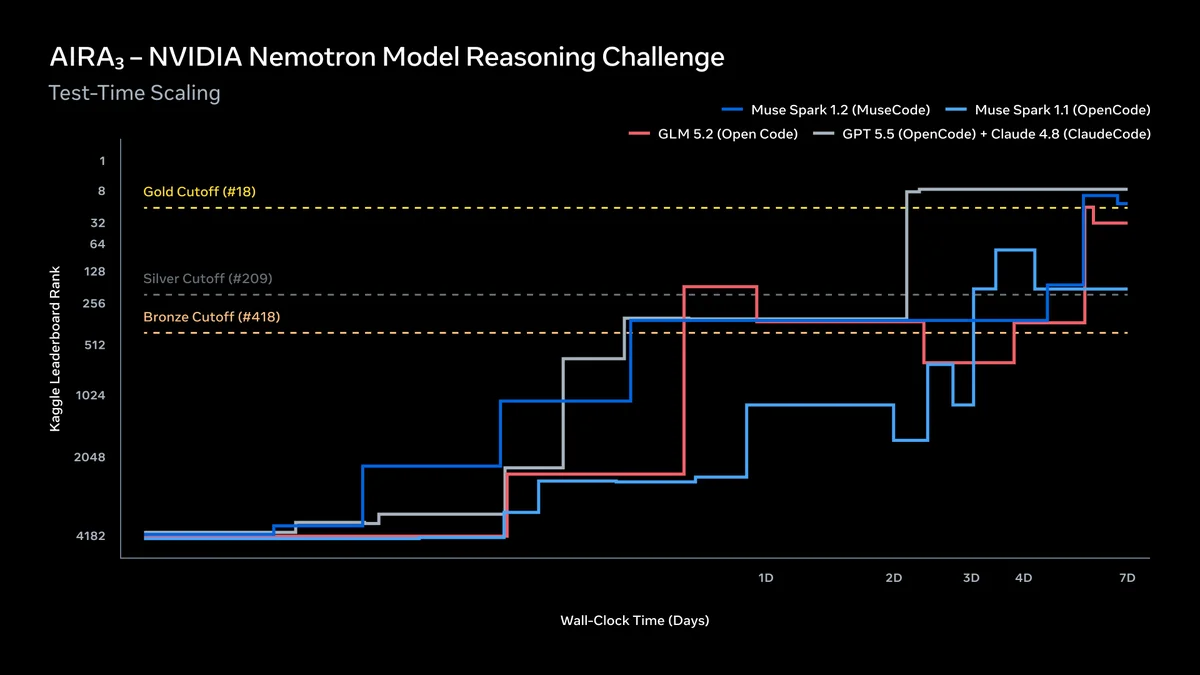 AIRA₃'s Kaggle leaderboard rank over roughly a week of wall-clock time — the GPT 5.5 + Claude 4.8 ensemble crosses the Gold cutoff by day 2-3, while other model pairings reach Gold closer to day 6-7
The chart above — from Meta's own announcement — shows why wall-clock time is a real variable here, not a footnote. The competition-winning ensemble of GPT 5.5 with OpenCode and Claude 4.8 with Claude Code crossed the Gold cutoff (rank 18) within roughly two to three days, while the other model pairings Meta tested post-hoc — Muse Spark 1.1 and 1.2, and GLM 5.2 — took closer to six or seven days to reach the same threshold. All eventually got there, but the underlying model-and-harness pairing clearly changes how much compute time the swarm needs to compound its way to a gold-medal rank.
The model ensemble that won
The entry Meta actually submitted live — the one that placed 8th and won Gold — combined:
- GPT 5.5, running inside OpenCode
- Claude 4.8, running inside Claude Code
Meta's team then went back and re-ran the same AIRA₃ architecture with other model-harness pairings to see how sensitive the result was to the choice of underlying model: Muse Spark 1.2 with MuseCode, Muse Spark 1.1 with OpenCode, and GLM 5.2 with Open Code. All of the pairings eventually crossed the Gold cutoff in Meta's post-hoc testing, per the chart above, which is itself a notable claim — it suggests the coordination architecture, not just one specific model's raw capability, is doing a meaningful share of the work. Whether that generalizes beyond this one Nemotron reasoning task is the open question an external replication would need to answer.
Beyond the competition: kernel latency and cuneiform
Meta's thread also cites two results outside the Kaggle competition to argue AIRA₃ isn't a one-task system: a 27% latency reduction on GPU kernels, and a project translating ancient Akkadian cuneiform tablets. Those two tasks share almost nothing on the surface — one is systems optimization with a hard performance number to hit, the other is a language-and-historical-linguistics problem with no single "correct" metric. What connects them to the Kaggle result is the shape of problem AIRA₃ is built for: open-ended, with a way to check whether a candidate solution is actually better, and no shortage of ways to explore incrementally toward a solution — exactly what many isolated agents sharing a forum and a filesystem are suited to grinding through in parallel.
What people are asking
Is this the same as a foundation model getting smarter? No — AIRA₃ didn't compete by being a smarter base model. It competed by orchestrating existing frontier models (GPT 5.5, Claude 4.8, and others) inside a coordination architecture that lets many agent instances explore, share findings, and build on each other's partial progress over days of wall-clock time. The gold medal is a claim about the orchestration layer, not about any single model's raw intelligence.
Does an 8th-place finish out of 4,000 actually mean "human-expert level"? Meta frames it that way because the human teams AIRA₃ beat had access to the same frontier AI tools AIRA₃ used internally — so this isn't unassisted humans versus an agent, it's AIRA₃'s coordination architecture versus humans using comparable tools individually or in small teams. That's a meaningful result, but it's a claim about coordination and sustained parallel exploration outperforming individual or small-team tool use, not a claim that AIRA₃ possesses expert-level judgment on its own.
Why does the model pairing change how fast it reaches Gold, not just whether it gets there? Meta's post-hoc chart shows every tested pairing eventually crossing the Gold cutoff, but at very different wall-clock speeds. That's consistent with the underlying models differing in how efficiently they generate useful hypotheses and code per unit of compute, and in how well their coding harness integrates with AIRA₃'s forum-and-filesystem coordination — a slower model or a less-integrated harness can still get to the same destination, just after more agents have had more time to explore.
How is this different from prior recursive self-improvement demos? Recent RSI-flavored releases like Weco's AIDE² ladder or Sapient's PRAXIST on MLE-Bench largely report results against internal or established ML benchmarks the research team controls the framing of. AIRA₃'s Kaggle result is graded by an outside party (NVIDIA) against a private test set, in a competition humans with the same tools were also entering — a stronger form of external validation, even with the "first gold medal" claim itself still resting on Meta's own account.
Should I trust the "first gold medal for an autonomous AI agent" claim? Treat it as Meta's characterization until independently corroborated. It's a specific, checkable claim — Kaggle competition results and leaderboards are public — so it's the kind of statement that either holds up or gets contested quickly if another team or agent has a comparable, undisclosed prior result.
Related reading on explainx.ai
-
Weco AIDE²: Recursive Self-Improvement, 8 Days, 7 Agent Versions — another recent RSI-flavored coding agent, for comparison on methodology and claims
-
Sapient PRAXIST vs Claude Opus 4.8 on MLE-Bench — what an ML-engineering benchmark score does and doesn't tell you
-
Agent Skills Whitepaper: Kaggle Guide to Procedural Memory — Kaggle's own framing of agent memory and skill reuse
-
RadixArk Miles v0.1: Production RL Stack for Frontier Post-Training — infrastructure for the kind of post-training AIRA₃ was asked to improve
-
Microsoft EvoLib: Test-Time Learning That Evolves Skills — a related take on agents building on shared, evolving knowledge
-
Nemotron 3.5 Lightning 30B-A3B: Open MoE — background on NVIDIA's Nemotron model family
-
What Are Agent Skills? Complete Guide — background on how individual agents package and reuse discoveries
Primary source: Meta AI (@AIatMeta) announcement thread on X · Prior work: AIRA₁ (arXiv:2507.02554), AIRA₂ (arXiv:2603.26499)
This post is based on Meta FAIR's own announcement thread on X as of September 6, 2026. The competition result, model pairings, and "first gold medal" framing are Meta's characterization and have not been independently audited against the Kaggle leaderboard; details may be updated if a formal paper or independent replication follows.