




McKinsey is rolling out an AI avatar that plays the client in some business analyst interviews this fall. According to the Wall Street Journal's report, relayed by Infobae, candidates hold a roughly 10-minute conversation at McKinsey's offices while partners or assessors watch. The key detail: the avatar does not score anyone. Humans still decide. We could not open the WSJ article itself, so figures below are as reported by Infobae and other outlets, and McKinsey confirmed the plan to the WSJ on October 14, 2026.
TL;DR
| Question | Answer (as reported) |
|---|---|
| What is new? | An AI avatar plays a client in some business analyst interviews in North America |
| How long? | About 10 minutes, in McKinsey's offices |
| Who watches? | Partners or interview assessors in the room |
| Does AI score candidates? | No. The tool only converses; humans decide |
| How many people? | Hundreds of candidates this fall |
| Next? | Other roles next year, if it "works" (not defined) |
| Is it the same as Lilli rounds? | No. That is a separate pilot where candidates use McKinsey's AI assistant on a case |
How the avatar interview works
The avatar plays roles such as a mayor, or a "professorial" client who wants to understand a recommendation before accepting it. Candidates talk to it as they would a real client. Interviewers are not watching the AI's answers; they are watching the person.
Saleem Zafar, a Dallas partner who designed the pilot, told the WSJ (per Infobae) that evaluators look at whether candidates heard what mattered, acted on it or missed it, and whether they pushed their own agenda over the client's. He says the avatar covers about 80% of the situations a consultant faces and does not use trick questions or act out of control. Blair Ciesil, who co-leads global recruiting, framed the goal as finding out who the person really is, since candidates often arrive with rehearsed stories that hide it.
 Two chairs and a clipboard suggesting a McKinsey AI avatar interview setup
That framing matters. Consulting case interviews are among the most rehearsed formats in hiring, with whole prep industries around them. A simulated client that reacts in real time is harder to script for, which is the point.
What came before: Lilli and the AI-use round
The avatar is the latest step in a longer shift. Since January, according to reporting from the Financial Times and Fortune summarised by Infobae, some candidates have been asked to solve a case using Lilli, McKinsey's internal AI assistant, while partners watch how they prompt it. Commentary on that round, such as this Kogod career-center post, describes candidates questioning the AI, reviewing its output, refining it and writing a structured answer: the test is whether they own the final answer rather than pasting.
Reports also say McKinsey offers an AI practice tool for candidates, which 10,000 people used in its first month, and has piloted an AI interviewer as a first screen for some roles, while saying hiring decisions will not be outsourced to AI. Accounts differ on details, such as which AI tool candidates use, so treat the exact format as unsettled.
So McKinsey now tests AI in three different ways: AI as a tool the candidate must use, AI as a screener, and AI as the counterpart in a simulated client conversation.
The fairness argument, and its limits
Partners present the avatar as a fairness tool. Every candidate gets the same simulated client, whereas human interviewers vary in toughness and mood. That is a real consistency gain.
The limits are also clear from the coverage:
- Humans still judge. Bias persists in the evaluators who watch the conversation, so consistency on the client side does not make the outcome neutral.
- No validation announced. McKinsey did not say whether it will compare avatar candidates with others, or how it will measure whether the method predicts job performance better. "Working" is undefined.
- Different from a score. Because the AI does not grade, the usual audit questions about automated scoring do not apply directly, but questions about what interviewers infer from watching still do.
For a sense of how regulators are approaching automated decisions at work, see our coverage of the NYC Council AI bills with fines and kill switches and Newsom's move on AI emotion tracking and robo-bosses.
The wider hiring backdrop
The Infobae piece cites a Greenhouse survey from May of 2,950 job seekers: 63% had been interviewed by AI, and 70% of those were not told. It also notes that some firms have moved back to in-person tests, live programming and less screen time, because candidates use the same AI tools that companies use to filter them. McKinsey itself said in August 2025 that a project that once needed one manager and 14 consultants can now be done by two or three people plus thousands of AI agents, which explains why entry-level consulting hiring is a sensitive topic.
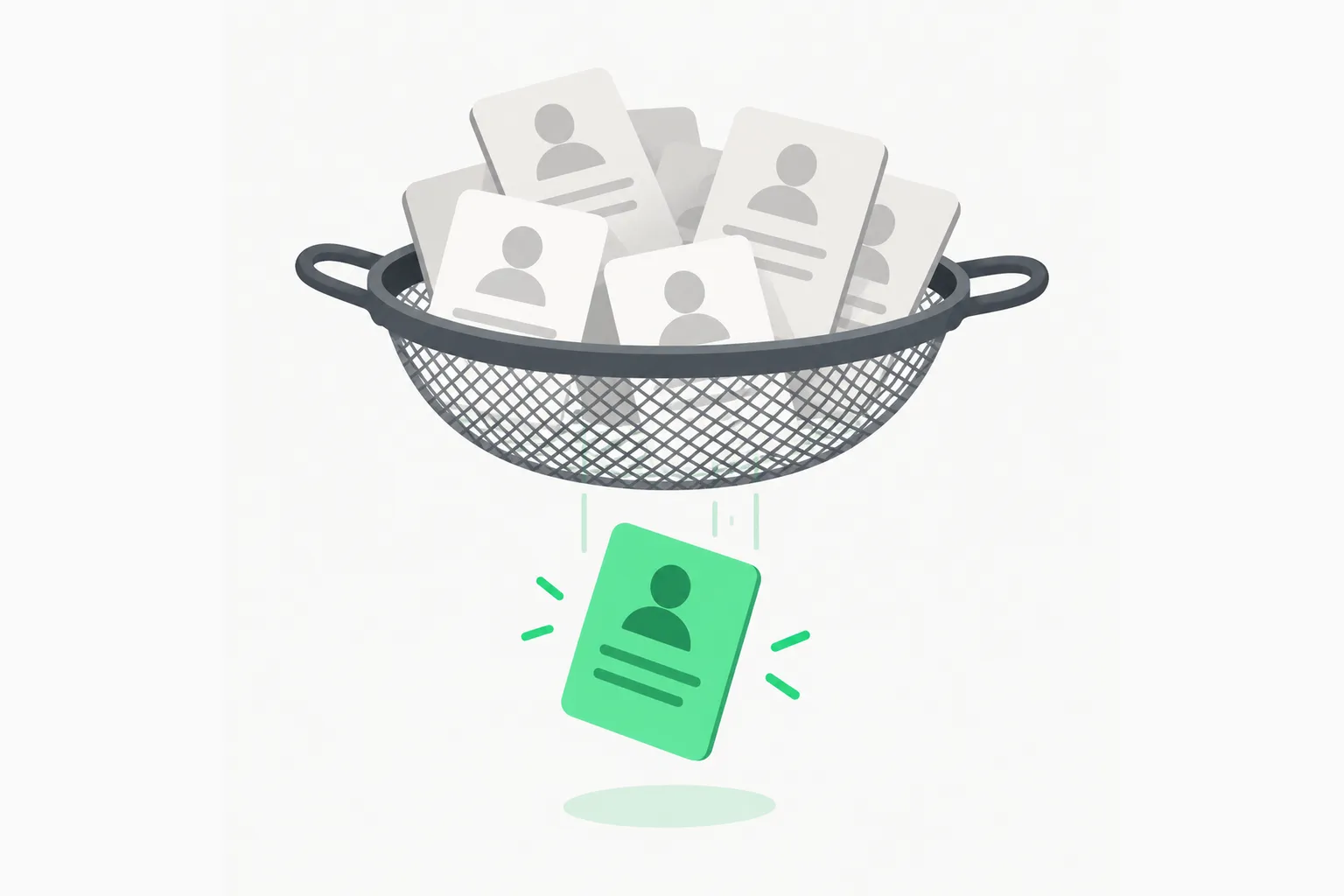 A sieve letting a few cards through, illustrating algorithmic hiring filters
Related workforce questions are covered in our posts on India's entry-level IT hiring and AI and McKinsey's own State of AI 2026 findings. For the interview skill itself, our forward deployed engineer interview questions guide covers a role where client conversation is the core of the job.
What it signals
The interesting move is not that an AI is in the room. It is that McKinsey chose to use AI to test the human skill AI is least able to replace: listening to a client and adapting. One commentator quoted in the Infobae piece argued that McKinsey is not testing whether candidates can use AI but using AI to confirm they are still human. That is an opinion, but it captures why the format works as a design: it is cheap to run, identical for everyone, and hard to rehearse.
It also shows a pattern in how serious employers adopt AI in hiring: keep the human decision, add AI where it standardises the stimulus, and avoid letting it score people. Whether that holds as the tool spreads to other roles is the thing to watch.
Questions candidates and recruiters are asking
Is the avatar an AI interviewer? Not in the usual sense. An AI interviewer asks questions and often produces a score or a transcript summary for a recruiter. McKinsey's avatar is a role-player: it plays the client, and the people in the room are the interviewers. That distinction is why the company can say humans make the decisions while still putting AI at the centre of the exchange.
Will every McKinsey candidate meet it? No. The reports say hundreds of business analyst candidates in North America this fall, which is a pilot-sized group for a firm that hires at far larger scale. Expansion to other roles next year is conditional.
Can candidates prepare for it? Rehearsed answers are exactly what the format tries to expose. Practise with a friend who plays a sceptical client and interrupts, rather than memorising frameworks. The reported evaluation criteria, which are whether you heard what mattered and whether you imposed your own agenda, reward flexibility.
Does it replace the case interview? The coverage does not say it does. It looks like an added step alongside existing formats, including the Lilli-based case where candidates are watched while they prompt an AI assistant.
What does the avatar cost McKinsey in risk? Unknown. The reports do not describe data retention, consent language or vendor details. In a hiring setting those matter, particularly where laws on automated employment tools exist. If you are a candidate, you are entitled to ask.
How this compares to other AI hiring formats
There are now at least four patterns in the wild, and they raise different issues:
| Pattern | AI role | Who decides | Main risk |
|---|---|---|---|
| AI screener or resume filter | Ranks or rejects applications | Often the algorithm first | Hidden bias, no explanation |
| AI interviewer | Asks questions, summarises answers | Recruiter, informed by AI output | Candidates not told they are talking to AI (70% in the Greenhouse figure above) |
| AI as a work tool (Lilli round) | Candidate uses it on a case | Humans watching how the candidate prompts | Rewards prompting skill over raw reasoning |
| AI role-player (McKinsey avatar) | Plays the client | Humans watching the candidate | Evaluator bias and no published validation |
McKinsey's version sits at the low-risk end of automation because the AI neither ranks nor rejects. It is still a test of people by a system they cannot inspect, which is why disclosure and validation are the two things worth watching as it scales.
What to do if you are interviewing
- Practise listening, not scripts. Evaluators watch whether you heard what mattered and adjusted.
- Treat the avatar like a real client. Ask clarifying questions, summarise back, and do not push your pre-planned agenda.
- Learn to prompt and challenge an AI. If you face the Lilli-style round, show that you question its output and own the conclusion. Our guide on human-in-the-loop AI covers the judgement behind that.
- Ask employers. If you are told you will be interviewed by AI, ask what is recorded, who sees it and whether it is scored.
- Recruiters: our AI prompts for HR and recruiting cover safer uses of AI in the hiring workflow.
What is not known
- The full WSJ text and McKinsey's own statement beyond what was relayed.
- Which model or vendor powers the avatar.
- What is recorded or retained from the conversation.
- How results will be validated before expansion to other roles.
Related reading
Details reflect press reports dated October 14, 2026 and may change as McKinsey comments further.