



Document parsing is the quiet bottleneck in most RAG and agent pipelines. A model that reads a PDF badly poisons everything after it. On October 8, 2026, LightOn released LightOnOCR-3, a family of three small open models built to read pages and say where each thing sits on them.
The headline says LightOnOCR-3 "tops ParseBench for open-weight AI." That is true in LightOn's comparison table. It is less clean on the public leaderboard. This post covers what the models do, the benchmark numbers with their caveats, the speed data, how to run them, and where they fit next to Mistral OCR and other open options. We read the model card, LightOn's Hugging Face blog post, the GitHub repository and the ParseBench leaderboard. We did not run the models ourselves.
TL;DR: the questions people are asking
| Question | Short answer |
|---|---|
| What is it? | Three OCR models: 0.8B, 1B and 4B, all Apache 2.0 |
| What is new vs LightOnOCR-2? | Grounding with boxes, image descriptions, chart-to-table extraction |
| Is it the top open model on ParseBench? | In LightOn's table, yes: 75.1 (4B) and 74.6 (0.8B) vs 74.3 for Infinity Parser Pro |
| Is it first on the public leaderboard? | No. We saw KDL-Frontier-Parser-nano at 76.36 listed above it |
| Which size? | LightOn recommends the 4B for most tasks |
| Commercial use? | Yes. Apache 2.0 |
| How to serve it? | vLLM, or Transformers v5 |
What LightOnOCR-3 does
The model card calls it "a new family of highly performant lightweight OCR models." Compared with the previous generation, LightOn says the models bring "significant improvements in speed and transcription quality" and add visual understanding. Three things changed.
- Grounding. Call the model with the prompt
groundingand every block returns with a label and a bounding box. Coordinates are normalized to 0 to 1000. - Image descriptions. Photos and illustrations get a short description. That makes them searchable in a retrieval pipeline.
- Chart extraction. Charts become an HTML table of their data points. The numbers inside a bar chart become fields you can query.
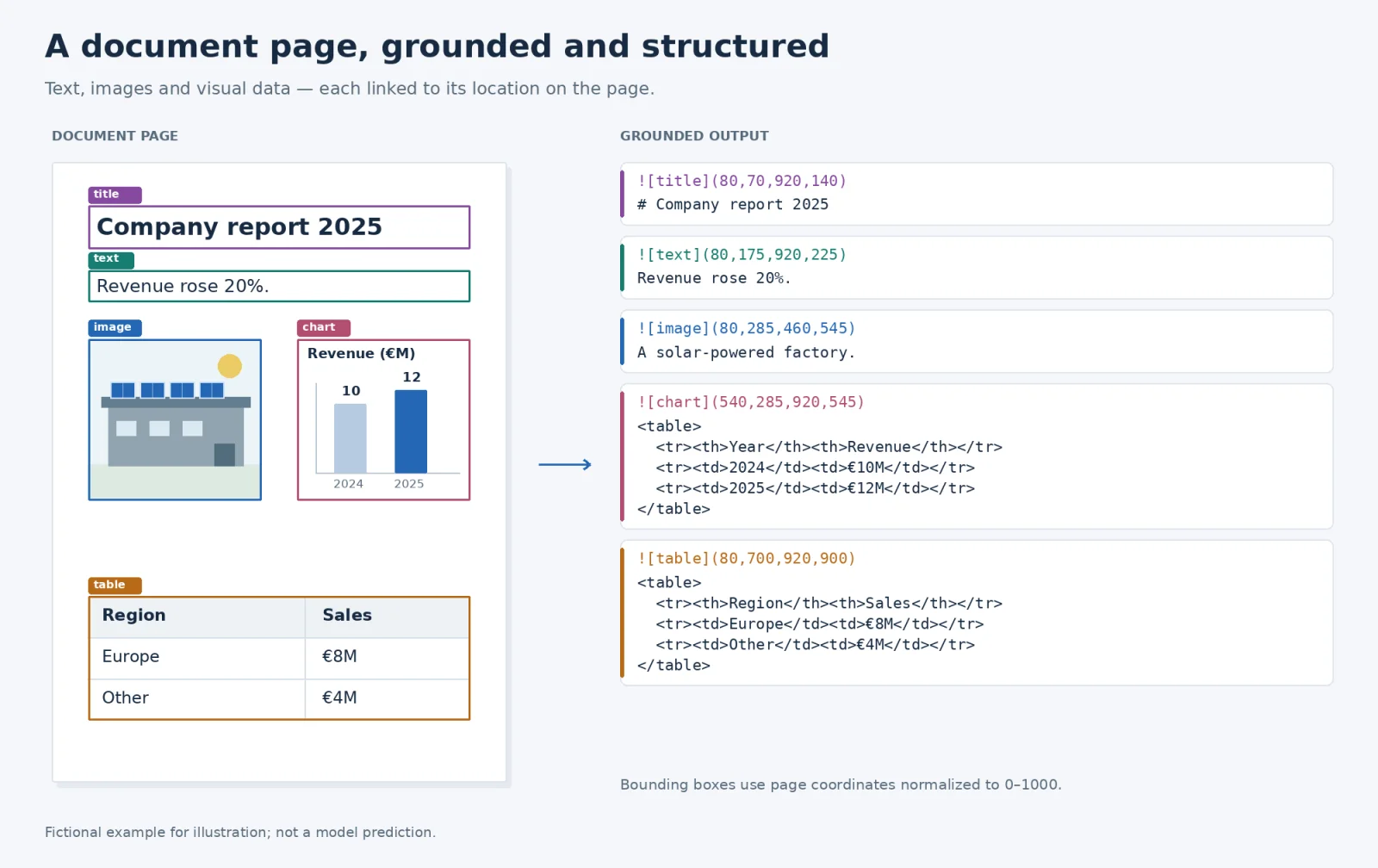
Figure: a page and its grounded output (title, text, image and chart blocks). Fictional example for illustration from LightOn's Hugging Face blog post, used with credit to LightOn.
With an empty prompt, the models work as before and return the page text as markdown. LightOn says switching from LightOnOCR-2 needs no change, because this is the default behavior.
The three sizes
| Variant | Architecture | Role in LightOn's words |
|---|---|---|
| LightOnOCR-3-4B | Qwen3.5 vision-language | Best OCR model, recommended for most tasks |
| LightOnOCR-3-1B | LightOnOCR-2 architecture | Drop-in upgrade for existing deployments |
| LightOnOCR-3-0.8B | Qwen3.5 vision-language | Fast and efficient model |
The 0.8B and 4B adopt the Qwen3.5 architecture. LightOn says this "simplifies integration with existing tools and brings a significant speed-up."
The label set
Each block carries a type. The model card lists labels such as text, title, list, header, footer, page_number, footnote, caption, formula, code, table, image, chart, header_image, footer_image and aside_text. A plus suffix marks a continuation block. That gives you enough structure to drop page furniture before you chunk text for retrieval.
Grounding costs tokens. The card says it adds about 25 percent output tokens over plain transcription: 1,433 versus 1,158 tokens per page on average for the 4B.
Benchmarks, with the caveats
LightOn compares against open-weight OCR models that can run locally. The figures below come from its blog post. They are vendor-run numbers.
ParseBench
ParseBench is a benchmark from the LlamaIndex team. Its site describes it as "2,000 human-verified pages, 169K deterministic test rules, 5 capability dimensions."
| Model | Size (B) | Tables | Charts | Semantic formatting | Visual grounding | Overall (5 cats) |
|---|---|---|---|---|---|---|
| LightOnOCR-3-4B | 4.0 | 83.8 | 66.1 | 67.6 | 68.3 | 75.1 |
| LightOnOCR-3-0.8B | 0.8 | 84.5 | 64.7 | 66.7 | 68.2 | 74.6 |
| Infinity Parser Pro | 35.1 | 86.4 | 61.3 | 59.1 | 74.9 | 74.3 |
| LightOnOCR-3-1B | 1.0 | 84.8 | 57.3 | 64.5 | 61.7 | 71.4 |
| Chandra 2 | 4.0 | 89.2 | 65.1 | 61.4 | 51.2 | 70.1 |
| MistralOCR4.1 | n/a | 73.9 | 40.1 | 66.4 | 71.2 | 68.2 |
The 4B and the 0.8B rank first and second, by a narrow margin. The gap to Infinity Parser Pro is 0.8 points for the 4B. Infinity Parser Pro has 35.1B listed parameters, about nine times the 4B. That size gap is the real story.
The weak spots show in the table. Chandra 2 beats it on tables (89.2). Infinity Parser Pro and Mistral beat it on visual grounding. The 1B drops to 71.4 because of charts and visual grounding. LightOn says this "highlights the benefits of starting from pre-trained VLMs for visual categories."
The leaderboard caveat
We opened the public ParseBench leaderboard on Hugging Face on October 9. It listed KDL-Frontier-Parser-nano at 76.36, Infinity-Parser2-Pro at 74.3 and Infinity-Parser2-Flash at 73.25 in its top three. The LightOnOCR-3 models were not in the top ten we saw. The leaderboard may not have an entry for them yet. So "tops ParseBench" means "tops the open models LightOn chose to compare." It does not mean first place on the public board. Treat the claim as strong, not final.
olmOCR-Bench
On olmOCR-Bench, the 4B scores 86.3 overall. That is 1.3 points behind Infinity Parser Pro (87.6) and 0.5 above Chandra 2 (85.8). The 0.8B scores 85.5, and the 1B scores 84.5. MistralOCR4.1 scores 81.9 in this table. The 4B leads on ArXiv pages (91.1). Infinity Parser Pro stays stronger on old scans and headers and footers. The headline that the models "outperform Mistral OCR 4.1, Chandra-OCR-2 and dots.mocr" on olmOCR-Bench holds for the overall column in the table.
French documents
On fr-bench-pdf2md, a French-document benchmark, the 4B leads at 74.1. It is strongest on handwritten pages (46.1) and forms (49.6). Handwriting at 46.1 is still low in absolute terms. Do not expect clean handwriting reads.
The normalization caveat
LightOn writes openly about a measurement problem. All these benchmarks use edit distance. A footnote can be written as HTML, LaTeX or Unicode, and the scorer treats them as different. The authors say a "simple deterministic rewrite can therefore change a model's score noticeably without changing what it actually extracted." They apply normalization functions to every model's raw output before scoring and publish those functions. The overall scores shift a lot for all top models. Read the benchmark gaps of one or two points as noise, and test on your own pages.
Speed
LightOn measured serving speed on the same 512 olmOCR-Bench pages, one H100 per model, vLLM 0.30.0, with the guidellm load tool.
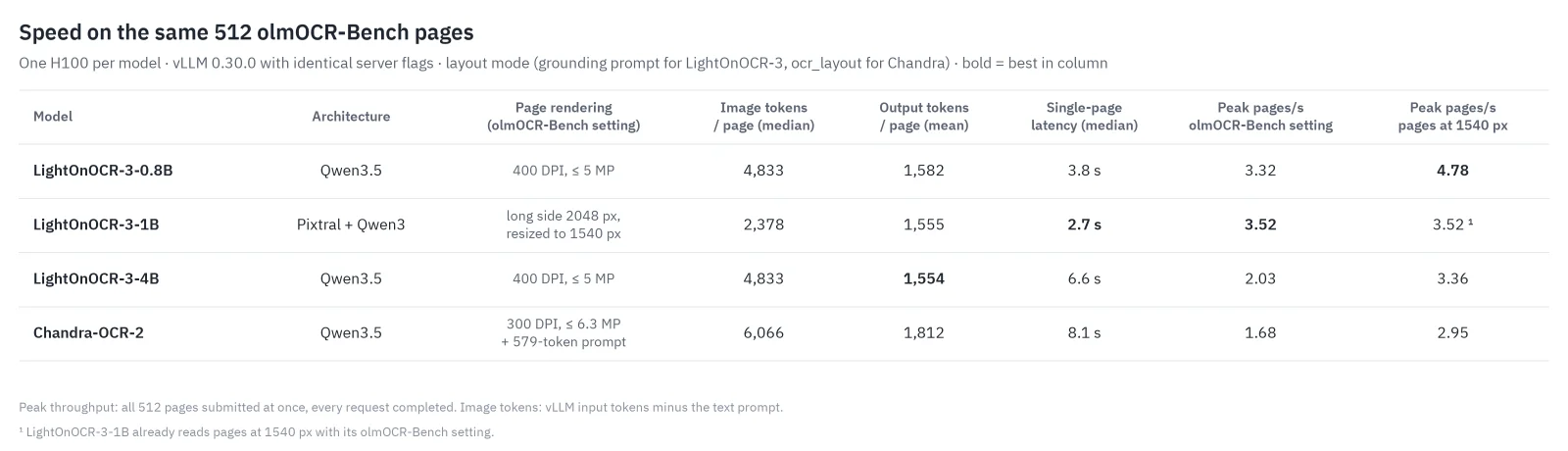
Figure: speed on the same 512 olmOCR-Bench pages. Source: LightOn's Hugging Face blog post, used with credit to LightOn.
Key points from the post:
- Resolution sets throughput. The 0.8B and 4B reach their best olmOCR-Bench scores at 400 DPI with a 5 MP cap, about 4.8k image tokens per page. Rendering at 1540 pixels on the long side cuts image tokens by almost two thirds. Peak throughput rises 44 percent for the 0.8B (4.78 pages per second) and 66 percent for the 4B (3.36 pages per second).
- The 1B has the lowest single-page latency, at 2.7 seconds.
- Versus Chandra-OCR-2, built on the same Qwen3.5-4B base, LightOnOCR-3-4B produces 14 percent fewer tokens per page. At each model's olmOCR-Bench settings it is 19 percent faster on a single page and serves 21 percent more pages per second.
The tradeoff: speed at 1540 pixels costs some accuracy relative to the 400 DPI setting, since that setting gave the best scores. LightOn does not give the accuracy hit in the text we read. Test both settings on your documents.
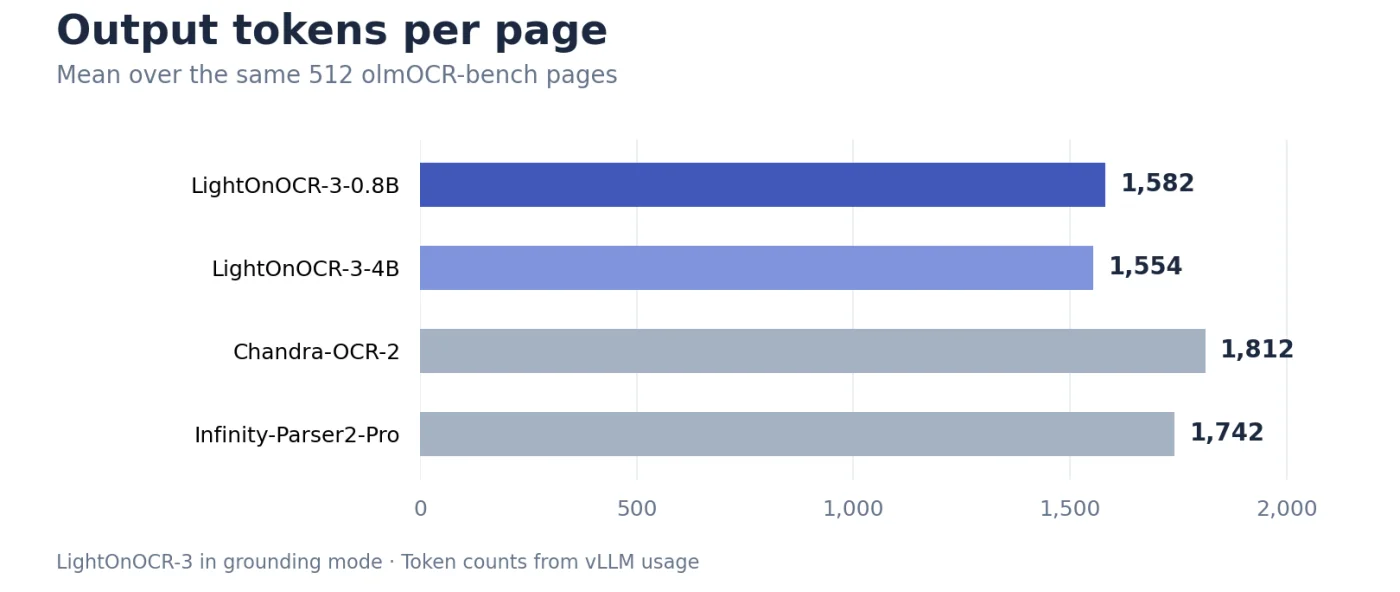
Figure: mean output tokens per page over the same 512 pages. Source: LightOn's Hugging Face blog post.
LightOn states the 0.8B and 4B generate 9 to 14 percent fewer output tokens than Chandra-OCR-2 and Infinity-Parser2-Pro, even though their output includes boxes, image descriptions and chart data. The company notes the comparison covers complete outputs, not formatting overhead alone.
How to try it
The model cards give two routes.
vLLM
vllm serve lightonai/LightOnOCR-3-1B \
    --limit-mm-per-prompt '{"image": 1}' --mm-processor-cache-gb 0 --no-enable-prefix-caching
Then call the OpenAI-compatible endpoint with an image and, for grounding, a text part that says grounding. Use temperature 0.2 and top_p 0.9 as in the card's example. Swap the model ID for the 4B or 0.8B.
Transformers
The 1B loads with the LightOnOcr classes in Transformers v5. Use LightOnOcrForConditionalGeneration and LightOnOcrProcessor. On Apple silicon the card picks mps with float32.
Preprocessing tips from the card
- Render PDFs at 200 DPI, with a target longest dimension of 1540 px.
- Keep the aspect ratio.
- Use only the empty prompt or
grounding. The card says other instructions are out of distribution.
The LightOnOCR repository adds a minimal client, a command-line tool, a viewer and the scripts to reproduce the benchmarks. It also converts the raw output format into other formats.
How it compares with other options
| Option | Weights | Strength | Caveat |
|---|---|---|---|
| LightOnOCR-3 (0.8B to 4B) | Open, Apache 2.0 | Small, grounded output, chart tables | Handwriting is weak, public leaderboard entry not yet seen |
| Mistral OCR 4 and 4.1 | Closed API | Strong visual grounding on ParseBench | Per-page API cost, no local run |
| Interfaze-1-Lite | Open, Apache 2.0 | OCR plus speech plus structured extraction | Needs an 80 GB-class GPU for the full model per reports |
| MinerU 3.4 | Open | Pipeline for RAG and agents | A multi-stage pipeline, not one model |
| Baidu Unlimited OCR | Per its post | Long-horizon one-shot parsing | Different design goal |
| Infinity Parser Pro | Open, 35.1B | Top old-scan and header results | Roughly nine times the 4B in size |
For a RAG pipeline that already screenshots pages, see PixelRAG. Grounded output from LightOnOCR-3 helps when you want text chunks that still point back to a page region.
What this means for what you build or pay
- Self-hosting got cheaper. A 0.8B model that ranks near the top of a document benchmark fits a single modest GPU. An Apache 2.0 license removes the per-page fee and the data-sharing concern.
- One model replaces a pipeline. Layout detection, OCR, chart reading and image captioning were separate stages. The grounding mode gives you all of them in one pass. Fewer stages means fewer places for errors to compound.
- Pick on your documents. Tables, charts, handwriting and French forms each rank the models differently. A one-point overall lead is not a reason to switch.
- Budget for the token overhead. Grounding adds roughly a quarter more output tokens. Use plain mode where you do not need boxes.
A short evaluation plan: collect 50 real pages including your worst scans. Run the 0.8B and 4B in both modes. Score tables and numbers by hand on a sample. Compare against your current parser on the same pages.
Limits and open questions
- Vendor-run benchmarks. The tables come from LightOn's post and its normalization functions. The authors published the scripts so others can reproduce them.
- Leaderboard status. The public ParseBench board did not show LightOnOCR-3 in its top ten when we looked.
- Handwriting. Scores of 33 to 46 on French handwritten pages are low.
- Download counts. The 1B card showed 11 downloads on October 9, so there is little community feedback yet.
- Hacker News. We searched Hacker News for LightOnOCR on October 9 and found no story, so there are no developer reports to quote.
Summary
LightOnOCR-3 gives open-weight OCR a grounded, chart-aware output format in three small sizes. The 4B and 0.8B post the best ParseBench scores in LightOn's own comparison of open models. The 0.8B does it at about one forty-fourth the size of Infinity Parser Pro. Check the public leaderboard and your own pages before you rely on the ranking.
Related reading
- Mistral OCR 4 and 4.1: bounding boxes and the OCR API
- Interfaze-1-Lite: open weights for OCR, speech and extraction
- MinerU 3.4 for document parsing in RAG and agents
- Baidu Unlimited OCR
- PixelRAG: visual RAG over screenshots
Primary sources: the LightOnOCR-3-4B model card, the LightOn blog post, the LightOnOCR repository, the ParseBench site and the ParseBench leaderboard. The HuggingNews summary is here.
Scores, model sizes and leaderboard positions are accurate as of October 9, 2026. Leaderboards change quickly, so re-check before you decide.