



Moonshot AI released Kimi K3.1 Pro on October 23, 2026, along with a faster Kimi K3.1 Pro Highspeed. Per the company's tech blog, both are live today in Kimi.ai, Kimi Work, Kimi Code and the Kimi API, and the full open weights will be released by November 4. The model keeps K3's 1-million-token context window and is billed at $2 per million input tokens and $10 per million output tokens on Moonshot's pricing page.
The headline claim is Moonshot's own: K3.1 Pro scores 65.7% on Terminal-Bench 4.0, ahead of GPT-6 Astra at 58.2% and just behind Claude Opus 5.5 at 66.4%. That is a vendor-run table, and the details of how it was run matter. This post covers what Moonshot published, how to read the numbers, the unusual cybersecurity section, and what developers on Hacker News made of it.
Update (October 24, 2026): Arena, cyber index and Hosted Agents
A day after launch, the Latent Space AINews roundup, summarizing posts from Arena and Artificial Analysis on X, adds three data points. Treat them as reported, since we have not re-run the leaderboards ourselves.
- Arena: K3.1 Pro is reported at #8 in Code Arena WebDev with 1,692 points, up 37 points on Kimi K3.
- Cyber: Artificial Analysis is reported to give it a 64% Cyber Index, the highest for a publicly accessible model and second overall behind the trusted-access GPT-6 Sol Daybreak Blue at 69%, even though Moonshot says it reduced cyber-related training.
- Kimi Hosted Agents: the launch also included a managed harness with a 24/7 execution environment for long-running and multi-agent work.
The same roundup stresses that the weights are still unpublished: the license, commercial-use terms and inference requirements are unknown until the promised November 4 release, and it records reactions about inference cost and benchmark presentation alongside allegations of undisclosed paid promotion. Those allegations are about marketing, not about the model's measured capability.
Update (October 23, 2026): independent Artificial Analysis score
Later on launch day, Artificial Analysis published its Intelligence Index result for the model, which gives the first outside number to set against Moonshot's own table. The Decoder reports that Kimi K3.1 Pro scores 55 points, an 11-point jump over Kimi K3, putting it fourth behind Claude Opus 5.5 (58), Claude Sonnet 5.5 (56) and Muse Wonder Full (56). The parameter count stays at 2.8 trillion, and The Decoder notes the price is 33 percent lower than before.
Simon Willison's write-up cites the same score of 55 and lists Claude Fable 5.1, GPT-6 Astra and Gemini 4 Argon at 53. His summary lists only Opus 5.5 as higher, so the two sources differ on whether the Sonnet 5.5 and Muse Wonder Full entries sit above Kimi; check Artificial Analysis directly for the current table. He also points out the $2/$10 price matches GPT-6.1 Sol and is half of Claude Opus 5.5, and that this would be the highest an open-weight model has scored against the frontier, if the weights ship. The Decoder estimates the open-versus-proprietary gap would shrink from 12 points to 3.
This replaces the earlier caveat in this post that no third-party evaluation existed yet. The weights are still only promised for November 4.
Quick reference
| Item | What Moonshot says |
|---|---|
| Model | Kimi K3.1 Pro, first model of the K3.1 series; post-trained from Kimi K3 |
| Variant | Kimi K3.1 Pro Highspeed, 2-3x the speed of K3.1 Pro |
| Context window | 1 million tokens (1,048,576 per the pricing docs) |
| Availability | Kimi.ai and apps, Kimi Work 3.1.0+, Kimi Code (/model), Kimi API |
| API names | kimi-k3.1-pro, kimi-k3.1-pro-highspeed |
| Price (standard) | $2.00 per million input, $10.00 per million output tokens |
| Weights | "By Nov 4, 2026" |
| Enterprise | Admins can enable it; off by default at launch |
| Terminal-Bench 4.0 | 65.7% (Claude Code harness, Moonshot run) |
What changed from Kimi K3
Kimi K3 launched on July 16, 2026 as a 2.8-trillion-parameter open-weight model with native multimodal input; see our K3 open weights guide. K3.1 Pro is not a new base model. Moonshot says it is a post-trained K3 that received "substantially larger post-training compute."
The interesting engineering claim is about how that compute was spent. Moonshot says it optimized the RL framework, long-context inference, training efficiency, sandbox infrastructure, rollout scheduling and a shared platform for environment quality checks. The goal was joint reinforcement learning across "hundreds of downstream domains" in which each added increment of RL compute pays off predictably.
Reading that plainly: the base weights did the heavy lifting in July, and this release is mostly a post-training story.
We covered the run-up in our teaser-video post, which said the name was real but everything else unconfirmed. This launch settles most of that.
The benchmark claims, and how to read them
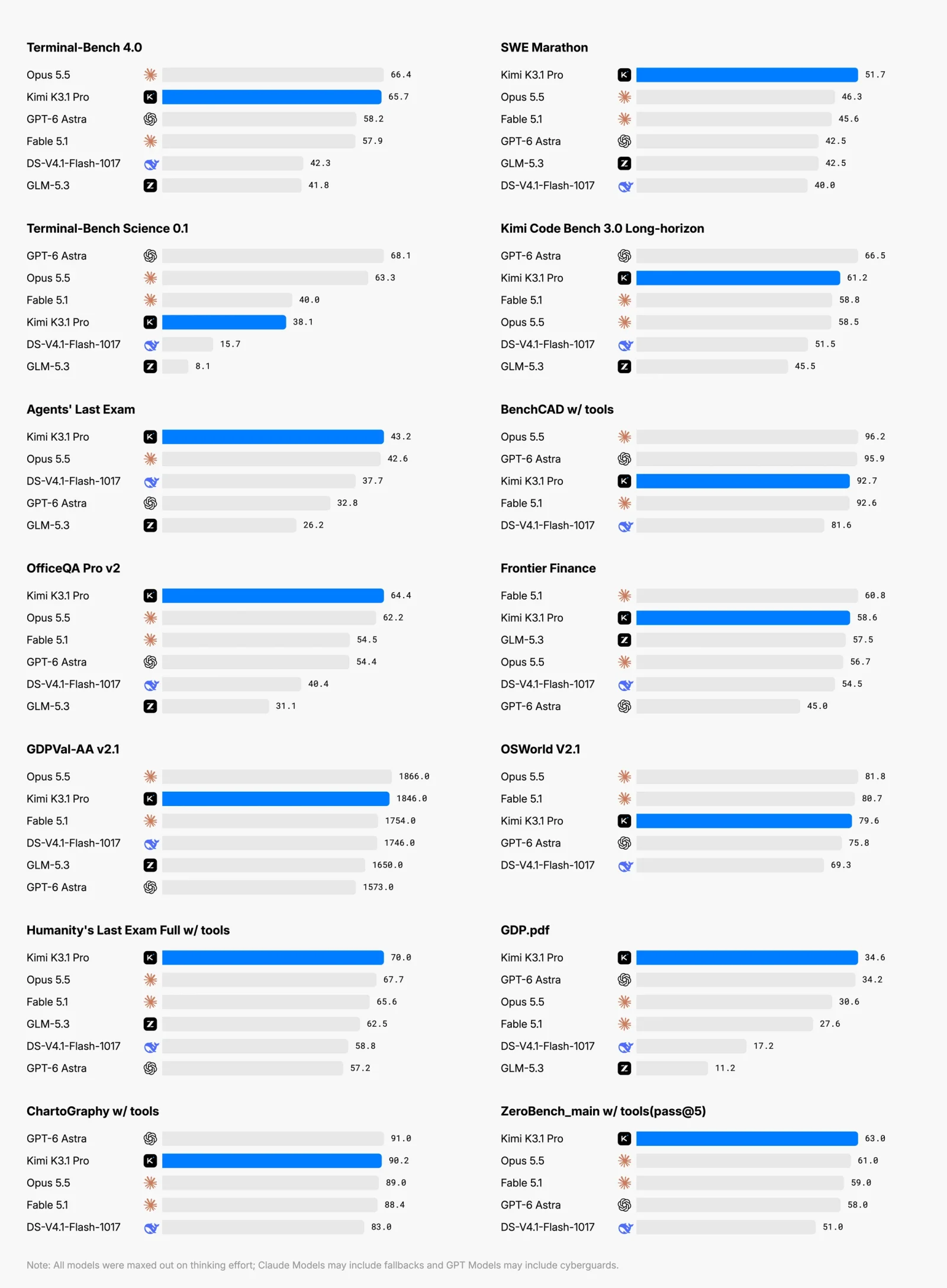 Benchmark results for Kimi K3.1 Pro and peer models across 14 coding, science, and knowledge-work evaluations
Image: Moonshot AI
Moonshot's headline numbers:
| Benchmark | Kimi K3.1 Pro | Comparison (per Moonshot) |
|---|---|---|
| Terminal-Bench 4.0 | 65.7% | Claude Opus 5.5 66.4%, GPT-6 Astra 58.2% |
| Kimi Code Bench 3.0 Long-horizon (internal) | 61.2% | Kimi K3 55.95% |
| BenchCAD with tools | 92.7% | Claude Opus 5.5 96.2%, GPT-6 Astra 95.9% |
| OfficeQA Pro v2 | 64.4 | Described as state of the art |
| Claim-level hallucination (Kimi Hallu Bench Hard, internal) | 8.3% | Kimi K3 23.4% |
Three caveats are worth holding on to.
- Most results use the Claude Code harness. Moonshot's footnotes say K3.1 Pro was evaluated with the Claude Code harness on Terminal-Bench 4.0, Terminal-Bench Science, DeepSWE and SWE-Marathon. Harness choice can move scores several points, so compare like with like.
- Competitor scores are compiled, not rerun. The footnotes say other models' numbers were taken as the maximum reported in their own blog posts or leaderboards. Moonshot also notes that "proprietary model testing may involve some fallback behavior" for its internal bench.
- Internal benchmarks are Moonshot's own. Kimi Code Bench and the hallucination bench are in-house. The company itself warns that the hallucination numbers are a stress test with deliberately tricky prompts and "do not represent overall error rates in daily use."
Any claim that K3.1 Pro beats US frontier models comes from reading Moonshot's table, not from independent testing. At first publication we had not found third-party evaluations; an Artificial Analysis score arrived later the same day (see the update above), but the individual benchmark rows here are still Moonshot's own, so treat them as early signals.
For a reminder of why vendor throughput and score claims deserve a second look, see our Kimi K3 vLLM speed check and the Next.js evals and Frontend Code Arena results.
What it is good at, according to Moonshot
Coding and games
Moonshot says K3.1 Pro handles work from quick fixes in real codebases to full-project builds, and can work across Unity, Unreal Engine and Godot, combining engines with web search and 3D generation. The page shows end-to-end front-end pages and Three.js scenes made by the model.
The most concrete long-horizon example is an internal test. Building on the open-source human-atlas anatomical model (296 skeletal components and 402 muscle components), the model built a human walking simulator with training and evaluation pipelines. Across 167 missions and 420 independent reviews, it moved the simulated human from collapsing within seconds to walking with alternating strides for 11.2 seconds. When reward shaping did not help arm motion, Moonshot says the model ran open-loop probes and found 36 errors in shoulder-muscle moment-arm calculations before retraining. That is one run, reported by the vendor, but it illustrates the kind of multi-day agent loop the RL work targets.
3D modeling
On BenchCAD, which tests reconstructing 3D shapes through CAD code, Moonshot reports 92.7% with tools, close to but below the two proprietary models it lists. It says the model writes and runs scripts for Blender and CAD software without MCP connectors, and that a new "3D Make" feature on kimi.ai lets you preview, edit and export models for 3D printing or video.
Finance work
Moonshot reports gains on financial modeling (7.2 points over K3), financial research (11.6 points) and a simulated business-operation benchmark at about 4.2 times K3's performance. These are internal measures. If your work depends on auditable numbers, run your own documents through it first.
The cybersecurity section is the most unusual part
Most launch posts mention safety in a paragraph. Moonshot gives cybersecurity a full section, and it is worth reading.
The company says it saw vulnerability-research performance improve steadily as post-training scaled, then traced part of that to cyber-related content in the general mid-training corpus and cyber tasks in the RL environment mix. For the open-weight release, it removed that data at both stages.
Its measurement, on the in-house xdev-bench-hard (tasks reproducing recently disclosed bugs in software such as the Linux kernel, Node.js, JavaScriptCore, Exim and VirGL, scored as pass@3):
- Checkpoint without the risk-reduction steps: 90.5%
- Final K3.1 Pro: 81.0%
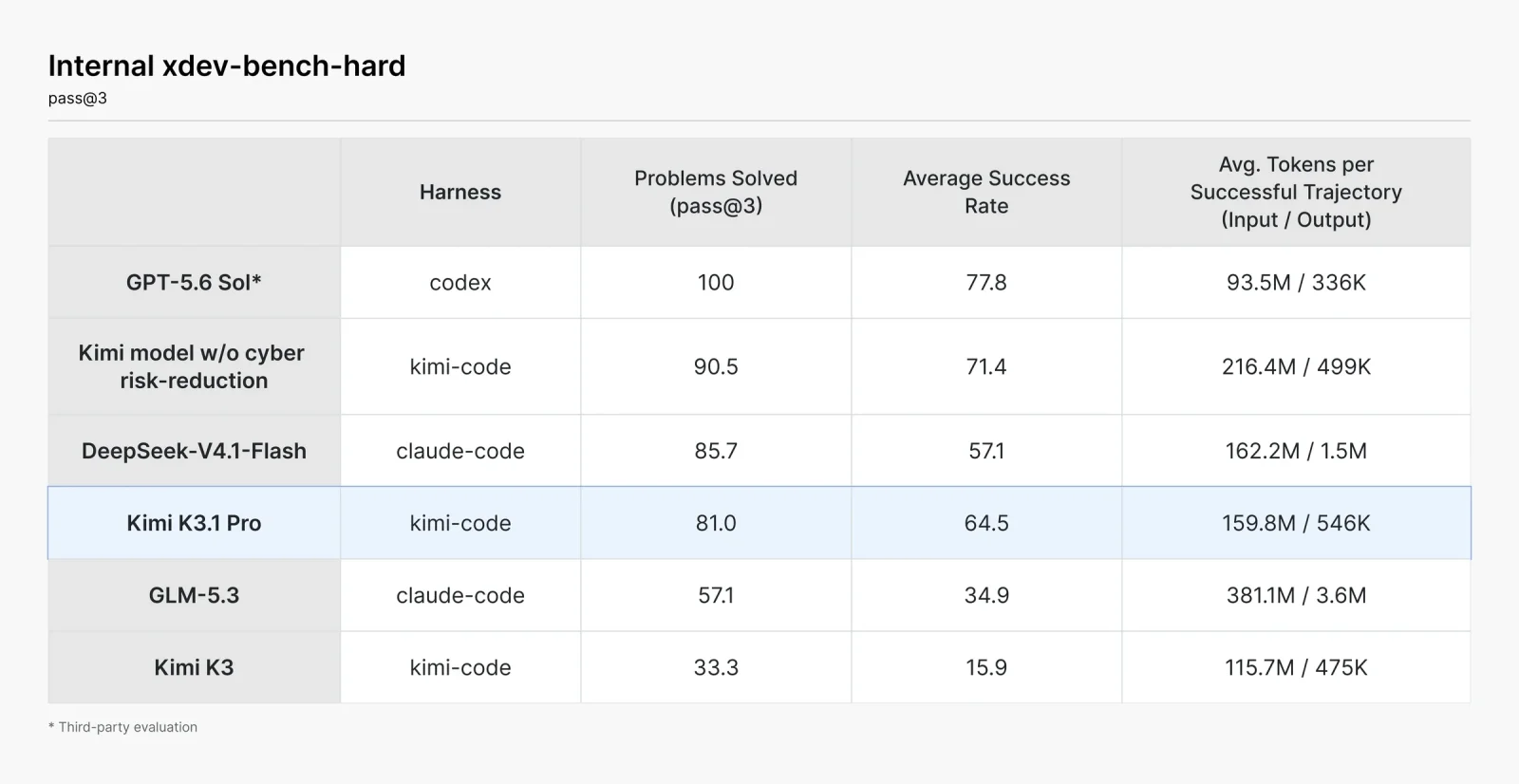 Moonshot's xdev-bench-hard pass@3 chart: Kimi K3.1 Pro at 81.0 versus 90.5 for the checkpoint without cyber risk reduction
Image: Moonshot AI
Moonshot states the final model's offensive capability remains behind frontier proprietary models that have been publicly available for at least three months. It also lays out two principles: not to release open weights that extend the absolute frontier of cyber capability, and to "progressively raise" the capability available in open weights, arguing that wide access helps defenders audit legacy code.
Two things stand out. First, it is a rare public admission that open-weight labs now make a deliberate dial-setting decision, which echoes the pattern in Western labs' reports; compare our coverage of Anthropic's explanation of the Mythos 5 incident. Second, the numbers are self-reported, and no one outside Moonshot has seen the benchmark. A dual-use caveat applies: a model that scores 81.0% on exploit tasks is still capable. Teams deploying coding agents with shell access should assume it can be misused, and should sandbox and gate its actions. AgentBeam is the agent security platform from the explainx.ai team for stopping agents before they take dangerous actions.
 Open box releasing green seeds toward hands, illustrating Kimi K3.1 Pro open weights arriving by November 4
Price and access
The Kimi API docs list kimi-k3.1-pro at $2.00 per million input tokens and $10.00 per million output tokens, with cached input billed at a lower rate and separate cache-write tiers by TTL (5 minutes or 1 hour). All K3-series models support a 1,048,576-token context window. Zero Data Retention is available to API customers, according to the launch post.
For comparison, our earlier K3 mobile app and API guide covers how K3 was priced and accessed in July. One Hacker News commenter who read the China pricing page reported K3.1 Pro as roughly 30% cheaper than K3 there, with Highspeed priced at about twice the standard rate. That comes from a commenter reading a regional page, so check the page for your region.
How to try it today:
- In Kimi Code, run
/modeland pick Kimi K3.1 Pro. - In the API, set the model to
kimi-k3.1-proorkimi-k3.1-pro-highspeed. - In the desktop agent, update to Kimi Work 3.1.0 or later (Windows and Apple silicon Macs). Our Kimi Work guide explains what the agent does.
- Enterprise admins must turn on access; it is off by default.
What developers are saying
The Hacker News thread (discussion) was active within hours. Paraphrasing, with the usual caution that these are individual impressions:
- Commenter rudolftheone highlighted the drop in hallucination rate from 23.4% to 8.3% as the most welcome change, while noting it is Moonshot's own metric.
- rudolftheone also pointed at Moonshot's open-weight cyber principle and read it as an admission the pipeline could produce a more capable model than the one being released.
- TuxSH and throwa356262 were disappointed that the open version has cyber data removed, comparing it to restrictions on US models.
- cesarvarela said few models match their benchmark scores in daily use apart from Anthropic's, which is the skeptical counterweight to the launch claims.
- wkcheng asked for task-specific guidance on when to reach for this model over Anthropic's or OpenAI's, which no benchmark table here answers.
- simonw ran his pelican-on-a-bicycle SVG test across reasoning levels and called the results solid.
Whether it is the strongest open-weight model so far cannot be confirmed until weights are published and independent evaluators test it.
Which model for which job
| Job | Reasonable starting point | Why |
|---|---|---|
| Terminal and agentic coding on a budget | Kimi K3.1 Pro | Reported near-parity with Opus 5.5 at half the listed input price, pending independent tests |
| Highest-stakes code review | Your current frontier model | Self-reported scores are not enough to switch |
| Self-hosting | Wait for the Nov 4 weights | Size, license and quantization are still unknown |
| Latency-sensitive chat or tools | K3.1 Pro Highspeed | Moonshot claims 2-3x speed |
| Security research | Check the license and use policy first | Cyber data was removed on purpose |
The Opus 5.5 price comparison ($4 and $20 per million tokens) comes from a Hacker News commenter's list. We have not verified it against Anthropic's pricing page, so confirm it before you plan around it.
What is still unknown
- License. The launch post says the weights are coming but the license is not summarized. K3 used the Kimi K3 License; check the Hugging Face model card on release.
- Parameter count. Moonshot calls it "3T-class"; K3 was 2.8 trillion parameters. Treat "3T-class" as K3-sized until the weights land.
- Independent evaluations. Artificial Analysis and other third-party results were not yet out when we wrote this.
- Whether weights match the hosted model. The weights will be released later, and the cyber data removal applies to the open release. Hosted behavior could differ.
- Harness dependence. Moonshot ran nearly everything through Claude Code. Scores with other harnesses are unknown.
What this means for what you build or pay
If you run coding agents at scale, a strong model at $2 per million input tokens changes the cost-per-task math, especially for long-context jobs, if it holds up in your own tests. Set up a small regression set of your real tasks and run it on K3.1 Pro against your current model before any switch. For teams that need self-hosting, the actual decision point is November 4, not today. And for anyone deploying agents with tool access, the cyber-capability discussion is a reminder to enforce permissions in the harness rather than rely on the model's training.
Geopolitically, the release also lands in the middle of the argument over Chinese labs and distillation; see our post on the White House and Moonshot distillation dispute. Nothing in the K3.1 Pro launch post addresses it.
Related reading
- Kimi K3 open weights: 2.8 trillion parameters
- Kimi K3.1 teaser video: what is confirmed
- Kimi K3 mobile app and API guide
- Kimi Work desktop agent
- Kimi K3 vLLM speed, claimed vs verified
- Kimi K3 Next.js evals and Frontend Code Arena
- Sources: Moonshot K3.1 Pro tech blog, Kimi API pricing
Details are accurate as of October 23, 2026. Benchmarks are Moonshot's own; weights, license and independent results were not yet published.