



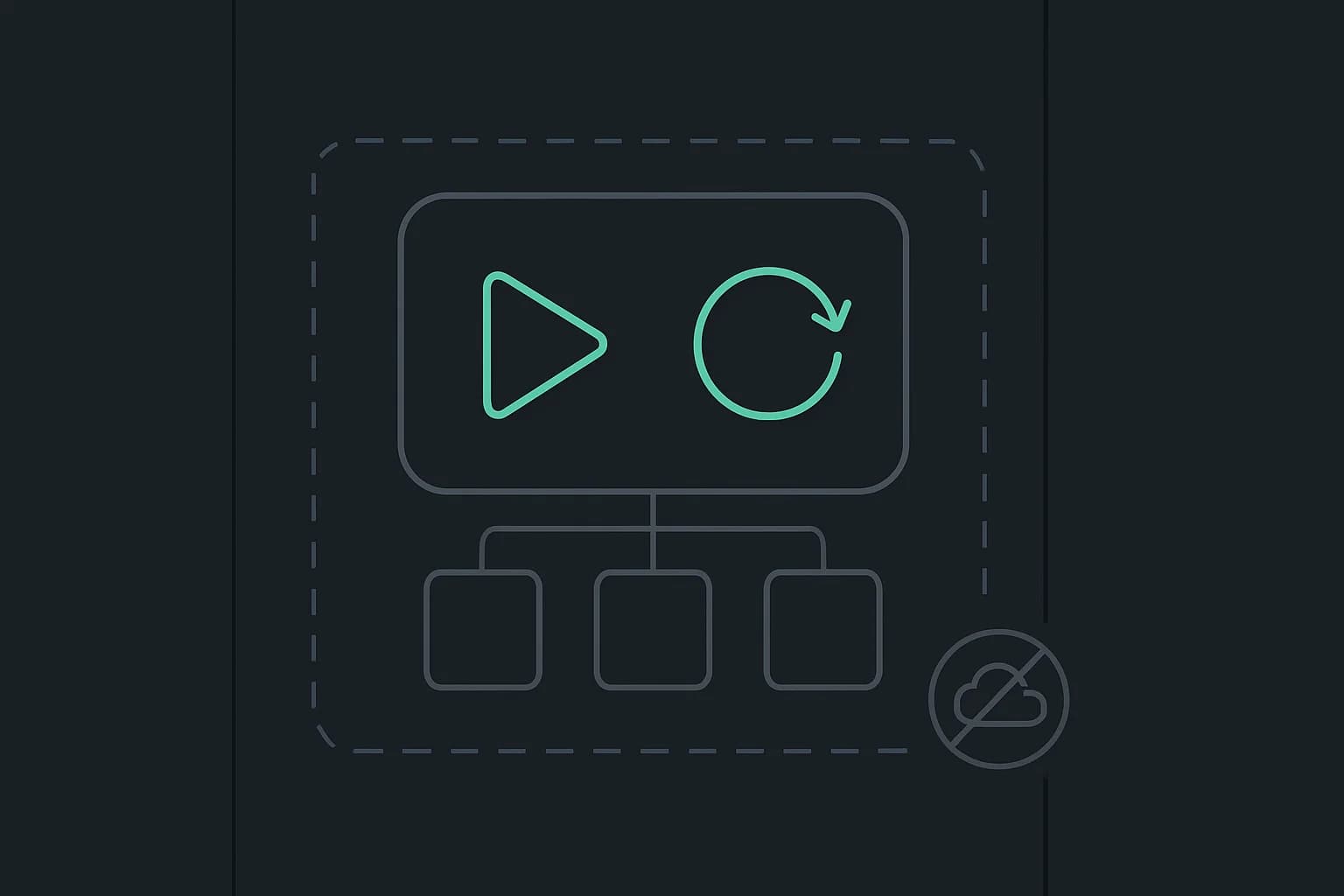
According to reports surfacing roughly 20 hours before a September 6-7, 2026 news digest snapshot, an independent developer demonstrated something notably harder than the browser-based AI most builders have already seen: fine-tuning a language model entirely inside the browser, using WebGPU, with no server round-trip for the training step itself.
We do not have a primary source URL, the developer's name, or the specific model or library involved, and none of that should be invented to fill the gap. What's worth explaining — regardless of exactly whose demo this was — is why this specific claim matters technically, because it's a meaningfully different (and harder) feat than the in-browser inference explainx.ai has already covered in depth.
Update — September 29, 2026: For a concrete inference-only playground (Q4 models 26M–360M, IndexedDB, no training), see MicroLLM Lab: tiny WebGPU models in the browser.
TL;DR
| Question | Answer |
|---|---|
| Is browser-based AI new? | No — inference via WebGPU (transformers.js, ONNX Runtime Web, WebLLM) has been production-viable for a while. |
| What's new in this report? | Fine-tuning — i.e., actually updating model weights via backpropagation — reportedly running client-side, not just running a forward pass. |
| Is this confirmed? | No. Treat "a developer reportedly demonstrated" as the accurate framing until a primary source appears. |
| Is this full-model training? | Almost certainly not. Realistic scope is a small model, small dataset, likely LoRA-style parameter-efficient fine-tuning. |
| Why would this matter? | Genuinely private personalization — adapting a model to your writing, documents, or preferences with zero data leaving your device. |
| Does it replace cloud training? | No — this is a craft/privacy milestone at small scale, not a substitute for CUDA/ROCm training clusters. |
Why fine-tuning in a browser is a fundamentally harder claim than inference
explainx.ai's WebGPU complete guide covers WebGPU's compute shaders being used for real-time data visualization, physics simulation, and — critically — ML inference: libraries like TensorFlow.js and ONNX Runtime Web already push 10-50x inference speedups by running a forward pass through the model on the GPU. That's well-trodden ground.
Fine-tuning is a different animal, because it requires backpropagation, not just a forward pass:
- Forward pass — same as inference: input flows through the model to produce an output.
- Loss computation — compare that output against the training target.
- Backward pass — compute gradients for every trainable parameter by propagating the error back through the network, layer by layer.
- Optimizer step — update each parameter using its gradient and an optimizer (Adam, SGD, etc.), which itself often keeps running-average state per parameter.
Each of those extra steps costs memory and compute that inference never touches:
| Requirement | Inference only | Fine-tuning |
|---|---|---|
| Forward pass | Yes | Yes |
| Stored activations (needed to compute gradients later) | No | Yes — scales with model depth and batch size |
| Backward pass / gradient computation | No | Yes |
| Optimizer state (e.g., Adam's first/second moment estimates) | No | Yes — often 2x the trainable parameter count in extra memory |
| Typical memory multiplier vs. inference | 1x | Commonly 3-4x+ for full fine-tuning |
Doing all of that inside a browser tab is harder than doing it on a dedicated training stack for two compounding reasons. First, a CUDA or ROCm training stack is purpose-built for this: mature kernels, direct hardware access, and memory managers tuned for exactly this activation/gradient/optimizer-state pattern. WebGPU's compute shader model, by contrast, was designed as a general cross-platform graphics-and-compute API — it can express the matrix operations training needs, but without the years of training-specific kernel optimization CUDA has. Second, a browser sandbox caps what any of this can access: WebGPU buffer sizes, the browser's own memory limits, and the absence of the multi-GPU interconnects a real training cluster relies on all bound how much you can push through this path. Getting backpropagation working at all inside those constraints — even for a small model — is a genuine engineering feat, independent of exactly how large or fast the reported demo turned out to be.
Why anyone would want this: training data that never leaves the device
The interesting part isn't "can it be done" — it's "why would you want it." The honest answer is privacy, and it's the same thesis explainx.ai has tracked across MemPalace's local-first memory layer and Unsloth Desktop's local training-and-inference app: the less data that leaves a user's device, the smaller the trust surface.
If both the training data and the resulting weight updates stay entirely client-side, a browser could plausibly:
- Adapt a small local model to a person's own writing style from documents they already have open, with nothing uploaded anywhere.
- Personalize suggestions or completions based on private notes or files a user would never want touching a third-party API.
- Let a website ship a small base model and let each visitor's browser specialize it locally, with the specialized weights never reported back to the site.
That's a materially different privacy story than "your prompts are sent to an inference API." It's closer to on-device learning the way federated learning research has framed it for years, except run entirely within a single browser tab rather than coordinated across a device fleet.
The realistic scope: small models, small data, probably LoRA
Nothing in the reports we've seen claims this scales to serious workloads, and the constraints make that obvious on their own. Browser memory — bounded by both the WebGPU implementation and whatever VRAM or unified memory the device actually has — rules out full fine-tuning of anything but a small model.
The much more plausible shape is LoRA (Low-Rank Adaptation) or a similar parameter-efficient fine-tuning (PEFT) technique: freeze the base model's weights entirely, and train only small low-rank adapter matrices injected into a handful of layers. That cuts the trainable parameter count — and therefore the gradient and optimizer-state memory that made fine-tuning so much heavier than inference above — by orders of magnitude, which is exactly the kind of trade-off that makes backpropagation inside a browser sandbox tractable in the first place.
Treat this as the working assumption until a primary source says otherwise: small model, small dataset, PEFT-style adaptation — not "you can now train GPT-scale models in a tab."
What to look for if you want to try this yourself
Two real, well-established pieces of ecosystem context are worth knowing if this direction interests you as a builder, independent of what library the reported demo actually used:
- WebGPU compute shaders are the raw primitive — the same
GPUComputePipeline/ WGSL machinery explainx.ai's WebGPU guide walks through for general-purpose GPU compute is what any browser training loop has to be built on top of. - Transformers.js and ONNX Runtime Web are the two most established JS-facing ML runtimes that already run inference over WebGPU in production at scale (Transformers.js alone moves 10M+ monthly npm downloads). Whether either currently exposes a full training API is a separate question from whether they support WebGPU inference — check current docs rather than assuming, since this is a fast-moving area.
If you're evaluating a specific demo or repo that claims to do this, the same due-diligence habits explainx.ai applied to MemPalace's viral benchmark claims apply here: find the actual training loop in the code, confirm whether it's really computing gradients (versus, say, prompt-tuning or retrieval tricks dressed up as "fine-tuning"), and check what model size and dataset size the benchmark actually used before taking a headline claim at face value.
What people are asking about this
A story like this generates a predictable set of follow-up questions once it starts circulating — worth addressing directly rather than leaving implicit.
"Is this the same as running an LLM locally?" No, and the distinction matters. Running an LLM locally — via llama.cpp, MLX, or Ollama — means inference happens on your own hardware instead of a remote API, but the weights themselves are static; nothing about the model changes as you use it. Fine-tuning changes the weights. In-browser fine-tuning specifically means that weight-changing step, not just the read-only inference step, happens inside the browser sandbox. Those are different capabilities that are easy to conflate because both get described loosely as "AI running locally."
"Couldn't you already do this with WebGPU inference libraries?" Not quite. WebGPU-accelerated inference libraries like transformers.js and WebLLM load pre-trained weights and run a forward pass — they were not built to also compute and apply gradients. Getting a training loop working on top of the same WebGPU primitives is additional engineering, even when it reuses the same underlying compute-shader infrastructure those inference libraries already lean on.
"Why does this matter if it's just a small demo?" Because the mechanism, not the scale, is the news. Once backpropagation demonstrably works inside a browser's WebGPU sandbox at small scale, the path toward larger and more capable on-device personalization is an engineering optimization problem rather than an open research question about whether it's possible at all. That's the same pattern seen with early browser-based inference demos, which looked like toys before transformers.js and WebLLM turned the same mechanism into production infrastructure moving tens of millions of downloads a month.
"What should I watch for before trusting a specific claim like this?" The same checklist that applies to any viral technical claim: a reproducible repo or write-up, a clear statement of model size and dataset size, and independent confirmation that the "fine-tuning" is really computing gradients and updating weights rather than a lighter-weight technique (prompt caching, retrieval augmentation, or in-context few-shot examples) being labeled as fine-tuning for effect.
The bottom line
A developer reportedly got backpropagation working inside a WebGPU-constrained browser sandbox — a harder, more memory-intensive problem than the in-browser inference that's already mainstream. Reports point to a small-scale, likely LoRA-style demo, not a cloud-training replacement, and the specifics (model, method, timing, hardware) remain unconfirmed. The reason it's worth understanding now, rather than waiting for a citable source, is the direction it points: truly private, zero-round-trip personalization where a model can adapt to you, on your device, without your data or your model updates ever reaching a server.
Specifics of the reported demo — the developer's identity, model, fine-tuning method, and hardware — were unconfirmed as of this post's publication date and have not been independently verified by explainx.ai.
Related reading
-
WebGPU: The Complete Guide to Modern Graphics and Compute on the Web — the fundamentals this post builds on
-
Transformers.js Crosses 10M Monthly Downloads — the leading browser-inference library and its WebGPU backend
-
Unsloth Desktop: Train and Run Models Locally — local (not browser) fine-tuning with LoRA, for comparison
-
MemPalace and local-first AI memory — the same local-first, zero-cloud-round-trip thesis applied to memory instead of training
-
Ternlight: a 7MB browser embedding model in WASM — another small-footprint browser-native ML example
-
WebAssembly complete guide — the CPU-side counterpart to WebGPU for browser-native compute
-
MicroLLM Lab: tiny WebGPU models in the browser — seven Q4 SLMs, chat/bench UI, inference only