



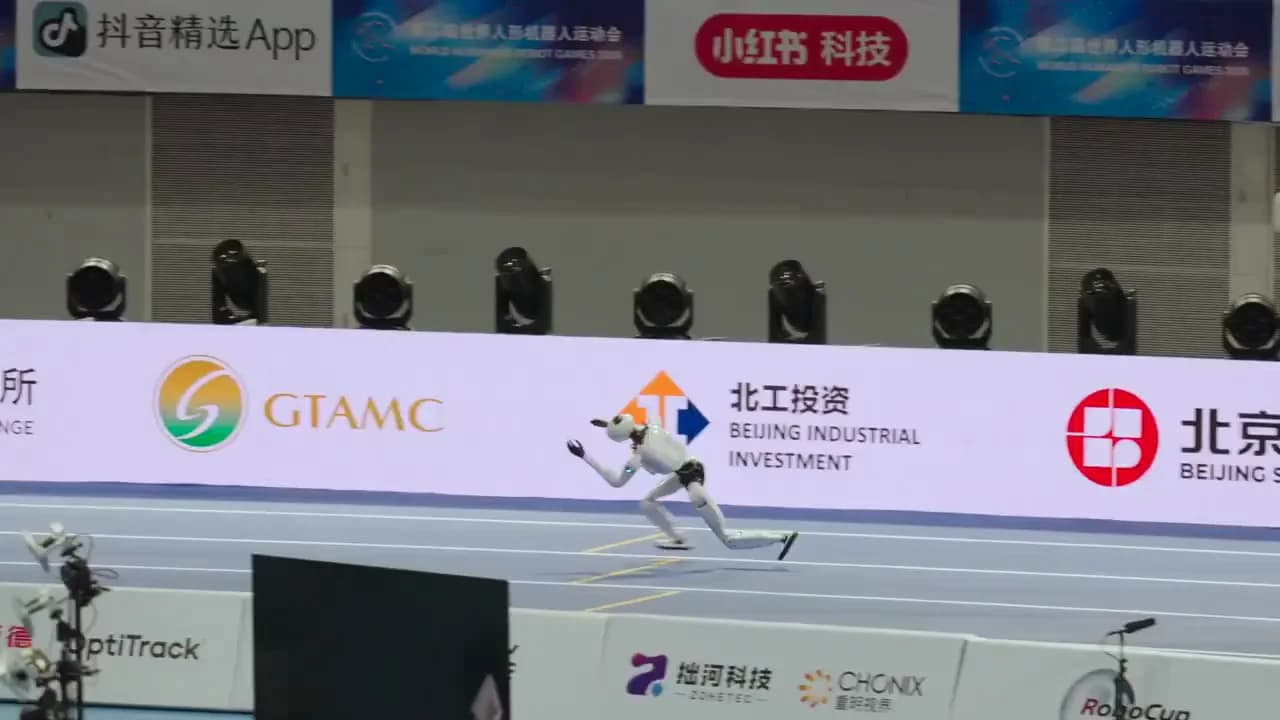
A slow-motion clip of a white humanoid eating up a blue indoor track hit hundreds of thousands of views on August 24, 2026. The caption was just "the 400m champion's running form" at the World Humanoid Robot Games. In real time the gait still looks a little wrong. Slowed down, the arm swing actually counterbalances the hips, the trunk stays stacked, and it reads as running.
The time behind that form is the number people asked next: 38.15 seconds. That is faster than the human men's world record.
TL;DR
| Question | Answer |
|---|---|
| How fast was the 400m? | 38.15 seconds (large-group final) |
| Who won? | Tien Kung Ultra (X-Humanoid / Beijing Humanoid Innovation Center) |
| Human world record? | 43.03s — Wayde van Niekerk, Rio 2016. The robot was 4.88s faster |
| Was it official competition? | Yes — large-group 400m final, August 23, 2026, Beijing Ice Ribbon |
| Who else was in the final? | Three Honor Lightning robots: 39.45s, 39.66s, 40.08s |
| Last year's winning 400m? | 1:28.03 at the 2025 games — nearly 50 seconds slower |
| The other 400m gold? | Tien Kung Omni, small-group, 45.66s, the "face-covering" gait |
What the slow-mo is actually showing
The clip is not a timing tape. It is a 38-second look at stride mechanics: forward lean, opposite-arm swing, hip rotation, foot strike. Commenters latched onto the arm swing because that is the tell. A biped that pumps its arms in time with its hips is canceling angular momentum through the torso. A biped that holds its arms still at that speed either falls or has to dump the rotation somewhere worse.
That is why this clip traveled further than another "robot runs" montage. Honor's Lightning 100m was about a number (9.32s in a test, 14.5 m/s peak). This one is about the body looking like it knows what a stride is. The full Games guide is the place for scale (2,056 robots, 51 events). This post is the 400m form.
Official results from the large-group final, as reported from the organizer's timing:
| Place | Team / robot | Time |
|---|---|---|
| 1 | Tien Kung Ultra | 38.15s |
| 2 | Zhuifeng Zaizai (Honor Lightning) | 39.45s |
| 3 | Jinghong Power (Honor Lightning) | 39.66s |
| 4 | Honor Shuangchi (Honor Lightning) | 40.08s |
Three of the four finalists were Honor's Lightning platform — the same family that beat Bolt's 100m in a test the day before. Ultra still won the one-lap race. Sprint peak speed and 400m sustain are different problems. Average speed for Ultra over 400 meters is about 10.5 m/s. Lightning's 100m test peaked at 14.5 m/s; it did not convert that into the 400m gold.
Treat 38.15 versus van Niekerk's 43.03 the same way explainx.ai treated "beat Bolt": a real robot on a real track, not a World Athletics-ratified record. Starting protocol, timing method, and how you handicap a machine that does not go hypoxic are unpublished.
The other 400m gold — the gait nobody designed
The same afternoon, Tien Kung Omni won the small-group 400m in 45.66 seconds with a gait that looked like it was covering its face. Developers at X-Humanoid told reporters they had designed a human-style arm swing. In simulation, with a continuous reward for finishing the distance, the policy dropped it.
The constraint was hardware, not aesthetics. Fast arm swing loads the shoulder joints, they heat up, energy goes into the arms instead of the legs, and the robot cannot hold 400 meters. Holding the hands near the face keeps the shoulders under low load so the legs stay powerful. Han Gang, a motion-control engineer on the team, described the result as the robot settling into what "felt more comfortable." That is reinforcement learning doing what it is supposed to do: optimize the reward, ignore the human prior.
That is the same family of technique behind Galbot's tennis rallies at these games — sim-to-real policies that look uncanny when the optimum is not a human demo. It is also why you should not read every weird gait as a bug. Sometimes it is the loss function winning.
Year-over-year, the large-group 400m collapsed from 88.03 seconds in 2025 to 38.15 in 2026. That is the number to sit with. The viral slow-mo is the visible surface of a year of actuator, balance, and policy work, including the training-school pipelines China has been standing up around this hardware.
"Why don't they put the robots on wheels?"
Because the benchmark would stop being a humanoid benchmark.
Wheels win on a flat, dry, indoor oval. Unitree already ships wheel-legged machines for exactly that reason. The Games exist to stress the form factor that has to share staircases, aisles, and doorways with people. A 400m on legs is a cruel, public test of whether the policy can keep a high center of mass from rotating into the floor for a full lap — two clean turns, no joystick, no catcher in frame.
The next test the Omni engineer pointed at is not a faster 400m. It is the robot getting shoved, walking on uneven ground, and still finishing a task. Track times will keep dropping. Robotics still is not "solved" until that disturbance rejection is boring.
Unitree's Superman claim (12.66 m/s, 2-meter jump) and Lightning's 100m were peak-speed headlines. The 400m is the first of these viral clips that is obviously about sustain and coordination. That is closer to what a deployed humanoid has to do than a 9-second straight.
Summary
Tien Kung Ultra won the large-group 400m at Beijing's 2nd World Humanoid Robot Games in 38.15 seconds on August 23, 2026 — faster than the human world record of 43.03, and nearly 50 seconds faster than the 2025 winning time. The slow-motion clip that spread on August 24 is the gait: arm swing canceling hip rotation, which is why it finally looks like running. A second gold the same day, Tien Kung Omni at 45.66s, is the reminder that reinforcement learning will abandon a human-looking arm swing if the shoulders overheat. Wheels would be faster. That is not the test.
Related on explainx.ai
- World Humanoid Robot Games: Complete Guide
- Lightning robot beats Usain Bolt's 100m record
- Humanoid robots play tennis at the Games
- Unitree Superman: 2-meter jump, 12.66 m/s
- China's humanoid robot training schools
- Unitree AS2-W wheel-legged robot
- Why robotics still isn't solved
- NVIDIA Cosmos 3 — physical AI world models
Sources: Xinhua — Tiangong 400m · Global Times — Ultra 38.15s · Global Times — Omni face-covering gait · slow-motion clip via Eren Chen on X
Race times and developer quotes reflect organizer and press reporting of the August 23, 2026 finals. 38.15 seconds is a competition result, not a ratified World Athletics record. The slow-motion clip is form, not a stopwatch.