



Ai2 has released a way to produce global, 3 km resolution extreme weather for a tiny fraction of what the physics costs. On October 14, 2026 the institute published HiRO-ACEv2 on Hugging Face: an AI emulator that runs a global climate at about 100 km and then sharpens it to about 3 km, with hurricanes, intense rain and mountain winds. Ai2 puts the cost of global 3 km data at roughly 1/300th of running X-SHiELD, the storm-resolving physics model it learned from.
This is not a daily forecast tool. It is a way to generate huge amounts of realistic, high-resolution weather statistics, which is what researchers need to study rare and damaging events. Here is how it works, what the numbers say, what is open, and the honest limits.
TL;DR: the questions people ask first
| Question | Answer |
|---|---|
| What is it? | A two-part AI emulator: ACE (about 100 km) plus HiRO (downscaling to about 3 km) |
| Who made it? | Ai2 (Allen Institute for AI), with collaborators on the arXiv paper |
| What does it copy? | X-SHiELD, a 3 km global storm-resolving physics model |
| How much cheaper? | About 1/300th for global data; over 100x cheaper for a single region, per Ai2 |
| Is it open? | Weights on Hugging Face (allenai/HiRO-ACEv2), tutorials and a demo; license not stated in the post |
| Is it a forecast? | No, it is a climate emulator for long simulations |
| Biggest limit | Only works with the ACE version tuned to X-SHiELD, no warmer-future or ERA5 mode yet |
What is HiRO-ACEv2?
HiRO-ACE stands for High Resolution Output Ai2 Climate Emulator. It has two stages. The first, ACE, simulates the atmosphere globally at about 100 km grid spacing. That is cheap to run but too coarse to show a hurricane's eye or wind funneling down a mountain slope. The second, HiRO, is a downscaling model: it takes the coarse ACE fields and generates a 3 km version.
Version 2 changes the second stage. According to Ai2, the new HiROv2 predicts several high-resolution fields at once instead of only rainfall, and it is better at extreme events. The paper, titled "Extreme events and statistics in an AI emulator of a global storm-resolving model," describes a diffusion model that downscales to 3 km, outputting precipitation, 10 m winds and sea level pressure. The authors focus on extremes by using multiple denoisers at inference and changing the training setup.
The training target is X-SHiELD, a 3 km global storm-resolving model. HiRO was trained on X-SHiELD data, so the whole system is an emulator of that one physics model, not a replacement for physics in general.
How good are the results?
Ai2 reports several checks, all against X-SHiELD:
- Given coarsened X-SHiELD data, HiROv2 matches the target simulation's high-resolution statistics to within 3%, including events rare enough to occur about once per million data points. The paper states agreement out to the 99.9999th percentile for precipitation and near-surface winds.
- It estimates the total energy of tropical cyclones accurately, including storms it did not see during training.
- Generated hurricanes have realistic eyes and rain bands. Ai2 notes winds and pressure around the eye are somewhat more lopsided than in X-SHiELD.
- It produces strong winds flowing down mountain slopes.
- The updated ACE matches X-SHiELD well over a 10-year simulation, including hurricanes, average climate patterns and distributions of rain, wind and pressure.
- A full year of global 3 km data from the combined system closely matches X-SHiELD's statistics, even though HiRO worked from an ACE-generated simulation rather than real X-SHiELD input. That matters because it is the realistic use case: ACE makes the coarse climate, HiRO adds the detail.
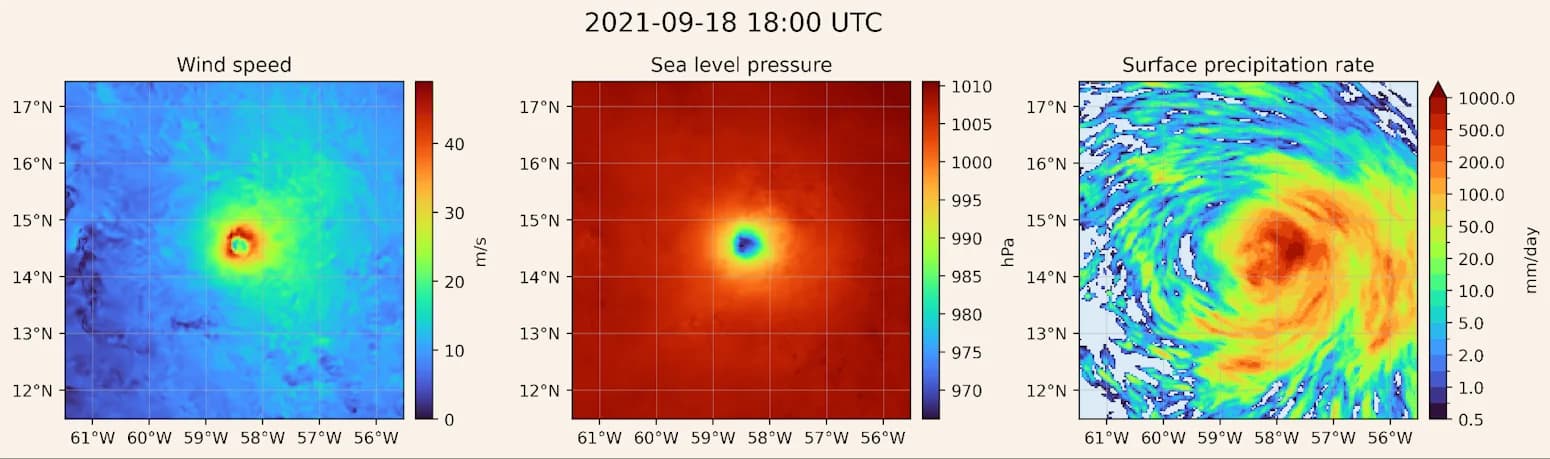
The hero image at the top of this post is Ai2's example of a strong North Atlantic hurricane generated during the 10-year HiRO-ACEv2 simulation. Over that 10-year run, Ai2 says the energy of HiRO-ACEv2's hurricanes is comparable to X-SHiELD's for the same period.
Seeing the 3 km detail
Ai2's data visualizer shows the gain from 100 km to 3 km directly. In this view, the main map is ACE2 at 100 km and the inset is HiRO-ACEv2 at 3 km, for 10 m wind speed over Baja California.
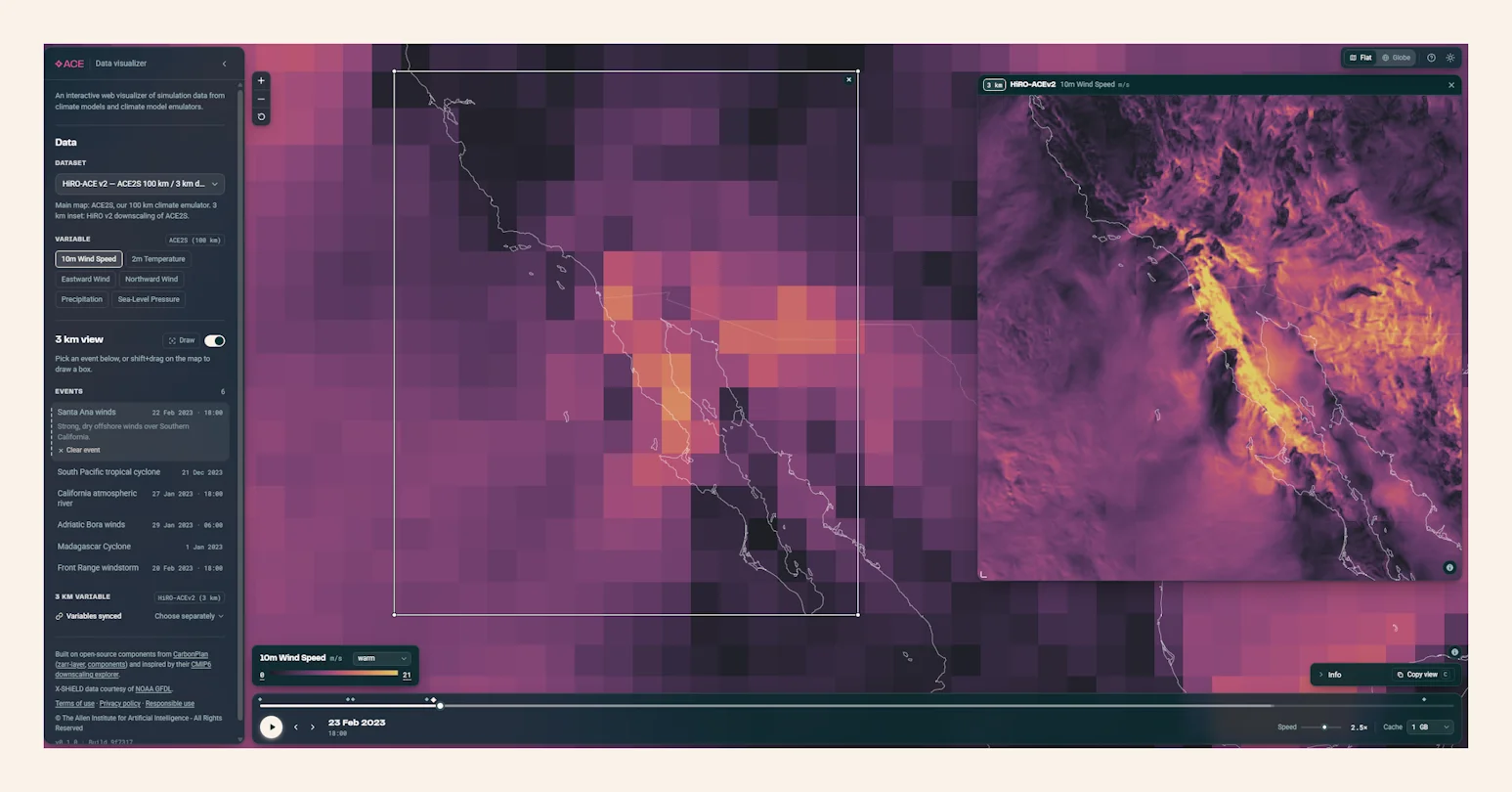 HiRO-ACEv2 extreme weather emulator 3 km wind inset over Baja California versus 100 km ACE2
Image: Ai2
HiRO-ACEv2 extreme weather emulator 3 km wind inset over Baja California versus 100 km ACE2
Image: Ai2
The same comparison for a simulated northeastern Pacific storm shows finer structure inside the storm that the 100 km grid cannot represent.
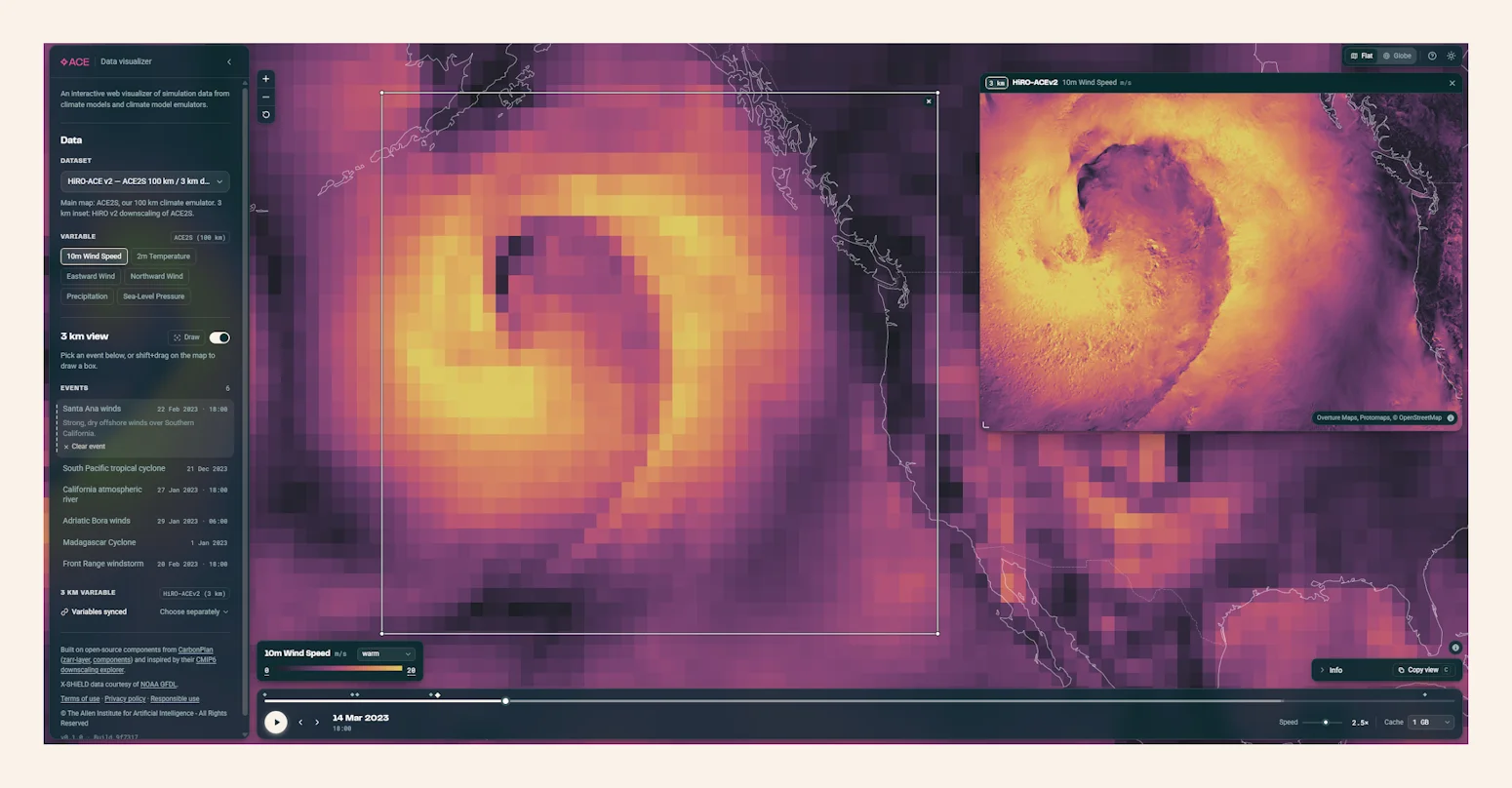 Simulated northeastern Pacific storm with a 3 km HiRO-ACEv2 inset showing finer wind structure
Image: Ai2
Simulated northeastern Pacific storm with a 3 km HiRO-ACEv2 inset showing finer wind structure
Image: Ai2
Why 1/300th of the cost matters
Storm-resolving physics models like X-SHiELD are accurate and expensive: a global 3 km run takes a supercomputer. That limits how many simulations a research group can afford, and rare extremes need many samples. A one-in-a-million rain event does not show up in a handful of short runs.
Ai2 says global 3 km generation costs roughly 1/300th of X-SHiELD, and regional work can be more than 100 times cheaper depending on the area's size. A streamlined HiROv2 is in development that could be more than 10 times faster again. For researchers, that turns a rare-event question from a one-off compute grant into something far more labs can afford, though Ai2 does not state hardware requirements. We have seen the same pattern of AI turning expensive science into cheap sampling in Hugging Face's Carbon DNA model for candidate genes and in the survey of AI in science from DeepMind's institute on the curve of discovery.
How it differs from forecast models
It is easy to confuse this with the weather AI that powers apps. Those models start from today's observations and predict the next days. HiRO-ACEv2 starts from a simulated climate and generates plausible weather for as long as you run it. Both are useful, for different jobs.
| Tool | Job | Resolution | Covered on explainx.ai |
|---|---|---|---|
| HiRO-ACEv2 | Climate emulation, rare extremes statistics | 3 km global | This post |
| WeatherNext | Operational forecasting | 5 km, hourly steps | WeatherNext 3, cyclone forecasting |
| Microsoft PBC | Bias correction for 2-to-6-week forecasts | Subseasonal | Microsoft PBC |
| Google Earth AI | Geospatial reasoning agent | Varies | Earth AI agent |
If you want to know whether it will rain on Saturday, HiRO-ACEv2 is the wrong tool. If you want to know how often a storm like Hurricane X would hit a coastline under a simulated climate, it is the right kind.
How to try it
Ai2 lists these resources:
- Interactive demo at ace.allen.ai, showing pre-generated precipitation, wind and sea-level pressure from HiROv1 and HiROv2 beside X-SHiELD. It needs no inference.
- Model weights on Hugging Face as allenai/HiRO-ACEv2.
- Tutorial notebooks at ai2cm.github.io/ace for running ACE and HiRO.
- The paper at arXiv 2610.17693.
Before building on it, read the model card for the license: the announcement does not state one. If you are new to the ecosystem, Ai2's other recent releases, such as AstaBrief, an 8B model for cited research reports, show the same habit of publishing weights and tools together, and its engineering write-up on the GPU cluster scheduler shows the compute side of how this lab works.
Limits and open questions
Ai2 is direct about what the model does not do yet:
- Tied to one physics model. HiRO works only with the version of ACE tuned to match X-SHiELD. It inherits X-SHiELD's biases, good and bad.
- One climate. It cannot yet produce high-resolution data for other climates, such as a warmer future, or for historical datasets like ERA5.
- Few variables. Outputs are precipitation, wind and pressure for now. Planned work adds near-surface temperature and snow and ice, which would support uses such as snowpack prediction.
- Asymmetry near hurricane eyes. Winds and pressure around the eye are somewhat more lopsided than in X-SHiELD.
- Not independently tested yet. The numbers above are from Ai2's post and a paper submitted on October 13, 2026. We have not seen outside replication, and an emulator is only as trustworthy as the checks used on data it did not train on. Ai2 does say the cyclone-energy result holds on storms unseen in training.
The next steps Ai2 names are training on new X-SHiELD datasets, including a simulation of a world 4 degrees C warmer. That is the version that would matter most for climate risk work, because the question there is how extremes change, not how they look today.
What this means for builders
Most readers of explainx.ai will not run climate emulators, but the design is a template. A cheap coarse model plus a generative downscaler that fills in detail is a pattern you can reuse for any physical simulation: fluid dynamics, grids, or maps. The lesson is to measure the tails, not the average. Ai2 judges success by rare-event statistics out to the 99.9999th percentile, which is where average-error metrics hide failure. If you build AI systems that must handle rare cases, copy that evaluation habit.
Related reading
- Microsoft PBC: open-source bias correction for 2-to-6-week forecasts
- Google DeepMind WeatherNext 3: hourly 5 km global forecasts
- WeatherNext cyclone forecasting goes open source
- Google Earth AI geospatial reasoning agent
- Ai2 AstaBrief 8B cited research reports
- Hugging Face Carbon: a DNA model proposing candidate genes
- Sources: Ai2 post on Hugging Face, arXiv 2610.17693
Details are accurate as of October 14, 2026; weights, license and demo may change.