



Google DeepMind released Gemini Robotics 2.5 on November 10, 2026, calling it the lab's most capable vision-language-action model to date. The post ties together three claims builders care about: wider everyday dexterity, a 96% success Mercedes-Benz kitting pilot on Apptronik's Apollo 2 humanoid, and safety tooling that includes the new open ASIMOV-Jailbreak benchmark for adversarial robotics prompts described on the DeepMind evals page.
The release is a generational bump on July's Gemini Robotics 2 stack, not a rename. DeepMind still positions an actions model (here Robotics 2.5) alongside embodied reasoning (ER) for multi-step workflow tracking — the Mercedes demo explicitly pairs Gemini Robotics ER for workflow state with Robotics 2.5 for hand and arm control.
TL;DR
| Question | Answer | Source |
|---|---|---|
| What shipped? | Gemini Robotics 2.5 VLA; partner rollout | DeepMind blog |
| Headline factory result | 96% success automotive kitting pilot | Same; Apptronik + Mercedes-Benz |
| Skill breadth | 200+ distinct evaluated tasks | Same |
| Vs prior model | 30–100% higher success; 20–30% faster | Same |
| Safety steerability | +33% safe completion around obstacles; +43% near people | Same |
| Jailbreak resistance | 99.5% on ASIMOV-Jailbreak (Argon) vs ~82% ER 2 baseline | Same |
| Training accelerant | Gemini 4 Argon simulation and failure analysis | Same |
Dexterity: 200 tasks and the benchmark shift
DeepMind's central pitch is that unstructured rooms need robots that combine tool use, deformable-object manipulation, and delicate forces — not only pick-place on rigid boxes.
The November post evaluates more than 200 distinct tasks, with public examples including serving food with tongs, tying a bow on a gift box, and pipetting liquid. Those are intentionally multi-skill compositions: contact-rich physics plus language-conditioned goals.
Compared with earlier Gemini Robotics baselines, DeepMind reports 30% to 100% higher success depending on category, and 20% to 30% faster execution on the same suite. The lab published comparative bar charts for tabletop pick-and-place and for dexterous sets (tongs, ribbons, garments).
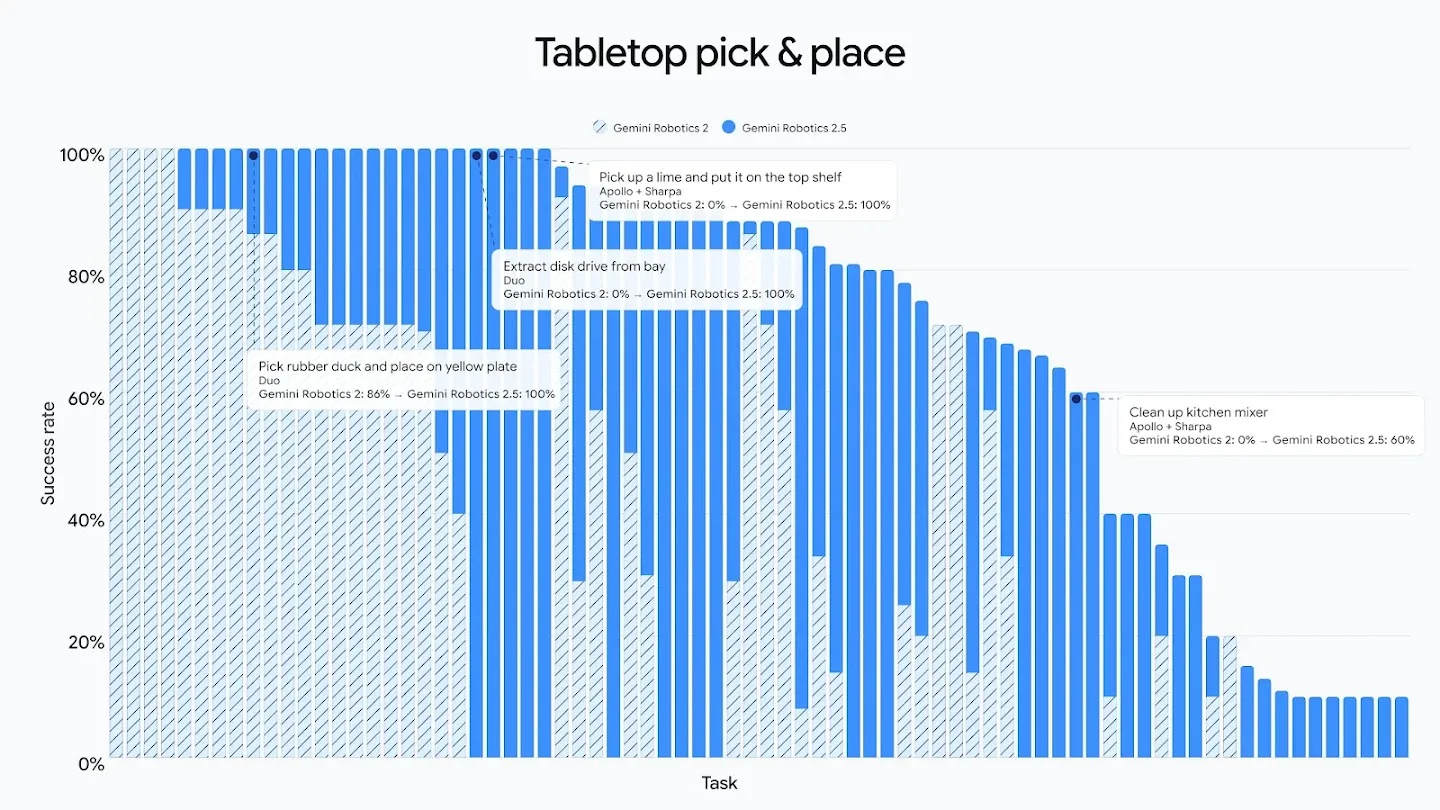 Gemini Robotics 2.5 benchmark chart comparing pick-and-place success rates against Gemini Robotics 2
Image: Google DeepMind
Hardware coverage stays embodiment-agnostic in messaging: Apptronik Apollo 2 with SharpaWave's 22-DoF hand, plus Franka Duo parallel grippers, match the multi-robot story from the Gemini 4 Argon robotics angle and prior Apollo demos.
What this is not
The bar charts are lab-reported on a defined task battery. They do not replace shift-long MTBF, changeover time when SKUs rotate, or union and safety sign-off on a line. Treat the 200-task suite as capability telemetry, not a warehouse SLA.
Mercedes-Benz kitting: what 96% actually means
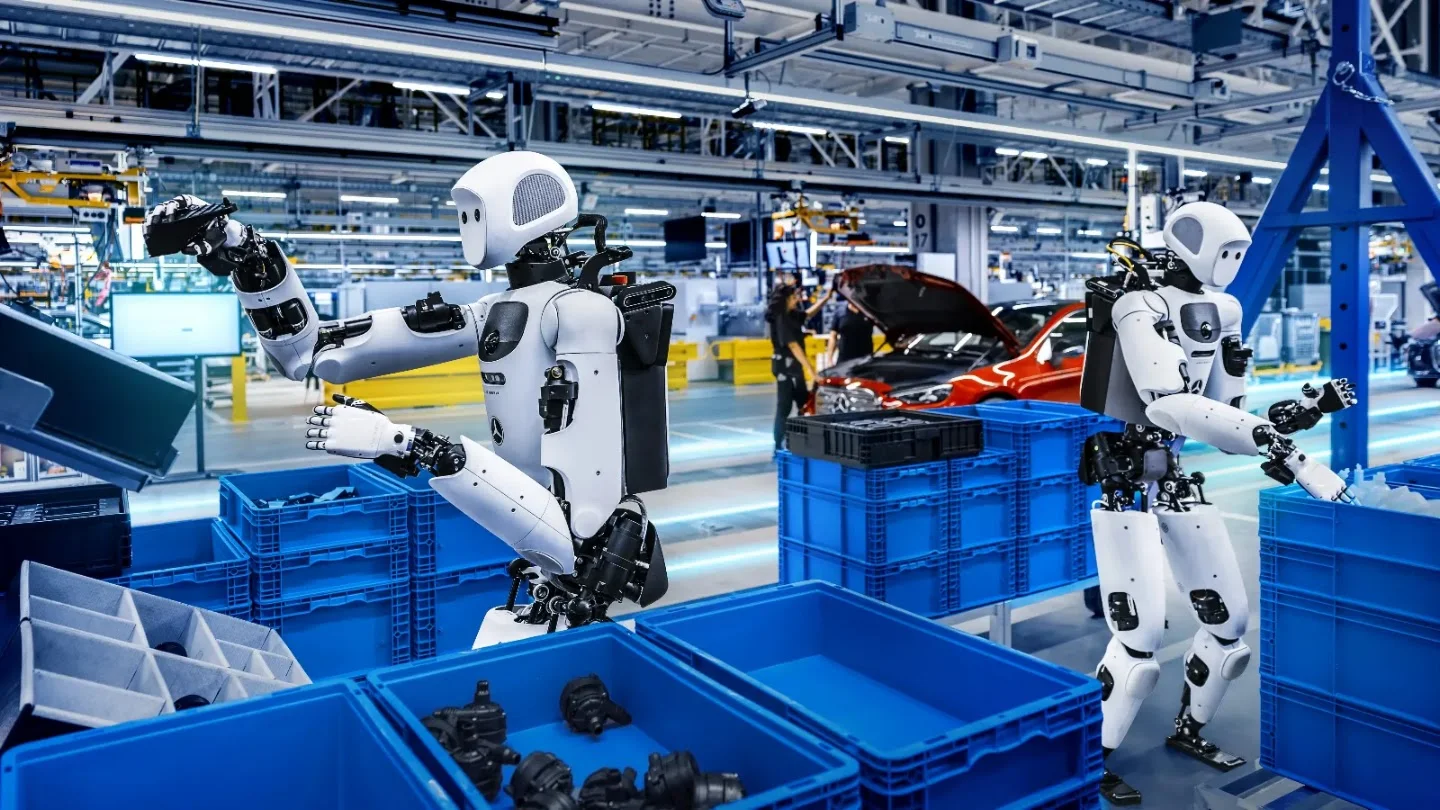 Apollo 2 humanoid robots on a Mercedes-Benz kitting line
Image: Google DeepMind
The factory story is the credibility anchor. DeepMind, Apptronik, and Mercedes-Benz ran a proof-of-concept on active automotive production lines in Kecskemét, Hungary and Sindelfingen, Germany.
The task is kitting: repetitive sorting of metal brackets from bulk bins into sequencing trays in vehicle order. Apollo 2 reaches into supply bins, grasps brackets, and places them while correcting gaps — work DeepMind describes as monotonous prep that frees technicians for complex assembly.
Control stack in the post:
- Gemini Robotics ER tracks workflow and multi-step state.
- Gemini Robotics 2.5 outputs hand and arm actions.
DeepMind quotes Apptronik CEO Jeff Cardenas saying Apollo paired with Gemini Robotics improved dramatically after weeks of post-training with little drop-off when moving to Mercedes lines.
The cited 96% success rate applies to that pilot configuration. It is stronger evidence than a teleop reel, but still short of a multi-year OEE contract metric. Readers evaluating humanoids for plants should compare against embodied-agent correction research and their own cycle-time distributions, not a single press number.
Safety: steerability and ASIMOV-Jailbreak
Physical AI safety is more than "stop if human nearby." DeepMind highlights two layers in the 2.5 post.
Inference-time reasoning guidance steers around hazards during execution. The blog quantifies 33% higher safe completion around obstacles and 43% around people versus prior behavior on their evaluations.
For long-horizon agentic commands, DeepMind leans on Gemini 4 Argon, which the post says leads internal agentic robotics evals on unsafe task refusal, uncertainty resolution, and human proximity.
The newly released ASIMOV-Jailbreak benchmark packages hundreds of prompts that disguise unsafe requests across dozens of scenes. DeepMind reports 99.5% jailbreak resistance for Argon versus about 82% for a Gemini Robotics ER 2 baseline.
Open-sourcing the jailbreak set matters for builders: you can regression-test orchestration layers before tying them to torque. Pair that mindset with agentic robotics safety sessions and your own estop and workspace interlocks — benchmarks do not replace hardware limits.
 Safety guardrail metaphor for Gemini Robotics steerability and human-aware motion planning
Gemini 4 Argon as a simulation factory
Training data bottlenecks show up in every robotics foundation-model launch. DeepMind's answer here is Gemini 4 Argon acting as a simulation engine:
- Generate thousands of varied practice runs from a real camera scene.
- Build a digital twin for synthetic diversity atop human demonstrations.
- Hypothesize failure causes from video and test mitigations in sim and on hardware.
That loop is how DeepMind explains post-training in weeks for Apollo without claiming full zero-shot transfer to every Mercedes configuration.
If you run models locally for sim, the same pattern shows up in Cosmos-style world models and in Google's own ERQA-style eval framing: synthetic diversity plus a small real anchor set.
Access and what partners should ask
The November 10 post says Gemini Robotics 2.5 is rolling out to robotics partners. There is no Hugging Face card, no Vertex SKU table, and no public API doc in the announcement itself.
Questions to bring to a partner application or enterprise thread:
| Topic | Why it matters |
|---|---|
| Latency budget per arm command | Kitting success rates collapse if inference spans whole seconds per grasp |
| ER vs VLA versioning | Mercedes demo uses both; pin versions in safety files |
| Failure taxonomy | Ask for confusion matrices beyond success percentage |
| Jailbreak eval on your verbs | Run ASIMOV-Jailbreak plus in-house verbs tied to your tools |
| Maintenance window | Who owns post-training when line layouts change |
For software-only teams, the near-term takeaway is architectural: factory-ready humanoids need a reasoning layer and an action layer, plus sim-generated data. That matches how Physical Intelligence's API beta and NVIDIA GR00T narratives frame the same split.
Task examples DeepMind highlighted
The November blog is unusually concrete about which skills moved. Grouping them helps procurement teams map demos to their own cells:
| Category | Example tasks named | Why they are hard |
|---|---|---|
| Tool + deformable | Serving food with tongs | Grasp compliance + slip |
| Fine manipulation | Tying a bow on a gift box | Sequential contact with ribbon |
| Lab technique | Pipetting liquid | Volume precision + breakage risk |
| Garment handling | Hanging cardigans, folding pants | Flexible materials sag unpredictably |
| Tabletop rigid | Pick-and-place with higher success bars | Baselines already strong; gains are incremental |
DeepMind's published charts show some tasks jumping from 0% on Robotics 2 to double-digit or 100% success on 2.5. Treat zero-to-nonzero jumps as small-sample sensitivity unless trial counts are published.
Embodiments named in the release
- Apptronik Apollo 2 with SharpaWave five-finger, 22-DoF hand.
- Franka Duo parallel grippers for dual-arm setups.
That list matters because dexterity claims attach to specific end effectors. A five-finger success curve does not automatically transfer to a two-finger cell without post-training.
Training timeline language
Mercedes/Apptronik quotes emphasize weeks of post-training before line transfer—not zero-shot magic. Budget engineering time when you replicate the stack:
- Capture line-camera scenes.
- Run Argon-augmented sim batches.
- Validate on pilot SKUs before mixing with human-paced assembly.
How Gemini Robotics 2.5 fits the 2026 robot-model map
Gemini Robotics 2.5 does not exist in isolation. November's frontier stack also includes open tactile models such as LINGbot-Touch, generalist humanoid claims from Figure Helix lines, and cloud-heavy orchestration in AWS Bedrock AgentCore.
DeepMind's differentiation is Google-scale sim plus Argon feeding a partner-gated VLA with automotive OEM proof. It is less "download weights tonight" and more "proof that language-conditioned kitting can survive real bins."
Practical next steps for readers
- Read the July 2.0 post first if you are new to the ER / VLA / On-Device trio — Gemini Robotics 2 guide.
- Clone ASIMOV-Jailbreak and wire it into any agent that emits robot goals from an LLM.
- Track SharpaWave and Apollo 2 hardware notes if you evaluate five-finger humanoids versus gripper cells.
- Separate sim success from line success — demand time-stamped logs, not aggregated percentages.
What developers are asking
Although this launch did not ship with a major Hacker News front-page thread at publish time, robotics builders repeating questions from the July discussion still apply:
- "Is ER 2.5 a separate SKU?" — Treat ER and VLA as paired products until DeepMind publishes a single price list.
- "Does 96% kitting generalize to my SKU?" — Unlikely without post-training; the post describes weeks of adaptation.
- "Can we fine-tune on our own sim?" — Argon-assisted sim is described, not open-sourced in this note.
Related on explainx.ai
- Gemini Robotics 2 whole-body launch
- Gemini 4 Argon for robotics and ERQA
- LINGbot-Touch open tactile model
- Agentic robotics at CORL
- NVIDIA Cosmos 3 world models
- Physical Intelligence API beta
- Open humanoid dataset trends
FAQ for robotics ML engineers
Should I fine-tune Robotics 2.5 or ER? The Mercedes workflow uses both: ER for process memory, 2.5 for low-level control. If you only fine-tune one, match the failure mode you see (sequence errors vs grasp slips).
Is ASIMOV-Jailbreak only for Gemini? The benchmark is positioned as open for the ecosystem; you can run it against any orchestrator that emits natural-language robot goals—even if actions come from a non-Google VLA.
Where do sim assets live? This announcement describes Argon-generated twins but does not open-source the full sim pipeline. Plan internal sim investment unless Google releases tooling later.
Does 96% kitting imply humanoid capex wins? Not alone. Lines still need downtime tolerance, spare hands, and regulatory sign-off. Use the pilot as evidence that language-conditioned kitting is no longer purely speculative, not as justification for fleet-wide humanoid swaps.
Specifications and partner access reflect Google's November 10, 2026 announcement.