




Two images that went viral after a protester was punched at President Donald Trump's rally in Youngstown, Ohio, are fake, according to a fact check by France 24's "Truth or Fake" team. The real event is not in doubt: video shows the woman being punched and removed. But the pictures many people shared as evidence were generated with AI tools, and France 24 says both carry SynthID watermarks that give them away. The report is published on France 24 and dated October 15, 2026.
This post is about the AI-image side of the story: what was checked, what is verified, and how to run the same checks. We do not take a position on the politics.
TL;DR
| Question | Answer | Source |
|---|---|---|
| Did the assault happen? | Yes: video shows a woman punched in the face and removed by law enforcement | France 24, TMZ video |
| Are the viral images real? | No: two AI-generated images are circulating | France 24 |
| How were they identified? | Invisible SynthID watermarks; plus visual inconsistencies in the second image | France 24 |
| Which tools? | One image indicates Google's AI tools, the other OpenAI tools, per the watermark | France 24 |
| Did the sharer admit it? | The first image's sharer said they chose "a symbolic graphic over the horrific raw footage" | France 24 |
| Reach | The second image passed one million views on a single X post | France 24 |
What happened at the rally
According to TMZ, whose DC team was in the room and filmed the moment, a protester wearing a shirt reading "Release the Epstein Files" heckled the president at the Youngstown rally on Monday, October 12. Several audience members got physical, one grabbed the protester by the hair, and law enforcement removed them. TMZ quotes Trump calling the protester a paid plant and saying "he's gotta go on a diet."
France 24, citing NBC News, says at least two men were involved and one punched the woman in the face and pulled her hair before uniformed officers removed her. It reports that Youngstown Mayor Derrick McDowell condemned the incident as "senseless political violence." CBS News, per France 24, reported that at least three protesters were removed, and France 24 says there is no evidence to support Trump's claim that the protesters were paid. Those are claims about the event itself; what we can say from the AI-media side is that real video exists, which matters for what follows.
The two fake images
 A paintbrush stroke turning into shapes, illustrating how AI image tools generate a scene that never happened
France 24 describes two images:
- The "hero" image. It shows a young woman in a "Release the Epstein files" T-shirt raising both middle fingers as angry Trump supporters surround her. Shared widely on X and Threads, it drew a post calling her a "hero" standing against "male violence," with a claim that she had been punched, had her hair pulled and was dragged to the ground. The image contains an invisible SynthID watermark, and France 24 says it was created using Google's AI tools. The user who shared it later acknowledged it was not genuine, saying they had "intentionally chosen a symbolic graphic over the horrific raw footage."
- The "punch" image. More than a million views on a single X post, it depicts the protester being punched in the face and attacked by the crowd. France 24 points to visual inconsistencies, including text on the T-shirt that does not match the clothing in the real footage, and a SynthID watermark indicating it was made or edited with OpenAI tools.
France 24's conclusion: although the images appear to draw on real events, neither is an authentic depiction of what took place.
Why "symbolic" AI images are a problem even when the event is real
The first sharer's defense is worth sitting with. The assault was real, and the image was meant to convey it. But a generated image invents details: faces, gestures, who is present, what a shirt says. Once it circulates without a label, viewers treat it as evidence. That has three effects.
- It hands doubters a way out. When a fake is exposed, people who want to dismiss the real event point to it. Fact-checkers then spend their time on the fake instead of the footage.
- It substitutes for the record. Search results and screenshots fill with the generated version, and the real footage competes for attention with something more polished.
- It scales. One generated image from consumer tools can reach millions of views within hours, as the second image did.
This is a pattern we have been covering as AI image tools improve. See our look at how celebrity AI deepfakes are handled on Instagram and YouTube, our report on jailbreaks of image models like GPT Image 2 and Nano Banana, and how YouTube Music is labeling AI-made tracks.
What SynthID can and cannot tell you
SynthID is a watermarking system that embeds an invisible signal in generated images, text, audio or video. France 24 reports finding it in both images and uses it to name the tool family behind each. A watermark is strong evidence of origin when present: it says the file was created or edited by a participating tool.
Its limits matter as much:
- Absence proves little. An image without a watermark could still be AI-made by a tool that does not embed one, or have had it degraded by edits.
- It covers participating tools. Open models and local tools often add nothing.
- It says nothing about context. A watermark shows an image is synthetic, not what it was used to claim or whether a similar real event occurred.
- Detection access varies. Not every tool for reading watermarks is public, so ordinary users may rely on fact-checkers.
France 24 also relied on old-fashioned visual checks: the T-shirt text in the second image did not match the clothing visible in the real footage. Both methods together are stronger than either alone.
How to check an image yourself
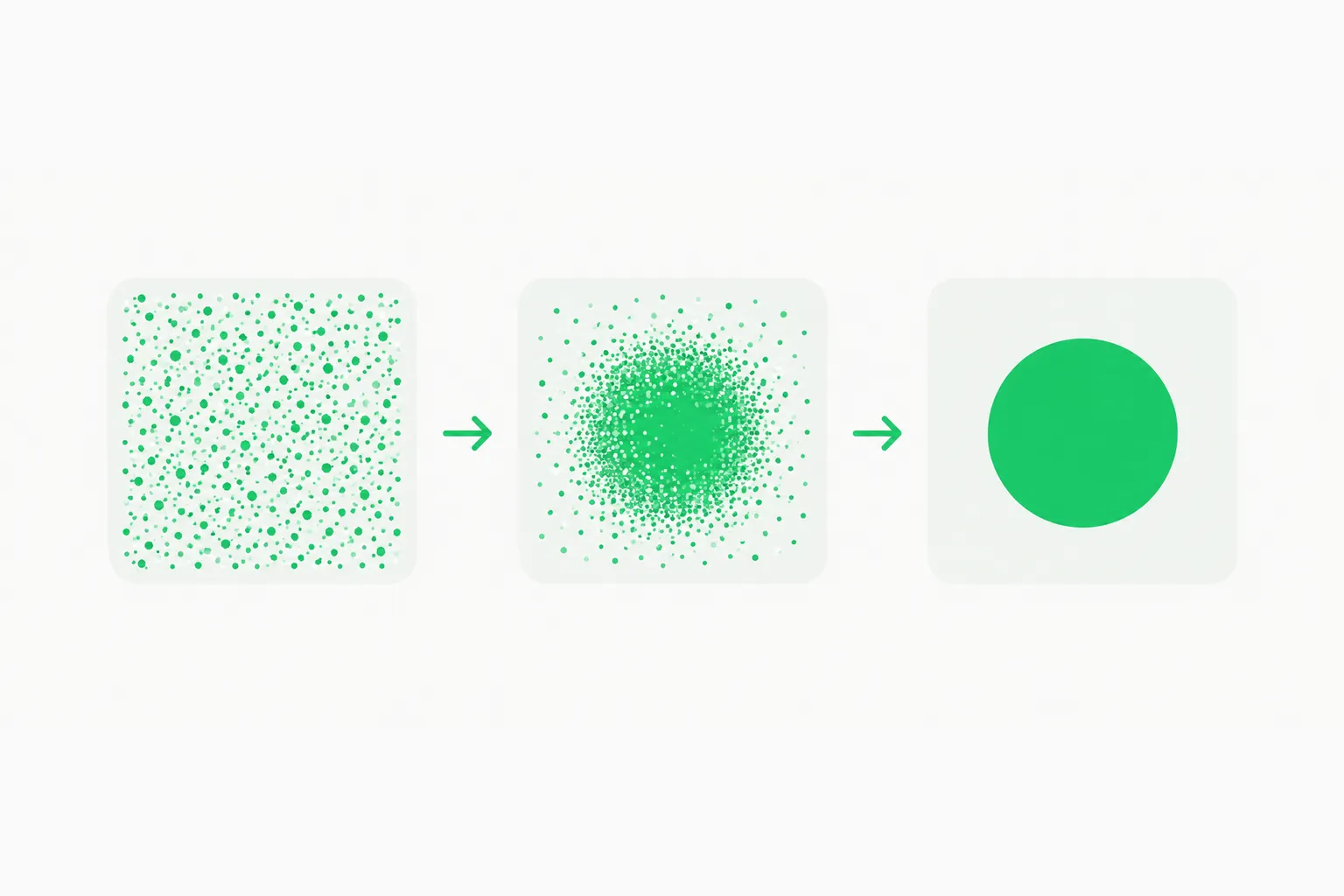 Diffusion noise resolving into a clean image, a reminder that realistic pictures can be synthesized from nothing
- Find the source. Who posted it first? Does a photographer, outlet or eyewitness video exist? An image with no origin and a perfect composition deserves suspicion.
- Compare with real footage. Look for known details: clothing, text, signs, the number of people present. Mismatches are common in generated scenes.
- Look at hands, text and edges. Generated images often fail on small writing and fine anatomy, though newer models do better.
- Run a reverse image search to see earlier versions or a prior identical image.
- Check provenance data. Look for content credentials or watermark checks where tools provide them.
- Read the replies. Community notes and fact-checkers frequently add corrections, but they arrive after the first wave of views.
- When in doubt, do not share. If you want to illustrate an event, label an AI image as AI.
If you work in a newsroom, a platform trust team, or on a political campaign, consider a standing process for provenance checks before amplifying viral visuals. If you run AI agents that post or summarize content automatically, add a verification step so they do not pass generated images along as evidence; AgentBeam, the agent security platform from the explainx.ai team, is built to stop agents before they take risky actions.
A note for people who share images in good faith
Most people who pass along a generated image believe the scene it shows, or at least believe the point it makes. The practical fix is a small habit: before reposting a dramatic image from a breaking event, search for the photographer's or outlet's original, and prefer sharing the actual video or a link to a news report. If you do want a symbolic illustration, say it is AI-generated in the post itself, not in a reply nobody reads. Platforms increasingly add labels, but labels arrive late and are often stripped when images are screenshotted or reposted.
The same applies in reverse. When a real photo or video is dismissed as "probably AI," ask for evidence either way. Here, the footage that confirms the assault came from a TMZ crew present in the room, and the fakes were exposed by watermark and detail checks. Both facts can be true at once: the event was real, and the viral pictures were not.
The wider picture ahead of the midterms
The Youngstown images arrive as the US heads into midterm elections, a period when platforms, labs and campaigns face pressure over AI-generated media. Anthropic described its own election safeguards in our post on Claude and the US midterms, and Meta's assistant has been drawn into disputes abroad, as in our report on Meta AI on WhatsApp and the Brazil campaign. Those cases involve text and assistant outputs; this one involves images that anyone can produce with consumer tools.
France 24's Truth or Fake segment lists several other recent items on its show page, including AI-altered images and videos linked to political content. That cadence shows how often synthetic media now shows up in news cycles, not only in this incident.
Verified versus unverified
| Item | Status |
|---|---|
| A woman was punched at the Youngstown rally on October 12 | Confirmed by video (TMZ, France 24 reviewing footage and NBC reporting) |
| Two viral images are AI-generated | Reported by France 24 via SynthID watermarks and visual mismatches |
| Tools used: Google (first image), OpenAI (second image) | France 24's reading of the watermark; we did not run detection ourselves |
| The first image's sharer acknowledged it was synthetic | Reported by France 24 |
| Claims the protesters were paid | No evidence, per France 24 |
| How many accounts shared the fakes | Not established; one X post passed a million views |
Details are from France 24 and TMZ reports on October 13 to 15, 2026 and may change.