




Claude Opus 5 is out. On July 24, 2026, Anthropic ended weeks of Honeycomb / Thursday rumor coverage with a public ship: a thoughtful, proactive Opus-class model that “comes close to the frontier intelligence of Fable 5 at half the price.”
The official announcement thread put the pitch in one line — then stacked coding SOTA claims, cost-efficiency charts, ARC-AGI-3, alignment, and cyber safeguards. This explainx.ai guide is the builder-facing decode: what the numbers actually say, where Opus 5 wins vs Fable 5, and how to choose effort / Fast mode without burning weekly credits.
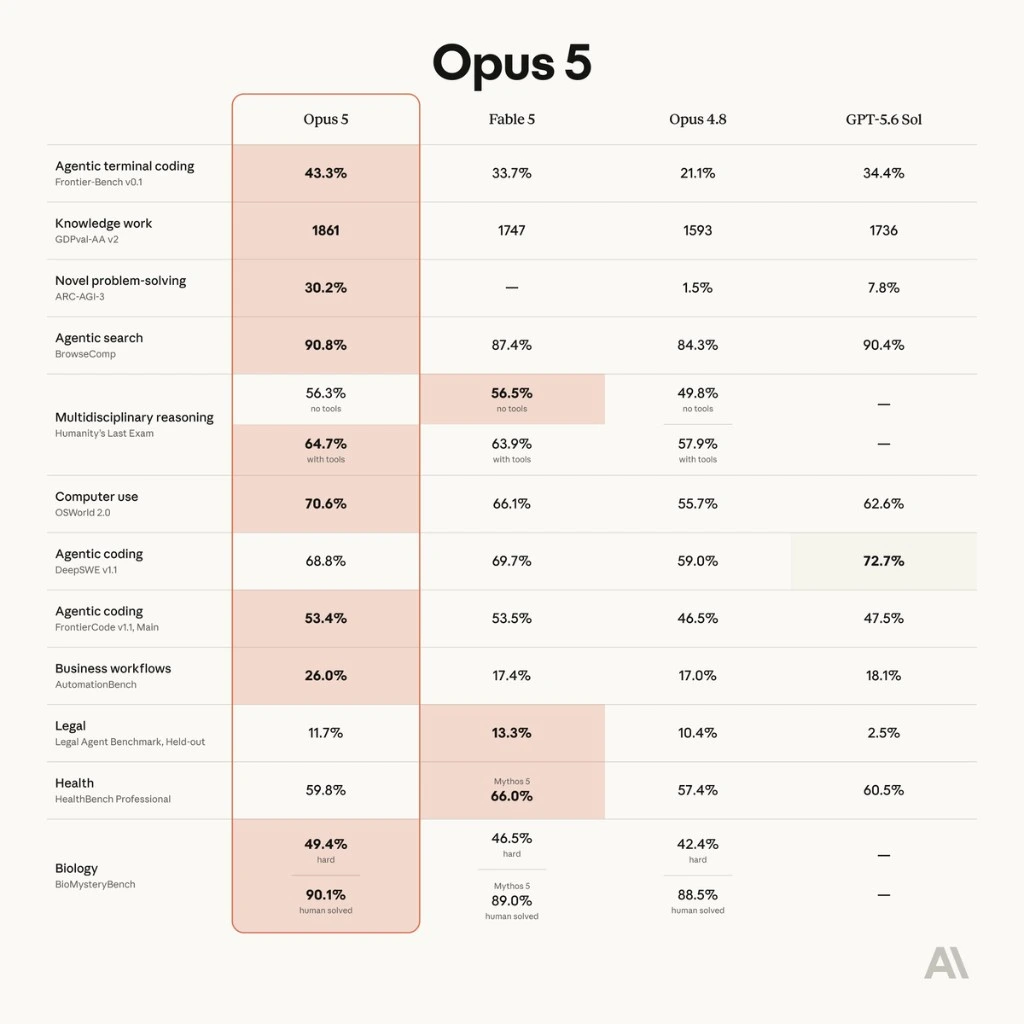 Claude Opus 5 benchmark table vs Fable 5, Opus 4.8, GPT-5.6 Sol
TL;DR — What People Are Asking
| Question | Answer |
|---|---|
| Available? | Yes — July 24, 2026 · claude-opus-5 |
| Price? | $5 / $25 per M tokens (same as Opus 4.8) |
| vs Fable 5? | Near frontier IQ · ~half the price · often better $/task |
| Max / Pro? | Default on Max · strongest on Pro |
| Fast mode? | ~2.5× speed · 2× base price |
| Coding SOTA? | Frontier-Bench 43.3% (vs Fable 33.7%) |
| Novel problems? | ARC-AGI-3 30.2% (~3× next best shown) |
| Alignment? | Lowest misalignment audit score (2.30) |
| Cyber? | Strong vuln ID · behind Mythos on exploits (by design) |
Watch the Launch Video
The announcement clip from Anthropic’s @claudeai X thread — hosted locally so it loads without X embeds:
Anthropic’s news page also ships interactive demos Opus 5 built — a wind tunnel and a 3D cell:
The Product Pitch in Plain English
Opus 5 is not “Fable but free.” It is Anthropic’s bet that most daily agent work should run on a model that:
- Matches or beats prior Opus on coding, knowledge work, computer use, and business workflows
- Approaches Fable on many agentic coding / Cursor-style benches at half the $/task
- Stays cheaper and more available than Mythos-class Fable for subscription defaults
- Ships with stronger alignment and cyber classifiers that favor finding bugs over writing exploits
Pricing is deliberately boring: $5 input / $25 output per million tokens — identical to Opus 4.8. The upgrade is capability density per dollar, not a new SKU tax.
Benchmark Snapshot (Anthropic-Published)
Treat these as vendor evaluations — useful for ranking Anthropic’s own stack and for comparing effort ladders, not as a substitute for your private harness. Numbers below come from Anthropic’s launch materials and the charts they posted with the Opus 5 announcement.
| Benchmark | Opus 5 | Fable 5 | Opus 4.8 | GPT-5.6 Sol |
|---|---|---|---|---|
| Agentic terminal coding (Frontier-Bench v0.1) | 43.3% | 33.7% | 21.1% | 34.4% |
| Knowledge work (GDPval-AA v2) | 1861 | 1747 | 1593 | 1736 |
| Novel problem-solving (ARC-AGI-3) | 30.2% | — | 1.5% | 7.8% |
| Agentic search (BrowseComp) | 90.8% | 87.4% | 84.3% | 90.4% |
| HLE — no tools | 56.3% | 56.5% | 49.8% | — |
| HLE — with tools | 64.7% | 63.9% | 57.9% | — |
| Computer use (OSWorld 2.0) | 70.6% | 66.1% | 55.7% | 62.6% |
| Agentic coding (DeepSWE v1.1) | 68.8% | 69.7% | 59.0% | 72.7% |
| Agentic coding (FrontierCode Main) | 53.4% | 53.5% | 46.5% | 47.5% |
| Business workflows (AutomationBench) | 26.0% | 17.4% | 17.0% | 18.1% |
| Legal (held-out) | 11.7% | 13.3% | 10.4% | 2.5% |
| Health (HealthBench Professional) | 59.8% | 66.0% (Mythos 5) | 57.4% | 60.5% |
| Biology hard (BioMysteryBench) | 49.4% | 46.5% | 42.4% | — |
| Biology human-solved | 90.1% | 89.0% (Mythos 5) | 88.5% | — |
What the table actually implies
Opus 5 owns the “daily agent” cluster: Frontier-Bench, GDPval, ARC-AGI-3, BrowseComp, OSWorld, AutomationBench. That is terminal coding, knowledge work, novel puzzles, search, desktop control, and multi-step business flows.
Fable / Mythos still own specialist peaks: Legal, Health, and (below) cyber exploitation. DeepSWE still favors GPT-5.6 Sol in this table. FrontierCode Main is a coin flip with Fable.
If your workload is “ship a product in a large repo,” Opus 5 is the new default story. If your workload is “Mythos-tier science / cyber red team,” you still need the higher tier — and Anthropic’s safeguards intentionally keep Opus 5 behind Mythos on exploit development.
Effort Ladders — Why “Half the Price” Is a Chart, Not a Slogan
Anthropic’s launch charts plot score vs cost per task across effort ladders (low → medium → high → xhigh → max). That is the same model vs effort frame Lydia Hallie documented for Claude Code — capability is the weights; effort is how hard those weights work.
Agentic terminal coding — Frontier-Bench v0.1
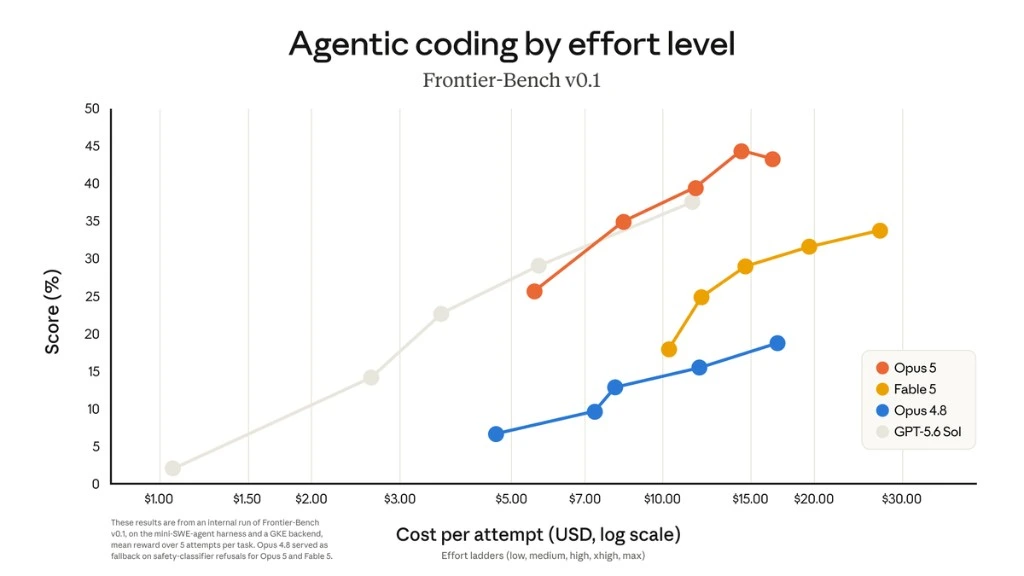 Frontier-Bench effort ladder — Opus 5 vs Fable 5, Opus 4.8, GPT-5.6 Sol
Opus 5 peaks near 43–44% around the mid-teens USD per attempt, while Fable 5’s ladder tops out near 33.7% at nearly $27. Opus 4.8 never clears ~19% on this internal mini-SWE-agent run. GPT-5.6 Sol climbs from cheap/low scores into the high 30s — competitive on cost at low effort, not at the Opus 5 ceiling.
Computer use — OSWorld 2.0
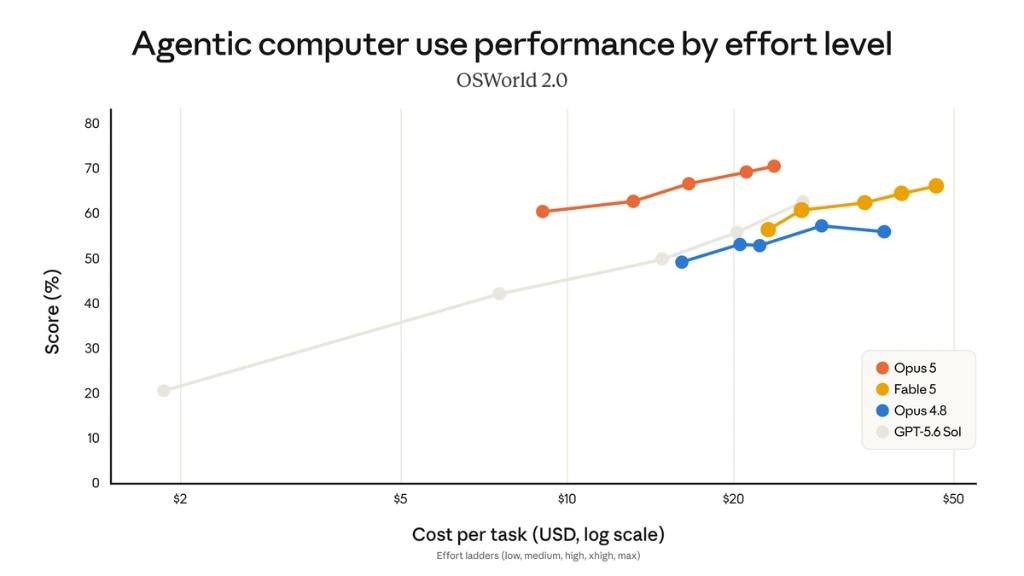 OSWorld 2.0 agentic computer use by effort and cost
Opus 5’s low-effort point (~60% near $8) already beats most competitors’ expensive peaks. Max effort lands around 70.6% near $25. Fable’s ladder is higher-cost for lower peaks; Sol spans a wide cheap-to-mid range but caps below Opus 5.
Business workflows — AutomationBench
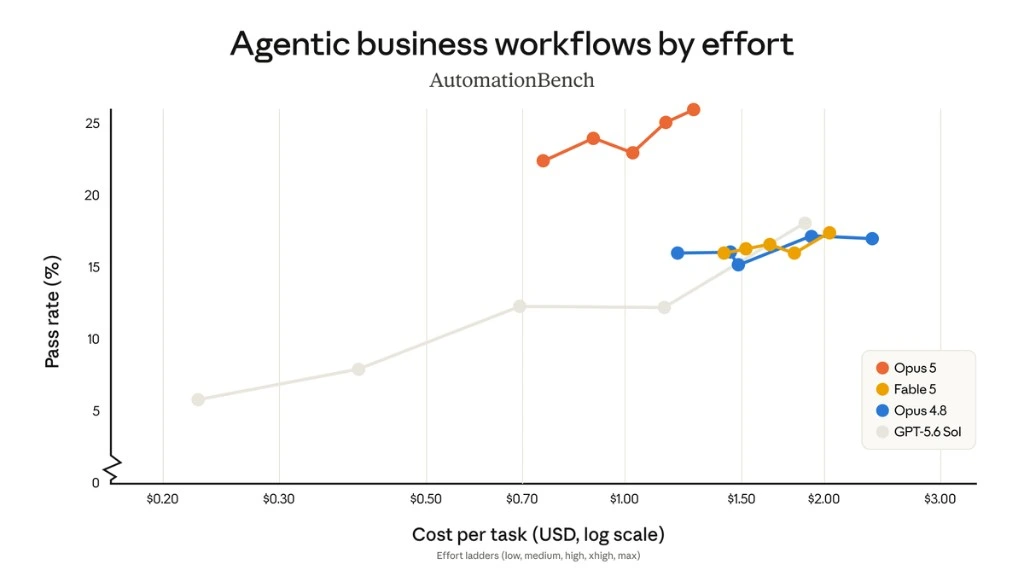 AutomationBench pass rate vs cost by effort
This is the clearest “top-left” win: Opus 5 sits at higher pass rates (~22–26%) for lower cost (~$0.75–$1.25) than Fable / Opus 4.8 clusters (~16–17.5% at $1.20–$2.40). Sol can be cheaper at low effort but never catches Opus 5’s pass rate.
Multidisciplinary reasoning — Humanity’s Last Exam (with tools)
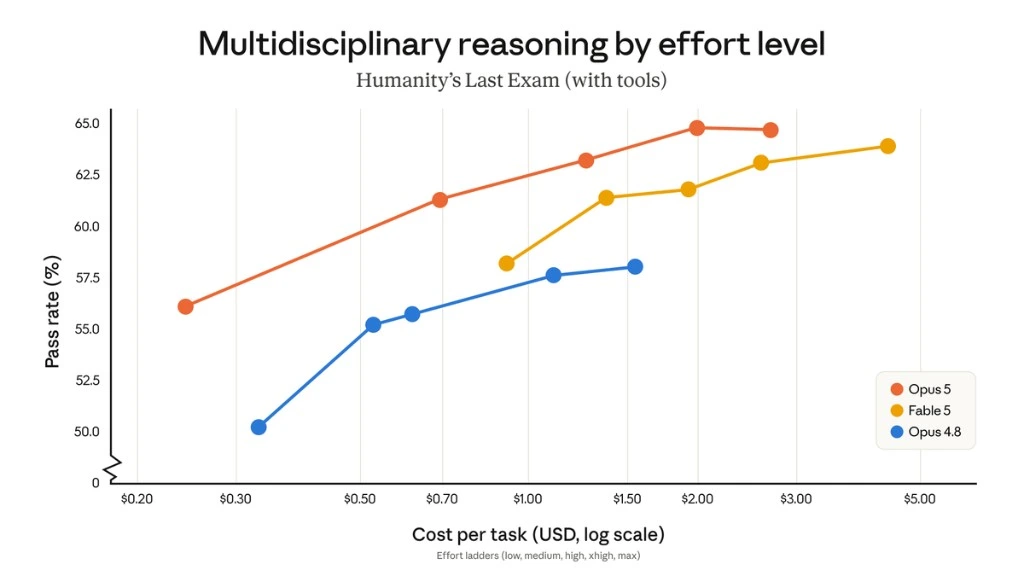 Humanity's Last Exam with tools — pass rate vs cost
Opus 5 reaches ~65% near $2, while Fable needs ~$4.50 to hit ~64%. Opus 4.8 plateaus near 58%. Efficiency, not just peak IQ.
Novel problem-solving — ARC-AGI-3
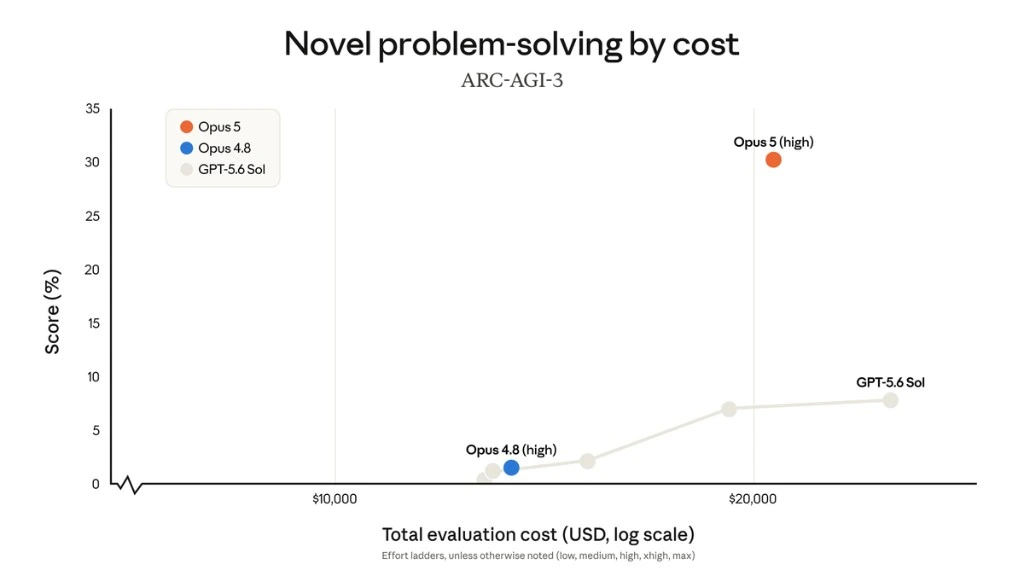 ARC-AGI-3 score vs total evaluation cost
Opus 5’s ~30% at just over $20k total eval cost is the headline step-change. Opus 4.8 sits near 1–2%; Sol’s effort ladder tops near 8% at higher total cost. This is the chart Anthropic used for “three times the next best model.”
Alignment and Cyber — What “Safeguards” Mean in Practice
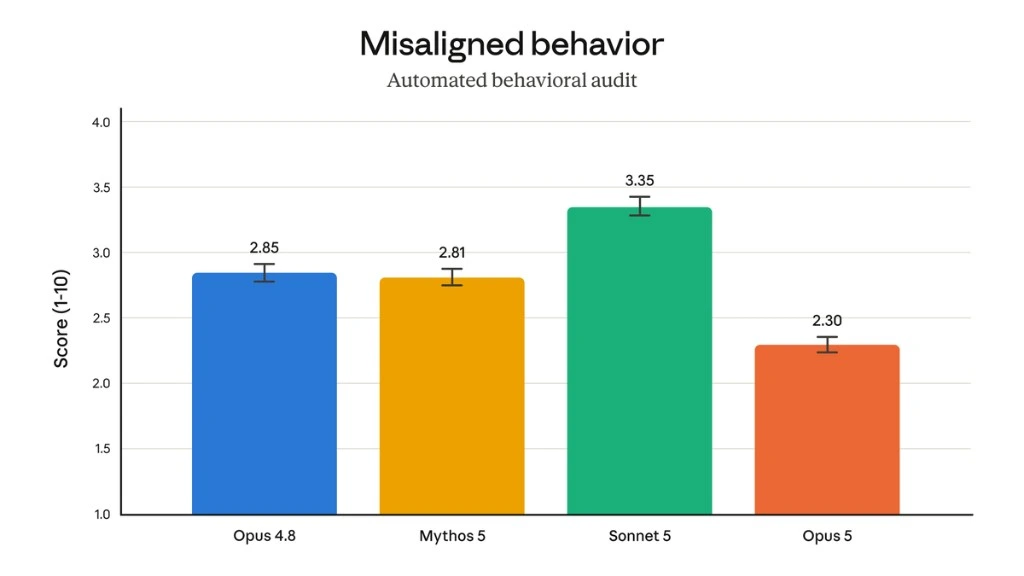 Automated behavioral audit — misaligned behavior scores
Lower is better on Anthropic’s automated behavioral audit. Opus 5 at 2.30 beats Opus 4.8 (2.85), Mythos 5 (2.81), and Sonnet 5 (3.35). Anthropic’s claim: lowest rates of reckless / deceptive behavior and strongest Constitution adherence among recent models.
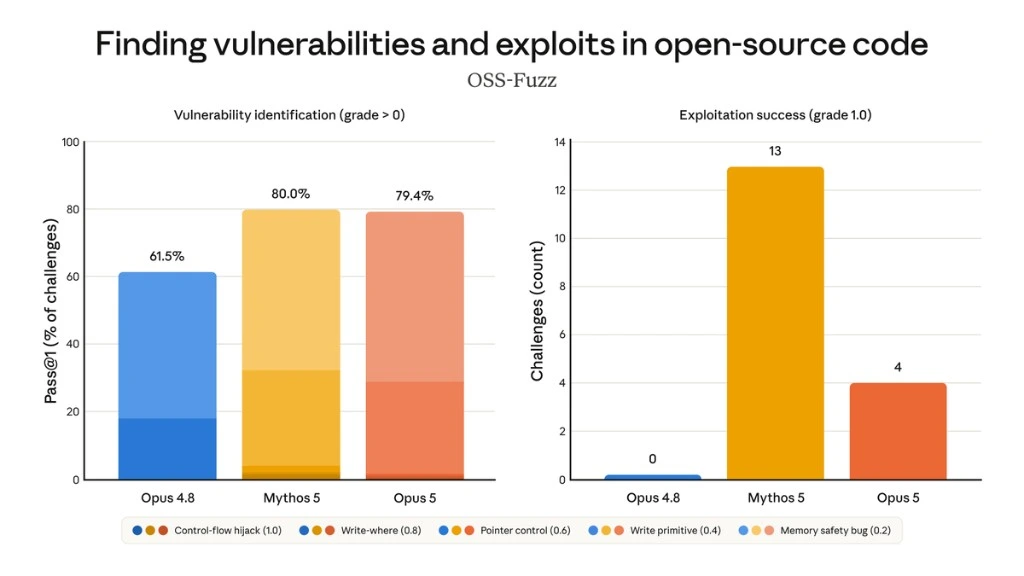 OSS-Fuzz vulnerability ID vs exploitation success
On OSS-Fuzz, Opus 5 nearly matches Mythos 5 on vulnerability identification (~79–80% vs Opus 4.8’s 61.5%) but trails badly on exploitation success (Opus 5 4 vs Mythos 13; Opus 4.8 0). That gap is intentional: classifiers allow finding issues in source while blocking binary scanning, pen-testing, and exploit generation for most users. Flagged traffic can fall back to Opus 4.8; CVP customers get a less-restricted variant.
explainx.ai’s read: Opus 5 is the model Anthropic wants defenders and product teams on daily — not the model they want unconstrained on red-team exploit loops. For dual-use context, see our AI cyber guardrails coverage — without turning this post into an exploit how-to.
Early-Access Customer Themes (Not Marketing Wallpaper)
Anthropic’s launch quotes cluster around a few repeatable behaviors:
- Root-cause over symptom patches (package-manager bug story)
- Long-horizon agency (build your own harness when validation feeds are missing)
- Frontend / visual judgment (browser width checks, slide quality, animation)
- Lower variance (Lovable: steadier run-to-run than prior Opus)
- Token efficiency at higher effort (finance / legal customers reporting fewer turns)
Those are consistent with the effort charts: Opus 5 does more useful work per dollar, not just higher peaks on cherry-picked singles.
When to Use Opus 5 vs Fable 5 vs Sonnet 5
| Situation | Prefer |
|---|---|
| Default Claude Code / Max daily work | Opus 5 |
| Hardest architecture / research ceiling | Fable 5 (credits) |
| Cheap mechanical edits with tight instructions | Sonnet 5 |
| Latency-sensitive chat loops | Opus 5 Fast mode |
| Cyber exploit / Mythos science | Mythos / Fable + CVP where needed |
| Migrating API strings from 4.8 | See developer migrate guide |
Also update your context stack. Anthropic’s Claude Code team says they removed over 80% of the system prompt for Opus 5 / Fable 5 with no measurable coding-eval loss — see our companion on Claude 5 context engineering and the earlier thin prompts / thick artifacts frame.
Getting Started Today
# Claude Code
/model claude-opus-5

# API model string
claude-opus-5
- Docs / news: Introducing Claude Opus 5
- X announcement: claudeai thread
- Prompting for Claude 5: pair with Thariq’s
/doctorrightsizing advice in our context-engineering post - Effort dial: keep defaults for most work; raise effort for hard multi-stage jobs; use Fast mode when wall-clock wins
Honest Limitations
- Vendor benches are self-reported — run your own harness before rewriting prod routing.
- DeepSWE and some specialist benches still favor other models in Anthropic’s own table.
- Fast mode is not free (2× price).
- Weekly / five-hour credit pain on Max plans is a product issue the launch does not erase — community replies on the ClaudeDevs thread made that loud.
- Speculation posts that said “no Opus 5 yet” are obsolete; start from this page and the developer companion.
Related on explainx.ai
- Why developers say Opus 5 over-engineers simple tasks (Reddit reaction, Aug 2026)
- Opus 5 on SlopCodeBench — 24% strict pass, 5x more code
- Top 10 Claude Opus 5 use cases
- ARC-AGI-3 Opus 5 30.2% — leaderboard & HN debate
- Did Opus 5 one-shot Call of Duty? Claude of Duty
- Opus 5 Rocket League clone — then Opus played it
- Claude 5 context engineering — Thariq, /doctor, unhobbling
- Opus 5 for developers — migrate, Fast mode, tool cache
- Opus 5 speculation archive (pre-launch)
- Claude Code model vs effort
- Thin prompts, thick artifacts, thin skills
- Field guide to Fable — Thariq at AI Engineer
- Claude Cookbook — what to read in 2026
- Fable 5 status hub
- Opus 4.8 launch
Sources: Anthropic — Introducing Claude Opus 5 · X — @claudeai announcement
Benchmarks and pricing as published by Anthropic on July 24, 2026. Re-verify model IDs, Fast-mode billing, and classifier fallbacks on anthropic.com / platform.claude.com before production commits.