




China's commerce and science ministries have proposed putting 40 technologies, 23 of them in artificial intelligence, into the country's export-control catalogue, and are asking exporters to register transfers right away. The notice, dated October 16, 2026, is described in a Geopolitechs summary as Announcement No. 48 from the Ministry of Commerce (MOFCOM) and the Ministry of Science and Technology (MOST). Bloomberg's headline says China "proposes export controls on AI models, chips and agents". Public comment is open until November 15.
This turns months of reporting into a published draft. We covered the Reuters July report on limiting overseas access to Chinese frontier models when it was only talks; this is the formal follow-up. A caveat up front: we could not open the original MOFCOM text or the paywalled Bloomberg article, so the figures below come from secondary summaries and are attributed as such.
TL;DR: what is confirmed and what is not
| Question | Answer |
|---|---|
| What is proposed? | Revising the Catalogue of Technologies Prohibited or Restricted from Export to add 40 technologies |
| Breakdown | 23 AI, 5 biomedicine, 12 photovoltaics (per Geopolitechs summary) |
| Prohibited vs restricted | 14 proposed as prohibited, 26 as restricted, per the ministry spokesperson as summarised |
| AI areas named | Large AI models, AI agents, AI chip design, computing clusters, information processing |
| Effective now? | Pre-export registration applies immediately, until the revised catalogue takes effect |
| Comment period | October 16 to November 15, 2026 |
| Official stance | "Not directed at any particular country, region, or entity" |
| Not confirmed | Original text, model-size or performance thresholds, final category for each AI item |
Update (October 16, 2026): the ministry's own Q&A and Global Times now confirm the scope
Since this post was first written, two readable sources have appeared. Global Times reports the draft as published by MOFCOM and MOST with 14 additions to the prohibited category and 26 to the restricted one, of which 23 relate to AI. It says the draft would prohibit exports of "core technologies of AI large models that are trained with national key sensitive data and AI agents that serve key national information infrastructure, national defense and core government affairs," while design technologies for 2.5D and 3D AI chips and 3D flash memory are restricted, and AI information processing and voiceprint recognition are added to the restricted list. Open-source, published and other public-domain technology is outside the scope.
A translation of the MOFCOM spokesperson's Q&A, published by China Tech Bite, answers the question this post left open about hosted access. It says scenarios where enterprises use restricted large models to provide API calls, app or web interactions, SaaS applications, or lightweight local edge deployment "do not fall under the scope of large model technology export management." For restricted AI technologies, overseas localized deployment is within scope, but deployment in risk-controllable environments such as overseas self-owned clouds may get automatic licensing. Open-sourcing AI technology, building computing centers abroad, overseas chip foundry services, joint R&D with overseas resources and international standard-setting are listed for automatic licensing, which the ministry describes as basically "instant reporting and release."
Aggregator reports now say the ministries confirmed thresholds of 2 trillion parameters or a global top-10 ranking for weights and source code, plus an agent definition tied to 200 third-party tools at 90% accuracy. We could not find those figures in Global Times or in the translated spokesperson Q&A, which says to refer to the original announcement for details. They remain unconfirmed here until the annex text is checked. The takeaway for builders: hosted Chinese model APIs and edge apps look unaffected, self-hosting by foreign firms of future restricted models is the exposed case, and the comment window runs to November 15.
Update (October 16, 2026, evening): The Decoder reports the draft's thresholds
The Decoder's walkthrough of the draft is the first readable source we have seen that states numbers for large models, which supports the aggregator figures flagged below. It reports that controls on weights, checkpoints, source code, architecture and training or inference methods would apply once a model meets any one of three thresholds: 10^26 FLOPs of training compute, at least 2 trillion parameters, or a place in the global top 10. Top-10 status would be judged from public rankings by domestic and foreign evaluators and industry platforms.
A second case covers models trained on China's "important data" under the Data Security Law. Publicly available data is exempt, and up to 0.1% of such data is allowed if it was cleaned beforehand, never appears in outputs and does not substantially boost core R&D. The Decoder also reports that AI tools that autonomously write or alter malware to attack critical infrastructure, the military or government would be banned outright, while AI tools for finding software vulnerabilities would be export-limited rather than banned.
On the fast track, The Decoder says publishing restricted technology as open source qualifies for automatic licensing, as do overseas data centers, overseas chip tape-outs and joint research with foreign partners. Using a restricted model through an API, app, website or SaaS tool, or a lightweight local version, is not controlled, while installing it on local servers abroad needs a standard export license unless it runs on the company's own overseas cloud. Reuters and the Financial Times also carried the story on October 16, but both were paywalled for us, so this post relies on The Decoder, Global Times and the translated ministry Q&A for the details. We have not seen the annex text itself, so treat the thresholds as reported rather than verified.
Earlier update (October 16, 2026): a "2 trillion parameters" threshold is circulating, but unconfirmed
A claim is spreading on social media and aggregator sites that the draft would restrict transfer of weights and source code for models with at least 2 trillion parameters. None of the write-ups we found link the Chinese text. We searched for the original Ministry of Commerce and Ministry of Science and Technology notice and for English and Chinese coverage, and found no source that states a parameter cutoff. Reports we could find say only that items would be controlled when they pass designated performance thresholds, without giving values.
What is confirmed: the draft exists, it lists 40 technologies including 23 in AI, and comments run until November 15. What is not confirmed: any parameter count, and which models would fall under it. Kimi K3 is widely reported at about 2.8 trillion parameters, which may be where the figure comes from. Treat the number as a claim until the notice text shows it, and check the Ministry of Commerce public notice page directly.
What exactly would be controlled?
According to the Geopolitechs summary, the AI entries cover large AI models, AI agents, AI chip design, computing clusters and information processing. Two examples reportedly given sit at opposite ends of the scale: AI-driven malicious code generation is proposed as prohibited, while AI-assisted vulnerability discovery is proposed as restricted. Bloomberg's report, as relayed in the search snippet we could read, says restricted technologies would include model weights and source code for products above certain performance thresholds, but we could not verify the thresholds.
Technologies that are already public through open-source releases or academic publications are reportedly excluded from the list. The summary also says automatic licensing may apply to open-source releases, overseas computing centres, overseas chip tape-out, joint research using overseas resources and work on international standards. That detail matters, because it suggests the drafters want to keep Chinese labs able to publish open models and to build abroad.
What does "overseas local deployment" mean?
The most consequential quote attributed to the ministry is that "overseas local deployment falls within the scope of technology export controls". Local deployment means running a model on infrastructure outside China, for example a company in Europe hosting Qwen or GLM weights on its own servers. Under that reading, handing a foreign customer a copy of a model, rather than serving it through an API, is a technology export.
A Startup Fortune summary of earlier Financial Times reporting describes the same distinction: hosted access via an API or cloud subscription would reportedly stay open, while the aim is to stop foreign parties from owning a copy. That article names Alibaba's Qwen, ByteDance's Doubao, Zhipu's GLM and DeepSeek as the open-weight families in focus, and says officials discussed tiered limits on training data sent abroad. Treat those names as press reporting about intent, not as entries in the draft catalogue.
What is the catalogue, and how has it changed before?
The Catalogue of Technologies Prohibited or Restricted from Export is the list under which China decides whether a technology may leave the country freely, needs a licence, or may not leave at all. It is maintained by MOFCOM together with MOST and rests on Article 20 of the Foreign Trade Law, which the ministry spokesperson is reported to have cited when calling the revision routine technical-trade management.
Revisions are usually incremental. Law-firm trackers describe a December 2022 consultation that proposed removing 32 entries, changing 36 and adding 7, ending at 139 items, and a July 2025 adjustment that deleted three entries and added one. AI-related technology has sat in the restricted category since 2020, according to the same trackers. What makes October 2026 different is scale and subject: 40 proposed entries in one go, more than half of them about AI, and wording that reaches models, agents and compute clusters rather than narrow interface technology.
That history is a useful guardrail against over-reading. A draft catalogue is a consultation document; entries are routinely reworded, moved between prohibited and restricted, or dropped after industry feedback. At the same time, the immediate registration duty is not a draft: per the summary, it applies from publication until the revised list takes effect.
How does this follow from July?
In July the Financial Times and Reuters reported that MOFCOM had consulted Alibaba, ByteDance and Zhipu about limiting foreign downloads of model weights. Our policy timeline on export controls, distillation and open weights lays out how the US and China moved in parallel through the summer. The new element in October is process: a numbered notice, a consultation window and an immediate registration duty.
There is also a precedent for Beijing intervening in foreign deals for AI companies. The Startup Fortune piece recalls the Manus case, in which China's NDRC opened a probe after Meta's roughly $2 billion acquisition, ordered it unwound in April 2026 and barred co-founders from leaving China. Our coverage of the Manus and Meta separation and of Manus resuming independent operations shows how that played out for users.
Who is affected, and how?
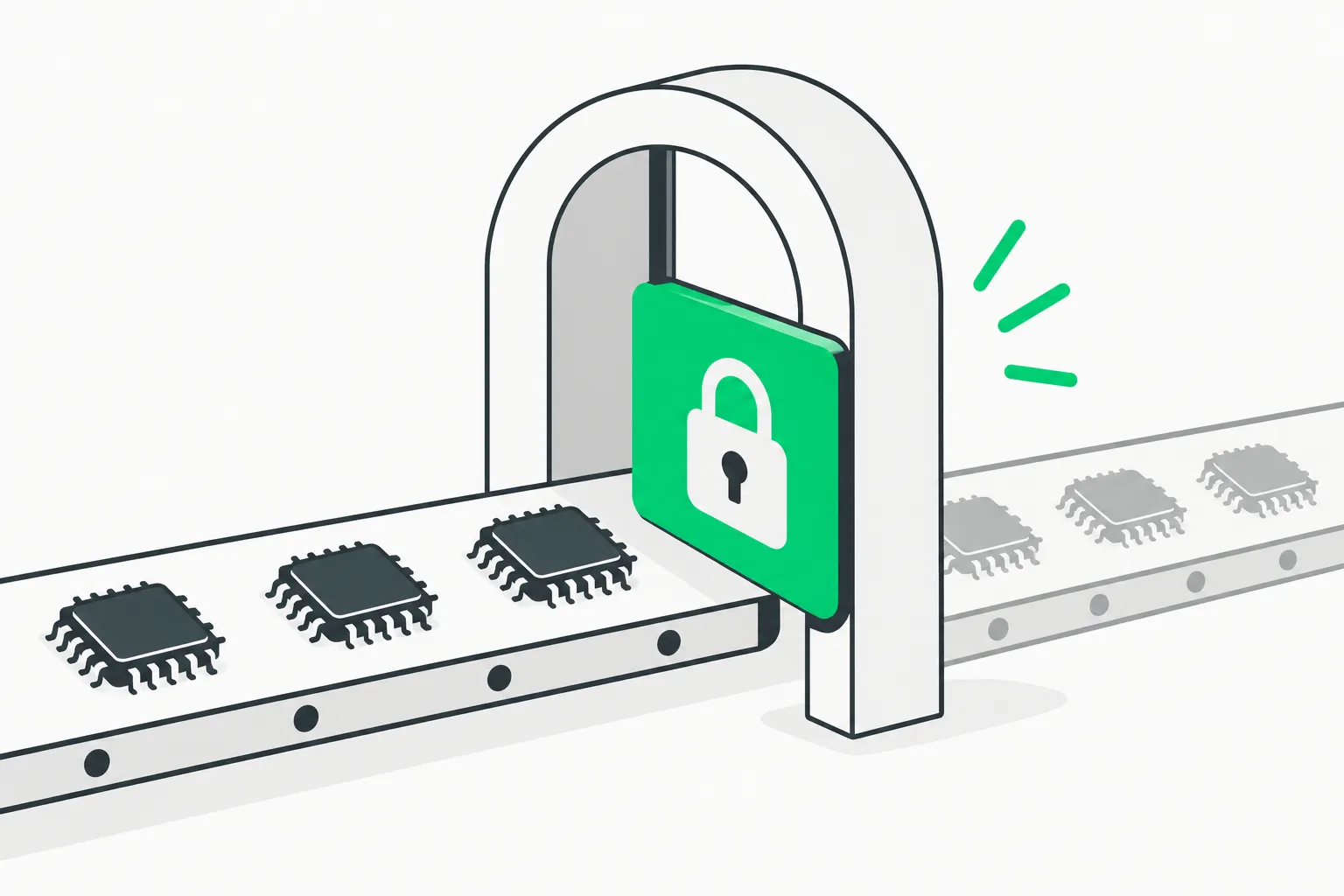 A gate with a half-closed lock over a stream of chips, illustrating China AI export controls on models and chips
- Chinese labs. Alibaba, ByteDance, Zhipu and DeepSeek would need to register or license transfers of controlled technology. Whether a routine open-weight release on a public hub counts depends on how the "already public" and open-source exceptions are written.
- Foreign companies running Chinese models. Teams that self-host Qwen or GLM could face licensing questions for future versions, not for weights already downloaded. As one summary notes, published weights cannot be unpublished, so the practical impact lands on future releases.
- Chip and cloud firms. Chip design and computing-cluster entries touch overseas data centres and tape-outs. See our reporting on Tencent and Oracle's overseas AI chip lease for how such arrangements already sit at the edge of export rules.
- Researchers. Joint R&D using overseas resources is reportedly eligible for automatic licensing, but the details are not yet public.
What should developers and companies do now?
- Inventory your dependencies. List which Chinese open models you run, where, and under what licence. Pin and archive the exact weights and licence files you already have.
- Do not assume a ban. Nothing in the sources says that existing downloads become illegal to use. The proposal concerns exports from China.
- Plan for slower or gated future releases. If registration or licensing slows new weights reaching public hubs, keep a fallback. Our look at Reflection AI's open-weight model as a US answer to DeepSeek and Qwen covers one alternative path, and the China open-weight playbook explains why these models became so widely used.
- Watch the consultation. Comments can be sent until November 15 to the email address given in the notice; final text may change categories and thresholds.
- Read the original. Check MOFCOM's own announcement page for the authoritative annex before acting on any summary, including this one.
If you operate AI agents that touch code or infrastructure, note that the draft's prohibited item on AI-driven malicious code generation reflects the same concern as the security work we track. To limit what an agent can do on your systems regardless of where its model comes from, see AgentBeam, the agent security platform from the explainx.ai team.
What are the open questions?
- Thresholds. Which models count, by size, capability or compute? Not stated in the sources we could read.
- Classification. Which of the 23 AI items are prohibited, and which are restricted?
- Open-source carve-out. How wide is the exception for technologies already published, and does it cover new releases?
- Enforcement. How would China verify what a foreign firm runs locally?
- Reaction. No company statements from Alibaba, ByteDance, Zhipu or DeepSeek appear in the material we could access.
- Safety context. China's labs have also come under scrutiny for what they disclose; see SemiAnalysis on China AI labs' safety disclosures and the Qwen censorship audit.
Why this matters beyond China
For three years the policy story ran one way: Washington limiting what Chinese firms could buy. This notice reverses the arrow. If Beijing treats model weights and agent code as controlled exports, the open-weight ecosystem that powers many startups, coding tools and local-AI hobbyists could become less predictable, and Western alternatives gain strategic weight. It also puts China's own labs under the kind of release review that American labs have debated since the Fable and Mythos restrictions.
For now the sensible stance is neither panic nor dismissal: the draft is a proposal, parts of it rest on summaries, and the comment window runs for a month. We will update this post when the original text and thresholds are available.
Related reading
- China may restrict overseas access to top AI models: Reuters July report
- AI policy timeline 2026: export controls, distillation, open weights
- China's AI playbook: free models, cheap compute
- Tencent and Oracle's 100,000-chip lease and export controls
- Reflection AI: a US open-weight answer to DeepSeek and Qwen
- Manus resumes independent operations
Details reflect secondary reporting as of October 16, 2026; the official notice and final catalogue may differ.