



Base Labs shipped bison-1 and groundhog-1 on November 20, 2026, open decision models built on Google Gemma 4. In the launch post, Baseten says bison-1 ranks #1 of 19 models on Artificial Analysis Decision Index v2.1 with the best Brier calibration on that leaderboard.
Quick answer
| Model | Params | Backbone | API context | Price / 1M tokens | Index claim |
|---|---|---|---|---|---|
| bison-1 | 31B | Gemma 4 31B | 128k | $0.10 | 76, #1 per Baseten |
| groundhog-1 | 26B MoE (~4B active) | Gemma 4 26B-A4B | 128k | $0.035 | ~mammoth-1 class expected |
| mammoth-1 (prior) | 27B | Qwen | 16k | $0.10 | 71 on same index |
| elephant-1 (prior) | 9B | Qwen | 16k | $0.035 | Lower tier |
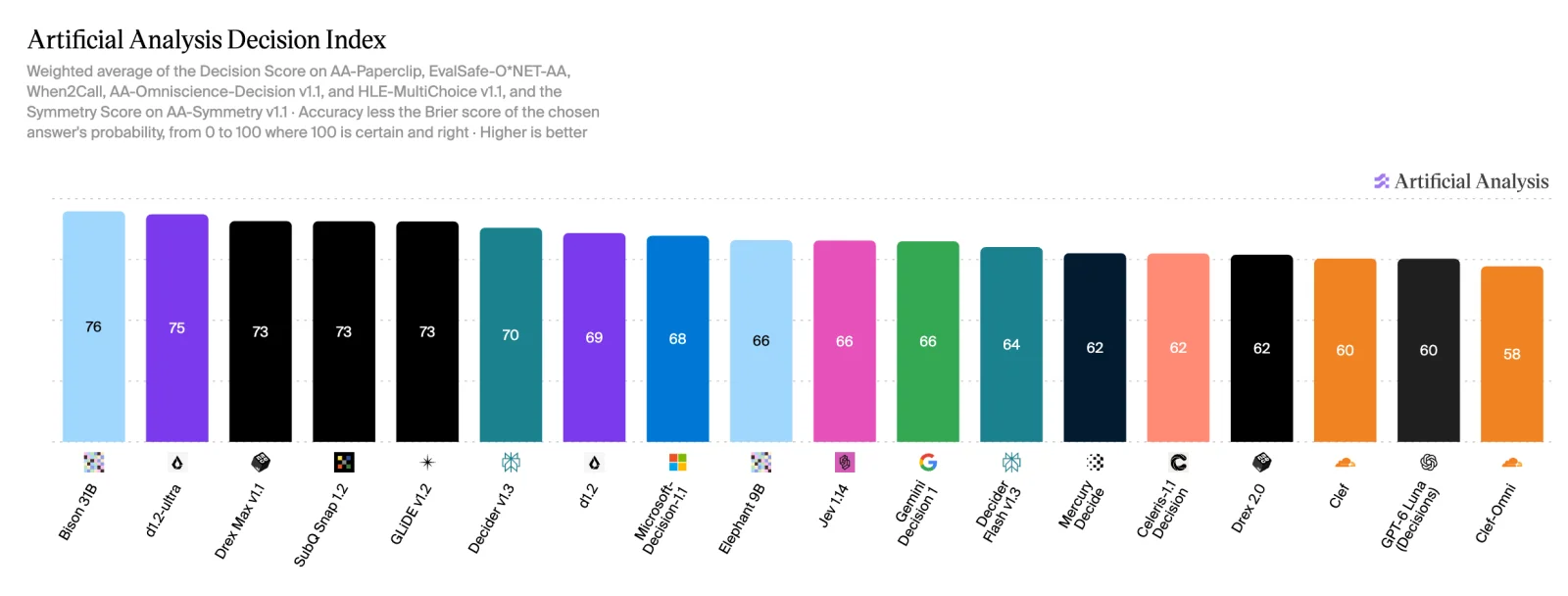 Artificial Analysis Decision Index ranking with bison-1 at number one
Image: Baseten
What decision models do
Decision models sit between cheap classifiers and frontier chat models. You feed state (text and optional images) plus a question with discrete options. The model returns probabilities, not a prose essay.
That pattern fits:
- Support ticket routing when policy paragraphs live in the context.
- Risk scoring when you need calibrated confidence for automation gates.
- Agent orchestration when each step is a small choice, as OpenAI Performance Factory and Microsoft-Decision-1.1 at Ignite describe for routing at scale.
Baseten’s earlier Liquid AI d1-ultra coverage explained the economics of sub-cent decision APIs. bison-1 is pricier per token but claims a higher index score and Gemma lineage.
Why Gemma 4 backbones now
Last month Baseten released mammoth-1 and elephant-1 on Qwen, then said teams asked for Western open bases for sovereignty and procurement reasons.
bison-1 and groundhog-1 answer that without resetting the API shape: change the model name on the same Baseten decision endpoint.
The post also claims the family now sits on the Pareto frontier of accuracy vs time from elephant-1 through bison-1 on Artificial Analysis charts—vendor graphics, not independent replication here.
Calibration and soft labels
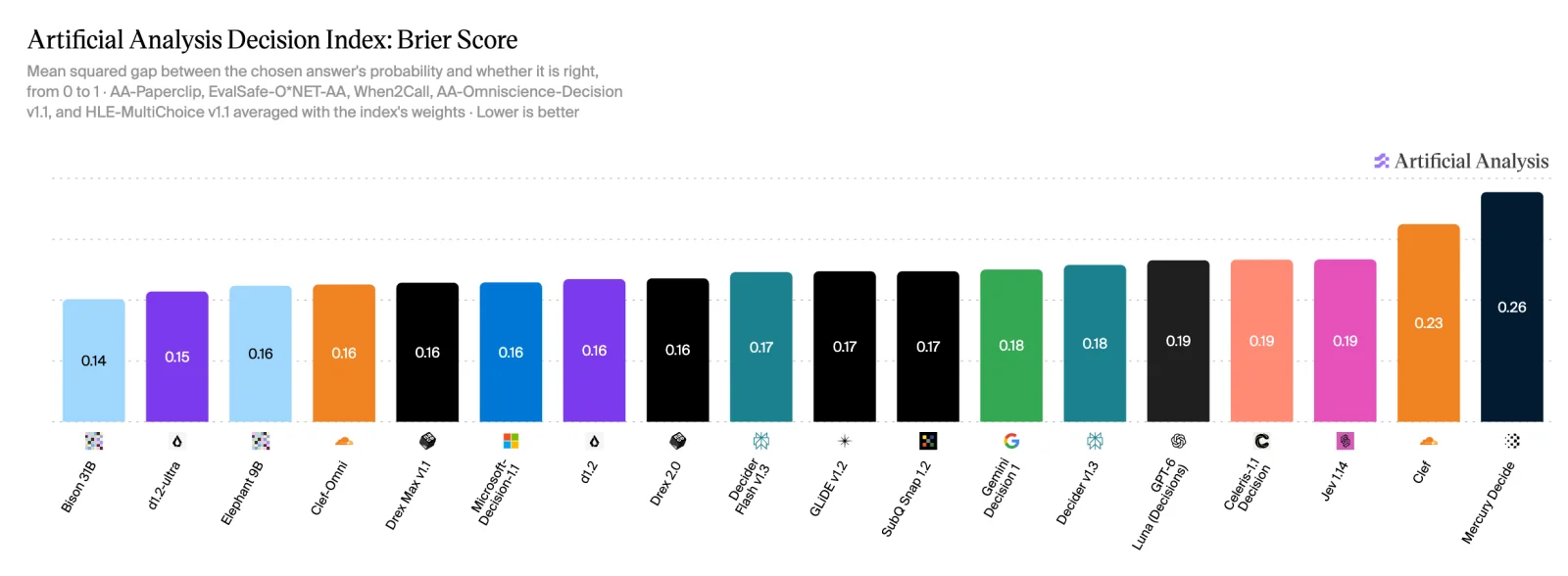 Brier score calibration chart for bison-1 at 0.14 on the Decision Index
Image: Baseten
Baseten highlights Brier score 0.14 for bison-1 versus 0.15 for d1.2-ultra on the Decision Index. Brier measures how well stated confidence matches empirical accuracy.
Training changes include more soft labels (example: teach 83% A / 17% B instead of hard 100% labels). That matters when your workflow sends only high-confidence decisions to straight-through processing.
Compare with Sarvam Prism open confidence models if you self-host instead of using Baseten APIs.
128k context use cases
Earlier Base Labs decision APIs capped at 16k tokens. 128k lets you include full policy PDFs, email threads, or multi-image packets without pre-summarization.
Baseten’s example: an invoice looks payable until an earlier cancellation email in the same thread changes the decision. Long context reduces wrong approvals when the decisive sentence is far from the question.
Watch latency: larger contexts still cost time even if per-token prices look small.
Model pick guide (from Baseten table)
| Choose | When |
|---|---|
| bison-1 | Highest accuracy needs, long context, budget for $0.10/1M |
| groundhog-1 | Long context with elephant-class pricing |
| mammoth-1 | Qwen backbone acceptable, knowledge-heavy decisions |
| elephant-1 | Default low-latency tier |
| joey-1 | Extreme cost sensitivity at 2B scale |
Weights for bison-1 and groundhog-1 are on Hugging Face per the post, with MIT license listed on the library page.
How to test without hype
- Baseline your current router (rules, embeddings, or chat model).
- Mirror traffic on Baseten with bison-1 on a sample of real tickets.
- Compare ECE/Brier on your labels, not only Artificial Analysis aggregates.
- Load test 128k inputs—verify p95 latency fits SLA.
- Check modality needs; both models accept text and images.
If you run Qwen harness adapters for coding agents, keep decision models on a separate endpoint so you do not conflate codegen and routing metrics.
Competitive landscape
Artificial Analysis is the named index in the launch. Community trackers such as Jev Decision Index on Metatext rank many open decision fine-tunes separately; scores differ by benchmark version.
Recent explainx.ai decision coverage includes:
- Liquid d1.2-ultra audio tasks
- Anthropic overtakes OpenAI on Ramp AI Index for spend, not decision calibration
- Microsoft-Decision-1.1 at Ignite for cheap routing inside Microsoft stack
Sovereignty and open weights
Open Gemma 4 weights let teams audit post-training data cards and host inference inside their VPC. Baseten still offers managed APIs for teams without GPU ops.
Pair with OVH Olala European open MoE discussions when RFPs demand EU or US model lineage.
Pricing snapshot
| API model | $/1M tokens (Baseten post) |
|---|---|
| bison-1 | 0.10 |
| groundhog-1 | 0.035 |
| mammoth-1 | 0.10 |
| elephant-1 | 0.035 |
Decision workloads with many tiny calls should model monthly call volume, not only token rates.
API migration from mammoth-1
Baseten stresses API compatibility: swap the model string on existing decision endpoints. That lowers migration cost for teams already on mammoth-1 or elephant-1.
Migration checklist:
- Shadow groundhog-1 on latency-sensitive paths while bison-1 handles hard cases.
- Log probabilities and compare to prior Qwen-backed outputs on held-out tickets.
- Revisit thresholds; calibration shifts can change auto-approval rates even when accuracy rises.
- Update data residency paperwork to cite Gemma 4 lineage and Hugging Face weight locations.
Multimodal decisions
Image plus text input matters when decisions depend on scanned forms, damage photos, or UI screenshots. bison-1 accepts both modalities per the library page.
Run ablation tests with text-only inputs to see how much vision actually contributes; some teams pay multimodal latency without gains when OCR text is already extracted.
Open weights operations
MIT-licensed weights on Hugging Face enable on-prem or VPC deploys. You still need GPU ops, batching, and monitoring Baseten otherwise sells as managed service.
For European deployments, compare against OVH Olala and ResolveAI open SRE weights if your problem is incident routing rather than generic classification.
Artificial Analysis vs your labels
The 76 index score is vendor-reported alongside Artificial Analysis. Community indexes like Jev Decision Index rank hundreds of fine-tunes with different scores.
Before marketing “#1 decision model,” run your labels through bison-1 and d1.2-ultra on the same API latency tier. Index leaders change whenever benchmark versions update.
Pareto frontier claim
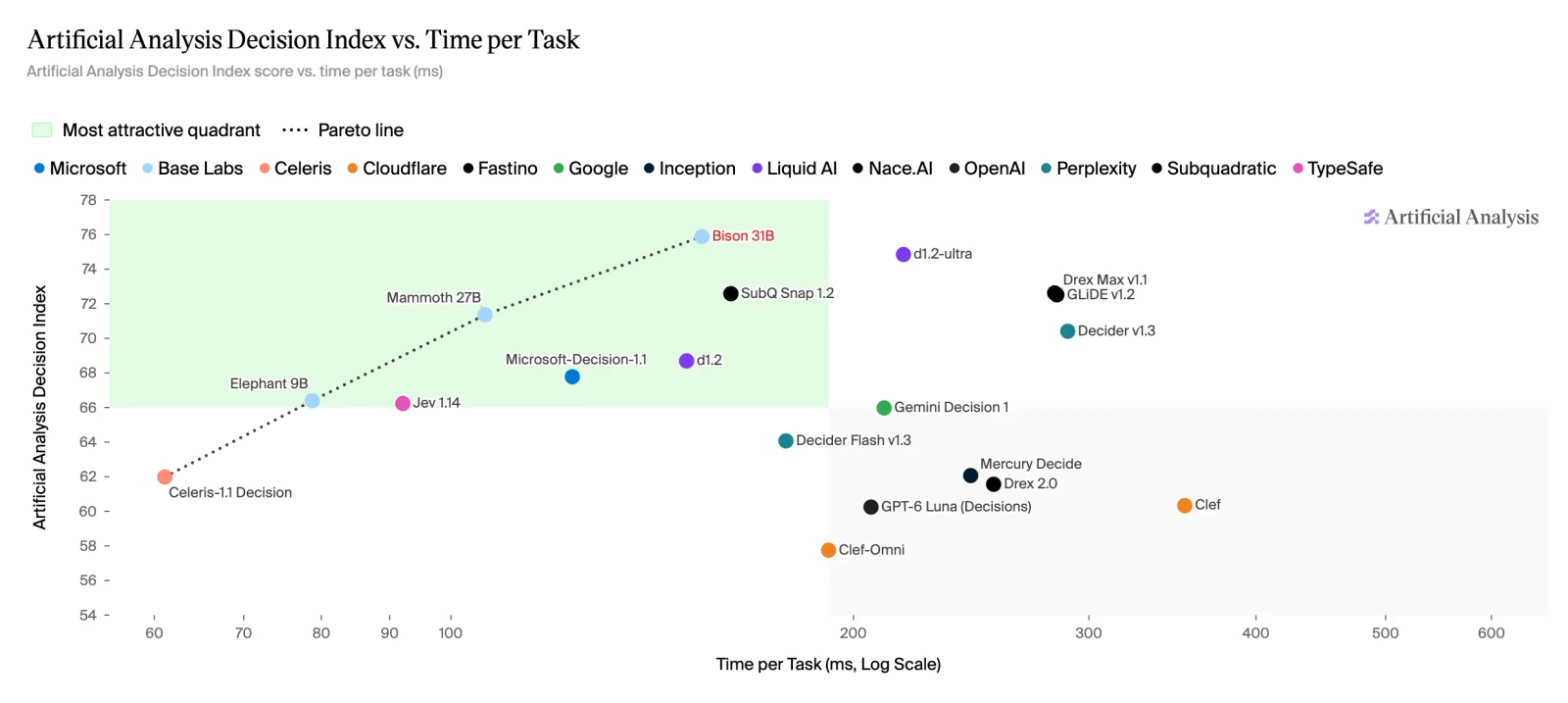 Decision Index score versus time per task for bison-1, mammoth-1, and elephant-1
Image: Baseten
Baseten’s blog includes a accuracy vs time chart placing bison-1, mammoth-1, and elephant-1 on a Pareto line. Charts illustrate positioning; they are not independent audits.
Use them to shortlist candidates, not to skip load tests.
Agent orchestration fit
Decision models excel when agents need dozens of micro-choices per task. Pair bison-1 with:
- OpenAI Performance Factory style routing fixes.
- Replit missions swarm economics when cost caps matter.
- Ploy gateway speed claims only after you measure end-to-end with your decision layer included.
Failure modes to log in production
Decision APIs fail quietly when option sets are misspecified or images exceed tokenizer limits. Log:
- Entropy of output distributions (flat probabilities often mean ambiguous prompts).
- Refusal or null options when schemas allow abstain.
- Latency vs context length coupling on 128k inputs.
Add human escalation when confidence sits in the middle band; calibrated models still err on tail events.
Gemma 4 supply chain notes
Choosing Gemma 4 backbones ties you to Google’s license and safety card updates for the base model. Monitor Gemma security advisories separately from Baseten API changelogs.
If procurement bans Qwen lineage but allows Gemma, document that choice in vendor security reviews alongside Cursor Spacex Chinese open-weight model policy threads customers now ask about.
groundhog-1 positioning
groundhog-1 targets elephant-class pricing with mammoth-class accuracy expectations on Gemma. Baseten says it should match mammoth-1 on the official AA index when scores publish.
Use groundhog-1 when p95 latency dominates SLAs and you still need 128k context—invoice thread example from the vendor post.
Building a decision-model evaluation harness
Treat Baseten’s index rank as hypothesis, not proof:
- Export 1,000 historical decisions with human labels.
- Format each as state + question + options identical to production schema.
- Run bison-1, mammoth-1, and a cheap baseline (rules or embeddings).
- Report accuracy, Brier, ECE, p95 latency, and dollars per 1M tokens on the same chart.
- Roll to 5% canary traffic before full cutover.
Without step four, you risk paying 31B inference where 9B elephant-1 already suffices.
Security and prompt injection on decision inputs
Long-context decision models ingest untrusted email bodies or user-uploaded scans. Attackers can hide instructions far from the question.
Mitigations mirror agent security elsewhere: strip HTML, hash known templates, require structured sender metadata, and cap image inputs from anonymous users. For deeper agent guardrails see Skyflow AgentCore interceptor patterns, adapted to your stack.
Re-run evaluations quarterly; Gemma and Qwen backbones will keep shipping, and Baseten’s menagerie will add new names that move the Pareto line again.
Quick glossary for buyers
| Term | Meaning here |
|---|---|
| Decision model | Returns probabilities over options, not chat prose |
| Brier score | Calibration metric; lower is better on the AA index |
| Decision Index | Artificial Analysis composite for this model class |
| Soft labels | Training targets like 83/17 splits instead of hard 100% |