



AWS on November 18, 2026 documented private certificate authority support in Amazon Bedrock AgentCore Identity, closing a gap for teams that run Keycloak, PingFederate, or other OIDC providers on private networks with TLS certificates signed by enterprise or AWS Private CA. Agents on AgentCore Runtime can now request OAuth tokens through credential providers that validate discovery, JWKS, and token endpoints over VPC Lattice while trusting a PEM anchor you control in Secrets Manager or S3.
AgentCore Identity is the AWS service that manages workload identities and outbound credential providers for agents. Until this release, "connect the agent to corporate SSO" often meant exposing an IdP on the public internet or terminating TLS in ways security teams reject. Private CA support keeps the IdP inside the VPC and moves trust configuration into infrastructure your IAM teams already audit.
Problem: agents need tokens from IdPs security won't publish
The AWS walkthrough imagines an agent calling an internal wiki API protected by Keycloak. The agent runs on AgentCore Runtime and needs an access token. A credential provider holds client credentials and discovery URLs—but if the IdP presents a cert signed by a private CA, AgentCore could not validate the chain.
That pattern is common in regulated industries that already deploy Bedrock AgentCore for treasury or fintech agents and pluggable seven-layer agent frameworks.
Architecture: Lattice, ALB, and trust stores
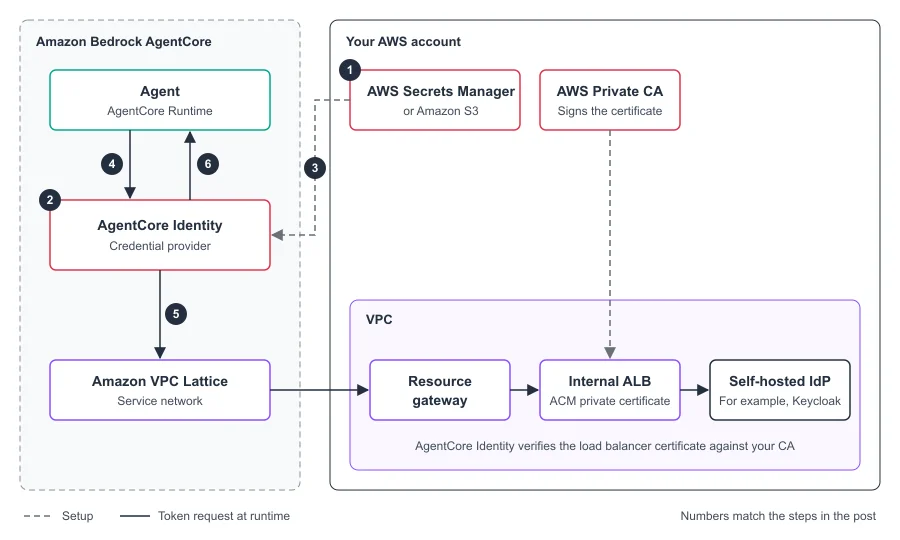 Diagram of AgentCore Identity reaching Keycloak through VPC Lattice with CA validation
Image: Amazon Web Services
AWS's diagram flow:
- Store the CA certificate (public half only) in Secrets Manager or S3
- Create a credential provider referencing that anchor plus a privateEndpoint
- AgentCore Identity validates the PEM is a CA cert
- On token request, Identity reaches the IdP through VPC Lattice (managed or self-managed resource configuration)
- TLS to the internal ALB is checked against your CA bundle
VPC Lattice is mandatory for this feature—if privateEndpoint is missing, AWS rejects private CA configuration with The private certificate authority feature can only be used with private IdP.
Cross-link readers planning governance to Okta Cross App Access with AgentCore Gateway: Cedar policies mean little if the agent cannot safely fetch tokens from the IdP that asserts identity.
Step-by-step: issue, store, wire, verify
Issue an IdP server certificate (AWS Private CA path)
AWS walks through AWS Private CA in general-purpose mode (not short-lived 7-day mode), authorizing ACM to renew. Request a private cert whose SANs cover every hostname in the OIDC discovery document—typically one hostname for discovery, JWKS, and token endpoints on Keycloak.
Attach the cert to the internal HTTPS listener on the ALB in front of Keycloak.
Store and sanity-check the CA PEM
Export the CA with aws acm-pca get-certificate-authority-certificate, then verify:
CA:TRUEin X.509 extensions- File size under 16 KB
openssl s_clientreports Verify return code: 0 (ok) against the live IdP hostname from a host that can reach the VPC
Upload to Secrets Manager (--secret-string file://idp-root-ca.pem) or S3. Secrets must live in the same Region and account as the credential provider unless S3 cross-account policies apply.
Create the OAuth2 credential provider
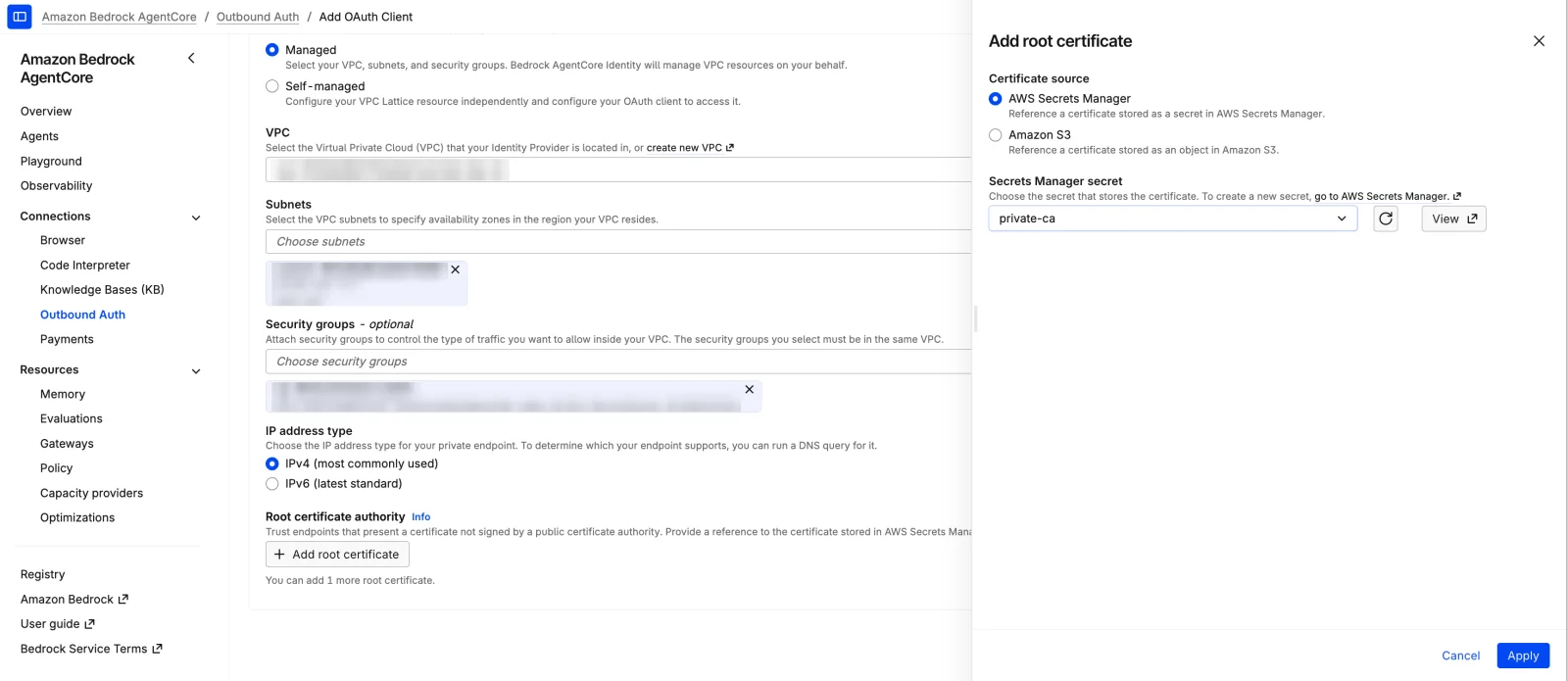 AWS console panel for adding a root CA certificate from Secrets Manager
Image: Amazon Web Services
Console or CLI: set discovery URL, client ID/secret, managed VPC Lattice resources (VPC, subnets, security groups), and certificateConfigurations pointing at the secret or s3:// URI.
Machine-to-machine, on-behalf-of, and user-delegated flows reuse the same provider without agent code changes, per AWS—important for teams standardizing on A2A multi-agent patterns.
Verify status CREATING to READY
New providers start in CREATING while Identity validates the cert and stands up private connectivity. Use get-oauth2-credential-provider for failureReason if stuck—common mistakes include uploading the server leaf instead of the CA, or IAM lacking secretsmanager:GetSecretValue / s3:GetObject on the caller that created the provider.
Rotation without taking agents offline
AWS describes a dual-CA PEM rotation:
- Concatenate old and new CA certs into
rotation.pem, update secret/object - Call UpdateOauth2CredentialProvider (must include
certificateConfigurationsor trust is dropped) - Reissue the IdP server cert from the new CA
- After tokens succeed, upload PEM with only the new CA and update again
Monitor EarliestCertificateDaysToExpiry with alarms on ProviderName, ProviderArn, and TokenVault dimensions—token requests fail when the CA expires because Identity re-reads the bundle only on create/update, not on every secret version change.
CRL/OCSP: AWS notes AgentCore does not check revocation lists. If a server private key leaks, remove trust in the issuing CA via PEM edit and provider update—same operational discipline as AgentCorruption hijack research on AgentCore emphasized for credential theft.
Protecting the trust store (integrity, not secrecy)
CA public certs are not secret—but who can overwrite the secret or S3 object is. AWS sample bucket policies:
- Allow GetObject only to
AgentCoreCredentialProviderAdminroles in your org - Deny PutObject/DeleteObject except an IdpAdmin role
- Enable S3 Versioning and CloudTrail data events
Secrets Manager equivalent: resource policy denying PutSecretValue except IdpAdmin. SSE-S3 is enough; cross-account KMS adds friction without confidentiality benefits here.
Scope trust narrowly: upload only the CA that signs your IdP listener, not a full enterprise bundle, unless you intend every corporate MITM-capable CA to be trusted by agents.
Inbound JWT authorizers on Runtime and Gateway
The same certificateConfigurations attach to customJWTAuthorizer beside privateEndpoint. Gateway creation validates discovery URLs; if the CA bundle does not match the presented chain, status becomes FAILED with Failed to validate discovery url.
That symmetric story helps platform teams: outbound token fetch and inbound JWT verification share TLS trust assumptions—relevant when you compare Claude Code remote sessions on AgentCore with home-grown MCP gateways.
How this fits AWS's responsible-agent roadmap
The same week AWS blogged responsible agentic AI phased roadmap, private CA support is a boring enterprise enabler—the kind that determines whether AgentCore pilots leave proof-of-concept. Finance and health teams rarely approve agents that need a public IdP endpoint.
Pair implementation with agent registry push/sync observability so token provider changes show up in CloudTrail, not only in the Bedrock console.
CLI snippet worth saving
AWS documents create-oauth2-credential-provider with a certificateConfigurations array pointing at Secrets Manager or S3. Teams that treat agents as cattle should template that JSON in Terraform or CloudFormation alongside Lattice service network IDs, because drift between staging and production CAs is a common source of Friday-night token outages when ACM renews the IdP listener cert but nobody updates the trust bundle.
Multi-account landing zones
In Organizations with a central identity account hosting Keycloak, S3 cross-account trust anchors plus bucketOwnerAccountId let workload accounts create providers without copying PEM files. The sample deny policy AWS shows—blocking PutObject except IdpAdmin—should live in the identity account, while workload accounts retain only GetObject via role assumption. That split mirrors how enterprises already segregate PKI teams from application teams.
Common failure modes AWS documents
AWS lists practical errors teams hit in the field:
- Leaf certificates are not allowed when operators upload the ALB server cert instead of the issuing CA
- Unable to access S3 object or missing Secrets Manager secret when the creating principal lacks read IAM
- READY provider but token failures when the live server cert’s chain does not match the configured CA or SANs omit the discovery hostname
Run these checks in staging with the same IAM role production agents use—not an admin console user—so permission gaps surface early.
Comparison: public IdP connectors vs private CA path
Many pilots start with a public SaaS IdP because TLS trust is bundled. Private CA mode is for when data residency, network segmentation, or legacy Ping/Keycloak realms block that shortcut. The marginal complexity buys:
- No public discovery URL leaking internal realm names
- Lattice-only network paths auditable in VPC Flow Logs
- CA rotation under change control distinct from quarterly Keycloak upgrades
If you still mirror identities to a public IdP for humans while agents use private realms, document two credential providers and never reuse client secrets across them—emulator testing for agents can catch wrong-provider wiring before production deploys.
Document the discovery URL, SAN list, and secret ARN in the same runbook entry as the Lattice resource ID. During incidents, on-call engineers should not grep three consoles to learn which CA signed a failing handshake.
Builder checklist
| Step | Action |
|---|---|
| 1 | Confirm AgentCore Identity private IdP support in your Region |
| 2 | Stand up VPC Lattice path to Keycloak/Ping ALB |
| 3 | Export CA PEM, validate CA:TRUE, store in scoped secret |
| 4 | Create provider with privateEndpoint + certificateConfigurations |
| 5 | Alarm on EarliestCertificateDaysToExpiry |
| 6 | Document rotation runbook with dual-CA PEM |
Bottom line
Private CA support is not glamorous—it is the TLS and IAM glue that lets AgentCore agents live in the same security model as human employees hitting internal SSO. Read AWS's November 18 post as the reference architecture for Keycloak-on-VPC plus Lattice, and treat trust-store write permissions as production-critical.
Schedule a quarterly drill that concatenates a dummy CA, runs UpdateOauth2CredentialProvider, and validates READY status before you rely on the runbook during a real expiry window. Record the ProviderArn in your CMDB so cert alarms route to the team that owns agent workloads, not only the IdP team.
Related reading
- AgentCorruption and Bedrock AgentCore hijack research
- Okta Cross App Access and AgentCore Gateway Cedar policies
- AWS pluggable seven-layer AgentCore framework
- Claude Code remote sessions on AgentCore controls
- Trovata treasury agents on Bedrock AgentCore
- AWS A2A multi-agent LangChain and Strands on AgentCore
- AWS responsible agentic AI roadmap
- Agent registry CloudTrail sync